THE DIRECT ANSWER
What a commercial HVAC replacement actually covers
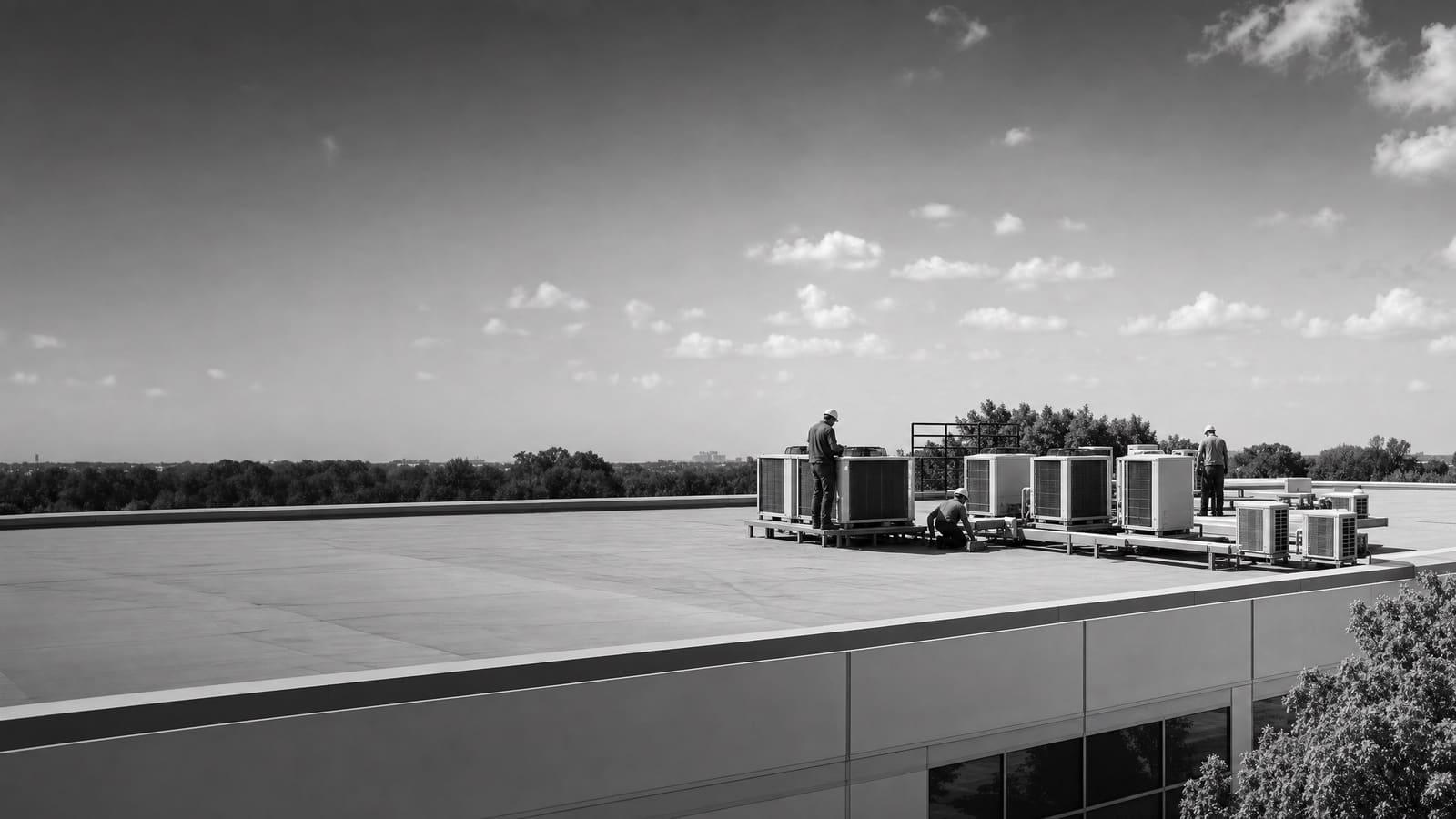
A commercial HVAC replacement covers a fresh load calculation, the unit itself, the curb adapter, the crane set, gas, electrical, and controls connections, permits, and commissioning. Replacement usually beats another repair once a unit passes fifteen years and starts failing in season. Federal analysis puts the waste from an old, inefficient rooftop unit at $900 to $3,700 a year in energy alone, which is often more than the repair you were about to approve.
A site review still has to confirm the real load, the curb and roof structure, crane reach and lot access, and whether existing electrical service and gas lines support the unit you want.
THREE WAYS TO PLAY IT
Run to failure, swap like-for-like, or upgrade
Most buildings end up in one of three approaches, usually without deciding on purpose. The default is waiting: run the unit until it stops, then install whatever is available that week. That costs the most, because the emergency removes your leverage on price, equipment choice, and schedule.
The second is a planned like-for-like swap at end of life. Same tonnage, same curb, same fuel. It is fast and cheap to engineer, and it is the right call when the space is still used the way it was when the old unit went in.
The third is a planned upgrade. High-efficiency packaged units were developed to cut energy use by up to half against the older standard, and a heat pump rooftop unit adds reverse-cycle heating on the same footprint. Federal guidance treats proactive replacement as the smarter business move over both replacement-on-failure and a straight like-for-like swap at end of service life. It costs more up front and it needs more planning.
WHAT MOVES THE NUMBER
The lines that actually change your price
Nobody can price a commercial replacement from a tonnage number alone. Six lines do most of the moving on a packaged rooftop job, and every one of them is something a walkthrough can settle before you sign anything.
IN PRACTICE
How to compare two replacement quotes
Two quotes for the same roof rarely describe the same project. The gap is almost never the unit itself. It is what each contractor assumed about the curb, the crane, the electrical, and the controls. Read both against the same list before you read either price.
Start with sizing. A twenty-year-old nameplate reflects the occupancy, lighting, and plug load the building had two decades ago. If the space changed use, added people, or got a tighter envelope, that number is stale, and carrying it forward locks in the comfort complaints you already have.
Then check availability. Equipment lead time is a design constraint, not a footnote. Federal guidance lists equipment availability and contractor familiarity among the factors that decide whether a given unit is genuinely the right choice for a site. A quote with a price and no delivery date is half a quote.
Last, check what happens after startup. Charge, airflow, and control setpoints verified against spec is the difference between a unit that runs and a unit that performs. It is also what keeps the warranty standing.
SCOPE CHECK
What makes this simple and what makes it complicated
Before you budget, work out which project you actually have. The same tonnage can be a straightforward swap or a multi-trade job with a structural review attached, and the difference shows up on the roof rather than on the spec sheet.
LOWER COMPLEXITY
One crane, one visit
Same tonnage, a matching curb, existing service and fuel already sized for the unit, and a lot the crane can set up in. Old unit off, new unit on, connected and started in a single visit.
HIGHER COMPLEXITY
Multi-trade, multi-visit
Tonnage or footprint changes, the roof needs reinforcement, the panel needs upgrading for an all-electric unit, or the crane has to close a drive aisle during business hours. Each one adds a trade and a schedule constraint.
BEFORE YOU BUY
What a real site review settles
A quote written from a nameplate photo is a starting number. It is useful when a unit is down and you need options today, but it is not the number you should budget against. Someone has to get on the roof.
The walkthrough answers questions a spec sheet cannot. Does the existing curb match the new footprint, or does the job need an adapter and a structural look? Where can a crane set up, how far does it have to reach, and how many stalls does that close? Is the electrical service sized for what you are considering, or does an all-electric unit push you into panel work? Are the gas lines staying, moving, or getting abandoned?
Those are the same constraints federal heat pump guidance flags before a site commits to a technology: electrical capacity, physical constraints, and gas lines, alongside equipment availability and whether contractors in the area work on that equipment regularly. None of them are exotic. All of them are cheaper to find in August than in the middle of a February startup.
Ask for the findings in writing. A contractor who walked the roof can tell you what they found. A contractor who quoted from the parking lot cannot.
Ask for this from the walkthrough
Confirmed load basis, curb and structural condition, crane setup point and closure time, available electrical capacity, fuel line disposition, and the control points that need tying in. Six answers, one page, before anyone talks about price.
OWNERSHIP ITEMS
Two things that follow the unit for years
The install is a week of your attention. The unit is the better part of two decades of your budget. Two decisions made during the replacement quietly set how much attention it takes later.
The first is refrigerant. New commercial equipment ships on newer refrigerants, and the old charge cannot simply be released. EPA rules under the Clean Air Act govern how refrigerant is handled and recovered when equipment is serviced or taken out of service. That is the installing contractor's obligation, and it belongs in the written scope.
The second is what a new unit does to a mixed fleet. If you own six rooftops and replace one, you now stock two sets of filters, two control interfaces, and two service procedures.
REFRIGERANT
Recovery is scope, not a favor
EPA rules govern how refrigerant is handled and recovered when equipment is serviced or retired. Confirm the quote covers recovery from the old unit and documents it at handoff.
FLEET
One new unit changes your service plan
A single replacement splits a uniform fleet into two. Decide up front whether you are standardizing over the next few years or accepting a mixed roof, then tell your service vendor.
THE LONGER PLAN
Phasing replacements instead of reacting to them
If you own more than one rooftop unit, the useful question is not which one to replace. It is which order to replace them in, and how to fund it.
Packaged rooftop systems cool close to half of all commercial floor space in the country, so for most buildings this is the mechanical budget rather than a line inside it. Units past fifteen years are the ones burning money, and a full replacement is not automatically the answer. Federal guidance is explicit that owners can either replace an aging unit or retrofit it with advanced controls, depending on which option pencils out for that specific unit.
The upside is documented rather than theoretical. Through the DOE campaign built around this work, more than two hundred public and private organizations upgraded over forty-three thousand rooftop units and cut a combined thirty-seven million dollars a year from their energy bills.
Build a plain list: age, tonnage, service history, and last year's failure count for each unit. Replace the worst one on a planned schedule, learn what your roof actually costs, then set next year's number from real numbers instead of an estimate.
QUOTE CHECKLIST
Five things a comparable quote shows
If two bids show these five things, you can compare them honestly. If one is missing three of them, you are comparing a price to a guess.
01
Load basis
Tonnage and efficiency tier, plus whether sizing came from a fresh calculation or the old nameplate.
02
Delivery date
Equipment lead time in writing, next to the price, for the model actually being quoted.
03
Rigging and access
Crane setup location, reach, closure time, and who coordinates the lot with tenants.
04
Trade scope
Curb adapter, structural work, electrical, gas, refrigerant piping, and controls, each priced or each excluded.
05
Startup and commissioning
Charge, airflow, and control setpoints verified against spec and documented at handoff.
Get a defensible number
Price the equipment and the building together.
Send the address, operating target, and target opening date. Flux will identify what must be verified before the project can be priced.
Get a free estimateQuestions
Straight answers.
When does replacement beat another repair?
Once a unit is past fifteen years and failing in season, repairs are usually buying months. Federal analysis puts the annual energy waste of an old, inefficient rooftop unit at $900 to $3,700, before you add the repair bills. Replacing proactively is generally the better business move than waiting for the failure.
Should the new unit be a heat pump?
That depends on the site rather than the trend. Heat pump rooftop units add reverse-cycle heating on the same footprint and are most efficient with mild-to-moderate winter heating, which federal guidance treats as appropriate for most southern regions. The deciding factors are electrical capacity, whether gas lines stay, utility rates, and contractor familiarity with the equipment.
What is the long pole on the schedule?
Equipment lead time, almost always. The on-roof work for a matched swap is a single visit once the unit and curb adapter are staged. Federal guidance lists equipment availability among the factors that decide whether a unit is the right choice at all, which is why availability belongs on the quote next to the price.
What usually gets left out of a low bid?
Four things: the curb adapter and any structural work, the real crane and lot closure cost, controls integration into building automation, and commissioning. A bid that covers only equipment and labor will look cheaper until those items come back as change orders.
Do we have to resize, or can we match the old unit?
Confirm the load either way. If the space is used the way it was when the old unit went in, like-for-like is often correct and simpler to permit. If occupancy, equipment, or the envelope changed, matching the nameplate carries the old sizing mistake forward for another fifteen years.
Sources used for this guide
- [1]betterbuildingssolutioncenter.energy.gov — DOE Advanced Rooftop Unit Replacement Guidance
- [2]betterbuildingssolutioncenter.energy.gov — DOE Commercial Heat Pump Rooftop Unit Replacement Guidance
- [3]betterbuildingssolutioncenter.energy.gov — DOE High-Efficiency Commercial Rooftop Unit Toolkit
- [4]energy.gov — DOE Efficient Commercial Rooftop Air Conditioner Program
- [5]epa.gov — EPA Stationary HVAC Refrigerant Management