THE SHORT ANSWER
What a commercial HVAC replacement actually covers
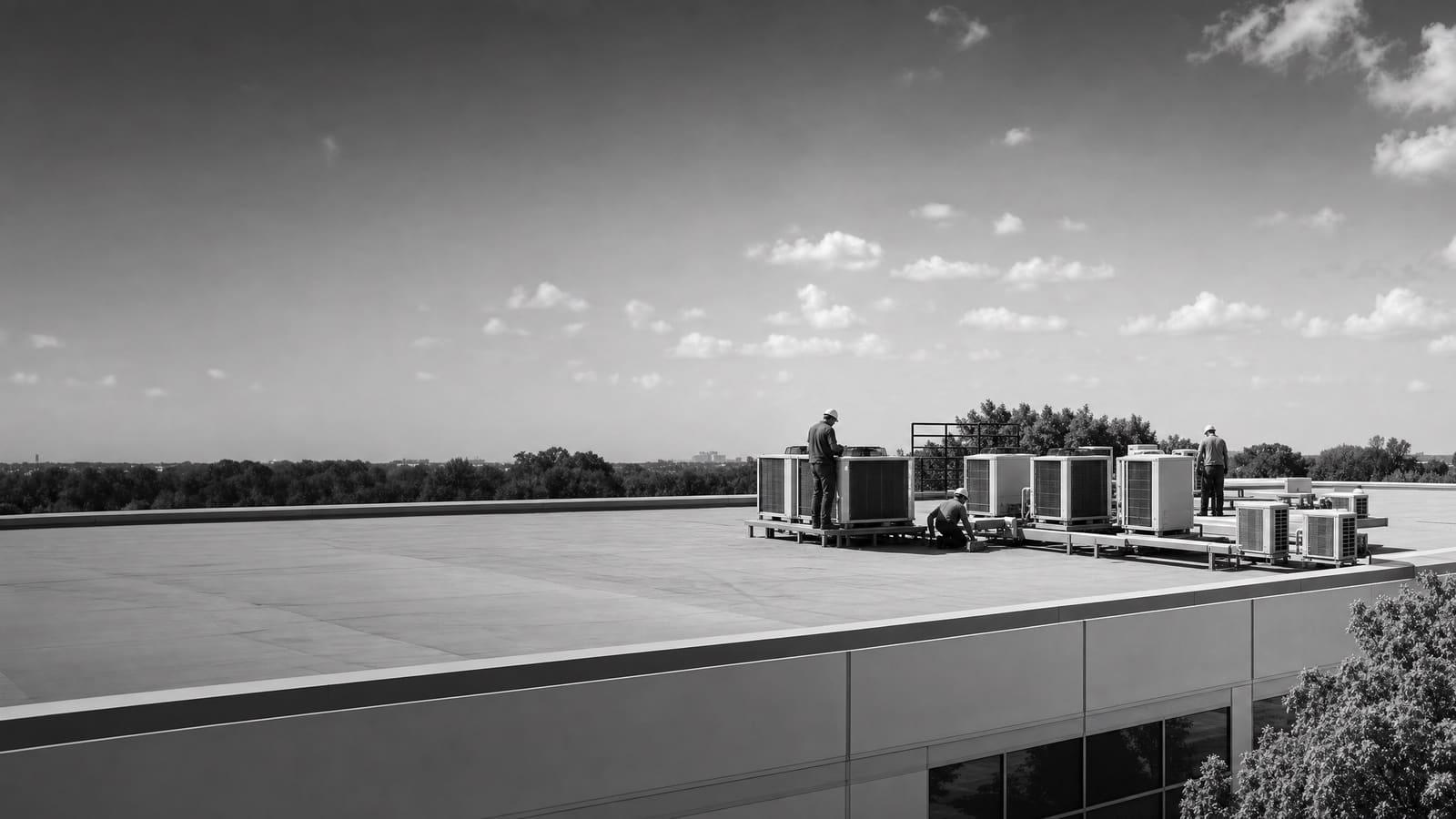
A commercial HVAC replacement is a scoped construction project, not a swap. It covers a load check against how the building runs today, equipment selection against real availability, recovery of the old refrigerant charge, rigging and set, gas, electric and control connections, plan review and inspection, then commissioning. Replacement usually beats one more repair once a rooftop unit passes about fifteen years, since aging units waste roughly $900 to $3,700 each per year and tend to fail in the worst possible week.
A site review still has to confirm the curb and roof structure, available electrical capacity, gas service, clearances and crane access. Those four items decide whether the price you were quoted is the price you pay.
THE REAL DECISION
Three ways to make heat, and what each one commits you to
Most Green Bay replacements come down to how the new unit makes heat. A packaged rooftop unit with gas heat is the familiar answer, and the one your gas piping, flue and controls already support. Heat pump rooftop units add reverse-cycle heating to the same basic machine, and DOE groups them into three types: dual fuel, all-electric, and cold climate. The guidance is direct about the tradeoff. Heat pump heating efficiency falls as outdoor temperature drops and trends toward parity with electric resistance heat, which is why all-electric units suit mild-to-moderate winters best. A long northern heating season does not rule out a heat pump here. It moves the sensible choices toward dual fuel or a cold-climate unit, and it turns the electrical capacity check into a real gate instead of a formality.
WHAT MOVES THE NUMBER
The lines that make two quotes look different
Nobody can price a rooftop replacement from a photo, but the items that move the number are predictable. Ask for each of these separately so you can see which part of the quote is equipment and which part is your building.
HOW TO BUY IT
Buying the unit you will still like in year ten
Start with the load, not the nameplate. A twenty-year-old unit was sized for a building with different occupancy, different plug loads and often a different envelope. Sizing forward from what the space does today is what turns a replacement into a fix for the complaints the old unit could never solve.
Then treat availability as a selection criterion instead of an afterthought. Rooftop units condition close to half of all commercial floor space in the country, so the model field is genuinely deep, and more than twenty rooftop models now exceed the high-efficiency specification DOE developed with manufacturers. That depth only helps if the unit you pick can arrive inside your window. DOE's own adoption checklist puts equipment availability and contractor familiarity right next to climate and infrastructure for exactly that reason.
Last, decide how much of the building you are willing to touch. A unit that matches the existing curb, fuel and service keeps the disruptive part inside one morning. A unit that changes heating type, footprint or electrical draw pulls in structure, service capacity and sometimes a wider plan review. Neither is wrong. They are different projects, and the quote should be clear about which one you are buying.
SIDE BY SIDE
What makes a replacement simple or complicated
Complexity is not about tonnage. It is about how many building systems the new unit touches on its way in. Reading which side you are on tells you what the schedule and the contingency should look like.
LOWER COMPLEXITY
Same curb, same services
The replacement matches the existing footprint, fuel and electrical draw. The space is used the way it always was, the crane has clear reach, and controls are a straight reconnection. This is the project that lands in a morning and gets commissioned the same week.
HIGHER COMPLEXITY
New heating type or new footprint
Heating type changes, tonnage grows, or the unit lands somewhere new. Now electrical capacity, roof structure, gas line changes and clearances all have to be confirmed, and the plan review is wider. Worth doing when the building has changed, but it should be scoped as a project.
SCOPING
What a real site review has to find
The site review is where a quote becomes trustworthy. The visit should settle the physical questions first: curb size and condition, roof structure at the opening, clearances around the unit, and whether a crane can reach the location without closing more of the lot than your tenants can absorb.
Then it should settle the services. DOE's heat pump adoption guidance groups these under infrastructure, and the list is short but decisive: electrical capacity at the panel and the service, physical constraints on the roof and in the shafts, and the gas line. A unit that adds electric heat can turn a straightforward swap into an electrical project. Far better to learn that during the walk than during the install.
The last piece is the operating picture. Occupied hours, what the space is actually used for now, the zones that have always been uncomfortable, and how the unit needs to talk to your existing controls. Those answers change tonnage, staging and the commissioning scope. A quote written without them is a price for equipment, not a price for a working system.
The four answers that stop change orders
Curb and structure confirmed, electrical capacity measured rather than assumed, gas service verified, and crane access mapped against the lot. Get all four in writing before the equipment is ordered.
IN WISCONSIN
Who reviews the plans changes your install date
Commercial HVAC work in Wisconsin runs through the state's commercial building and heating code review. Submittals come in a few shapes, including HVAC only, HVAC with a kitchen hood, and commercial building with HVAC, so the type of work you are doing determines the package.
The part worth checking early is where the package goes. The state publishes a delegated municipality list, and where a municipality is delegated, the plan review can be submitted locally instead of to state Industry Services. That single question changes who you are waiting on and how long. The state also publishes a contractor memo covering HVAC equipment replacement, which is the right reference for whether a straight replacement needs a review at all.
Decide this before the order goes in, not while the crane is scheduled.
Settle the authority before you order
Ask your contractor, in writing, which authority is taking the submittal, whether it is an HVAC-only package, and whether a kitchen hood or building item pulls the project into a wider review.
OWNING IT
Two things the new unit hands you on day one
Most of a replacement is over when the crane leaves. Two parts of it are not. The refrigerant in the new machine and the utility bill it produces both follow you for the life of the equipment, and both are far easier to plan on the front end than to renegotiate later. Neither belongs in a footnote on the quote. They belong in the decision about which unit you buy, alongside price and lead time.
REFRIGERANT
A charge you are now responsible for
EPA Section 608 rules govern how refrigerant is handled and recycled in stationary cooling and heat pump equipment. The old charge gets recovered, not vented. And if the new unit does not share a refrigerant with the rest of your roof, your service contract now covers a mixed fleet.
OPERATING COST
The bill is part of the purchase
DOE treats utility bill impact as a modeling question driven by location, local electricity and gas prices, and the building's heating load. Over a long heating season, the fuel you choose is a decade-long operating decision. Ask for the assumption behind any efficiency upgrade rather than taking the tier on faith.
TIMING AND MONEY
Planned replacement costs less than the one you didn't plan
DOE's guidance is blunt about how these projects usually happen. Facility managers put off a new rooftop unit until the old one stops conditioning the space, needs constant attention, or fails outright. Replacing proactively often beats replacement-on-failure, and it can even beat a like-for-like swap made at the end of the unit's service life, because a failure picks the season, the lead time and the price for you.
That is an argument for ranking, not for replacing everything at once. Put the roof in order by age, repair history and how much the space depends on each unit. Anything past fifteen years with a repair record moves to the front of the list. The DOE-supported campaign built around this approach saw more than two hundred organizations upgrade over forty-three thousand rooftop units, and those upgrades save a combined thirty-seven million dollars a year in energy costs.
Then check the money outside the deal. Incentive programs are tied to equipment type and efficiency tier, and the time to find out whether one applies is before the purchase order, not after the unit is on the roof. A quote that arrives with lead times and incentive eligibility already answered is a quote you can schedule against.
BEFORE YOU SIGN
Five things a comparable quote shows
Two quotes for the same roof can be far apart and both be honest. The gap is usually in what one of them included. A quote you can actually compare shows these five without you having to ask.
01
The equipment line, spelled out
Make, model, tonnage, heating type and efficiency tier. Not "replace RTU." You cannot compare two prices for two different machines.
02
Availability next to the price
Lead time for the specific unit quoted, and what the alternate is if that model slips. Schedule risk is part of the price.
03
The rigging plan and the lot
Crane size, staging area, how many stalls close and for how long, and who carries the crane cost.
04
Permit and plan review scope
Which authority reviews the submittal, what package is being filed, and who schedules the inspections.
05
Refrigerant handling and commissioning
Recovery and documentation of the old charge, plus a startup report covering charge, airflow and control settings before handoff.
Get a defensible number
Price the equipment and the building together.
Send the address, operating target, and target opening date. Flux will identify what must be verified before the project can be priced.
Get a free estimateQuestions
Straight answers.
When does replacement beat one more repair?
Age plus repair pattern is the honest test. Rooftop units over fifteen years old can waste a substantial amount of energy compared with current models, and an old inefficient unit can burn roughly $900 to $3,700 a year in wasted energy on its own. Once repairs are recurring and the space is no longer comfortable, you are paying for the replacement anyway, just in pieces and on the equipment's schedule instead of yours.
Does a heat pump rooftop unit make sense with Green Bay winters?
It can, but the type matters. Heat pump heating efficiency falls as outdoor temperature drops and trends toward parity with electric resistance heat, which is why all-electric units are best matched to mild-to-moderate winter heating. In a long heating season, dual-fuel and cold-climate heat pump units are the versions that carry the load without leaning on resistance heat. The deciding factor is usually electrical capacity, so check that first.
Who handles plan review and permits for commercial HVAC in Wisconsin?
Commercial HVAC work goes through the state's commercial building and heating code plan review, and the submittal can be HVAC only or combined with building or kitchen hood work. Some municipalities are delegated to take that review locally instead of state Industry Services, so ask which authority applies to your address before you commit to an install date. There is also a state contractor memo covering equipment replacement specifically.
What happens to the refrigerant in the old unit?
It gets recovered by a certified technician, not released. EPA rules under Section 608 of the Clean Air Act govern how refrigerant is handled and recycled in stationary refrigeration, air conditioning and heat pump equipment. That work and its documentation should appear in the scope of the quote. It is also worth confirming whether the new unit uses the same refrigerant as the rest of your equipment, since a mixed roof changes service planning.
How do I compare two quotes that are far apart?
Line them up on scope, not on the bottom number. Check that both name the same tonnage, heating type and efficiency tier, that both state lead time, and that both include the crane, permits, refrigerant recovery and commissioning. Most large gaps come from one quote assuming the existing curb and electrical service work as-is while the other actually verified them. The verified one is usually the cheaper project.
Sources used for this guide
- [1]betterbuildingssolutioncenter.energy.gov — DOE Advanced Rooftop Unit Replacement Guidance
- [2]betterbuildingssolutioncenter.energy.gov — DOE Commercial Heat Pump Rooftop Unit Replacement Guidance
- [3]betterbuildingssolutioncenter.energy.gov — DOE High-Efficiency Commercial Rooftop Unit Toolkit
- [4]energy.gov — DOE Efficient Commercial Rooftop Air Conditioner Program
- [5]epa.gov — EPA Stationary HVAC Refrigerant Management
- [6]dsps.wi.gov — DSPS Heating, Ventilation, & Air Conditioning