THE SHORT VERSION
What a commercial HVAC replacement actually includes
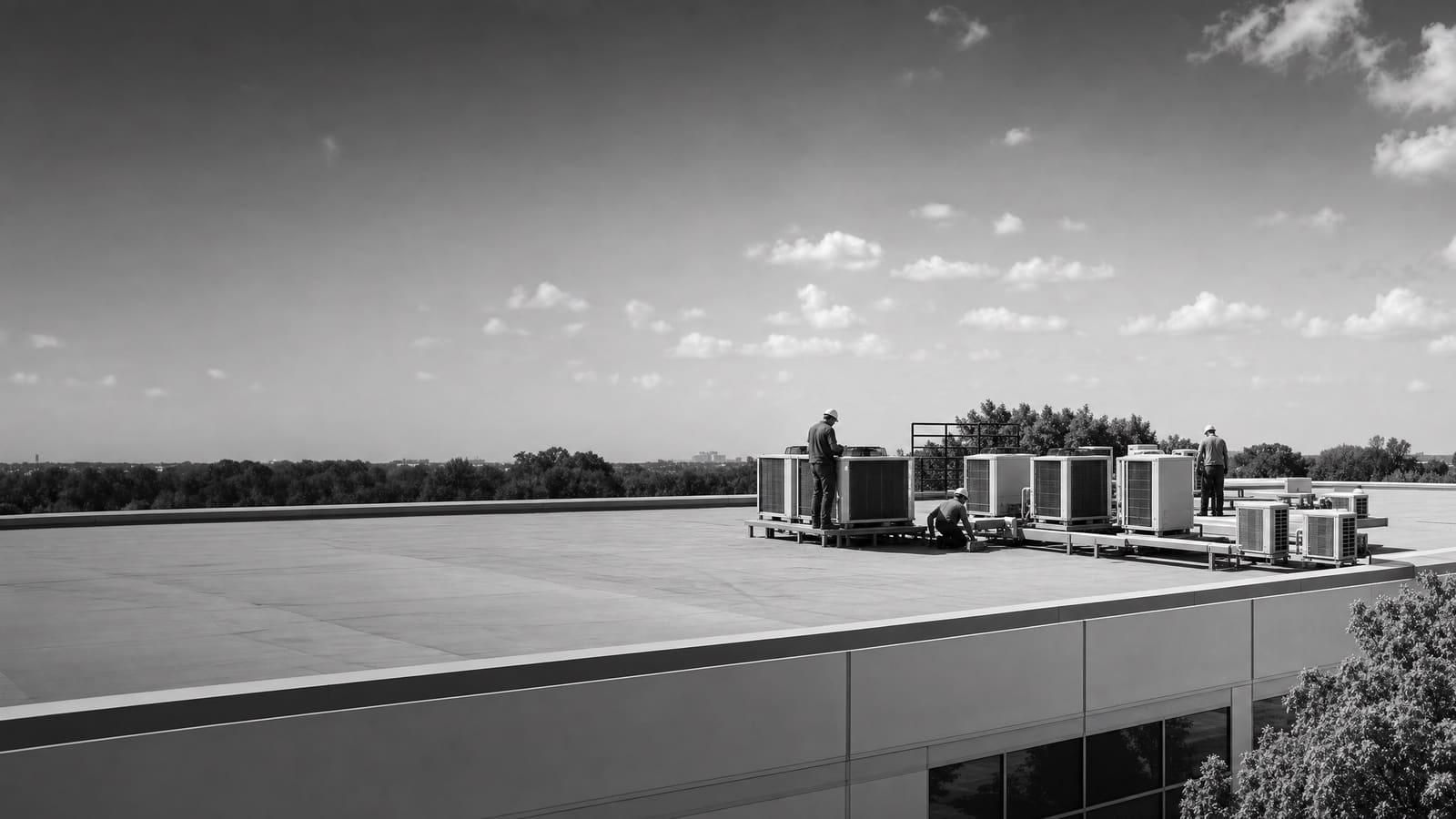
A commercial replacement is a small construction project: confirm the load the building carries today, select equipment against real availability, recover refrigerant from the old unit, set the new one, reconnect power, gas, and controls, then commission it. Replacement beats another repair once a unit is past its efficient years. Rooftop units over 15 years old waste substantial energy, and an old, inefficient unit can burn $900 to $3,700 a year in avoidable operating cost.
A site review has to confirm what the nameplate can't: curb and structural fit, crane reach and lot access, available electrical capacity, existing gas service, and any control change the swap triggers.
THE FORK IN THE ROAD
Three ways commercial buyers handle a replacement
Timing matters more than most buyers expect. Facility managers usually delay a purchase until the unit no longer conditions the space, needs constant service, or fails outright. Replacing proactively is often the better business move than replacement-on-failure, and often better than an automatic like-for-like swap at end of life, because a failure removes your ability to compare equipment or wait for the unit you actually want.
There is a fourth path worth knowing. If the cabinet and coil are sound, retrofitting advanced controls onto an existing unit can capture part of the savings without a crane day. It sits alongside full replacement as a legitimate option, and it is worth pricing before you commit to a set.
WHAT MOVES THE NUMBER
The lines that decide what your quote says
No two roofs price the same, so treat these as the lines that move a quote rather than a price list. The tag shows where the number is most likely to shift between bidders.
HOW TO BUY IT
Choosing equipment before the old unit chooses for you
Rooftop units condition nearly half of all commercial floor space in the country, so this is the most common capital decision in the building. That is good news. The path is well worn and the equipment choices are documented.
The real fork is fuel. Department of Energy guidance for commercial heat pump rooftop units lays out what to check before switching: climate zone and heating load, the effect on your utility bill, emissions goals, building type, equipment availability, and infrastructure — electrical capacity at the panel, physical constraints on the roof, and what happens to the gas line. Contractor familiarity with the equipment and available incentives belong on the same list. Heat pump rooftop units come in three shapes: dual fuel, all-electric, and cold climate. Heating efficiency drops as outdoor temperature drops and trends toward electric resistance, so a building with a real winter heating load needs that modeled, not assumed.
Work that list while the old unit still runs. Once it fails, the fuel question collapses into whatever is on a truck this week, and you inherit that decision for the life of the next unit.
SCOPE CHECK
What makes a replacement simple or complicated
Two roofs with the same tonnage can price very differently, and the difference is almost never the equipment. It is access, infrastructure, and what the swap triggers on the way in.
LOWER COMPLEXITY
Straight swap conditions
Same fuel, same capacity, and a curb that matches or takes a standard adapter. The lot gives the crane reach without closing the whole frontage. Electrical and gas are already sized. Controls are stand-alone or already compatible.
HIGHER COMPLEXITY
What adds real scope
Fuel switching that needs new electrical capacity. Capacity changes that trigger structural review. Tight or shared parking that limits crane placement. Occupied space that can only go down outside business hours. Integration into an existing building automation system.
BEFORE THE QUOTE
What a real site review has to answer
A quote written from a nameplate photo is a starting number, not a price. The nameplate tells you tonnage, fuel, and age. It does not tell you whether the curb will take the new unit, whether the roof structure was ever sized for more weight, or whether the panel has capacity left in it.
A useful site review walks the roof and the electrical room. On the roof: curb dimensions, unit condition, duct connections, and how the unit will physically come off and go back on. In the electrical room: available capacity, breaker and disconnect sizing, and what an all-electric option would require. Outside: where the crane sets up, what it closes, and for how long.
The review should also settle the operating question. How does the space get used now? Years of tenant changes, added equipment, and envelope work rarely leave the original load intact. Sizing to the old nameplate carries forward every mistake in it, including the ones causing the comfort complaints you were planning to fix with new equipment.
Ask for this before you compare bids
Every bidder should walk the same roof and the same electrical room. When one number lands far below the others, it usually means a scope item — curb work, crane time, controls, or electrical capacity — quietly moved into someone else's column.
OWNERSHIP
Two things that outlive the install
The install ends. The obligations do not.
Refrigerant is the one most owners underestimate. EPA rules under the Clean Air Act govern how refrigerant is handled and recycled in stationary air conditioning and heat pump equipment. That applies to the recovery from your old unit on set day and to every service call afterward. New equipment is shipping on newer refrigerants, so a building with a mixed fleet runs two service and parts strategies at once until the fleet turns over.
The second is standardization. If you own more than one unit, replacing them one failure at a time produces a roof full of different manufacturers, control platforms, and filter sizes. A replacement plan that picks a platform and holds it makes every future service call cheaper, even when the individual unit costs a little more today.
REFRIGERANT
Handling rules follow the equipment
Recovery from the old unit is regulated work, and the new unit's refrigerant sets your parts and service plan for its whole life. Ask what the new unit ships with and who can service it locally.
FLEET
One platform beats five
Matching controls, filters, and parts across a roof cuts service cost and stocking headaches. Failure-driven replacement guarantees the opposite outcome.
PLANNING AHEAD
Phasing, procurement, and what the unit costs to run
The number on the quote is the smaller half of the decision. An old, inefficient rooftop unit can waste $900 to $3,700 a year on its own, money that leaves the building whether or not the unit is technically working. Multiply that across a roof with several units and planned replacement stops being an efficiency argument and becomes a budget one.
Phasing is how most owners handle it. Rank the units by age, service history, and how much of the building each one serves. Replace the worst one on a schedule you chose rather than during the first hot week. That sequencing also protects procurement, because you order into a lead time you picked instead of paying for whatever can ship immediately.
The scale of this is not theoretical. Under the national rooftop unit campaign, more than 200 organizations upgraded over 43,000 units and cut a combined $37 million a year from their energy bills. Those were ordinary commercial buildings making the same call you are making: replacing on plan with the efficiency tier chosen deliberately, instead of replacing on failure with whatever arrives first.
THE QUOTE
Five things a comparable quote shows
Bids only compare when they cover the same scope. If one is missing a line below, it is not cheaper, it is smaller. Ask for these in writing before you sign anything.
01
Equipment, capacity, and efficiency tier
Model number, tonnage, fuel, and efficiency rating, plus availability, so the schedule is priced alongside the equipment.
02
Curb, structure, and roof work
Adapter or new curb, any framing, and who owns the cost if structural review adds scope after the walk.
03
Crane day and site access
Rigging plan, lot closure, and lift hours, stated as part of the installed price rather than billed later.
04
Utility and connection changes
Electrical capacity, breaker and disconnect work, gas line changes, and any duct or refrigerant line modifications.
05
Commissioning and documentation
Startup, airflow, charge, and control settings verified against spec and documented so the warranty holds up.
Get a defensible number
Price the equipment and the building together.
Send the address, operating target, and target opening date. Flux will identify what must be verified before the project can be priced.
Get a free estimateQuestions
Straight answers.
When is replacement better than one more repair?
Rooftop units over 15 years old waste substantial energy, and an old, inefficient unit can burn $900 to $3,700 a year in operating cost. Once repairs stack up and the unit no longer holds the space, proactive replacement usually beats waiting for failure, and it keeps the equipment choice in your hands.
Should you replace like-for-like or resize?
Confirm the load either way. If the space and how it is used have not changed, like-for-like is often right and it is the fastest path back to conditioned air. If occupancy, equipment, or the envelope changed, right-sizing fixes problems the old unit was never able to solve.
Is a heat pump rooftop unit the right call?
It depends on heating load, electrical capacity, gas service, and utility rates. Heat pump heating efficiency falls as outdoor temperature drops and trends toward electric resistance, which is exactly why dual fuel and cold climate versions exist. Have it modeled for your building rather than assumed.
Do you have to replace, or can controls be retrofitted?
Both are legitimate. If the cabinet and coil are sound, retrofitting advanced controls onto an existing unit can capture part of the savings without a crane day. Price the retrofit next to the replacement and let the operating math pick.
What does refrigerant handling mean for the project?
EPA rules under the Clean Air Act govern how refrigerant is handled and recycled in stationary air conditioning and heat pump equipment, so recovery from your old unit is regulated work. New equipment ships on newer refrigerants, which matters for parts and service planning on a mixed fleet.
What does a commercial HVAC installation cost?
There is no honest universal number. The base is equipment tier and capacity, then curb and structural work, crane access, electrical or gas changes, and controls. What is knowable up front is the operating side: an old, inefficient unit can waste $900 to $3,700 a year, and that belongs in the comparison next to the installed price.
Sources used for this guide
- [1]betterbuildingssolutioncenter.energy.gov — DOE Advanced Rooftop Unit Replacement Guidance
- [2]betterbuildingssolutioncenter.energy.gov — DOE Commercial Heat Pump Rooftop Unit Replacement Guidance
- [3]betterbuildingssolutioncenter.energy.gov — DOE High-Efficiency Commercial Rooftop Unit Toolkit
- [4]energy.gov — DOE Efficient Commercial Rooftop Air Conditioner Program
- [5]epa.gov — EPA Stationary HVAC Refrigerant Management