THE SHORT VERSION
What a commercial HVAC replacement actually includes
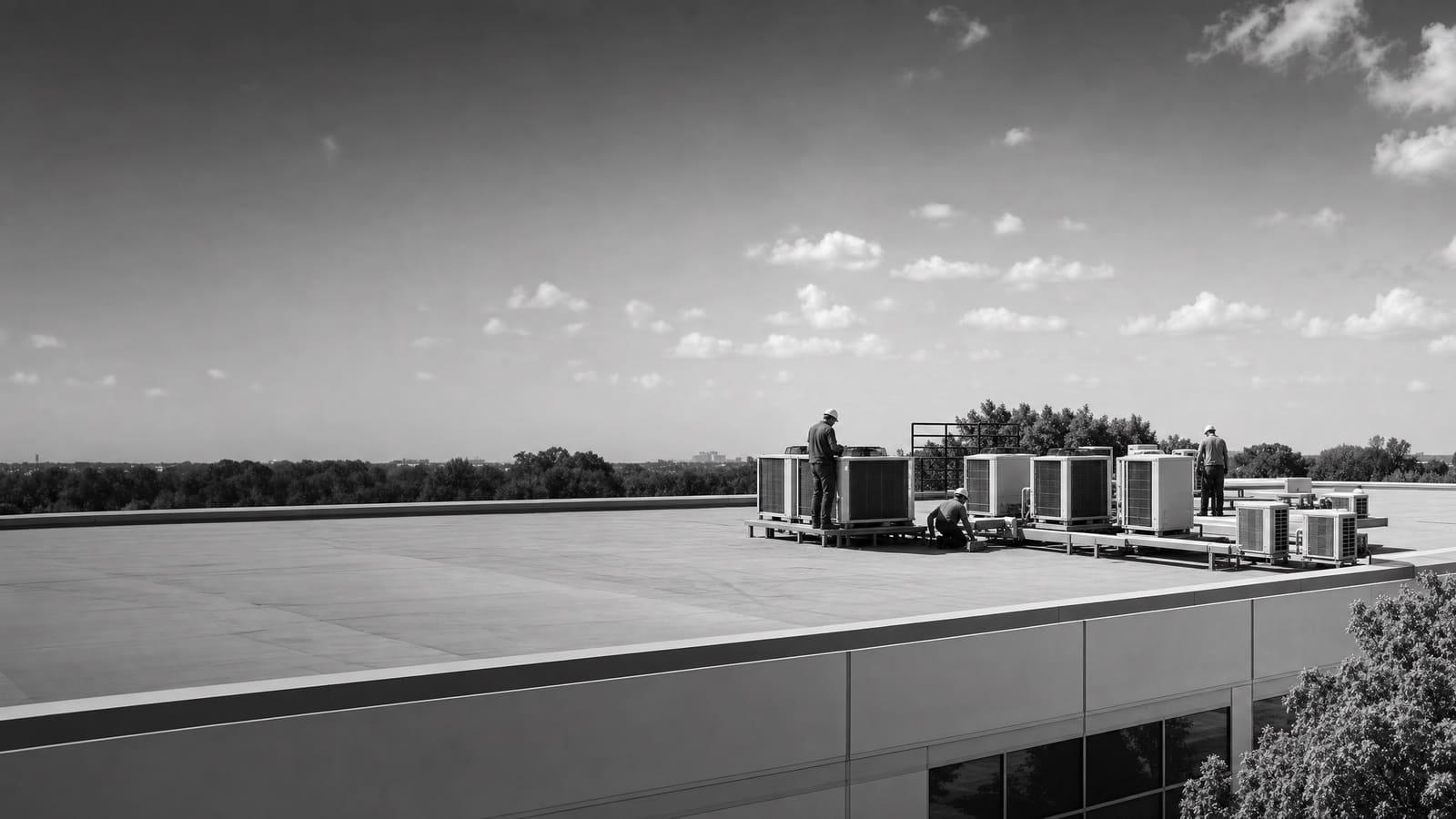
A commercial replacement covers load confirmation, equipment selection, rigging and set, a new curb or adapter, power and gas connections, controls tie-in, refrigerant recovery from the old unit, and commissioning. Replacement beats one more repair once the unit is past roughly 15 years, once service calls repeat inside a season, or once the box can no longer hold the space. DOE puts the annual waste of an old, inefficient rooftop unit at $900 to $3,700.
A site review still has to verify roof structure at the curb, crane reach and lot access, available electrical capacity, the condition of existing gas lines, and how the unit ties into building controls.
THE REAL CHOICE
Three ways owners handle an aging rooftop unit
Facility managers often wait until a unit no longer conditions the space, needs frequent service, or fails outright. DOE's guidance is blunt about that habit: replacing an inefficient unit proactively is usually the better business move than replacement-on-failure, and often beats a like-for-like swap at the end of service life. The third path gets skipped too often. Under DOE's Advanced RTU Campaign, owners could either replace old units with more efficient ones or retrofit them with advanced controls, whichever made better financial sense. More than 200 organizations upgraded over 43,000 units that way, saving a combined $37 million a year on energy bills. Pick your path from the condition of the cabinet and the age of the unit, not from whichever quote lands first.
WHAT MOVES THE NUMBER
What actually separates two prices on the same roof
No source publishes a universal installed price for a commercial rooftop replacement, and a number quoted before anyone looks at the roof is a guess. These are the lines that decide whether yours is a clean swap or an expensive one.
BUYING GUIDANCE
Choosing what goes back on the curb
Rooftop units condition close to half of all commercial floor area in the country, so most of these projects come down to one question: what goes back on the curb. A heat pump rooftop unit is technologically close to a straight air-conditioning unit, with reverse-cycle heating added. DOE's guidance puts today's heat pump units squarely in range for most of the South and West, where they are capable of carrying most or all of winter heating demand.
Texas complicates that slightly. Winters here are mild in most years, which is exactly where heat pumps run most efficiently, but the February 2021 freeze is a reminder that sharp heating demand does happen. That is the argument for a dual-fuel unit, which keeps a gas heat section behind the heat pump, or for sizing supplemental heat honestly instead of optimistically.
Sizing is the other half of the decision. Two decades change occupancy, plug load, lighting, and sometimes the envelope, so the old nameplate is a data point rather than an answer. Confirm the load against how the space is used now. A like-for-like swap that carries an old sizing mistake forward is not a cheap replacement. It is the same comfort complaint on a newer warranty.
SIDE BY SIDE
What makes a replacement simple, and what doesn't
Two buildings can run the same tonnage and land in completely different price ranges. The difference is almost always what has to change besides the unit itself.
LOWER COMPLEXITY
Same curb, same fuel
The new unit matches the old footprint and weight, gas and electric are already sized for it, the lot gives the crane clean reach, and the space is used roughly the way it was when the original unit went in. Minimal engineering, short set.
HIGHER COMPLEXITY
New footprint or new fuel
Different tonnage or dimensions mean a curb adapter and possibly structural review. Going all-electric can expose capacity limits at the panel or the service. Tight lots, tenant hours, and units set behind parapets add rigging cost before anything gets connected.
SCOPING
What a real site review covers
DOE's heat pump rooftop guidance gives owners a checklist, and it works as a frame for any replacement, electric or not. It asks about climate zone, cost and utility bill impact, emissions, building type, equipment availability, infrastructure, contractor familiarity, and incentives. Infrastructure is where projects surprise people, and it splits three ways: electrical capacity, physical constraints, and gas lines.
Electrical capacity is the first thing to check on any all-electric swap. If the panel or the service cannot carry the new unit, that upgrade becomes its own project with its own lead time and its own inspection. Physical constraints are the roof itself: curb dimensions, structural capacity, clearances, and how the unit gets up there. Gas lines matter whether you keep them or not, because a unit that no longer burns gas still needs its line handled properly.
Equipment availability belongs on the same list. Availability moves with tonnage, efficiency tier, and configuration, so an honest schedule ties the crane day to a confirmed ship date instead of a hopeful one.
Ask for the infrastructure findings in writing
Electrical capacity, curb and structural condition, gas line disposition, and confirmed equipment availability should appear in the proposal as findings, not assumptions. If they are not written down, they are being priced as a guess, and you will meet the difference as a change order.
OPERATING VIEW
Two things owners underrate
A rooftop replacement gets treated as a one-day event, but it sets your operating conditions for well over a decade: the service contract, the spare-parts strategy, and how the next three replacements go. DOE aims its guidance at portfolio owners for exactly that reason. The second and third unit are cheaper and faster when the first one was chosen deliberately. Two decisions carry most of the weight after the crane leaves, and neither of them shows up as a line on the quote.
REFRIGERANT
Service planning on a mixed roof
EPA Section 608 governs how refrigerant is handled, recycled, and recovered in stationary air-conditioning and heat pump equipment. New units ship on newer refrigerants, so a roof holding old and new units is a roof with two service and parts realities. Plan contracts and spares around that.
STANDARDIZATION
One unit or the whole roof
Replacing units one at a time as they die leaves you with mixed controls, mixed refrigerants, and mixed warranty dates. Standardizing on a model across a roof or a portfolio simplifies service, shortens troubleshooting, and gives you volume to negotiate with.
THE LONGER VIEW
Phasing, procurement, and lifetime cost
The strongest argument for planning replacements is that it moves the decision off the worst possible day. A unit that fails in August gets replaced with whatever is available, in whatever efficiency tier is on the truck, at whatever the crane costs that week. A unit replaced on a schedule gets specified, bid, and set on your terms.
Lifetime cost is where the tiers separate. DOE's work with manufacturers produced high-efficiency rooftop units designed to cut energy use by as much as half against the standard of the time, followed by third-party verification in real buildings and, in December 2015, a raised federal minimum standard. That history matters because every unit you can buy today sits on a higher floor than the one it replaces. The spread between the code minimum and the top tier is where your payback math lives, and it depends on your run hours and your rates, not on a brochure.
Check incentives before you sign, not after. Utility and program incentives change from year to year, and what applies depends on your utility, your equipment tier, and sometimes the date you commit. Verify what is active at the time you buy, and treat any figure you find in older material as history rather than money on the table.
COMPARING BIDS
Five things a comparable quote must show
Two bids on the same roof can differ by a wide margin and both be honest, because they scoped different work. Make every quote answer the same five questions and the comparison becomes real.
01
Unit, tonnage, and efficiency tier
Model number and rated efficiency, not just "like for like." The tier drives both the price and the operating cost.
02
Curb, structural, and roof work
Adapter or new curb, any structural review triggered, and who patches and flashes the roof afterward.
03
Rigging and access plan
Crane size, staging area, lot closure hours, and whether that cost is included or excluded.
04
Infrastructure changes
Electrical capacity findings, any panel or feeder work, and how the existing gas line is handled.
05
Commissioning and closeout
Startup, charge, airflow, and control settings verified and documented, plus permits and inspections.
Get a defensible number
Price the equipment and the building together.
Send the address, operating target, and target opening date. Flux will identify what must be verified before the project can be priced.
Get a free estimateQuestions
Straight answers.
When does replacement beat one more repair?
Units past about 15 years waste substantial energy compared with newer models, and DOE's guidance treats proactive replacement as the better business move than waiting for failure. If the unit needs frequent service, no longer holds the space, or is nearing the end of its useful service life, you are paying for the replacement either way. Planning it just gets you a better one.
Should you choose a heat pump rooftop unit or stay with gas heat?
A heat pump rooftop unit is mechanically similar to a standard air-conditioning unit with reverse-cycle heating added, and DOE considers today's units appropriate for most of the South and West, capable of covering most or all of winter heating demand. The decision turns on your electrical capacity, your electricity and gas rates, and how you want to handle rare hard freezes. Dual-fuel keeps a gas heat section as backup.
How much does a commercial HVAC installation cost?
There is no honest universal installed price, because tonnage, curb work, crane access, electrical capacity, and controls all move the number. What is documented is the cost of waiting: DOE estimates an old, inefficient rooftop unit wastes $900 to $3,700 per unit per year. That figure belongs in your comparison next to the installed price.
What happens to the refrigerant in the old unit?
EPA regulations under Section 608 of the Clean Air Act govern how refrigerant is handled, recycled, and recovered in stationary refrigeration, air-conditioning, and heat pump equipment. Recovery from the old unit is part of the job, and it should be listed on the quote rather than assumed.
Can you improve a rooftop unit without replacing it?
Sometimes. DOE's Advanced RTU Campaign gave owners two paths: replace old units with more efficient models, or retrofit them with advanced controls, depending on which made better financial sense. Controls retrofits are worth pricing when the cabinet and compressors are still sound and the unit is not near end of life.
Sources used for this guide
- [1]betterbuildingssolutioncenter.energy.gov — DOE Advanced Rooftop Unit Replacement Guidance
- [2]betterbuildingssolutioncenter.energy.gov — DOE Commercial Heat Pump Rooftop Unit Replacement Guidance
- [3]betterbuildingssolutioncenter.energy.gov — DOE High-Efficiency Commercial Rooftop Unit Toolkit
- [4]energy.gov — DOE Efficient Commercial Rooftop Air Conditioner Program
- [5]epa.gov — EPA Stationary HVAC Refrigerant Management