THE DIRECT ANSWER
What a commercial HVAC replacement actually includes
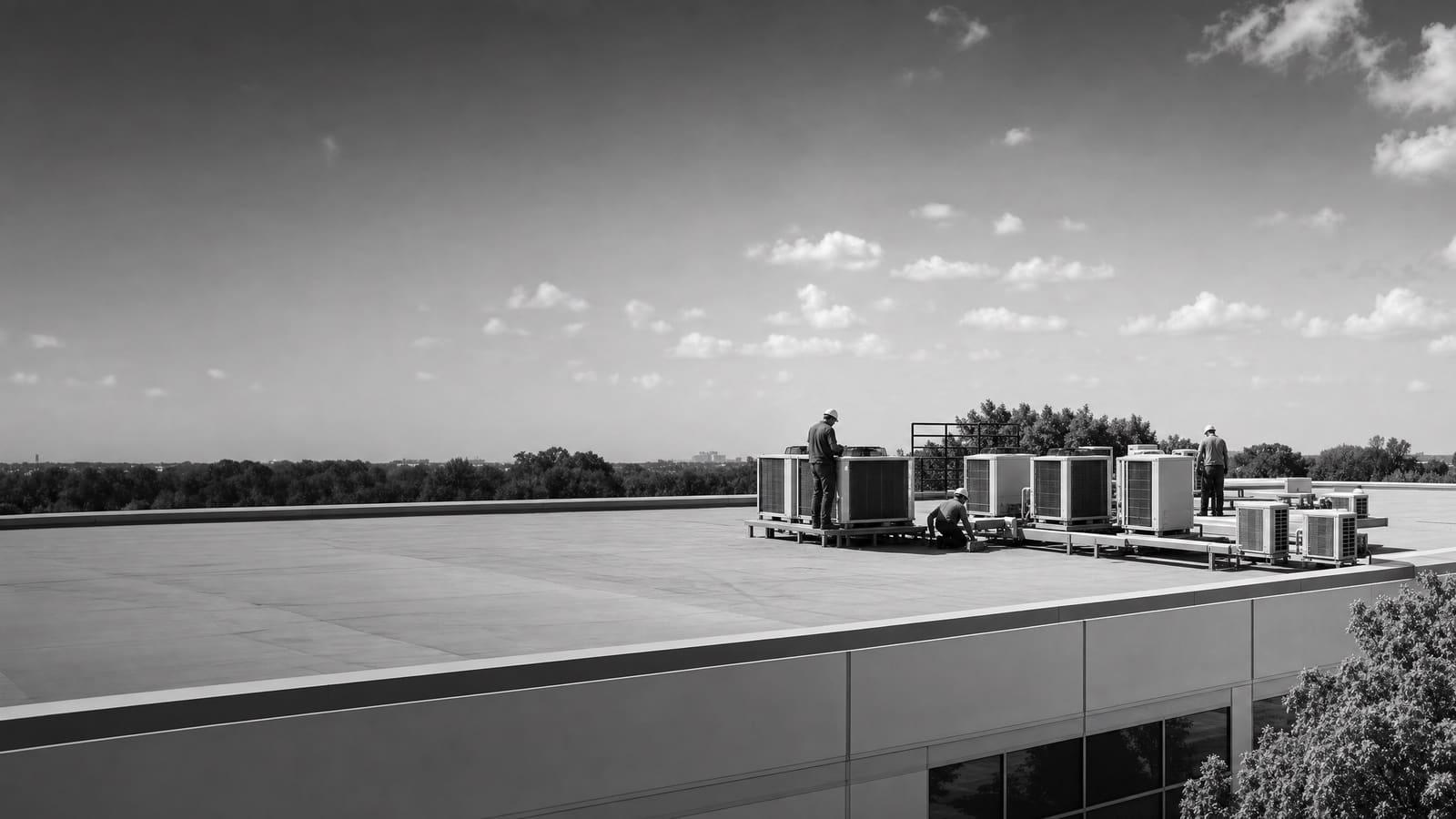
A commercial HVAC replacement is four things: a confirmed load, an equipment decision, a rigging and shutdown plan, and a commissioned startup. Replacement beats another repair once the waste is structural rather than fixable. Federal rooftop guidance puts the annual energy waste of an old, inefficient commercial rooftop unit at roughly $900 to $3,700 per unit, and flags units past fifteen years as the ones worth planning around instead of nursing through one more season.
A site review still has to confirm the curb and the structure under it, electrical capacity at the roof, gas or refrigerant line routing, and crane access before any of that becomes a price.
THREE WAYS TO GO
Three replacement paths, and when each one is right
Most commercial replacements come down to three paths. The right one depends on whether the building still uses the space the way it did when the old unit was specified.
A like-for-like swap reuses the existing curb and connections, so it is the shortest path back to conditioned air. It also carries forward whatever sizing the old unit had, including a mistake.
A right-sized, high-efficiency replacement starts from a fresh load calculation. The federal high-performance rooftop specification was written to cut unit energy use by up to half against the older standard, and more than twenty models now exceed it, so the efficiency step is a catalog choice rather than a custom order.
A heat pump rooftop unit adds reverse-cycle heating in place of gas heat. It is the most consequential of the three, because it touches electrical capacity at the roof and not just the equipment line on the quote.
WHAT MOVES THE NUMBER
The lines that carry the variability
Nobody can price your roof from a search result. What a real quote can do is show which lines are firm and which ones move once someone stands up there and looks. These are the lines that carry the risk.
HOW TO BUY IT
Buying the unit is the easy part
The most expensive version of this project is the one you never chose. Federal rooftop guidance is blunt about the pattern: facility managers put off a new unit until the old one stops holding the space, needs constant service, or fails outright. Replacing proactively with a more efficient unit often comes out ahead of replacement-on-failure, and sometimes ahead of a like-for-like swap at the end of the old unit's service life.
The reason is that a failure sets every term of the deal for you. You take the unit that is available, at the price it is offered, on the day a crane can get there, with no room to weigh an efficiency tier or a heat pump option. Planning the same replacement six months earlier turns all of that back into a decision you control.
So treat availability as part of the price. Ask for the equipment lead time in writing, right next to the number, and ask what the alternate unit is if that model slips. A quote naming one unit and one date is telling you less than a quote that names two.
SCOPE CHECK
What makes a replacement simple or hard
Two buildings can order the same tonnage and get very different projects. The split is almost always about whether anything except the equipment is changing.
STRAIGHTFORWARD
Same load, same footprint
The new unit matches the old capacity, lands on a curb adapter, and reuses the existing electrical, gas, and duct connections. Lot access is open, the structure under the curb is sound, and the visible part of the job is cones in the parking lot.
PLAN FOR MORE
New capacity or a fuel change
Tonnage grows, the footprint changes, or gas heat becomes electric. Now you are checking roof structure, panel capacity, feeder routing, and whether the old gas line is resized or capped. Expect engineering time, longer lead times, and a longer approval path.
BEFORE ANYONE QUOTES
What a site review has to settle
A number you can trust comes from someone standing on the roof, not from a nameplate photo alone. The photo is a good start. It gets you the tonnage, the refrigerant, the age, and a first list of candidate units. It cannot tell anyone what the curb looks like underneath or what the panel has left in it.
Four things decide most of the scope. First, the curb and the structure beneath it, because a different footprint or a heavier unit changes the roof work. Second, electrical capacity at the roof, which is the question that quietly ends heat pump conversions when the panel has nothing left to give. Third, physical constraints: clearance, hatch access, screen walls, and whether a crane can reach the pad without closing half the lot. Fourth, the gas line, which stays, gets resized, or gets capped depending on the equipment you choose.
Add a load calculation to that list if anything about the space has changed. Twenty years of tenant turnover, added plug loads, and envelope work rarely leave the original sizing correct.
Settle these five before you compare prices
Curb and structural condition, available panel capacity at the roof, crane reach and lot closure time, gas line disposition, and a current load calculation. Two quotes that assume different answers to those five are not comparable, no matter how close the totals look.
OWNERSHIP AND OPERATIONS
Two questions that outlast the install
The equipment outlives nearly every decision made around it, which is why two questions deserve real time before the order goes in.
The first is who pays for what. A replacement is capital work with an operating payoff, and in a leased building those two land on different parties. The second is whether you are buying one unit or the first unit of a fleet. Commercial roofs rarely hold a single machine, and rooftop systems condition close to half of all U.S. commercial floor area, so the choice you make now usually sets the pattern for the next three.
WHO PAYS, WHO SAVES
Capital cost versus the utility bill
An owner-occupied building captures the efficiency savings directly. In a leased building, the party writing the check for the equipment is often not the party whose utility bill drops. Settle that split before you pick an efficiency tier.
ONE UNIT OR A FLEET
Set the pattern deliberately
If five units share a roof, the first replacement sets your refrigerant mix, your controls platform, and your parts inventory. Staggering replacements spreads the capital, but keeping a common platform keeps service simple.
PHASING AND LIFETIME COST
Spreading the work without spreading the mess
A roof full of aging units does not have to be replaced in a single budget year. The usual approach is to rank units by condition and by what they cost to run, then take the worst two or three first. An old, inefficient rooftop unit can waste somewhere between $900 and $3,700 a year against a current one, so the ranking is not about which unit is loudest. It is about which one is quietly billing you the most every month.
That same waste figure is why lifetime cost belongs in the comparison at all. The equipment price covers one year of the decision. The efficiency tier, the controls, and how carefully the unit is commissioned cover the other fifteen or twenty. Organizations working through the national rooftop upgrade campaign have replaced or retrofitted tens of thousands of units and documented tens of millions of dollars in combined annual energy savings. That is what this work looks like once you view it at fleet level instead of one crane day at a time.
Procurement follows the same logic. Order early, accept a phased crane schedule if it buys you better equipment, and keep a common platform across the roof wherever you can.
THE QUOTE CHECKLIST
Five things a comparable quote shows
Two installed prices are only comparable when both describe the same scope of work. Before you sign anything, confirm that each quote puts these five in writing.
01
Equipment, tonnage, and efficiency tier
Model number, capacity, and efficiency rating, so you are comparing the same machine rather than two different ones.
02
Lead time and a named alternate
The quoted availability in writing, plus what happens to the schedule if that model slips.
03
Curb, structural, and roof scope
Curb adapter, any framing or decking work, and who patches and flashes the roof afterward.
04
Rigging, permits, and lot logistics
Crane, closure window, permit fees, and inspection coordination included in the installed price instead of billed later.
05
Recovery, startup, and commissioning
Handling of the old refrigerant charge under federal rules, then verified airflow, charge, and control settings at handoff.
Get a defensible number
Price the equipment and the building together.
Send the address, operating target, and target opening date. Flux will identify what must be verified before the project can be priced.
Get a free estimateQuestions
Straight answers.
When does replacing beat one more repair?
Watch for three signals together: the unit no longer holds the space, it needs service often, and it is past about fifteen years. At that point the waste is built into the machine. An old, inefficient rooftop unit can burn $900 to $3,700 a year more than a current one, and no repair recovers that.
How long does the installation itself take?
The crane set and connections are the shortest part of the project. Equipment lead time is what usually sets your date, which is why availability belongs on the quote next to the price. Structural work, electrical upgrades, or a fuel change extend the schedule well beyond the lift.
Is a heat pump rooftop unit a good fit for a commercial building?
Heat pump rooftop units are most efficient where winter heating is mild to moderate, and across most of the U.S. South and West they can handle most or all of the winter heating demand. The deciding factors are local electricity and gas prices, available electrical capacity at the roof, physical constraints, and whether your installer has done them before.
What happens to the refrigerant in the old unit?
It has to be recovered and handled under federal Clean Air Act rules that govern refrigerant in stationary air-conditioning and heat pump equipment. Venting it is not an option. Make sure recovery appears as a line on the quote rather than an assumption.
Should we replace like-for-like or resize?
Confirm the load either way. If the space and its use have not changed, like-for-like is often the right call and the fastest path back to service. If occupancy, plug loads, or the envelope have changed, right-sizing fixes comfort complaints the old unit was never able to solve.
Sources used for this guide
- [1]betterbuildingssolutioncenter.energy.gov — DOE Advanced Rooftop Unit Replacement Guidance
- [2]betterbuildingssolutioncenter.energy.gov — DOE Commercial Heat Pump Rooftop Unit Replacement Guidance
- [3]betterbuildingssolutioncenter.energy.gov — DOE High-Efficiency Commercial Rooftop Unit Toolkit
- [4]energy.gov — DOE Efficient Commercial Rooftop Air Conditioner Program
- [5]epa.gov — EPA Stationary HVAC Refrigerant Management