THE DIRECT ANSWER
What a commercial HVAC replacement actually includes
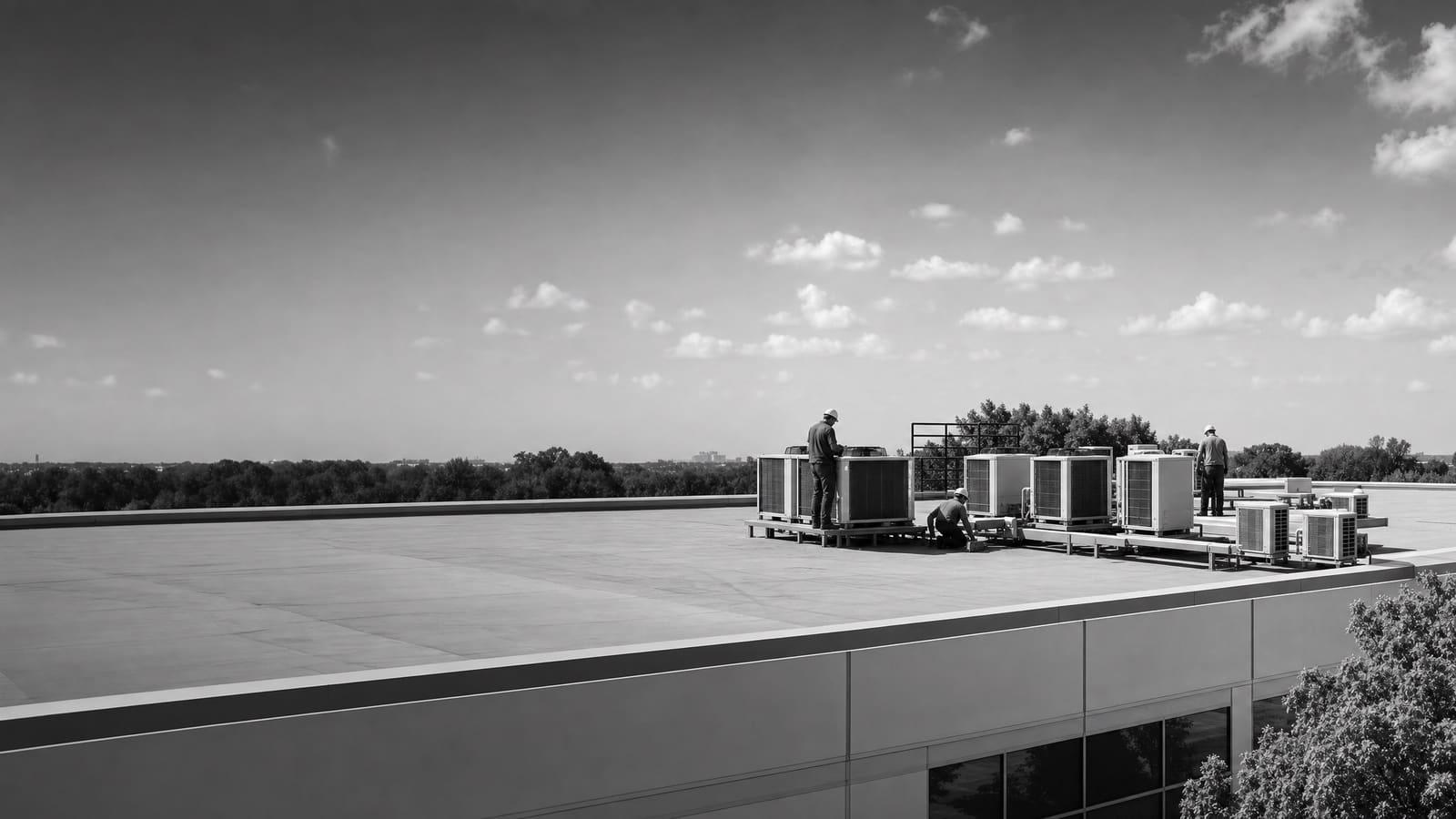
A commercial HVAC replacement covers load confirmation, equipment selection, certified recovery of the old refrigerant charge, removal, rigging the new unit onto a curb or curb adapter, gas and electrical and control connections, permits, inspection, and commissioning. Replacement beats another repair once a unit passes about fifteen years. Old, inefficient rooftop units waste anywhere from $900 to $3,700 each per year against current equipment, and that runs whether or not the unit broke this week.
A site review still sets the number. It has to confirm tonnage against how the space is used now, curb and structural condition, electrical capacity at the roof, and how a crane reaches the unit.
THE THREE CHOICES
Repair again, swap like-for-like, or change the system
Almost every commercial HVAC decision reduces to three paths, and which one is right depends on the age of the equipment and what changed in the building since it was installed.
Repair still makes sense while a unit is young and the failure is isolated to one component. Past fifteen years, repair spending stops buying much. The unit is losing money every month it runs, and the next failure is rarely the last.
Replacement is where the real choice lives. A like-for-like swap is the fastest path back to conditioned space and the cheapest to engineer, but it inherits whatever sizing error the old unit had. A right-sized or all-electric replacement takes more thinking up front and fixes comfort problems the old unit never could. The decision worth making deliberately is whether to keep gas heat, because that answer shapes the electrical work, the permit, and the equipment order all at once.
WHAT MOVES THE PRICE
The budget lines that actually swing
Two quotes for the same roof can land far apart and both be honest. The difference is almost always in these lines. Ask which are included, which are allowances, and which are excluded entirely.
IN PRACTICE
Buy the equipment, not just the installation
The nameplate on the old unit records a decision someone made twenty years ago. It is not a specification for your building today. Occupancy, plug load, lighting, and glazing have all moved since. Ask for the load calculation rather than a tonnage, and expect the new unit to be a different size than the one coming off.
The second question is the heat source. A heat pump rooftop unit is the same basic machine as an air-conditioning unit with reverse-cycle heating added, and it performs best where winters are mild. Southern California sits squarely in that range, which makes all-electric a live option here rather than a stretch. What decides it is infrastructure: electrical capacity at the roof, physical room for the unit, and whether the existing gas line still has a job. When capacity is tight, a dual-fuel unit keeps gas for the coldest hours.
Third is availability. Lead time is part of the cost of being down. A quote that names a model without naming a delivery window is only half a quote.
SCOPE CHECK
What makes this simple and what makes it complicated
Before anyone prices it, know which project you have. The gap between these two is measured in weeks and permits, not in equipment price.
LOWER COMPLEXITY
Same size, sound curb, open roof
The new unit matches the old tonnage and footprint, the existing curb is in good condition, gas and electrical stay where they are, and the crane has clear reach from the lot. Permitting is routine and the visible disruption is one morning of coned-off parking.
HIGHER COMPLEXITY
New capacity, new heat source, tight site
Tonnage grows, the footprint changes, or the unit goes all-electric. Now you have structural review on the curb, possible feeder and panel work, controls to reintegrate, and a crane that may need a street closure or a longer reach. Plan this one in phases, well ahead of the season.
BEFORE THE QUOTE
What a site review has to look at
A quote written from a photo is a guess. A quote written from a roof visit is a number. The visit should produce more than a tonnage — it should produce the reasons the price is what it is.
On the roof, the review confirms the existing curb's dimensions and condition, the structural support under it, the state of the membrane around the unit, and whether a re-roof is close enough that the two jobs should be sequenced together. It checks the electrical service at the roof and whether the panel has room for a larger unit. It confirms where the gas line runs and whether it stays.
On the ground, it works out the crane. Where the truck sets up, how far it has to reach, what closes during the lift, and whether the lift can happen outside business hours. On a dense block, that one question moves the schedule more than the equipment does.
Then it settles what the replacement triggers on paper. Permits, inspections, and any requirements that apply to the new unit rather than the old one belong in the scope before the order goes in, not in a change order after the crane leaves.
The one question that reprices the job
Ask whether the roof is due for replacement in the next few years. Setting a new unit on an aging membrane means paying for the same crane and the same curb work twice. Sequencing the roof and the unit together is usually the cheaper order.
GLENDALE SPECIFICS
Permits, roofs, and what the climate allows here
California building departments treat rooftop equipment work as permitted mechanical work, and the electrical changes that come with it are permitted too. Re-roofing carries its own permit, whether it is an overlay or a tear-off. That matters for sequencing. If the membrane under a unit is near end of life, the roof and the unit are two permitted jobs that can share one crane day and one set of lot closures, and doing them together is almost always cheaper than doing either one early.
The climate helps the equipment decision. Heat pump rooftop units are most efficient where winters are mild, and Southern California sits in that range, so an all-electric unit can generally carry most or all of a building's winter heating instead of leaning on backup resistance heat. Whether it pencils comes down to the electrical service at your roof and the rates you pay.
Put permits in the contract
The installing contractor should pull the mechanical and electrical permits and carry the inspections inside the installed price. Get that in writing before you sign, including who schedules the inspection and who is responsible if it fails.
AFTER THE CRANE LEAVES
Two things that outlive the install
The installation ends in a morning. The consequences run for the next fifteen or twenty years, and two of them are worth deciding before the order goes in rather than after.
Both come down to the same question: does the new unit join a fleet you can service consistently, or does it become the odd one out on the roof? Buildings with several rooftop units accumulate mixed vintages, mixed refrigerants, and mixed controls, and every mismatch shows up later as a slower service call or a part that has to be ordered.
COMMISSIONING
Verified, not just running
Startup should document refrigerant charge, airflow, and control settings against the design, not just prove the unit turns on. Most comfort complaints that surface a month after an install trace back to a setting nobody wrote down. Keep the commissioning report — it is what backs a warranty claim.
REFRIGERANT PLANNING
The roof gets mixed
Federal rules require certified technicians to recover and handle refrigerant rather than vent it, and new equipment ships on a different refrigerant than the unit coming off. Nothing changes on day one. But a roof with several vintages needs a service contract and a parts plan that cover both.
THE LONGER VIEW
Replace on your schedule, not the equipment's
Most commercial HVAC work happens on the worst possible day. A unit fails in August, the building is uncomfortable, and every decision gets made under pressure with whatever equipment is available that week. That is the expensive version of this project. Planned replacement is the same scope of work at a better price, because you can compare equipment, time the lift for a weekend, and order before the delivery window becomes the emergency.
Getting there means treating the roof as a set of assets rather than one. Inventory the units, note the age of each, and set a replacement order. Anything past fifteen years is already spending money you cannot see, so the oldest unit is usually the one to plan first, even when it is not the one generating complaints.
Phasing also improves the buying. Two or three units replaced across a year earns more contractor attention and produces a more consistent fleet than one emergency swap at a time. It also leaves room to check which utility incentives apply to the efficiency tier you are choosing — a conversation that goes better before the order than after.
THE QUOTE
Five things a comparable quote shows
Two bids are only comparable when they are scoped the same way. If a quote is missing any of these, ask for it in writing before you compare prices. The cheaper number is usually the one with something left out.
01
Model number and efficiency tier
The exact unit, not a tonnage. The efficiency tier drives operating cost and determines which incentives are available.
02
Delivery window
A committed lead time sitting next to the price, and what happens to the schedule if the unit slips.
03
Curb, structural, and roof scope
Whether a curb adapter is included, what structural work is assumed, and how the membrane gets sealed back.
04
Crane, rigging, and closures
Who supplies the crane, how long the lot is closed, and whether the lift runs inside or outside business hours.
05
Permits, inspection, commissioning
Permits pulled by the contractor, inspections carried through, and a startup report documenting charge, airflow, and controls.
Get a defensible number
Price the equipment and the building together.
Send the address, operating target, and target opening date. Flux will identify what must be verified before the project can be priced.
Get a free estimateQuestions
Straight answers.
When is replacement better than another repair?
Once a rooftop unit passes about fifteen years, each repair buys less. An old, inefficient unit can waste $900 to $3,700 a year in energy against current equipment, and that loss runs every month whether or not something is broken. At that age, the repair invoice is only part of what you are paying.
Should a Glendale building choose a heat pump or stay on gas?
Heat pump rooftop units are most efficient in mild winters, and Southern California qualifies, so an all-electric unit can usually carry most or all of the heating load. The deciding factors are electrical capacity at the roof, physical space for the unit, and whether the gas line still has a job. Dual fuel is the middle answer when capacity is tight.
Do you need a permit to replace a rooftop unit?
Yes. California building departments permit mechanical equipment work, and the electrical changes that come with it are permitted as well. Re-roofing carries a separate permit. The installing contractor should pull the permits and carry the inspections inside the installed price rather than handing that back to you.
What happens to the refrigerant in the old unit?
Federal Clean Air Act rules require refrigerant to be recovered and handled by certified technicians instead of vented. It is a small line on a quote, but it should be there. It is also one reason an old unit cannot simply be cut loose and lifted off.
How disruptive is the swap for tenants?
On a straightforward job, the visible part is one morning. The crane sets up, parking stalls close, the old unit comes off, and the new one lands on the curb. Most tenants notice the cones. The work that keeps it that short — rigging plan, curb measurement, utility confirmation — happened weeks earlier.
Sources used for this guide
- [1]betterbuildingssolutioncenter.energy.gov — DOE Advanced Rooftop Unit Replacement Guidance
- [2]betterbuildingssolutioncenter.energy.gov — DOE Commercial Heat Pump Rooftop Unit Replacement Guidance
- [3]betterbuildingssolutioncenter.energy.gov — DOE High-Efficiency Commercial Rooftop Unit Toolkit
- [4]energy.gov — DOE Efficient Commercial Rooftop Air Conditioner Program
- [5]epa.gov — EPA Stationary HVAC Refrigerant Management
- [6]californiacity-ca.gov — HVAC Permits