THE DIRECT ANSWER
What a commercial HVAC replacement actually includes
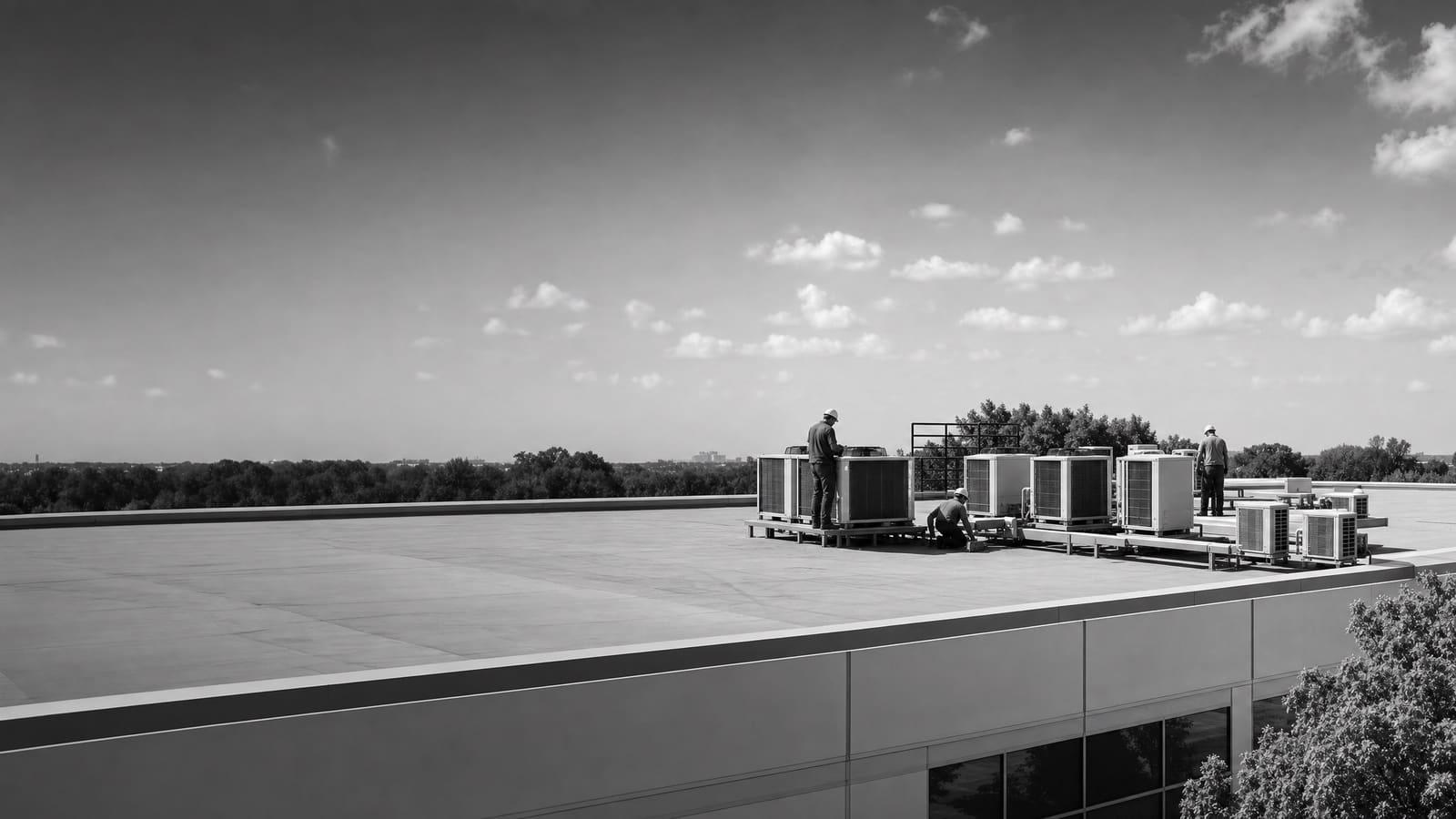
A commercial HVAC replacement covers a confirmed load calculation, equipment selected against real availability, curb and rigging work, gas or electrical changes, controls integration, and commissioning. Replacement usually beats another repair once a unit passes about 15 years, the point where federal guidance says rooftop units start wasting substantial energy and money. Old, inefficient units have been measured wasting $900 to $3,700 per unit each year, before you count the service calls.
A site review still has to verify tonnage against how the space is used now, curb and roof condition, crane access, and whether the electrical service and gas supply support the unit you actually want.
THE THREE MOVES
Three ways to handle a failing rooftop unit
When a rooftop unit is struggling, there are really three moves, and only one of them is buying the same thing again. Federal guidance is direct about the trade: an owner can replace an old unit with a more efficient one, or retrofit the existing unit with advanced controls, depending on which option makes better financial sense. That question deserves an answer before the purchase order goes out. A unit that already needs a compressor is a poor host for a controls upgrade, and a unit with a sound cabinet and a failed economizer may not need replacing at all. The pattern worth avoiding is the default one: waiting until the equipment quits completely, then taking whatever is on the truck. Replacement on failure removes every option except speed, and it usually costs more than the same swap would have cost on your schedule.
WHAT MOVES THE NUMBER
The lines that decide the price
No two roofs price the same, and the honest reason is that most of the cost sits in site conditions rather than in the box itself. These are the lines that move a commercial HVAC quote the most, tagged by how much they tend to vary from building to building.
THE EQUIPMENT DECISION
Picking the equipment, not just the size
Sizing is only half of the equipment decision. The other half is what the unit burns. Heat pump rooftop units are technologically close to standard air-conditioning rooftop units, but they add reverse-cycle heating, so one machine covers both seasons. Federal guidance sorts that choice into a short list: climate and geography, utility bill impact, emissions goals, building type, equipment availability, and infrastructure, meaning electrical capacity, physical constraints on the roof, and existing gas lines. Contractor familiarity and available incentives round it out.
Geography does real work here. Heat pump heating efficiency falls as outdoor temperature drops, so the technology suits mild-to-moderate winter heating best. For most of the U.S. South and West, DOE guidance says today's heat pump rooftop units are an appropriate solution and fully capable of covering most or all of the winter heating demand. Sites with lower electricity prices and a cleaner grid are the strongest candidates, because that is where the utility-bill math and the emissions math both land in your favor.
If a building already runs gas heat and the electrical service is close to its limit, a dual-fuel unit keeps the option open without forcing a service upgrade into the same project.
SIDE BY SIDE
A one-morning swap or an engineered project
Two projects with identical tonnage can sit a week apart on schedule and far apart on price. The difference is almost never the equipment. It is what the building asks the crew to work around.
LOWER COMPLEXITY
Same load, same footprint
The space is used the way it always was, the curb matches or takes a simple adapter, the roof carries the weight, and the lot has room for a crane on an off-hours morning.
HIGHER COMPLEXITY
Anything that changes
Tonnage grows, gas heat comes out, the electrical service is already tight, the roof needs structural review, or the building has to keep operating through the work. Each one adds engineering and time.
SCOPING
What a site review has to confirm
Start with load. Sizing should come from how the space is used today, not from the nameplate on a twenty-year-old unit. Occupancy, plug loads, lighting, and envelope work all change what a building actually needs, and carrying the old number forward carries the old mistakes forward with it.
Then the physical questions get answered on the roof, not in an office: curb dimensions and condition, structural capacity, crane reach and staging, and the routes for power, gas, and condensate. Federal heat pump guidance treats infrastructure as a gate rather than a footnote. Electrical capacity, physical constraints, and existing gas lines each decide which equipment is even on the table.
Availability belongs in the same conversation. DOE lists equipment availability and contractor familiarity among the deciding factors for a reason. A unit nobody can source inside your window is not an option, it is a delay wearing an option's clothes. Incentives work the same way. Programs open and close, so confirm what is active at the moment you buy rather than assuming last year's offer is still there.
Send this before anyone prices it
A nameplate photo, a roof photo, curb dimensions, your operating hours, and one honest sentence about what the space is used for now. Those five things let a contractor scope the load and the access instead of guessing at both.
AFTER THE INSTALL
Two things that outlive the install day
A rooftop replacement is a short project attached to a long obligation. The install gets the attention, but the numbers that justified the project — lower energy use, fewer service calls, comfort complaints that finally stop — only show up if the unit is commissioned correctly and maintained after handoff. Two ownership items deserve a decision before the equipment arrives rather than after. Both are far cheaper to settle in the contract than in a warranty argument a year and a half later.
COMPLIANCE
Refrigerant handling
EPA Section 608 rules govern how refrigerant is handled, recovered, and recycled in stationary air-conditioning and heat pump equipment. Recovery from the unit coming off the roof is regulated work, and it belongs on the quote as a line item, not an assumption.
PERFORMANCE
Commissioning and follow-through
Charge, airflow, economizer operation, and control settings verified against spec at startup, then documented. That is the difference between a unit that reaches its rated efficiency and one that merely runs.
PROCUREMENT
Plan the fleet before it plans you
The most expensive way to buy commercial HVAC is one emergency at a time. DOE's guidance is blunt about the habit: facility managers often delay buying a new unit until the current one no longer conditions the space, requires frequent maintenance, or fails completely. Replacing inefficient and underperforming units proactively can be the smarter business move, not only against replacement-on-failure but even against a like-for-like swap at the end of a unit's useful service life.
The aggregate case is real. Through the Advanced RTU Campaign, more than 200 public- and private-sector organizations upgraded over 43,000 rooftop units and saved a combined $37 million a year on energy bills. Those savings came from a mix of full replacements and controls retrofits, chosen unit by unit on financial merit rather than by blanket policy.
For a building carrying several units, that argues for a survey instead of a purchase order: age, condition, and runtime recorded for each unit, then a two- or three-year sequence that puts the worst performers first and spreads capital across budget years. Some units will fail on their own and interrupt the sequence. A plan still beats no plan.
COMPARING QUOTES
Five things a comparable quote shows
Two quotes are only comparable when they price the same scope. When one number comes in noticeably low, it is usually missing one of these five lines rather than beating the market on equipment.
01
Equipment, spelled out
Make, model, tonnage, efficiency tier, heating type, and refrigerant. Not just "new rooftop unit."
02
Curb, roof, and structural work
Adapter or new curb, any framing, and who stands behind the roof penetration and its warranty.
03
Rigging and site access
Crane size, how many stalls close and for how long, and which day the set happens.
04
Work at the connections
Electrical, gas, condensate, duct transitions, and controls integration, each priced rather than assumed.
05
Permits, startup, and paperwork
Permits and inspections, refrigerant recovery, commissioning results, and the documentation the warranty depends on.
Get a defensible number
Price the equipment and the building together.
Send the address, operating target, and target opening date. Flux will identify what must be verified before the project can be priced.
Get a free estimateQuestions
Straight answers.
When does replacement beat one more repair?
Age and repair frequency usually settle it. Federal guidance notes that rooftop units over 15 years old can waste substantial energy and money compared with newer models, and that old, inefficient units have been measured wasting $900 to $3,700 per unit each year. Once a unit is in that range and needs a major component, a planned replacement generally wins on total cost.
How much does a commercial HVAC installation cost?
There is no honest universal price, because tonnage, curb and structural work, crane access, and electrical or gas changes each move the number independently. Ask for a quote that breaks those out as separate lines. That way you can compare bids and see which condition, not which brand, is driving the difference.
Is a heat pump rooftop unit a realistic option?
Often, yes. DOE guidance says that for most of the U.S. South and West, today's heat pump rooftop units are an appropriate solution and fully capable of handling most or all of the winter heating demand. The gating questions are electrical capacity, roof constraints, and existing gas lines. Where the service is tight, a dual-fuel unit keeps the option open.
Should I replace like-for-like or resize?
Confirm the load either way. If occupancy, equipment, and the envelope are the same as when the original unit was installed, like-for-like is usually right and simplest. If any of those changed, resizing fixes comfort problems the old unit was never able to solve.
What happens to the refrigerant in the old unit?
EPA Section 608 regulations govern the handling, recovery, and recycling of refrigerant in stationary air-conditioning and heat pump equipment. Recovery from the removed unit is regulated work performed by certified technicians, and it should appear on the quote rather than being folded into a vague demolition line.
Sources used for this guide
- [1]betterbuildingssolutioncenter.energy.gov — DOE Advanced Rooftop Unit Replacement Guidance
- [2]betterbuildingssolutioncenter.energy.gov — DOE Commercial Heat Pump Rooftop Unit Replacement Guidance
- [3]betterbuildingssolutioncenter.energy.gov — DOE High-Efficiency Commercial Rooftop Unit Toolkit
- [4]energy.gov — DOE Efficient Commercial Rooftop Air Conditioner Program
- [5]epa.gov — EPA Stationary HVAC Refrigerant Management