THE DIRECT ANSWER
What a commercial HVAC replacement actually includes
A commercial HVAC replacement is a load check, an equipment decision, a removal and set, the connection work that follows, and a commissioning pass that proves the unit performs. Replacement wins over another repair when the unit is old enough to lose money every year it runs. Federal analysis of commercial rooftop units puts that waste at roughly $900 to $3,700 per unit each year, and units past fifteen years are the usual candidates. A second major failure on a unit that age is a budget decision.
A site review still has to confirm the real load, the curb and roof structure, available electrical capacity, and crane access before any of that turns into a number for your building.
THREE PATHS
The three replacements you are actually choosing between
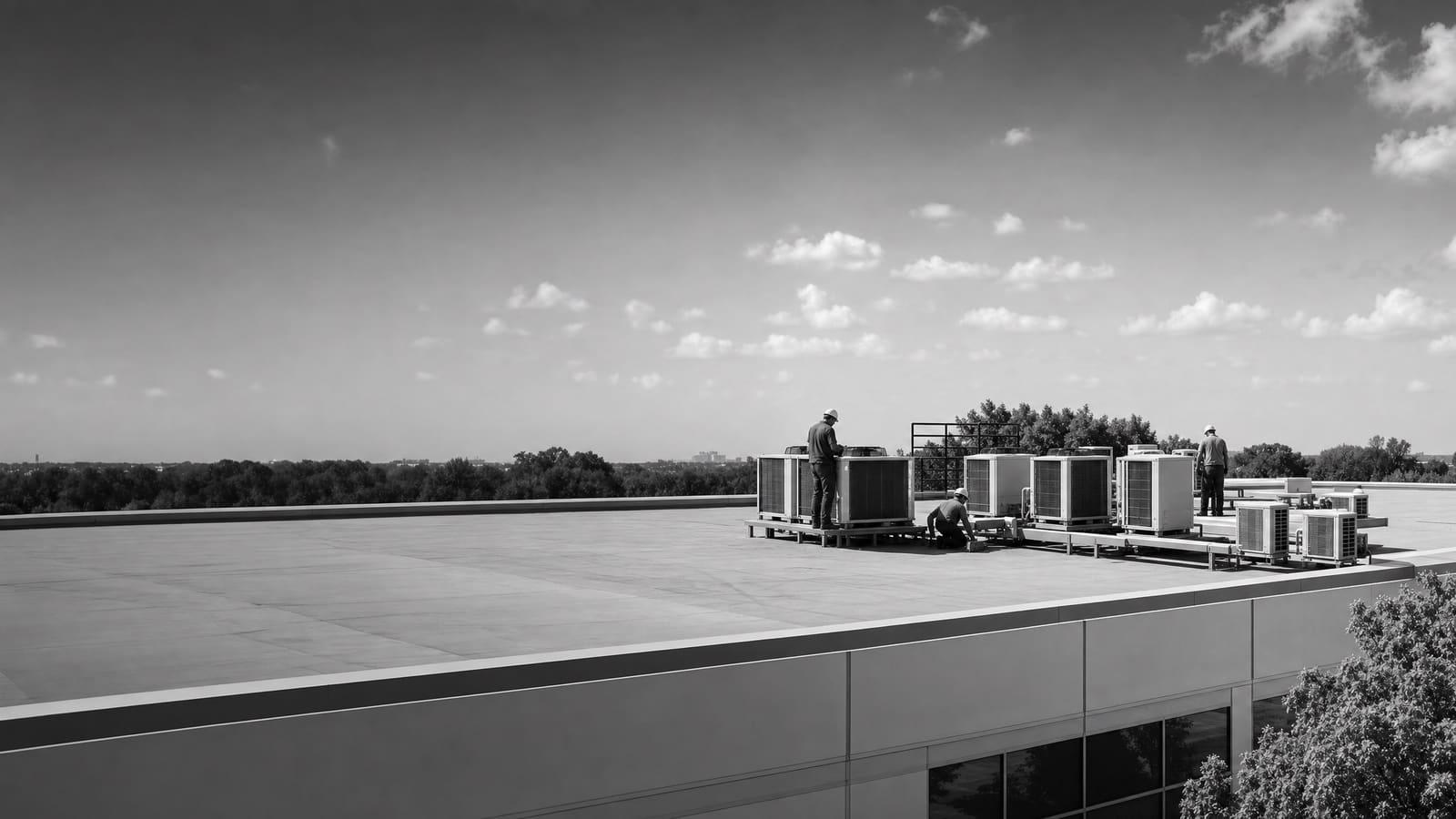
Most commercial buildings are replacing a packaged rooftop unit, because rooftop equipment conditions close to half of all commercial floor space in the country. The real choice is rarely one brand against another. It is which of three paths you are buying.
The gas-heat unit you own now can be matched, upgraded to a high-efficiency version of the same thing, or replaced with a heat pump rooftop unit that heats and cools on electricity. Federal guidance says heat pump rooftop units suit mild-to-moderate winter heating best, and that across most of the South and West they can cover most or all of a building's winter demand. Dual-fuel versions keep a gas burner for the coldest hours. All three land on a roof curb and use the same crane day. What separates them is first cost, electrical capacity, and what the utility bill looks like for the next fifteen years.
WHAT MOVES THE NUMBER
The six lines that decide your price
No two roofs price the same, so treat these as the lines that move your number rather than a menu. The tags show where the risk sits. Some of these are known the day you sign. Others are not settled until someone walks the roof.
IN PRACTICE
How to choose the unit you will own for fifteen years
The most expensive way to buy commercial HVAC is to wait until the unit quits. A replacement-on-failure job takes whatever equipment is available that week, at whatever it costs that week, with no time to ask whether the size still fits the building. Federal rooftop guidance makes the same point in plain terms: replacing an aging unit on purpose usually beats both the emergency call and a like-for-like drop-in at the end of service life.
Start with the load, not the nameplate. A twenty-year-old unit was sized for the occupancy, lighting, and equipment the building had then. Offices got emptier and denser at the same time. Lighting retrofits cut heat gain. Warehouses picked up equipment nobody planned for. Sizing off the old tag just repeats an old guess with new money.
Then check the things that decide which equipment you can actually buy. Availability is real, and it belongs next to the price on the quote. Electrical capacity decides whether an all-electric option is a swap or a service upgrade. Physical constraints — curb size, roof access, clearances, gas line routing — decide the rigging plan. And the installer's familiarity with the equipment class matters more on a heat pump than on a like-for-like gas unit, because startup and controls are where the savings either show up or quietly disappear.
SIDE BY SIDE
What keeps a job simple, and what grows it
Two buildings can order the same tonnage and get very different quotes. The difference is almost never the box. It is what the box has to land on and connect to.
LOWER COMPLEXITY
A straight swap
Same fuel and roughly the same size. The existing curb takes an adapter, the roof structure is sound, and the electrical service already has room. The lot gives the crane clean reach, and the space is used the same way it was when the old unit went in.
HIGHER COMPLEXITY
Where scope grows
Tonnage or footprint changes, so the opening and structure get reviewed. The building switches fuel and needs panel or service work. Access is tight, so the crane sets up in a fire lane on a Sunday. Or the unit ties into a building automation system that has to be re-pointed and retested.
SCOPING IT
What a site review has to settle before anyone prices it
A quote written from a phone call is a guess with a letterhead. The walk exists to convert unknowns into line items, and there are only a handful of questions that matter.
First, the load. How is the space used today, how many people are in it, what equipment runs in it, and what has changed to the envelope since the last unit went in. Second, the curb and the structure. What is under the old unit, whether an adapter will do, and whether the opening has to move. Third, the electrical. What capacity exists at the panel and at the service, because that single answer decides whether an all-electric option is a swap or a much larger project.
Fourth, access. Where the crane sets up, how far it has to reach, how many stalls close, and for how long. Fifth, controls. What system the unit reports to and who owns the tie-in. Get those five answered and the remaining variability is small. Skip them and the change orders arrive later, at worse prices, on someone else's schedule.
Bring these to the walk
A nameplate photo, the last two years of utility bills, any comfort complaints by zone, the electrical panel schedule, and your real operating hours. That is usually enough to scope the job in one visit instead of three.
AFTER THE INSTALL
Two questions that outlive the crane day
The install is a week of your attention. The decisions made during it follow the building for fifteen years or more, and two of them are worth deliberate thought before you sign anything.
The first is whether you are buying one unit or starting a pattern. The second is what your service program looks like once the roof holds equipment from more than one era. Neither question changes the crane day. Both change what the roof costs to own.
ONE UNIT OR A FLEET
Decide the pattern now
If the roof carries several units, the first replacement sets the standard for the rest. Choosing the equipment class deliberately gives you common parts, one set of controls, and technicians who already know the system. Federal rooftop programs are built around exactly this: portfolio owners upgrading many units to one spec rather than one at a time.
SERVICE AND REFRIGERANT
Plan for a mixed roof
Federal Clean Air Act rules govern how refrigerant is handled and recycled in stationary cooling and heat pump equipment. On a roof running units from different generations, that means certified handling, proper recovery at removal, and a service contract that accounts for more than one system on the same building.
PLANNING AHEAD
Phasing, procurement, and what the unit costs after year one
If more than one unit is near the end of its life, do not replace them all at once and do not wait for each one to fail. Rank them by condition, run hours, and how much the space they serve actually matters, then replace worst-first over two or three budget cycles. That keeps the capital request defensible and gives you time to buy equipment instead of accepting equipment.
Procurement follows the same logic. Lead time belongs on the quote next to the price, because a unit you cannot get in August is not an option in August. Ordering ahead of a planned outage is what turns a two-day set into a routine morning.
Then look past the invoice. An aging rooftop unit can burn roughly $900 to $3,700 a year in wasted energy, which means the gap between an efficient replacement and a matched one closes on the utility bill, not the purchase order. The scale of that is not theoretical: more than 200 organizations working through federal rooftop upgrade programs have replaced or retrofitted over 43,000 units and cut a combined $37 million a year from their energy bills. Ask for the operating math on your two finalists before you choose on first cost alone.
BEFORE YOU SIGN
Five things a comparable quote should show
Two quotes are only comparable when both show the same scope. If one is missing any of these, you are comparing a complete price to a partial one, and the difference will find you during installation.
01
The load basis
Where the tonnage came from — a calculation from current use, or the old nameplate. Say which, in writing.
02
Equipment, tier, and availability
Model, efficiency level, heating type, and a real lead time. Availability is part of the offer, not a footnote.
03
Roof and curb scope
Curb adapter, any structural work, opening changes, and roof patching. Note clearly what is excluded pending inspection.
04
Rigging, access, and permits
Crane size, setup location, how long stalls close, and who pulls the permits and meets the inspector.
05
Startup and commissioning
Charge, airflow, and control settings verified against spec and documented at handoff, with the warranty terms attached.
Get a defensible number
Price the equipment and the building together.
Send the address, operating target, and target opening date. Flux will identify what must be verified before the project can be priced.
Get a free estimateQuestions
Straight answers.
When does replacement beat one more repair?
Once a unit is past about fifteen years, it is usually losing money whether it runs well or not — federal figures put the annual waste on aging commercial rooftop units at roughly $900 to $3,700 each. At that age, a second major component failure is a capital decision, not a repair call.
Should we replace like-for-like or resize?
Confirm the load either way. If the space is used the same way it was when the old unit went in, matching it is often right. If occupancy, lighting, or equipment changed, sizing from current conditions fixes comfort complaints the old unit could never solve.
Is a heat pump rooftop unit worth considering?
Federal guidance says heat pump rooftop units are best suited to mild-to-moderate winter heating, and that across most of the South and West they can handle most or all of a building's winter demand. The deciding factor is usually electrical capacity, so check the panel and service before you price the unit.
How much does commercial HVAC installation cost?
There is no honest universal number, because equipment tier, tonnage, curb and structural work, crane access, and electrical scope all move it. The reliable path is a site review that settles those five items, then an installed price with the lead time attached.
What happens to the refrigerant in the old unit?
Federal Clean Air Act rules cover how refrigerant is handled and recycled in stationary cooling and heat pump equipment. The old charge gets recovered by certified technicians during removal rather than vented, and it should appear on the quote as a known line item.
Sources used for this guide
- [1]betterbuildingssolutioncenter.energy.gov — DOE Advanced Rooftop Unit Replacement Guidance
- [2]betterbuildingssolutioncenter.energy.gov — DOE Commercial Heat Pump Rooftop Unit Replacement Guidance
- [3]betterbuildingssolutioncenter.energy.gov — DOE High-Efficiency Commercial Rooftop Unit Toolkit
- [4]energy.gov — DOE Efficient Commercial Rooftop Air Conditioner Program
- [5]epa.gov — EPA Stationary HVAC Refrigerant Management