THE SHORT VERSION
What a commercial HVAC replacement actually includes
A commercial HVAC replacement covers the load check, equipment selection against real lead times, certified refrigerant recovery, the crane set, curb and connection work, controls, permits, and commissioning. Replacement usually beats another repair once a unit passes 15 years and the same failures keep returning. DOE puts the yearly energy waste of an old, inefficient rooftop unit at $900 to $3,700 — that number often settles the argument before the next compressor does.
A site review still has to confirm tonnage against current occupancy, the curb and roof structure, available electrical capacity, and crane reach across your lot. Those four items move both the price and the schedule.
THE THREE PATHS
Replace like-for-like, go electric, or don't replace yet
Most buildings pick from three paths, and the right one depends on the unit's age, your heating source, and how long you plan to hold the building.
The first is a like-for-like swap: same fuel, similar tonnage, new equipment on the existing curb with an adapter. It is the fastest path back to conditioned space and the cheapest to engineer.
The second is a heat pump rooftop unit. DOE describes heat pump RTUs as technologically similar to air conditioning RTUs, with reverse-cycle heating added, and calls them an appropriate solution across most of the U.S. South and West, where they can cover most or all of the winter heating demand.
The third is not a replacement at all. DOE's rooftop campaign lets owners either replace old units with more efficient ones or retrofit them with advanced controls, depending on which makes better financial sense. On a unit with real service life left, controls can be the honest answer.
WHAT MOVES THE NUMBER
The lines that decide what your replacement costs
No one can quote a rooftop replacement from a phone call, because the price is built from parts that vary by building, not by city. These are the lines that move the number most, roughly in the order they show up on a real proposal.
IN PRACTICE
How the replacement week actually runs
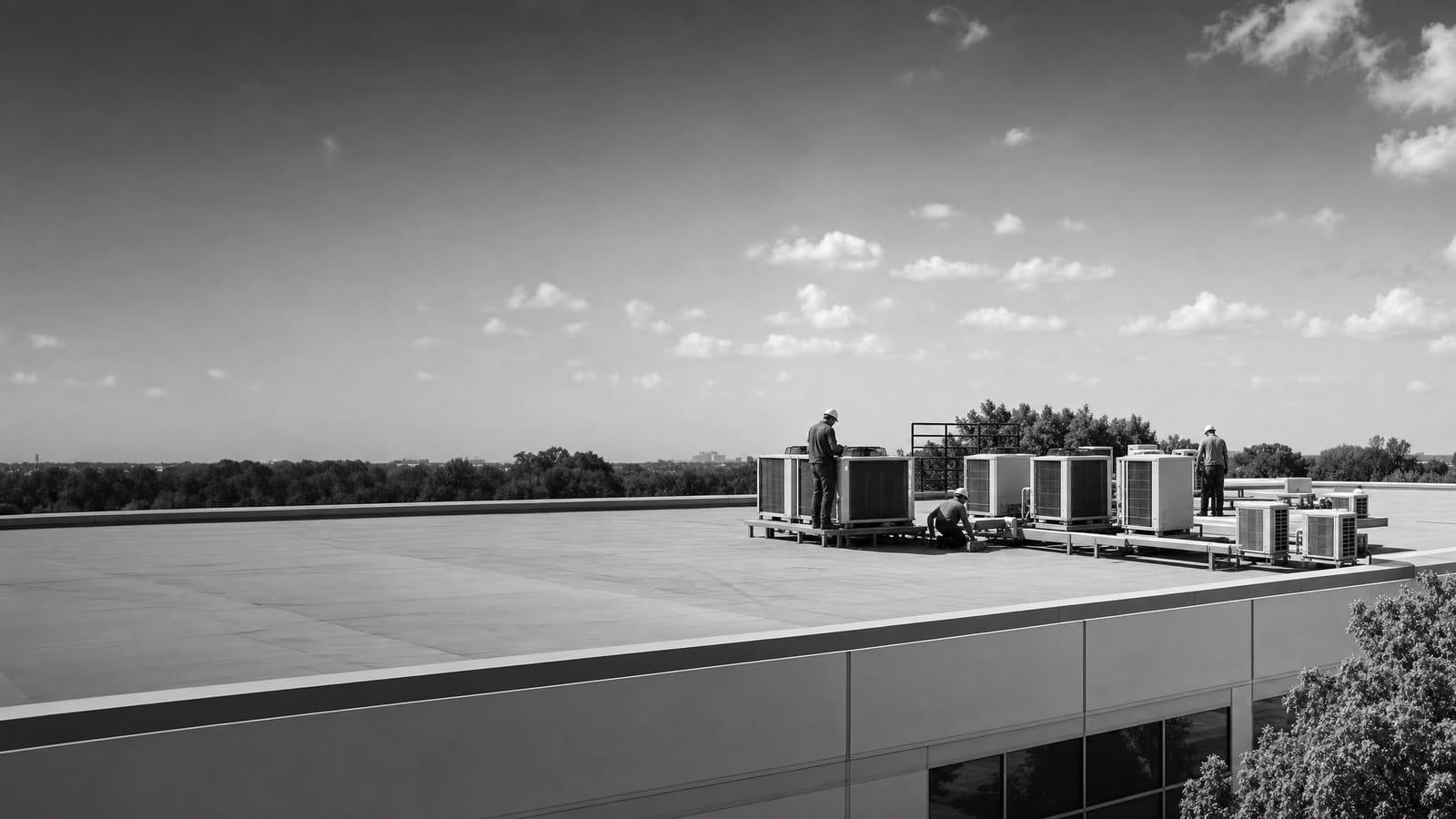
The visible part of a commercial HVAC replacement is one morning. A crane sets up, stalls get coned off, the old unit comes off the curb, and the new one lands on an adapter that was measured weeks earlier. Tenants notice the cones more than the outage.
Everything that makes that morning boring happens before it. The load gets confirmed against how the space is used now, not against a nameplate from twenty years ago — occupancy, plug loads, and lighting all changed since then. The curb is measured and the roof structure checked. Gas and electric are verified at the unit, not assumed from the drawings. Refrigerant comes out of the old unit under EPA Section 608 rules, which govern how refrigerant is handled and recovered in stationary air conditioning equipment. The rigging plan gets written, the lot closure gets scheduled with whoever runs the property, and someone makes a weather call the day before.
Then the part most buyers never see: commissioning. Charge, airflow, and control settings get verified against spec and written down. This is the step that separates a unit that turns on from a unit that performs. DOE's own rooftop work leaned on third-party verification for exactly this reason — measured performance in a real building, not a data sheet. Skip it and the comfort complaints arrive in month two, after the crane is long gone.
COMPLEXITY
Why one replacement takes two weeks and another takes two months
Two buildings with the same tonnage can be a short project or a long one. The difference is rarely the equipment itself. It is what the replacement touches on the way in — structure, power, fuel, and access.
LOWER COMPLEXITY
Same fuel, same footprint, open lot
The new unit matches the old one closely, the curb adapter is standard, and a crane can reach the roof from a parking area you control. Permits are usually mechanical and electrical, and the schedule is driven by equipment lead time rather than by construction.
HIGHER COMPLEXITY
Fuel switch, bigger unit, tight site
Going all-electric adds panel and feeder work that DOE lists as a gating item. A larger or heavier unit can trigger structural review. A tight site can mean a bigger crane, a street closure, or a night lift, and each of those adds cost and calendar.
BEFORE YOU BUY
What a site review has to settle first
A good scoping visit answers questions in a specific order, because the later answers depend on the earlier ones.
Start with the unit itself: age, tonnage, refrigerant, heating source, and honest condition. DOE notes that rooftop units over 15 years old can waste substantial energy and money compared with newer models, and that facility managers often wait until a unit fails completely before acting. Age alone is a legitimate reason to plan.
Next is load. What does this space actually do now? A retail bay converted to offices, a kitchen added, a warehouse racked to the ceiling — each one changes the answer, and none of them changed the nameplate.
Then infrastructure. DOE's heat pump guidance names electrical capacity, physical constraints, and gas lines as the three things that decide whether an electric unit is practical at a given roof. Panel space and feeder size are the usual surprise. Physical constraints mean curb size, roof structure, and clearances.
Last is operations. When can the building lose conditioning, and for how long? A clinic, a server closet, and a warehouse give three different answers, and that answer sets whether you need temporary cooling, a night lift, or nothing at all.
The visit should produce all four answers in writing, before anyone picks a model number.
The question that changes the whole plan
Ask what happens if the old unit dies before the new one arrives. If the answer is temporary cooling, that cost belongs in the plan now, not in an emergency call in July. Lead time is a risk you can price.
OWNERSHIP MATH
Two things that decide the real cost of the unit
The purchase price is the number you argue about. The operating cost is the number you actually pay.
DOE's rooftop work put hard figures on that gap. Old, inefficient units waste roughly $900 to $3,700 per unit each year. The high-efficiency specification DOE set with manufacturers targeted units that cut energy use by up to half against the standard of the time, and more than twenty models eventually exceeded it. Across DOE's rooftop campaign, more than 200 organizations upgraded over 43,000 units and cut a combined $37 million a year from their energy bills.
The second consideration is who holds the building and for how long. An owner-occupant with a fifteen-year horizon and a landlord with a lease turning over in three do not have the same math, even on the same roof. Neither answer is wrong. But the answer should be stated before the efficiency tier is picked, because that single choice is where the horizon shows up on the invoice.
OPERATING COST
Efficiency pays back in run hours
The waste on an old unit is measured yearly, so a building that runs long hours recovers a higher efficiency tier faster than one that runs part-time. Match the tier to your operating schedule, not to a brochure.
HOLD PERIOD
Own or lease changes the answer
If the building sells or the lease turns before payback lands, the base-tier unit can be the disciplined choice. If you are holding it, the cheap unit is the expensive one. Decide this before you compare quotes.
PHASING
Replacing a fleet without replacing it all at once
Buildings with more than one rooftop unit rarely replace them in a single purchase order, and they should not. A staged plan spreads capital, keeps the building conditioned, and lets each swap teach you something about the next one.
The workable version is simple. Rank the units by age, run hours, and failure history. Replace the worst one first and treat it as the pilot: confirm the curb adapter approach, the crane setup, the controls integration, and how long the lot actually needs to close. The second unit costs less to plan, and the third is close to routine.
Procurement is where the schedule lives. Equipment availability is a real constraint, and DOE lists it among the considerations that decide whether a given technology is practical at a site at all. Ask for the lead time in writing next to the price, and ask what the alternate model is if the first choice slips. A quote with a model number and no availability date is half a quote.
One planning note for mixed fleets. As units get replaced one at a time, your roof ends up holding more than one generation of equipment. EPA Section 608 governs how refrigerant is handled and recovered in stationary air conditioning and heat pump equipment, and that work belongs with certified technicians on every removal. It changes nothing about day-one operation. It does change what your service contract has to cover, so raise it while you are still phasing.
APPLES TO APPLES
Five things a comparable quote shows
Two proposals for the same roof can differ by a wide margin and both be honest, because they are not scoping the same work. Before you compare price, make sure both quotes show these five items. If one is missing a line, it is not cheaper — it is incomplete.
01
Model number, tonnage, and efficiency tier
Not "a 10-ton unit." The actual model, so two proposals can be judged on the same equipment.
02
Lead time and a named alternate
The availability date next to the price, plus what gets substituted if the first choice slips.
03
Curb, structural, and connection scope
Adapter or new curb, any framing, and every gas, electrical, and refrigerant change on the way in.
04
Crane, permits, and lot closure
Who owns the rigging plan, who pulls the permits, and how many stalls close for how long.
05
Commissioning and closeout documents
Charge, airflow, and control settings verified against spec, documented, and handed to you at the end.
Get a defensible number
Price the equipment and the building together.
Send the address, operating target, and target opening date. Flux will identify what must be verified before the project can be priced.
Get a free estimateQuestions
Straight answers.
When is replacing a rooftop unit better than one more repair?
When the repairs keep repeating and the unit is past its useful service life. DOE notes that rooftop units over 15 years old can waste substantial energy and money compared with newer models, and that owners often delay until a unit fails completely. Replacing on your schedule almost always costs less than replacing during a heat wave.
How much does a commercial HVAC installation cost?
There is no honest universal number, because the price is built from tonnage, efficiency tier, curb and structural work, electrical scope, and crane access. You get a real per-unit installed price after someone looks at the roof. What DOE can tell you is the other side of the ledger: an old, inefficient unit wastes roughly $900 to $3,700 a year in energy on its own.
Is a heat pump rooftop unit a real option in Texas?
DOE calls heat pump rooftop units an appropriate solution across most of the U.S. South and West, capable of covering most or all of the winter heating demand. It also notes that southern climates can still see sharp winter heating demand, pointing to the February 2021 Texas freeze. That is the argument for confirming backup heat rather than assuming it.
What has to be checked before switching a gas unit to electric?
DOE's heat pump guidance names electrical capacity, physical constraints, and gas lines as the deciding items. Panel and feeder capacity is the usual surprise, and curb size and roof structure are close behind. Check all of it before the equipment order, not after it lands.
Who handles the crane, the permits, and the old refrigerant?
The installing contractor should own the rigging plan, lot coordination, permits, and inspections inside the installed price. Refrigerant recovery from the old unit falls under EPA Section 608 rules for stationary equipment and belongs with certified technicians. Confirm all of that in writing before you sign.
Sources used for this guide
- [1]betterbuildingssolutioncenter.energy.gov — DOE Advanced Rooftop Unit Replacement Guidance
- [2]betterbuildingssolutioncenter.energy.gov — DOE Commercial Heat Pump Rooftop Unit Replacement Guidance
- [3]betterbuildingssolutioncenter.energy.gov — DOE High-Efficiency Commercial Rooftop Unit Toolkit
- [4]energy.gov — DOE Efficient Commercial Rooftop Air Conditioner Program
- [5]epa.gov — EPA Stationary HVAC Refrigerant Management