THE DIRECT ANSWER
Commercial HVAC replacement and installation in Gastonia.
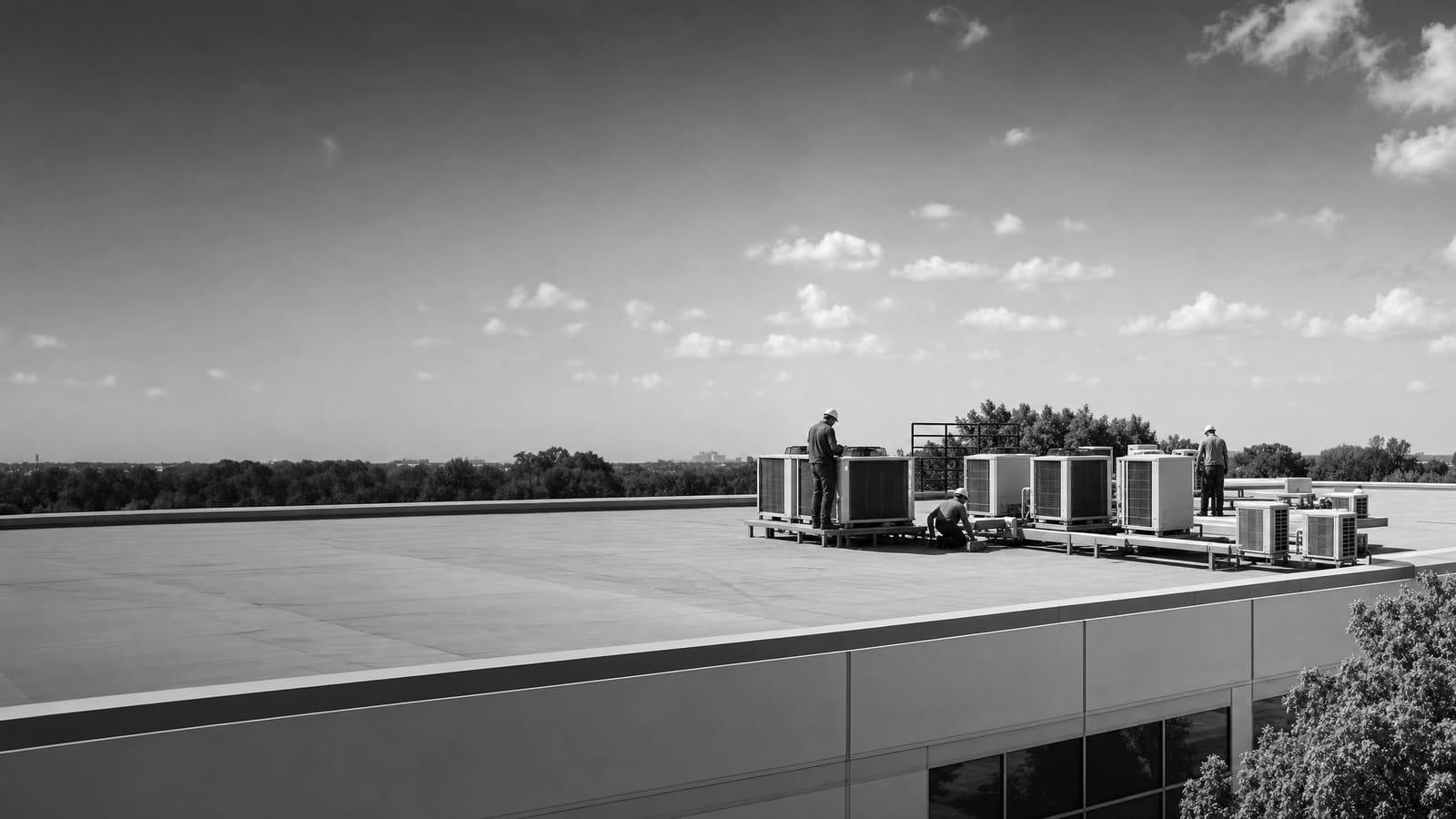
A commercial HVAC replacement includes sizing, equipment selection, removal, rigging, connections, controls, startup, and performance checks. Replacement becomes more useful than another repair when an aging unit needs frequent service, cannot hold the space conditions, or puts operations at risk. DOE guidance says rooftop units over 15 years old can waste substantial energy compared with newer models.
A site review must confirm the load, roof and curb condition, power, fuel, ventilation, controls, access, and shutdown limits before pricing.
THREE OPERATING CHOICES
Choose the project path before choosing a model
Start with the business problem. A failed unit may call for the fastest sound replacement. A working but unreliable unit gives you time to compare efficiency, heating type, and controls. A changed space may need a fresh load review instead of a copy of the old nameplate.
DOE notes that owners often delay rooftop-unit replacement until comfort falls, repairs become frequent, or equipment fails. Planned replacement gives the team more control over equipment availability, shutdown timing, and design. It also creates room to compare a conventional rooftop unit with heat-pump options. That choice should account for heating demand, electricity and gas costs, electrical capacity, physical limits, gas service, equipment availability, and contractor knowledge. The right path protects operations first and then weighs energy, maintenance, and ownership goals.
BUDGET STRUCTURE
What moves the installed price
No supplied evidence supports one universal installed price. Ask bidders to separate equipment from the work needed to place it, connect it, control it, and prove that it operates correctly.
EQUIPMENT SELECTION
Do not copy the old nameplate without checking the load
A like-for-like replacement can be sensible when the old system served the space well and the building has not changed. It can reduce redesign work and may simplify connections. It can also repeat an old sizing error. Oversized equipment may cycle poorly, while undersized equipment may struggle during heavy demand. Neither problem is fixed by choosing a newer box with the same capacity.
Review the present occupancy, hours, ventilation needs, internal heat, envelope, zoning, and comfort history. Include planned changes, not just today’s conditions. Then match the equipment to the load and operating pattern. For several units, decide whether every unit should be replaced together or whether condition and service history support phases.
Efficiency matters, but the published rating is not the whole decision. Controls, airflow, ventilation, maintenance access, and actual run time shape performance after installation. Ask the bidder to explain why the proposed capacity and configuration fit the space. A clear selection basis makes competing quotes easier to compare and gives the commissioning team a target to verify.
SCOPE COMPLEXITY
A simple swap and a system change are different projects
Two quotes can name similar equipment yet cover very different work. Sort the job by physical and operational complexity before comparing the bottom lines.
LOWER COMPLEXITY
Compatible replacement
The selected unit fits the existing location, and the curb, duct path, utilities, controls, and access need limited change. The quote should still include removal, connections, startup, testing, and disposal.
HIGHER COMPLEXITY
Changed system
Capacity, dimensions, heating source, electrical demand, ventilation, controls, or equipment location changes. This path needs more field verification, coordination, design decisions, and a clearer outage plan.
SITE REVIEW
Turn the walkthrough into a complete scope
Begin indoors. Record comfort complaints, operating hours, sensitive rooms, tenant needs, and areas that cannot lose conditioning. Review service records for recurring faults rather than treating each repair as a separate event. Confirm which unit serves each zone and whether thermostats, sensors, dampers, and controls work as intended.
At the equipment, document the model, condition, capacity, heating type, electrical data, curb or pad, ducts, drains, filters, outdoor-air path, and service clearances. The team should also trace power, gas where used, control wiring, and any building-automation connection. Roof access, staging space, lifting reach, pedestrian routes, vehicles, and occupied areas belong in the same survey.
For heat-pump rooftop units, DOE guidance adds several decision points: geography, utility-bill effects, emissions goals, building type, equipment availability, electrical capacity, physical constraints, gas lines, and contractor experience. This does not mean every facility should convert. It means the quote should show which conditions were checked and what supporting work the option requires.
Bring useful records
Provide equipment schedules, service history, utility data, operating hours, comfort complaints, controls information, and known building changes. Better inputs reduce allowances and late scope changes.
HEATING OPTIONS
Compare conventional and heat-pump rooftop units on the same basis
Commercial heat-pump rooftop units cool like conventional rooftop air conditioners and also provide reverse-cycle heating. DOE says they can suit mild-to-moderate winter heating, but the decision remains specific to the building and location. Heating load, utility rates, electrical capacity, backup heat, gas infrastructure, emissions goals, equipment availability, and service support all matter.
Do not compare only purchase prices. Ask for the full electrical and mechanical scope, expected control sequence, backup-heating approach, and assumptions used to discuss operating cost. If an electric option needs capacity upgrades or other infrastructure work, that work belongs in the proposal. If retaining gas better fits the facility, the quote should state that basis as clearly.
CONVENTIONAL PATH
Air conditioning with separate fuel heat
This may align with existing gas service and electrical capacity. Check combustion-related components, ventilation, controls, and the condition of every connection being retained.
ELECTRIC PATH
Heat-pump rooftop unit
This can support electrification goals, but requires a review of heating performance, electrical demand, backup heat, utility impacts, physical fit, and local service capability.
PROJECT DELIVERY
Plan the outage, lift, startup, and handoff as one job
The installation plan should work backward from the approved shutdown window. Confirm that equipment and required accessories are available before promising a date. Coordinate roof access, lifting, staging, occupied areas, deliveries, weather decisions, and temporary conditioning where the business cannot tolerate a full outage. For a multi-unit property, phasing can limit disruption and spread spending, but it may also create a mixed fleet with different controls, parts, refrigerants, and maintenance needs.
Removal and setting are only the visible middle of the project. Connections must be completed, ducts and curbs sealed, drains tested, filters installed, controls programmed, and safety devices checked. The system then needs startup and commissioning. That work should confirm airflow, temperatures, operating modes, ventilation, sensors, alarms, and control sequences against the approved design.
Handoff should include equipment data, warranties, startup reports, settings, control information, maintenance requirements, and staff instruction. EPA refrigerant rules address handling and recycling for stationary air-conditioning and heat-pump equipment. The proposal should assign refrigerant recovery, documentation, and lawful disposal rather than leaving those duties unclear.
OWNERSHIP COST
Judge the replacement over its working life
The lowest bid can cost more if it omits controls, curb work, electrical changes, commissioning, or disposal. Compare the same scope first. Then consider energy use, expected maintenance, filter and belt access, warranty terms, parts support, staff familiarity, and the effect of downtime. DOE has documented meaningful energy waste from older commercial rooftop units and has shown that high-efficiency units can reduce energy use in real buildings. Those findings support careful evaluation, but they do not guarantee a specific saving for one Gastonia property.
For a fleet, standardization can simplify parts, training, controls, and service. Selective replacement can preserve capital when some units remain dependable. Use condition, failure history, criticality, and operating cost to rank units for future work. Record the reason for each choice so the next project does not start from zero.
Treat incentives as time-sensitive. None of the supplied research confirms a current Gastonia program for August 2026, so do not include an incentive in the project budget until its eligibility, funding, deadline, and application timing are verified.
QUOTE CHECKLIST
Five things every comparable proposal should show
Put each bid into the same five-part format. Missing detail should become a written question before award, not a surprise during installation.
01
Selection basis
List capacity, configuration, efficiency, heating type, ventilation, controls, and the load assumptions behind the choice.
02
Complete installed scope
Define removal, rigging, curb or pad, ducts, drains, power, fuel, controls, accessories, disposal, and repairs.
03
Schedule and outage plan
State equipment availability, project sequence, shutdown needs, access limits, phasing, and responsibility for coordination.
04
Testing and closeout
Include startup, commissioning checks, reports, training, warranties, operating data, and required handoff documents.
05
Price boundaries
Separate base scope, options, allowances, exclusions, change-order triggers, payment terms, and quote validity.
Get a defensible number
Price the equipment and the building together.
Send the address, operating target, and target opening date. Flux will identify what must be verified before the project can be priced.
Get a free estimateQuestions
Straight answers.
When is replacement better than another commercial HVAC repair?
Replacement deserves serious review when an older unit needs frequent repairs, no longer maintains the required space conditions, uses excessive energy, or creates unacceptable failure risk. DOE guidance identifies inadequate conditioning, frequent maintenance, and complete failure as common points that drive replacement. Compare the next repair with remaining service risk, not only with the price of new equipment.
Should a commercial rooftop unit be replaced like-for-like?
Only after the present load and use are checked. Like-for-like can work when the old unit performed well and occupancy, hours, layout, ventilation, and internal loads remain similar. If the space changed or comfort was poor, copying the old capacity may preserve the same problem. Ask the bidder to state the sizing basis.
What should a commercial HVAC installation quote include?
It should identify the exact equipment and cover removal, rigging, curb or pad work, ducts, drains, electrical work, fuel connections where used, controls, ventilation accessories, startup, commissioning, refrigerant recovery, disposal, warranty, schedule, exclusions, and change-order rules. It should also assign responsibility for coordination and closeout documents.
Is a commercial heat-pump rooftop unit worth considering?
Yes, as an option to evaluate rather than an automatic answer. DOE guidance says the decision should consider heating needs, utility costs, emissions goals, electrical capacity, physical constraints, gas infrastructure, equipment availability, and contractor experience. Compare it with a conventional option using the same load, scope, operating assumptions, and ownership period.
How much does commercial HVAC replacement cost in Gastonia?
The supplied research does not establish a reliable local installed-price range, so a universal number would be misleading. Price depends on capacity, configuration, access, rigging, curb or structural work, utilities, ducts, controls, ventilation, and commissioning. A useful budget comes from a site-based scope with equipment and supporting work shown separately.
Can a commercial HVAC replacement be phased?
Yes. Phasing can reduce one-time disruption and focus spending on the least reliable or most critical units. It can also leave the owner with mixed equipment, controls, refrigerants, parts, and maintenance needs. Build the phase order from condition, service history, operational importance, and access—not age alone.
What should happen during commissioning?
The team should verify that the installed system matches the approved selection and operates through its required modes. Checks should cover airflow, temperatures, ventilation, sensors, alarms, drainage, safety devices, and control sequences. The owner should receive the results, final settings, warranty information, and maintenance requirements.
Are incentives available for a Gastonia commercial HVAC project in August 2026?
No current local incentive is confirmed by the supplied research. Treat any rebate, tax benefit, or utility offer as unverified until the program administrator confirms eligibility, funding, application timing, equipment requirements, and the August 2026 deadline. Do not count it in the approved budget before that confirmation.
Sources used for this guide
- [1]betterbuildingssolutioncenter.energy.gov — DOE Advanced Rooftop Unit Replacement Guidance
- [2]betterbuildingssolutioncenter.energy.gov — DOE Commercial Heat Pump Rooftop Unit Replacement Guidance
- [3]betterbuildingssolutioncenter.energy.gov — DOE High-Efficiency Commercial Rooftop Unit Toolkit
- [4]energy.gov — DOE Efficient Commercial Rooftop Air Conditioner Program
- [5]epa.gov — EPA Stationary HVAC Refrigerant Management