THE DIRECT ANSWER
What a commercial HVAC replacement actually includes
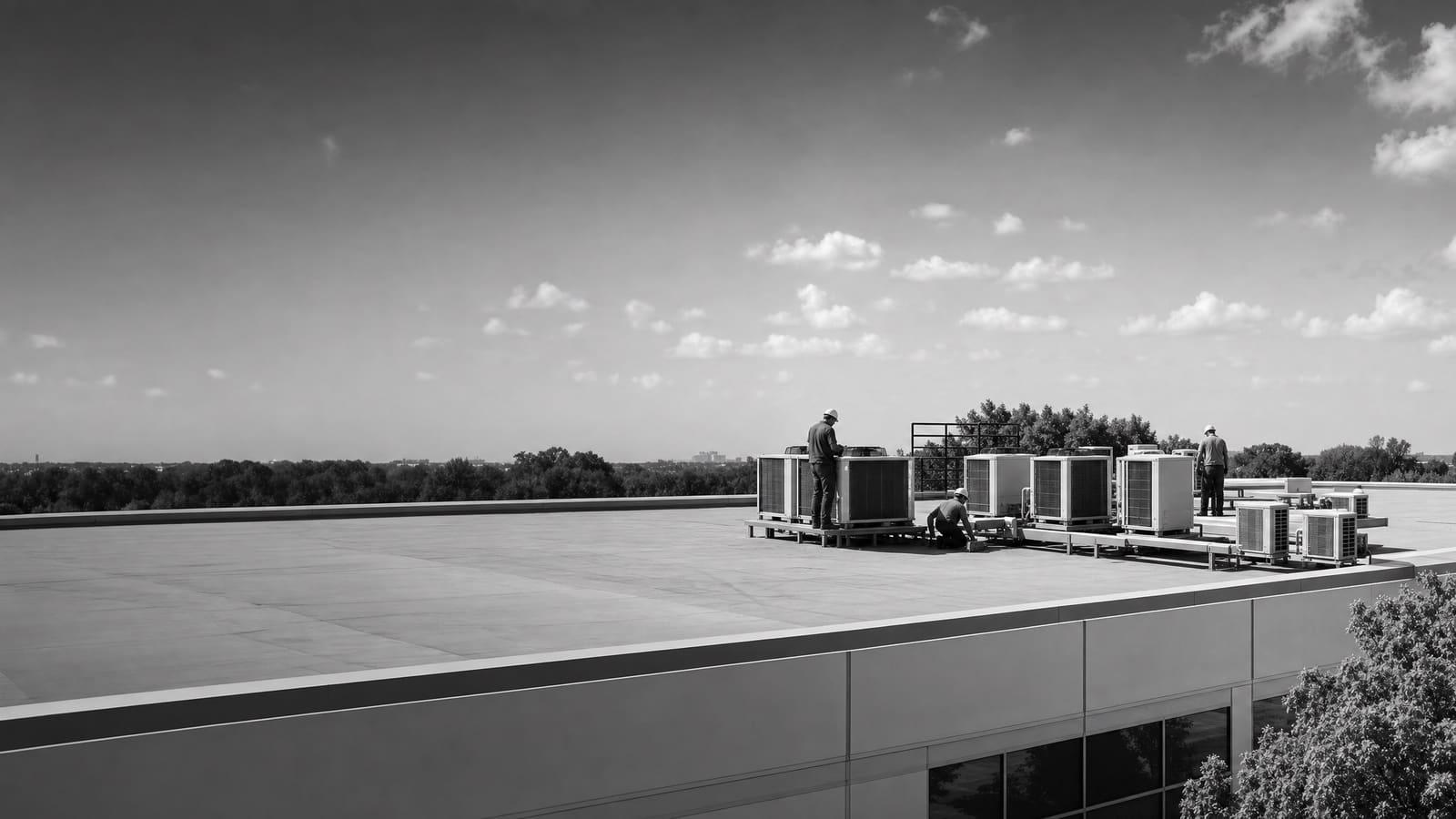
A commercial HVAC replacement covers a confirmed load calculation, equipment selection with a real delivery date, removal of the old unit with its refrigerant recovered, rigging and setting the new one, electrical, gas, and duct connections, permitting, controls, and commissioning. Replacement earns its price over another repair once a unit is past fifteen years and failing in season. Federal analysis puts the annual penalty on an old, inefficient rooftop unit at $900 to $3,700 each.
A site review still has to verify the actual load, the curb and roof deck, available electrical capacity, crane access to the roof, and whether existing gas service stays or goes. Those five items decide the real scope.
THREE WAYS TO GO
Three replacement paths for an aging rooftop unit
Three paths cover almost every commercial replacement, and the right one depends on how much the building has changed since the last install.
Like-for-like is the fastest way back to conditioned space. It also carries forward the original sizing, including any mistake in it.
A high-efficiency upgrade keeps the same footprint and moves up a tier. Federal work with manufacturers produced a challenge specification aimed at units that cut energy use by up to half against the standard of that time, and a minimum efficiency standard finalized in 2015 later raised the floor for everything sold.
A heat pump conversion replaces gas heat with reverse-cycle heating. Federal guidance treats today's heat pump rooftop units as appropriate for most of the South, where they can handle most or all of the winter heating demand. That decision turns on electrical capacity and on what happens to the gas line.
WHAT MOVES THE NUMBER
Budget lines that swing a rooftop replacement
Equipment is rarely the line that surprises anyone. The surprises live in access, structure, and infrastructure — the parts of the job that depend on your specific roof and lot rather than on the model number. Here is where a replacement budget actually moves.
HOW TO BUY IT
Buying the replacement instead of buying the emergency
The difference between a good replacement and an expensive one usually shows up months before the crane arrives.
Start with the load, not the nameplate. A unit installed fifteen or twenty years ago was sized for the occupancy, plug load, and envelope of that year. Offices got denser, then emptier. Kitchens added equipment. Retail changed its hours. Sizing from the old data plate copies a decision nobody has checked in two decades, and an oversized unit short-cycles, controls humidity poorly, and wears itself out early.
Then buy availability alongside price. A selection is only real if the unit can be delivered on a date you can plan around. A quote that names the model but not the lead time is half a quote, and in season that missing half is what leaves a building warm for weeks.
Last, decide the fuel question on purpose rather than by default. If the existing unit heats with gas, the replacement is a fork: stay with gas, go dual fuel, or go all-electric. Federal guidance points at electrical capacity, physical constraints on the roof, and the fate of the gas line as the three things that settle it.
SIMPLE VS COMPLICATED
What makes a swap straightforward, or not
Two roofs carrying the same tonnage can price very differently, and the gap is almost never the equipment. It is access, structure, and how much of the existing infrastructure the new unit can reuse.
LOWER COMPLEXITY
Straightforward swap
Same tonnage and same fuel, an existing curb that fits or takes a standard adapter, a sound roof deck, and a lot where the crane can set up without closing everything. Electrical and gas stay where they are.
HIGHER COMPLEXITY
Engineered replacement
Capacity or footprint changes, the deck needs a structural review, panel capacity is short for an all-electric unit, the lift has to reach over occupied space, or controls must integrate with an existing building automation system.
THE SITE REVIEW
What a scoping visit has to settle before pricing
Pricing a replacement without a site visit is guessing with confidence. A scoping visit exists to answer a short list of questions that each carry real money.
The first is capacity. What does the space need now, and does that answer change the unit size? The second is the curb and the deck. Will the new unit land on what is already there, does it need an adapter, and can the structure carry it? The third is infrastructure. Federal heat pump guidance is blunt about this: electrical capacity, physical constraints, and gas lines are what determine whether a fuel change is a simple selection or a separate project with its own budget.
The fourth is access. Where does the crane set up, how far does it reach, which stalls close, and for how long? On a tight lot, that answer can cost more than an efficiency upgrade.
The fifth is what the removal drags along with it. Federal refrigerant rules govern how the charge in the old unit is recovered and handled, and that work belongs in the written scope rather than in an assumption about who takes care of it.
Bring these to the walk
Nameplate photo, the roof access route, a panel schedule or photo of the electrical service, recent utility bills, and the hours the building cannot lose cooling. Those five inputs turn a rough number into a quotable one.
IN GAINESVILLE
Florida permitting and a mild winter change the sequence
Two local realities shape a Gainesville replacement before anyone talks price.
The first is permitting. Florida commercial alteration packages call for mechanical plans whenever the scope includes installing or relocating HVAC equipment, and those plans must be signed and sealed by a Florida-licensed architect or engineer. Energy calculations are required any time the work touches heating, ventilation, or air conditioning, and the drawings have to show equipment location. That is design time and review time sitting ahead of the crane date, not paperwork that runs alongside it. Requirements vary by jurisdiction, so confirm the submittal list with the local building department before the schedule is set.
The second is climate. North Florida winters are mild, and federal guidance treats heat pump rooftop units as capable of most or all of the winter heating demand across the South. Here, all-electric is a genuine option rather than a compromise.
Confirm before the crane is booked
Ask who is sealing the mechanical drawings, when the energy calculations will be finished, and how many business days review usually takes. Those three answers set the earliest honest install date you have.
OWNERSHIP QUESTIONS
Two decisions that outlast the install
Most rooftop units get replaced on failure, in season, at whatever price and availability the moment allows. Federal guidance is direct that proactively replacing an inefficient, underperforming unit is often the better business decision than waiting for it to quit, and often better than a reflexive like-for-like swap at the end of its service life.
The second decision is about your fleet. A roof with six units rarely replaces all six at once, which means running mixed vintages and, increasingly, mixed refrigerants. That is manageable. It should be a plan rather than something the service contractor discovers in July.
TIMING
Planned beats replace-on-failure
A planned swap lets you compete the price, choose the efficiency tier, and pick a week the building can absorb. An emergency swap takes whatever is available at whatever the market is charging that month.
SERVICE
Refrigerant and the years after
New equipment ships on newer refrigerants. Federal rules govern recovery and handling on the unit coming off, and your service contract and spare-parts strategy should reflect a roof that now runs two generations at once.
PHASING AND LIFETIME COST
Replacing a roof full of units without shutting anything down
Buildings with several rooftop units rarely need them all at once, and treating the roof as one program instead of a series of emergencies changes the economics.
Start by ranking the units by age and by what each one is costing you to run, not by which one generated the loudest complaint last summer. Rooftop equipment past fifteen years is where the waste concentrates, and that is also where an upgrade returns the most. Replace in that order and the savings from the first unit help fund the second.
Then group the work. One mobilization, one permit package, and one crane day covering two or three units costs less per unit than three separate visits spread across three seasons. It also gives you a single commissioning pass and a single set of documentation instead of three partial ones.
Finally, judge the lifetime cost rather than the install line. The cheapest unit on the roof today is often the one you keep paying for every month afterward. Incentive programs sometimes close the gap between a baseline unit and a high-efficiency one, but what is open changes year to year. Confirm what is actually available right now, and treat anything unconfirmed as zero in the budget.
APPLES TO APPLES
Five things a comparable quote shows
Two quotes for the same roof can differ by a wide margin and still both be honest. The way to tell them apart is whether each one shows its work. Ask that every bid include these five, in writing.
01
Unit, tonnage, and efficiency tier
The specific model, its capacity, and the efficiency level, so you are comparing equipment instead of brands.
02
Equipment lead time
A delivery window next to the price. Availability is part of the offer, not a detail to sort out after signing.
03
Curb, structure, and rigging
Whether a curb adapter is included, any deck work, and who owns the crane, the lift plan, and the lot closure.
04
Permits, sealed drawings, and energy calculations
Named as line items, with who prepares them, who submits and pays, and who meets the inspector.
05
Commissioning and documentation
Startup, refrigerant charge, airflow, and control settings verified against spec and handed over in writing for the warranty file.
Get a defensible number
Price the equipment and the building together.
Send the address, operating target, and target opening date. Flux will identify what must be verified before the project can be priced.
Get a free estimateQuestions
Straight answers.
When does replacement beat another repair?
Age and repair frequency together make the call. Rooftop units past fifteen years waste substantial energy compared with current equipment, and once a unit needs frequent service or can no longer hold the space, repair money stops buying anything back. Waiting for total failure removes your choice of timing, price, and equipment.
Should the new unit match the old one's size?
Confirm the load either way. If the space and how it is used have not changed, like-for-like is often correct and it is the fastest path back. If occupancy, equipment, or hours changed, right-sizing fixes comfort problems the old unit was never able to solve.
Does a heat pump make sense in North Florida?
Often, yes. Federal guidance treats today's heat pump rooftop units as appropriate across the South, where they can meet most or all of the winter heating demand. The real gate is infrastructure: available electrical capacity, physical room on the roof, and what happens to the existing gas line.
Who handles the crane, permits, and inspections?
The installing contractor should own the rigging plan, the lot coordination, the permit package, and the inspections as part of the installed price. In Florida that also means sealed mechanical drawings and energy calculations. Make sure the quote says who prepares and pays for each before you sign.
What does a commercial HVAC installation cost?
The number comes from tonnage and efficiency tier, curb and structural work, crane access, and any electrical or gas changes the new unit triggers, plus engineering and permit fees. A price given before someone has looked at the roof and the lot is a guess. Ask for the line items, not a single figure.
Sources used for this guide
- [1]betterbuildingssolutioncenter.energy.gov — DOE Advanced Rooftop Unit Replacement Guidance
- [2]betterbuildingssolutioncenter.energy.gov — DOE Commercial Heat Pump Rooftop Unit Replacement Guidance
- [3]betterbuildingssolutioncenter.energy.gov — DOE High-Efficiency Commercial Rooftop Unit Toolkit
- [4]energy.gov — DOE Efficient Commercial Rooftop Air Conditioner Program
- [5]epa.gov — EPA Stationary HVAC Refrigerant Management
- [6]tampa.gov — Permit Application Guide Commercial Alteration