THE DIRECT ANSWER
What a commercial HVAC replacement actually includes
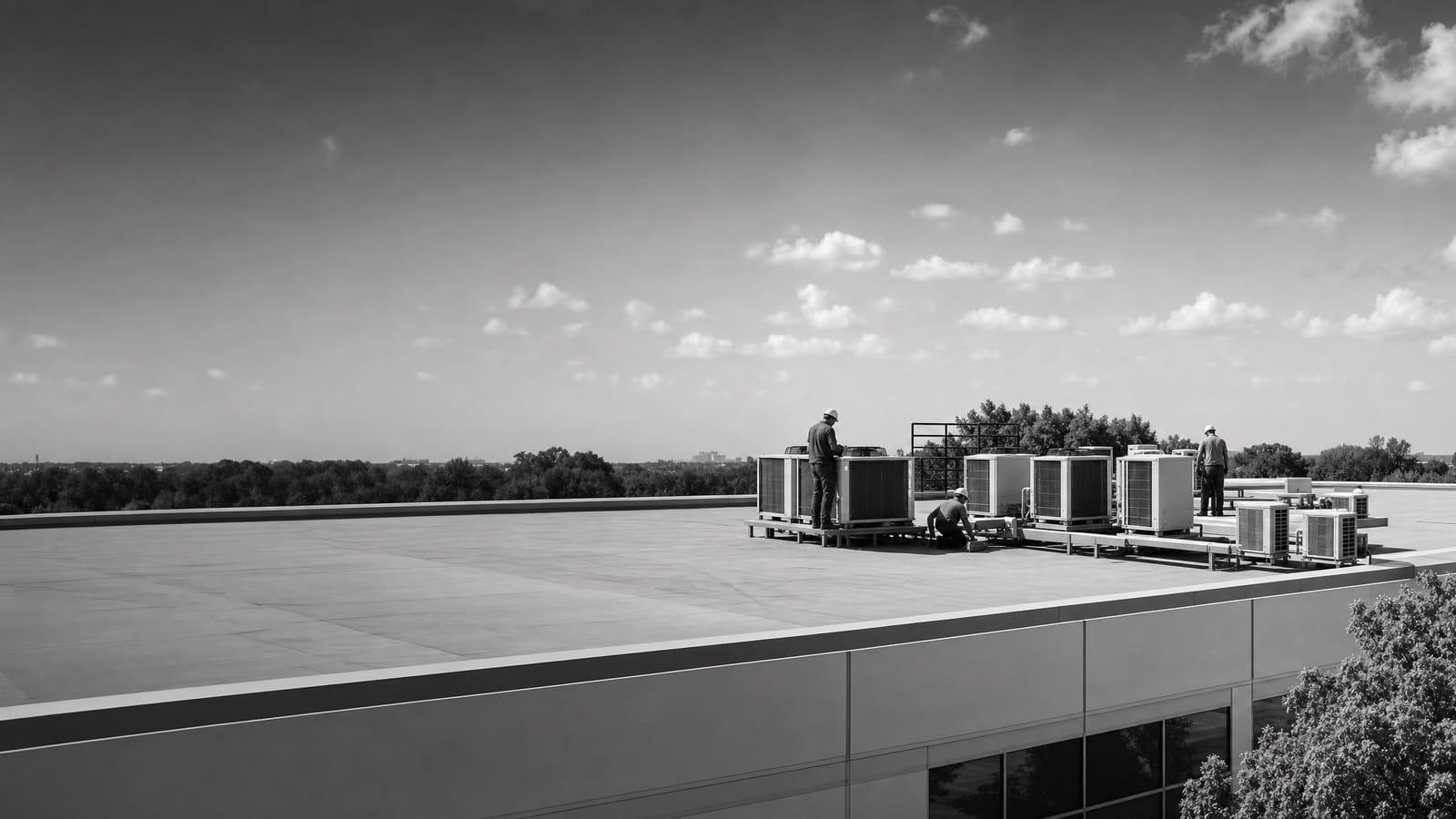
A commercial HVAC replacement covers load verification, equipment selection against real lead times, rigging and set, mechanical and electrical connection, certified refrigerant recovery, controls integration, and documented commissioning. Replacement beats another repair once a unit is past about fifteen years and the service calls keep repeating. DOE puts the annual waste from an old, inefficient rooftop unit at roughly $900 to $3,700 per unit — a cost the repair invoice never shows you.
A site review still has to confirm the real load, the curb and roof structure, crane access across the lot, and available electrical capacity before any of that becomes a firm installed price.
THE MAIN DECISION
Three ways to replace a rooftop unit
Almost every commercial rooftop replacement lands on one of three answers, and the right one depends on what you are willing to verify before you buy. DOE counts rooftop units as conditioning nearly half of all commercial floor area in the country, so this same decision repeats across most buildings.
Like-for-like is the default when the space still does what it did when the old unit went in. High efficiency is the default when the unit runs long hours, because the DOE High-Performance Rooftop Unit Challenge set a specification targeting up to fifty percent less energy than the older standard, and more than twenty models now exceed it.
Heat pump rooftop units are the newer question. They are built much like an air-conditioning unit but add reverse-cycle heating, so electric heat replaces gas heat. DOE's guidance treats most of the South and West as appropriate territory for them today. The catch is infrastructure: electrical capacity, physical constraints on the roof, and what happens to the existing gas line.
WHAT MOVES THE NUMBER
The lines that decide your installed price
Nobody can quote a rooftop replacement from a nameplate photo alone, but the lines that move the price are predictable. Ask for these priced separately so you can see what you are actually paying for and where two bids really differ.
IN PRACTICE
Planned replacement buys you options that failure never does
The most expensive version of this project is the one nobody planned. DOE's framing is blunt about it: facility teams tend to wait until a unit stops holding the space, needs constant service calls, or fails completely — and replacement on failure is usually the worst deal available. You buy whatever is available, at whatever the season's price is, on whatever week a crane can get to you.
Planned replacement changes three things. You compare equipment tiers instead of taking the only unit in stock. You run the load against how the building is used today rather than what the nameplate assumed twenty years ago. And you set the unit around your operating hours instead of around the failure.
Contractor availability is part of the equipment decision, not separate from it. DOE lists it as a live consideration for heat pump rooftop units specifically, because reverse-cycle equipment, its controls, and its backup heat strategy are not identical to a gas-heat unit at startup or in year four. If you are switching fuel, ask who commissions it and who services it. A vague answer tells you something useful about the bid.
SIDE BY SIDE
Simple swap or a real project
Two replacements with the same tonnage can be very different jobs. What separates them is almost never the equipment itself.
LOWER COMPLEXITY
Same fuel, same footprint
The new unit matches the old one on fuel type and curb footprint, the roof structure is sound, the lot gives a crane clear reach, and the existing electrical service already carries the load. Most of the remaining work is scheduling.
HIGHER COMPLEXITY
Fuel switch or added capacity
Going all-electric, adding tonnage, or landing on a curb that no longer matches. DOE names electrical capacity, physical roof constraints, and gas line disposition as the items that most often stall a heat pump conversion after the order is placed.
SCOPING THE WORK
What the site review has to settle before you order
A useful site review answers questions that cannot be fixed later without paying twice. The first is load. Sizing from the old nameplate assumes nothing about the building changed, and over fifteen or twenty years occupancy, plug loads, lighting, and tenant use usually did. Confirming the load is what separates a replacement that fixes comfort complaints from one that reproduces them.
The second is the physical envelope of the work: curb condition and match, roof structure under the new weight, clear crane reach, and where the unit's connections land. DOE groups these as physical constraints and treats them as a gate on equipment selection, not a detail to sort out on install day.
The third is service capacity. If a heat pump rooftop unit is on the table, the panel, feeder, and available capacity decide whether all-electric is realistic, whether a dual-fuel unit is the better answer, or whether the existing gas heat should stay. That question is cheap to answer during scoping and expensive to answer after delivery.
Ask for these three answers in writing
The load basis used for sizing, the curb and structural finding, and the confirmed electrical capacity for the unit selected. If a bid skips any of them, it is an estimate of a project nobody has looked at yet.
OWNERSHIP CONSIDERATIONS
Two things that follow the unit for its whole life
The install is one morning. The consequences of what you bought stay on the roof for the next fifteen to twenty years, and two of them are worth settling before signing rather than after.
Refrigerant handling is a compliance question with an owner on the hook, and incentives are a real part of the equipment ranking — but only the ones you can confirm are currently open. An incentive that closed is history, not budget.
COMPLIANCE
Refrigerant is regulated, not incidental
EPA rules under Section 608 of the Clean Air Act govern the handling and recycling of refrigerants in stationary air-conditioning and heat pump equipment. Recovery at removal and certified handling on the new unit belong in the scope and on the invoice.
FINANCING
Confirm incentives before you budget them
DOE lists incentives among the deciding factors for heat pump rooftop adoption, and they can change which tier wins. Verify that a program is open and that your equipment qualifies before the savings go into the project budget.
LOOKING AHEAD
Phasing a fleet instead of replacing one unit at a time
If your building carries more than one rooftop unit, the better question is not which unit to replace this year but what order to replace them all in. The DOE Advanced RTU Campaign gives a sense of the scale that approach reaches: more than two hundred organizations upgraded over forty-three thousand rooftop units, and those upgrades save a combined thirty-seven million dollars a year on energy bills. Those savings came from treating replacement as a program, not as a series of emergencies.
Phasing gives you leverage. You can standardize on one manufacturer and one control platform so service and spare parts get simpler. You can put the oldest and hardest-working units first, since those are the ones burning the most money. And you can spread capital across budget years while the failure risk drops each time a unit comes off the list.
It also makes the equipment decision easier to revisit. Replacing on failure locks in whatever is on the shelf that week. Replacing on a schedule lets you take a high-efficiency or heat pump unit where the site supports it, and stay like-for-like where it does not, without pretending one answer fits every roof you own.
BEFORE YOU SIGN
Five things a comparable quote should show
Two bids are only comparable when both spell out the same five things. If one leaves a line blank, that is where the difference in price is hiding.
01
Equipment and efficiency tier
Make, model, tonnage, heating type, and efficiency tier — plus current lead time, stated next to the price.
02
The load basis for sizing
Whether the size came from a calculation against today's use or was carried over from the old nameplate.
03
Curb, structural, and rigging scope
Curb adapter, any roof structural work, crane plan, and who owns lot closures on set day.
04
Electrical, gas, and controls scope
Service changes, gas line disposition, and how the unit ties into existing building controls.
05
Refrigerant handling and commissioning
Certified recovery on the old unit, and startup, charge, airflow, and controls verified and documented before handoff.
Get a defensible number
Price the equipment and the building together.
Send the address, operating target, and target opening date. Flux will identify what must be verified before the project can be priced.
Get a free estimateQuestions
Straight answers.
When is replacement smarter than another repair?
Once a unit is past about fifteen years and the failures keep repeating. DOE notes that rooftop units older than fifteen years can waste substantial energy compared with current models, on the order of $900 to $3,700 per unit each year. That waste does not appear on any repair invoice, which is why repeat repairs feel cheaper than they are.
How much does a commercial HVAC replacement cost?
There is no honest universal number, because tonnage, efficiency tier, curb and structural work, crane access, and electrical scope each move the total independently. Ask for those as separate lines rather than one lump sum. That is what makes two bids comparable and shows you where the real difference sits.
Should a gas rooftop unit be replaced with a heat pump?
It is worth pricing. DOE's guidance treats most of the South and West as appropriate for heat pump rooftop units today, since they run most efficiently in mild to moderate winter heating. The deciding factors are electrical capacity, physical roof constraints, and the gas line. A dual-fuel unit is the middle answer when all-electric is a stretch.
Does a heat pump still heat during a hard freeze?
Heat pump efficiency falls as outdoor temperatures drop and trends toward electric resistance heating. DOE points to the February 2021 Texas cold snap as the reason southern buildings should not assume winter demand is always mild. Backup heat strategy — resistance, dual fuel, or a cold climate unit — should be part of the selection, not an afterthought.
Who handles refrigerant, permits, and the crane?
The installing contractor should own all of it inside the installed price. EPA rules under Section 608 govern refrigerant handling and recycling on stationary equipment, so recovery from the old unit is a certified task with your name on the outcome. Confirm the quote says who performs it and who pulls the permits.
What does commissioning actually add?
It is the difference between a unit that runs and a unit that performs to spec. Startup, refrigerant charge, airflow, and control settings get verified against the design and documented. Most comfort complaints that surface a month after a replacement trace back to one of those four items never being checked.
Sources used for this guide
- [1]betterbuildingssolutioncenter.energy.gov — DOE Advanced Rooftop Unit Replacement Guidance
- [2]betterbuildingssolutioncenter.energy.gov — DOE Commercial Heat Pump Rooftop Unit Replacement Guidance
- [3]betterbuildingssolutioncenter.energy.gov — DOE High-Efficiency Commercial Rooftop Unit Toolkit
- [4]energy.gov — DOE Efficient Commercial Rooftop Air Conditioner Program
- [5]epa.gov — EPA Stationary HVAC Refrigerant Management