THE SHORT VERSION
What a commercial HVAC replacement actually covers
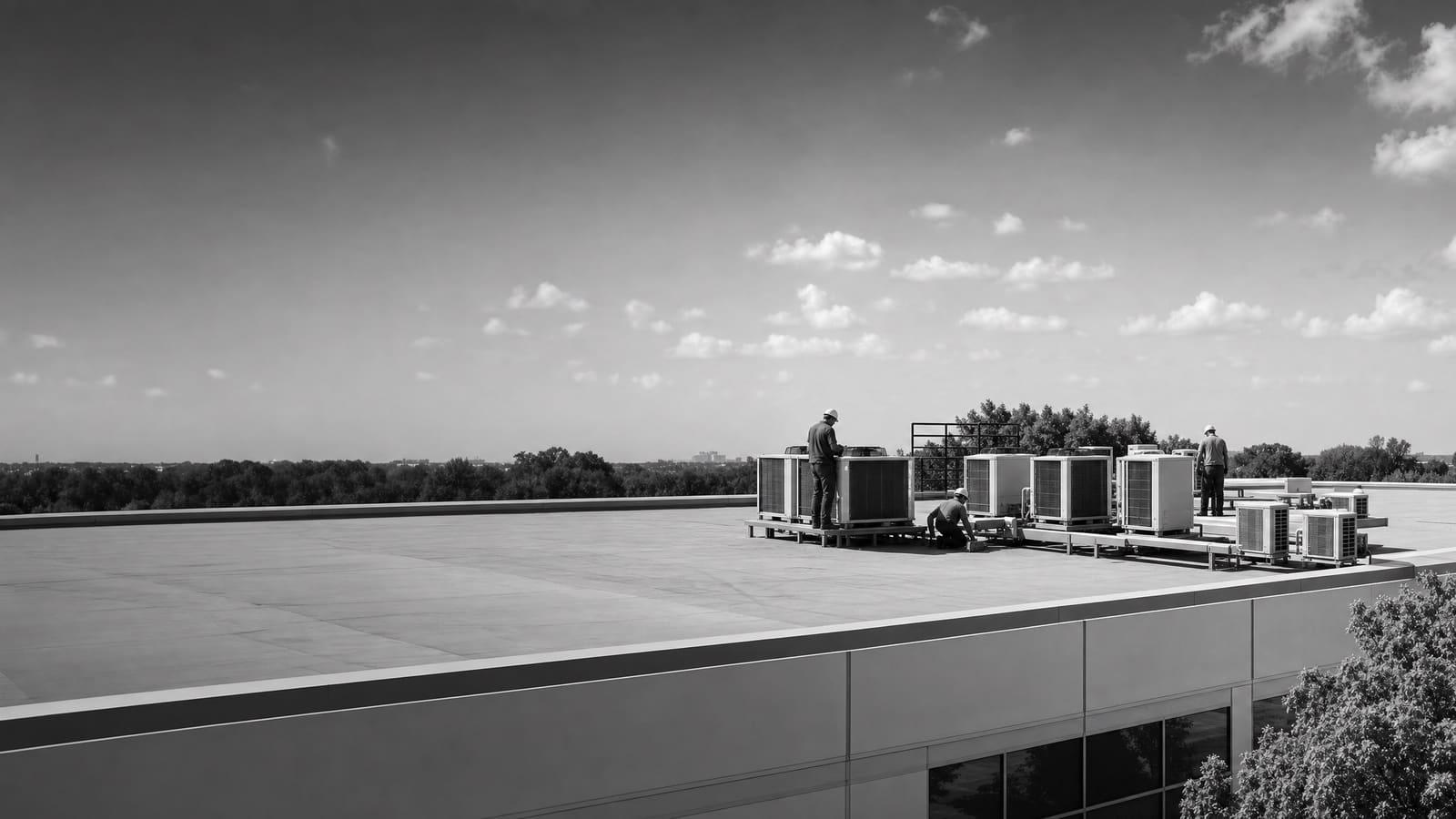
A commercial replacement confirms the load the building carries today, selects equipment against real availability, and covers rigging, curb work, gas and electrical connections, controls, and commissioning. Replacement beats another repair once a unit passes fifteen years and starts missing your schedule. DOE puts the annual waste from an old, inefficient rooftop unit at $900 to $3,700 — money you spend either way, every year you wait.
A site review has to verify what the roof and the panel can carry: curb and structural condition, crane reach and lot access, available electrical capacity, and whether the load still matches how the space is used.
THREE PATHS
Three ways to replace a rooftop unit
Most commercial replacements come down to three choices, and the right one depends on how much has changed since the last unit went up. A like-for-like swap is the fastest path back to conditioned air, but it carries forward whatever sizing mistake the old unit had. A high-efficiency replacement costs more up front and pays back through the meter; DOE's high-performance specification targeted rooftop units that cut energy use by up to half against the standard in place at the time, and manufacturers have since brought more than twenty models past that bar. A heat pump rooftop unit adds reverse-cycle heating in the same footprint, which is worth pricing when the old unit burned gas. DOE treats that as a site-by-site question: climate, electricity and gas prices, electrical capacity, physical constraints, gas lines, equipment availability, contractor familiarity, and incentives all decide whether the switch makes sense at a given building.
WHAT MOVES THE NUMBER
The lines that separate two quotes for the same tonnage
No one can price a roof from a nameplate photo alone. These are the items that make two quotes for identical tonnage land thousands apart, and the ones worth asking about before you compare totals.
IN PRACTICE
Buy the replacement instead of reacting to it
Most rooftop units get replaced the day they fail. DOE's read of the market is the same one facility managers will admit to: teams delay buying until the unit no longer conditions the space, needs constant service calls, or quits outright. DOE's guidance is that replacing proactively is often the better business move than replacement-on-failure, and sometimes better than a like-for-like swap at the end of service life. The reason is simple. When the unit dies in August, you buy whatever is available, on whatever schedule the supplier has, with no leverage on price and no time to weigh an efficiency tier or a heat pump option.
Buying ahead changes all three. You can price two or three equipment paths against each other. You can schedule the crane on a Saturday instead of a Tuesday. You can order the curb adapter before the lift date rather than after the failure. And you can settle the sizing question deliberately, because an old nameplate reflects the occupancy, plug load, and envelope of twenty years ago, not the space you run now.
The practical trigger is age plus behavior. Once a unit is past fifteen years and you are watching it stumble in season, it belongs on a replacement plan with a budget number attached, even if you do not pull it this year.
SIDE BY SIDE
Simple swaps versus complicated ones
Two buildings carrying the same tonnage on the roof can be very different projects. The gap is usually access, electrical capacity, and whether anything about the load has changed.
LOWER COMPLEXITY
Straight replacement
Same tonnage and footprint, an existing curb in sound condition, open lot with clear crane reach, electrical service already adequate, and a space used the same way it was when the old unit went up.
HIGHER COMPLEXITY
Scope that grows on the roof
A different footprint needing a curb adapter or structural review, tight access that limits crane placement, a fuel switch that adds electrical work, or occupancy changes that make the old nameplate the wrong target.
SCOPING
What a site review has to settle before anyone quotes
A quote written from a nameplate photo is a guess dressed up as a number. The site review exists to turn the unknowns into line items, and there are only a handful of them.
Start with the load. The right question is what the space needs now: occupancy, plug load, operating hours, and any envelope work done since the last unit went in. If nothing has changed, the old tonnage is probably still right, and you get to say that with confidence instead of assumption.
Then the physical envelope of the job. Curb condition and dimensions. Roof structure under the new weight. Where the crane sets up, how far it reaches, and how much of the lot goes out of service while it works. Whether gas, electrical, and refrigerant connections land where the new unit expects them.
If a heat pump is on the table, the review gets one more layer. DOE flags electrical capacity, physical constraints, gas lines, equipment availability, and contractor familiarity as the elements that decide whether a site can take the switch. Any one of them can turn a clean swap into a larger project, and it is far cheaper to learn that at the site visit than on the lift date.
The one question that reprices a project
Ask whether the new unit lands on the existing curb without modification. If the answer is no, a curb adapter, a possible structural review, and a longer lift day all enter the project — and they belong in the written quote, not in a change order later.
OWNERSHIP
Two things owners underestimate
The equipment decision gets all the attention, but two operating realities usually shape what a replacement is worth across the years you own it. One is what happens to your service program once the roof holds a mixed fleet. The other is what the building can support electrically if you ever want to move off gas, whether that is this project or the next one.
MIXED FLEETS
Service and parts planning
New equipment ships on newer refrigerants, and EPA Section 608 governs how refrigerant is handled, recovered, and recycled on stationary equipment. A roof carrying three generations of units needs a service contract and a parts strategy that account for all of them.
ELECTRICAL HEADROOM
Room for the next decision
Even if you replace like-for-like today, it pays to know what spare capacity the panel has. Electrical capacity is one of the constraints DOE lists as decisive for heat pump rooftop units, and it is cheapest to verify while an electrician is already on site.
PHASING
Planning a roof full of aging units
Buildings rarely have one rooftop unit. They have four, or nine, or twenty-two, installed the same year and aging on the same curve. That is a budgeting problem more than a mechanical one, and the answer is almost never replacing everything at once or waiting for each unit to fail on its own.
Rank them. Age first, then condition, then consequence: which unit serves the tenant who calls, the server closet, or the space you cannot shut down. Units past fifteen years with a service history behind them go into the first phase. Units still performing move to a watch list with a budget line rather than an emergency line.
Then set the standard once. If you choose an efficiency tier and a control approach for the first phase, every later phase gets easier to specify, simpler to service, and cheaper to stock parts for. Portfolio owners chase this leverage deliberately. DOE's rooftop campaign counted more than 43,000 units upgraded across 200-plus organizations, saving a combined $37 million a year, largely because those owners treated replacement as a program instead of a run of emergencies.
The lifetime math follows. An old unit's waste is annual and recurring. The replacement premium is paid once. The longer a phase plan stretches, the more of that yearly waste you keep buying.
BEFORE YOU SIGN
Five things a comparable quote must show
If two quotes do not show all five of these, you are not comparing the same project. Ask for them in writing before you weigh the totals against each other.
01
Equipment, tonnage, and efficiency tier
The specific model, its capacity, and where it sits against current efficiency levels — not a line reading "replacement rooftop unit."
02
Real lead time, in writing
Availability for the exact unit quoted, plus the date the price expires.
03
Curb, structural, and roof scope
Whether the unit lands on the existing curb, what adapter or structural work is included, and what is explicitly excluded.
04
Crane day, permits, and lot impact
Who owns the rigging plan and the permitting, how long the lot is closed, and whether both sit inside the quoted price.
05
Commissioning and documentation
Startup, refrigerant charge, airflow, and control settings verified against spec, with the report handed to you.
Get a defensible number
Price the equipment and the building together.
Send the address, operating target, and target opening date. Flux will identify what must be verified before the project can be priced.
Get a free estimateQuestions
Straight answers.
When does replacement beat one more repair?
Age plus behavior is the trigger. Rooftop units past fifteen years waste substantial energy compared with current equipment, and DOE puts the annual waste from an old, inefficient unit at $900 to $3,700. Once a unit that old is also failing in season, the repair is buying you months on a bill you are already paying.
Should we replace like-for-like or resize?
Confirm the load either way. If occupancy, plug load, operating hours, and the envelope have not changed since the last unit, the old tonnage is usually still correct. If any of those moved, the nameplate is pointing at a building you no longer run, and right-sizing fixes comfort problems the old unit could never solve.
Is a heat pump rooftop unit worth pricing?
It is worth pricing whenever the old unit burned gas. Heat pump rooftop units are technically similar to air-conditioning units and add reverse-cycle heating in the same footprint. Their efficiency drops as outdoor temperatures fall, so DOE weighs climate, utility prices, electrical capacity, gas lines, and equipment availability before recommending the switch at a given site.
What does new equipment change about refrigerant?
New units ship on newer refrigerants, which changes little about day-one operation but matters for service planning across a mixed fleet. EPA Section 608 rules govern how refrigerant is handled, recovered, and recycled on stationary equipment, so certified recovery from the outgoing unit is part of any legitimate replacement scope.
Why will no one quote a price over the phone?
There is no universal installed price for a commercial unit, because tonnage is only one input. Curb condition, structural review, crane reach and lot closure, electrical capacity, and controls integration all move the number independently. A real quote follows a real look at the roof, and it shows those items as separate lines.
Sources used for this guide
- [1]betterbuildingssolutioncenter.energy.gov — DOE Advanced Rooftop Unit Replacement Guidance
- [2]betterbuildingssolutioncenter.energy.gov — DOE Commercial Heat Pump Rooftop Unit Replacement Guidance
- [3]betterbuildingssolutioncenter.energy.gov — DOE High-Efficiency Commercial Rooftop Unit Toolkit
- [4]energy.gov — DOE Efficient Commercial Rooftop Air Conditioner Program
- [5]epa.gov — EPA Stationary HVAC Refrigerant Management