THE SHORT ANSWER
What a commercial HVAC replacement actually includes
A commercial HVAC replacement covers load verification, equipment selection, removal and certified recovery of the old refrigerant charge, curb and structural work, gas, electrical, and control connections, permitting, and commissioning. Replacement beats one more repair once a unit is past fifteen years and wasting energy every hour it runs. Federal analysis of that fleet puts the annual waste on old, inefficient rooftop units at roughly $900 to $3,700 per unit.
A site review still has to confirm the load for how the space is used now, the roof curb and structure, electrical capacity at the panel, and crane reach across the lot before any number holds.
THREE WAYS TO GO
Three replacement paths, and when each one is right
Most commercial buyers are choosing between three things, not twenty. You can put back what was there, you can move up an efficiency tier on the same equipment type, or you can change the fuel and go to a heat pump rooftop unit. Federal guidance is blunt about the trap in the first option: owners often wait until a unit fails completely, then replace on failure with whatever matches the curb. That is the most expensive way to buy equipment, because the decision gets made under pressure and the efficiency gain is left on the table. The high-efficiency path exists because DOE pushed manufacturers to build units that cut rooftop energy use by up to half against the older standard, and more than twenty models now exceed that specification. The heat pump path adds reverse-cycle heating on one electric unit and deserves a hard look in a climate like this one.
WHAT MOVES THE PRICE
The lines that actually swing a replacement quote
Nobody can hand you an installed price for a commercial unit without seeing the roof. These are the items that separate two quotes on the same building, and each one should appear as its own line instead of disappearing into a single number.
IN PRACTICE
Buying the replacement before the unit forces your hand
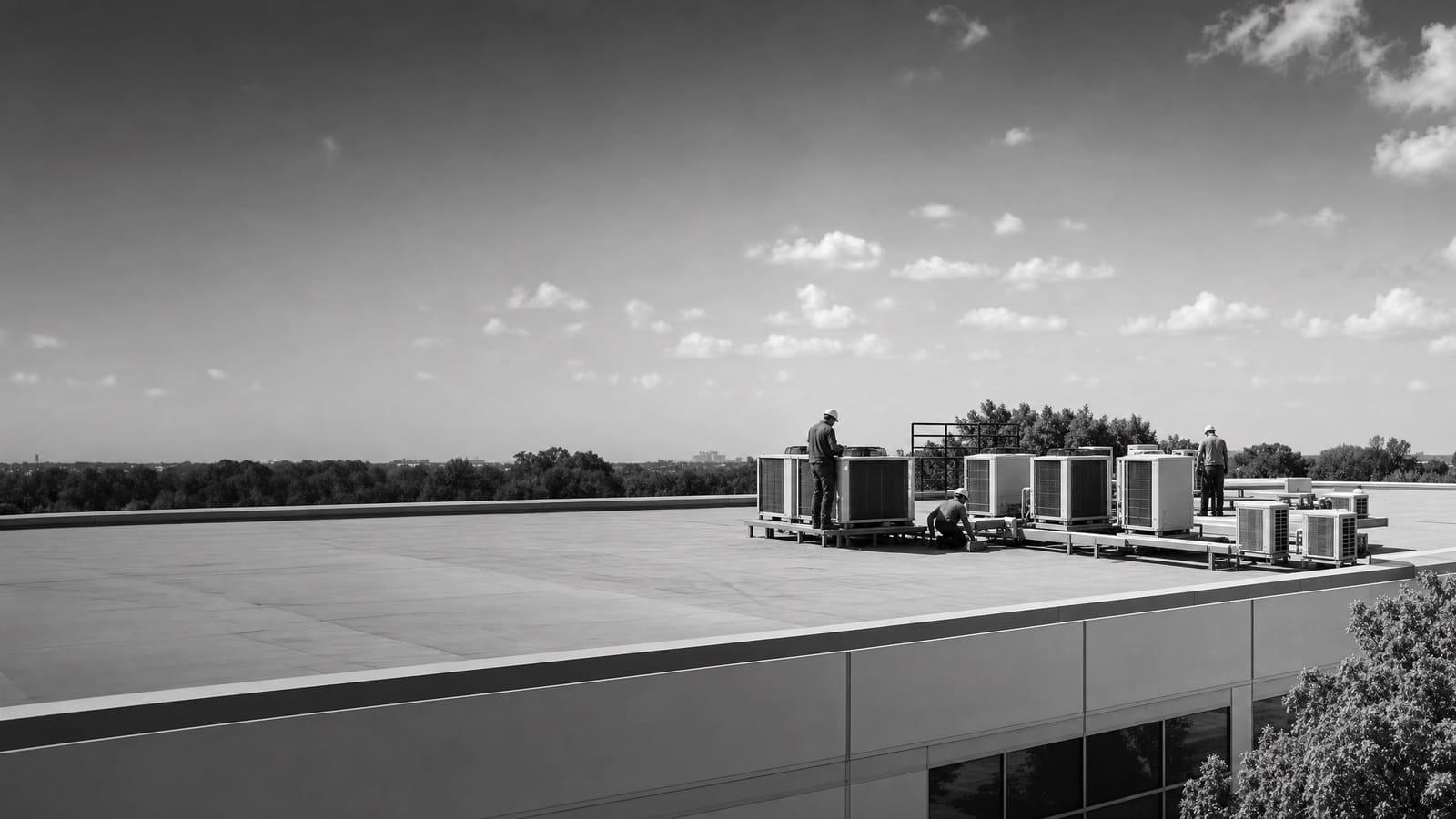
The most useful thing an owner can do is decide about the unit before it dies. Rooftop equipment cools close to half of all commercial floor space in the country, and the units past fifteen years are the ones quietly running up the bill. Federal analysis puts the annual energy waste on old, inefficient rooftop units somewhere between about $900 and $3,700 each. Multiply that by the number of units on your roof and a planned replacement usually looks better than it did an hour ago.
Planning also buys you options. When a unit fails in August, you take whatever is available and whatever fits the existing curb. When you plan, you can price a high-efficiency tier against a standard one, check whether the panel has room for an all-electric unit, and schedule the crane for a day the lot is empty. DOE's rooftop campaign was built around exactly that comparison: replace with a better unit, or retrofit the existing one with advanced controls, whichever the numbers actually support.
The other planning item is the fleet. If several units are the same age, replacing them one at a time on failure leaves you running different refrigerants and different service relationships across one roof. Sequencing them deliberately keeps parts, controls, and service on one page.
COMPLEXITY CHECK
What makes one replacement simple and another one a project
Two buildings on the same street can get very different quotes for the same tonnage. The difference is almost never the equipment itself. It is what the building makes the crew do to get that unit in place, connected, and inspected.
LOWER COMPLEXITY
Straight swap on an open roof
Same capacity going back on the existing curb, clear crane reach from the lot, adequate electrical already at the unit, and no change to the space it serves. Permit scope stays narrow and the set happens in one morning.
HIGHER COMPLEXITY
New footprint, new load, tight access
Different capacity or footprint, a curb adapter and structural review, a panel that needs upgrading before an electric unit works, or a roof the crane can only reach from an occupied drive. Each one adds engineering, permit scope, and phasing.
SCOPING THE WORK
What a real site review has to settle
A quote that arrives without anyone walking the roof is a guess wearing a number. The site review exists to turn unknowns into scope. DOE's own checklist for rooftop replacement runs through the same items a good contractor will: electrical capacity, physical constraints on the roof, existing gas lines, equipment availability, and whether the local trade base actually knows the equipment being proposed.
Electrical capacity is the one that surprises people. An all-electric rooftop unit draws differently than a gas-heat unit, and whether it fits is answered at the panel and the service, not in the equipment catalog. That check has to happen before anything is ordered, because the fix is an electrical and utility project running on its own schedule.
The old refrigerant is the second item worth settling early. EPA rules under Section 608 govern how refrigerant is handled and recovered when stationary equipment comes out of service, and that work belongs to certified technicians. It is neither optional nor free, so it should be a visible line on the quote rather than a surprise on demolition day.
Settle these before the order goes in
Confirmed load for how the space is used today, electrical capacity at the panel, roof curb and structural condition, crane reach and lot closure hours, and who recovers the existing refrigerant charge. Anything unresolved here comes back later as a change order.
FORT MYERS SPECIFICS
The Florida permit package changes your schedule
In Florida, a commercial HVAC replacement is a permitted alteration, and the plan requirements are heavier than most owners expect. Commercial alteration permit guidance used by Florida jurisdictions calls for mechanical plans whenever the scope includes installing or relocating HVAC equipment, and those plans must be signed and sealed by a Florida licensed architect or engineer. Energy calculations are also required when the scope touches heating, ventilation, or air conditioning, and the submittal has to show equipment location.
That has a real scheduling consequence. Design and sealing time sits in front of the permit, and the permit sits in front of the crane day. Wait for the unit to fail and you start the sealed-plan clock in the middle of a Fort Myers summer with the space uncooled.
Start the plan set before the crane
Budget time and money for a Florida licensed architect or engineer to seal the mechanical plans, plus energy calculations on any scope touching HVAC. Confirm the exact submittal checklist with the building department holding jurisdiction over your address before you build the timeline.
OWNING THE DECISION
Two things that outlast the install
The install is a few days. What you signed lasts fifteen years or more. Two decisions carry that far, and both are far easier to make now than to revisit later.
The first is the refrigerant your roof runs on. New commercial equipment ships on newer, lower-global-warming-potential refrigerants, and EPA rules govern how the old charge comes out and how the new one is serviced. That is manageable on one unit and messy across a roof where every unit is on something different.
The second is who holds the performance. A unit that is set and switched on is not the same as a unit that is commissioned. Charge, airflow, and control settings verified against the submitted design are what turn the efficiency you paid for into the bill you actually get.
REFRIGERANT
Plan the fleet, not the unit
Section 608 rules cover recovery and servicing of refrigerant in stationary equipment. Sequencing replacements deliberately keeps your roof on fewer refrigerants and your service contract simpler.
SERVICE DEPTH
Contractor knowledge is part of the spec
DOE lists local contractor availability and knowledge as a genuine selection factor. Equipment nobody nearby services well is a maintenance problem you bought on purpose.
OVER THE LIFETIME
Phasing, procurement, and what the unit costs after year one
Purchase price is the smallest number in a rooftop replacement. The unit runs for well over a decade in a climate that asks it to cool most of the year, so the operating line passes the install line long before the equipment is retired. That is the whole argument behind the federal push on rooftop efficiency. Units built to the high-performance specification were designed to cut rooftop energy use by as much as half against the older standard, and the campaign that followed tracked tens of millions of dollars in annual savings across tens of thousands of upgraded units.
For procurement, that argues for pricing at least two efficiency tiers side by side instead of accepting one quoted unit. Ask for the operating difference in writing rather than as a claim. DOE guidance also treats incentives as a real selection factor, so confirm any program's timing and paperwork before the equipment is ordered, not during closeout.
For phasing, sequence by consequence rather than by age alone. The unit over a server room or a kitchen carries different risk than the one over storage. Replace the consequential ones on your schedule, let the low-stakes units run out their service life, and have the plan already written for the day they go.
QUOTE CHECKLIST
Five things a comparable quote has to show
Two quotes are only comparable when they scope the same work. Ask for these five lines explicitly. If one bidder has them and the other does not, the cheaper number is usually just a smaller scope.
01
Equipment, tier, and capacity
Make, model, tonnage, and efficiency rating of the exact unit, plus its availability, so schedule and price are quoted together.
02
Curb, structural, and roof scope
Curb adapter, framing, flashing, and any engineered detail the new footprint requires.
03
Rigging and site plan
Crane size, staging area, lot closure hours, and who coordinates access with tenants.
04
Permit and sealed plan set
Who prepares the mechanical plans, who seals them, who files, and who carries the energy calculations.
05
Commissioning and closeout
Startup, charge, airflow, and control verification documented against the design, with warranty registration included.
Get a defensible number
Price the equipment and the building together.
Send the address, operating target, and target opening date. Flux will identify what must be verified before the project can be priced.
Get a free estimateQuestions
Straight answers.
When is replacing a rooftop unit better than another repair?
Once a unit is past fifteen years, the repair conversation changes. Federal analysis puts the annual energy waste on old, inefficient rooftop units at roughly $900 to $3,700 each, and that money leaves whether or not the compressor holds. Repair a young unit; plan the replacement for an old one.
Does a Fort Myers replacement need sealed plans?
Florida commercial alteration permit guidance calls for mechanical plans when the scope includes installing or relocating HVAC equipment, signed and sealed by a Florida licensed architect or engineer, along with energy calculations. Confirm the exact submittal checklist with the building department for your address, since detail varies by jurisdiction.
Does a heat pump rooftop unit make sense in this climate?
DOE guidance says today's heat pump rooftop units are an appropriate solution across most of the U.S. South and are capable of covering most or all of the winter heating demand. The real gate is electrical capacity at your panel and service, which has to be verified before the unit is ordered.
What happens to the refrigerant in the old unit?
EPA rules under Section 608 govern how refrigerant is handled and recovered in stationary air conditioning and heat pump equipment. Recovery is certified work that happens before the old unit leaves the roof, and it should appear as a visible line on your quote.
How much does commercial HVAC installation cost in Fort Myers?
There is no honest universal number, because capacity, curb work, electrical capacity, and crane access move it more than the equipment does. What you should expect is a quote built from an actual roof visit, with equipment, structural, rigging, permit, and commissioning priced as separate lines you can compare.
Sources used for this guide
- [1]betterbuildingssolutioncenter.energy.gov — DOE Advanced Rooftop Unit Replacement Guidance
- [2]betterbuildingssolutioncenter.energy.gov — DOE Commercial Heat Pump Rooftop Unit Replacement Guidance
- [3]betterbuildingssolutioncenter.energy.gov — DOE High-Efficiency Commercial Rooftop Unit Toolkit
- [4]energy.gov — DOE Efficient Commercial Rooftop Air Conditioner Program
- [5]epa.gov — EPA Stationary HVAC Refrigerant Management
- [6]tampa.gov — Permit Application Guide Commercial Alteration