THE SHORT VERSION
What a commercial HVAC replacement actually includes
A commercial HVAC replacement covers the load calculation, equipment selection, refrigerant recovery and removal of the old unit, curb and structural work, the crane set, power, gas and control connections, permits, and commissioning. Replacement usually beats another repair once a rooftop unit passes fifteen years and needs frequent service. The Department of Energy puts the annual energy waste of an old, inefficient rooftop unit at $900 to $3,700 per unit.
A site review has to confirm the real load, the curb and roof structure, available electrical capacity, crane access to the roof, and whether the existing gas line stays or goes.
THREE PATHS
Three ways to handle an aging commercial unit
Most buyers land on one of three paths. The right one depends on how much life the current unit has left and whether the space still runs the way it did when that unit was installed.
Waiting for failure is the expensive default. DOE's guidance is blunt about it: facility managers tend to delay until the unit no longer conditions the space, needs constant service, or dies outright, and replacing proactively usually beats replacement-on-failure and even a like-for-like swap at the end of service life. If the unit still has years in it, advanced controls are a genuine alternative — owners in the federal rooftop campaign chose between replacing units and retrofitting controls based on which one made better financial sense.
Mild winters open the third path. DOE places most of the U.S. South in the range where heat pump rooftop units can carry most or all of the winter heating demand, so an all-electric unit is a fair comparison here rather than a stretch.
WHAT MOVES THE NUMBER
The lines that decide a commercial HVAC quote
No two roofs price the same, and the gap between two bids usually lives in these lines rather than in the unit itself. Ask each bidder to show them separately so you are comparing scope, not just a total.
IN PRACTICE
How to buy the replacement, not just the box
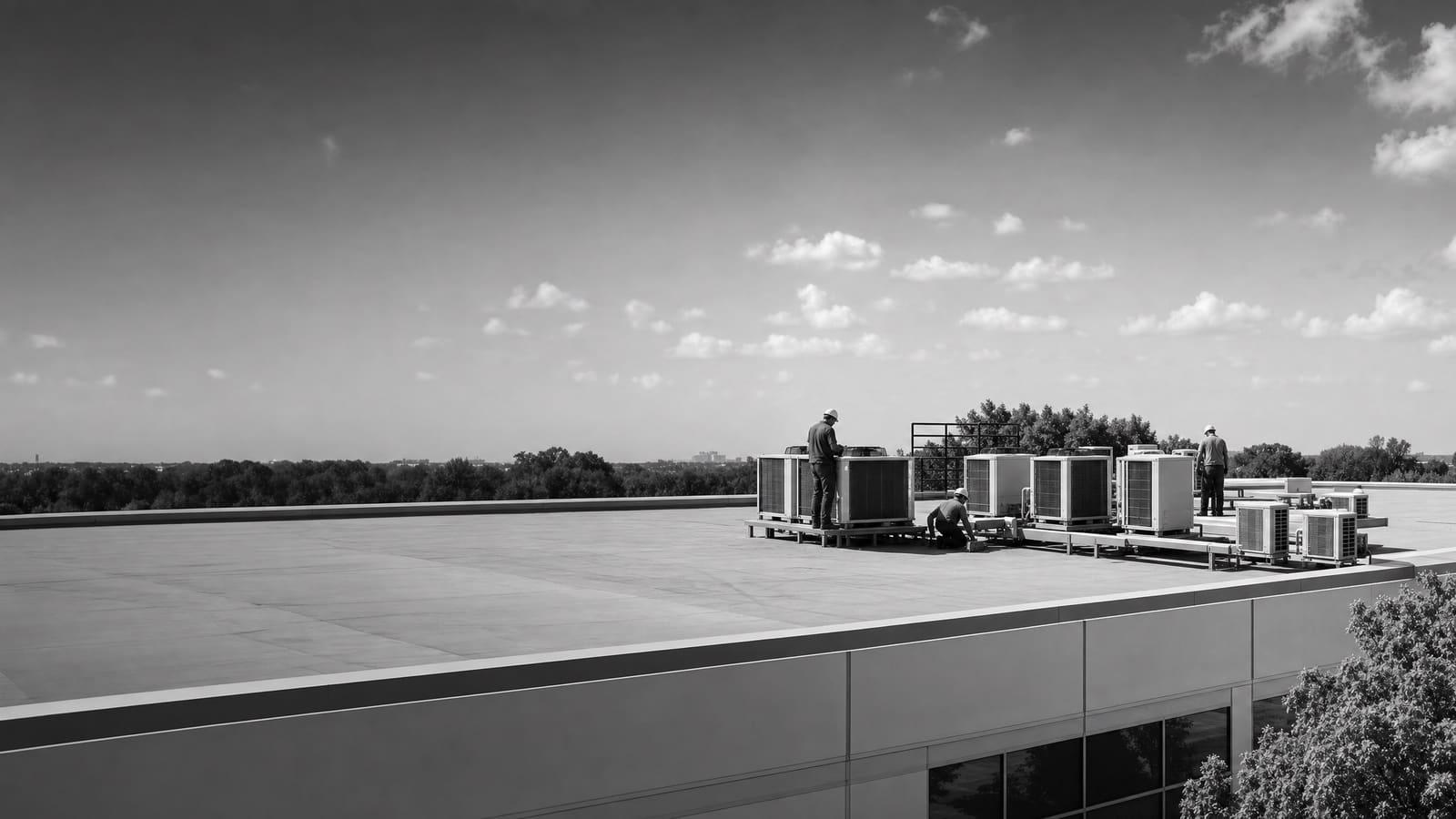
The unit is the easy part. Rooftop equipment cools nearly half of all commercial floor space in the country, which means the market is deep, the models are well documented, and any competent contractor can price a box. What separates a good project from a bad one is everything attached to that box.
Start with the load. A unit installed twenty years ago was sized for the occupancy, lighting, plug load, and envelope of that year. If you have added workstations, taken out a wall, changed operating hours, or moved to LED lighting, the old nameplate is a record of a building that no longer exists. Confirming the load costs a small fraction of the project and decides whether the new unit short cycles for the next two decades.
Then price the efficiency decision with real numbers. Old rooftop units waste $900 to $3,700 a year each, and the federal high-performance specification pushed manufacturers toward equipment using up to half the energy of the prior standard, with more than twenty models now exceeding it. Run those savings against your own rate and hours before you accept the cheapest tier. Check incentives at the same time — DOE keeps them on its standing rooftop replacement checklist, and they are easiest to capture before the order goes in.
SCOPE CHECK
What makes this project simple or complicated
Two projects with the same tonnage can differ by weeks of schedule and a wide margin of price. The difference is almost always structural, electrical, or access — not the equipment. Here is how to tell which one you have before the first quote arrives.
LOWER COMPLEXITY
Same size, same curb, same fuel
The replacement matches the old unit's tonnage and footprint, the existing curb takes an adapter, power and gas stay as they are, and the crane sets up in the lot without closing a drive aisle. Permit scope stays mechanical and electrical.
HIGHER COMPLEXITY
Bigger unit, new fuel, or tight access
Tonnage or footprint grows, so framing plans and structural review enter the permit. Going all-electric adds a panel or service question. A courtyard roof, a tight lot, or a close neighboring building can turn a one-morning set into a staged night lift.
BEFORE YOU BUY
The walk that prevents the change order
Nearly every unpleasant surprise on a rooftop replacement is visible from the roof before anyone orders equipment. DOE's adoption checklist for commercial rooftop replacement is built around infrastructure questions: electrical capacity, physical constraints, and the gas line. Those three answers set the scope more than the model number does.
Electrical capacity is the one that bites. A higher-efficiency or all-electric unit can ask more of the existing feeder and panel than they were built to serve, and finding that out after the equipment lands turns a scheduled swap into a two-trip project with an electrician in the middle. Physical constraints come next: curb dimensions, roof structure, service clearances around the unit, and whether a crane can actually reach the position it needs to reach. Gas is third — if the old unit burned gas and the replacement does not, someone has to cap and document that line.
Equipment availability belongs on the same walk. DOE flags it as a real constraint on these projects, and a quote that names a price without naming a lead time is only half a quote.
Five answers to get before ordering
Confirmed load for how the space runs today, curb and roof structure, available electrical capacity at the panel, crane reach and lot closure time, and what happens to the existing gas line. Get all five in writing before equipment is ordered.
FORT LAUDERDALE SPECIFICS
What the permit adds in Florida
Florida treats a commercial HVAC replacement as a permitted alteration, not maintenance, and the paperwork is heavier than most first-time buyers expect. Florida commercial alteration permit guidance calls for mechanical plans signed and sealed by a Florida licensed architect or engineer whenever the scope includes installing or relocating HVAC equipment. It also calls for energy calculations any time the scope touches heating, ventilation, or air conditioning, and for drawings showing where the equipment sits. If the replacement changes tonnage or footprint enough to affect the roof, framing plans and details come with it.
That has a schedule consequence. A sealed drawing set and energy calculations are design work with their own turnaround, and they happen before submittal, not after. Confirm the exact submittal package with the Fort Lauderdale building department for your address, since local requirements sit on top of the state's.
Build the design time into the schedule
If a sealed mechanical plan set and energy calculations apply to your scope, that engineering has to be finished before the permit is submitted. Ask your contractor who produces it, what it costs, and how long it takes.
OWNERSHIP
Two things that outlive the install
The install is a week. The consequences run fifteen to twenty years, and two of them are worth deciding on purpose rather than by default.
The first is who carries the risk of the next failure. A proactive replacement is a scheduled expense you control. A replacement-on-failure is an emergency purchase at whatever price and lead time the market offers that week. DOE makes the same point to portfolio owners: waiting until the unit can no longer condition the space is usually the most expensive way to buy one.
The second is the fleet. If you own several units of different ages, replacing them one emergency at a time leaves you managing a mix of equipment, refrigerants, controls, and service relationships. A plan built around the whole roof, even if it is executed over two or three years, tends to price better and operate simpler.
SCHEDULED VS FORCED
Who controls the timing
A planned replacement lets you compete the bid, pick the lift date, and coordinate with tenants. An in-season failure removes all three levers at once and usually costs more for the same equipment.
ONE ROOF, ONE PLAN
Fleet consistency
Standardizing tonnage, controls, and refrigerant across a roof simplifies spare parts, service training, and troubleshooting. It matters most for owners with more than a few units or more than one building.
PHASING AND PROCUREMENT
Sequencing a multi-unit replacement
If your building has one unit, this is a single yes or no. If it has six, you are running a program, and the sequencing question is worth an afternoon.
Rank by age and condition first. Units past fifteen years are the ones quietly spending the $900 to $3,700 a year that DOE attributes to old rooftop equipment, so they earn the front of the line even while they are still running. Then look at what each unit serves. The one over the server room, the one over the dining area, and the one over a storage mezzanine do not carry the same failure cost, and the replacement order should reflect that rather than a straight age list.
Procurement follows from the sequence. Ordering two or three units together against a single drawing set usually beats three separate emergency purchases on lead time, on mobilization, and on engineering, since the sealed plan work and energy calculations can cover the whole scope at once. Plan one lift day per phase, tie the payment schedule to commissioning rather than delivery, and keep the remaining older units on tight service until their turn arrives.
QUOTE CHECKLIST
Five things a comparable quote must show
Two quotes are only comparable when they carry the same scope. If a bidder leaves one of these out, the difference in the total is not a discount — it is a line you will pay for later, usually mid-project.
01
Tonnage, efficiency tier, and model
The actual unit being priced, not a size class.
02
Curb, structural, and roof work
Adapter or new curb, plus any framing a tonnage or footprint change triggers.
03
Crane plan and lot impact
Lift date, staging area, stalls closed, and how long they stay closed.
04
Permit scope and who seals the plans
Mechanical and electrical permits, sealed drawings, and energy calculations where required.
05
Lead time and commissioning
Equipment availability in writing, plus startup, charge, airflow, and controls verification.
Get a defensible number
Price the equipment and the building together.
Send the address, operating target, and target opening date. Flux will identify what must be verified before the project can be priced.
Get a free estimateQuestions
Straight answers.
Should I replace the unit or repair it one more time?
Once a rooftop unit is past roughly fifteen years and needs frequent service, DOE's guidance treats proactive replacement as the better business move than waiting for failure. An old, inefficient unit also wastes $900 to $3,700 a year in energy on its own, which usually swamps the difference between one more repair and a planned replacement.
How much does a commercial HVAC replacement cost in Fort Lauderdale?
Price is driven by tonnage and efficiency tier, curb and structural work, crane access, electrical capacity, and permit scope, so a real number comes from a roof visit rather than a phone call. Ask each bidder to break those lines out separately — that is what makes two quotes comparable instead of two totals.
Do I need a permit and sealed plans for a rooftop replacement?
Florida commercial alteration permit guidance calls for mechanical plans signed and sealed by a Florida licensed architect or engineer when the scope includes installing or relocating HVAC equipment, along with energy calculations and drawings showing equipment location. Confirm the exact submittal package with the Fort Lauderdale building department for your address.
Is a heat pump rooftop unit a real option here?
DOE places most of the U.S. South in the range where heat pump rooftop units can handle most or all of the winter heating demand, so it is a fair comparison in South Florida rather than a stretch. The deciding factors are electrical capacity at the panel, your electricity price, and whether the existing gas line is being retired.
What happens to the refrigerant in the old unit?
It has to be recovered and handled under federal rules rather than vented. EPA's Section 608 regulations govern the handling and recycling of refrigerant in stationary air-conditioning equipment. Recovery is real labor on removal day, so it should appear as a named line on the quote instead of an assumption.
Sources used for this guide
- [1]betterbuildingssolutioncenter.energy.gov — DOE Advanced Rooftop Unit Replacement Guidance
- [2]betterbuildingssolutioncenter.energy.gov — DOE Commercial Heat Pump Rooftop Unit Replacement Guidance
- [3]betterbuildingssolutioncenter.energy.gov — DOE High-Efficiency Commercial Rooftop Unit Toolkit
- [4]energy.gov — DOE Efficient Commercial Rooftop Air Conditioner Program
- [5]epa.gov — EPA Stationary HVAC Refrigerant Management
- [6]tampa.gov — Permit Application Guide Commercial Alteration