THE DIRECT ANSWER
Commercial HVAC replacement is a complete building project
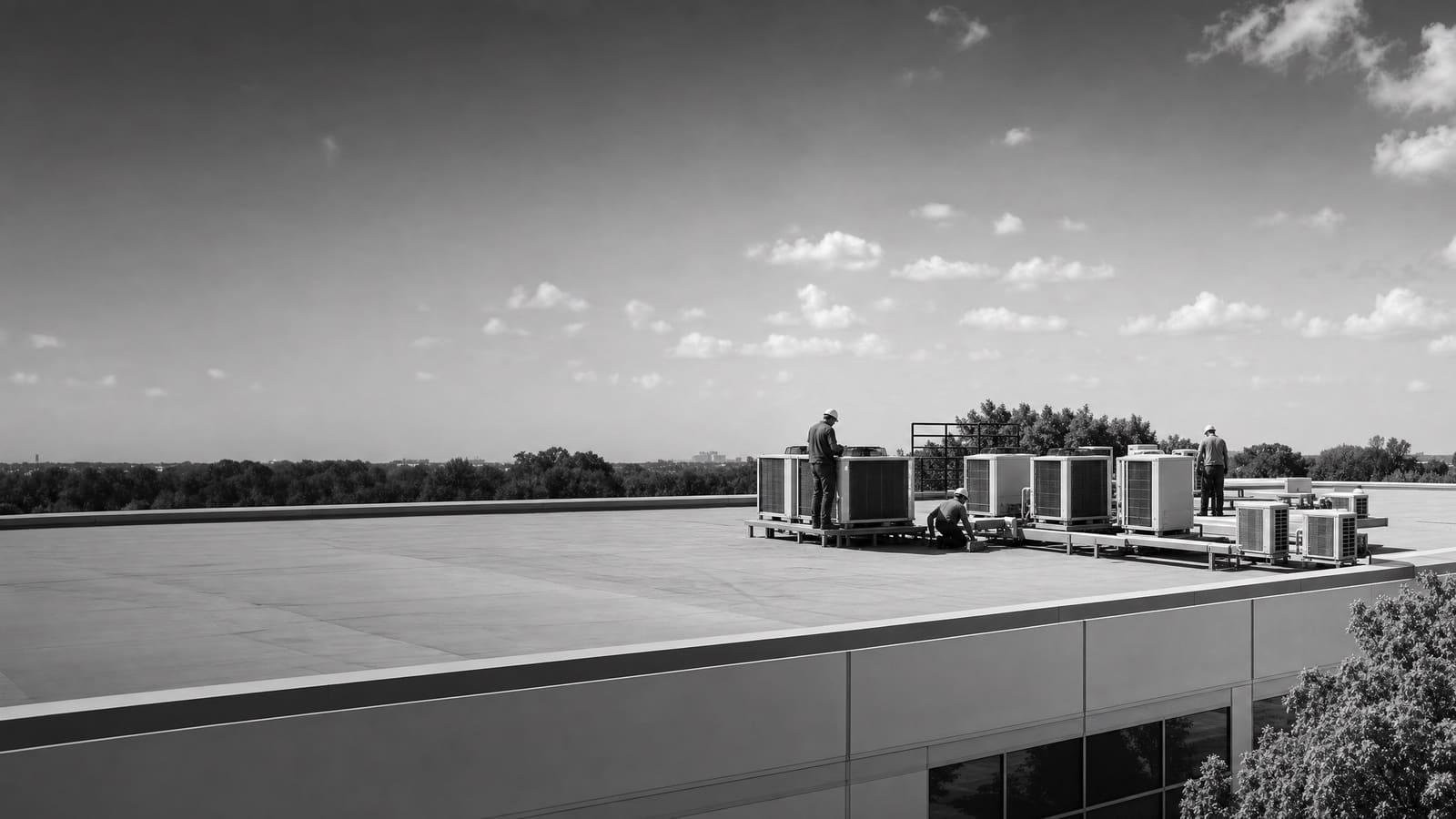
A commercial HVAC replacement includes load review, equipment selection, removal, rigging, connections, controls, startup, and commissioning. Replacement becomes more useful than another repair when an older unit needs frequent service, cannot hold the space conditions, or creates too much failure risk. DOE guidance flags rooftop units over 15 years old for closer replacement review.
A site review must confirm capacity, curb fit, roof access, electrical service, fuel connections, ventilation, controls, and the work needed beyond the equipment.
THREE OPERATING CHOICES
Choose the replacement path before choosing a model
Start with the result the building needs. A direct replacement may shorten the project when the present capacity, fuel, layout, and controls still fit. A right-sized replacement is more useful when occupancy, internal equipment, hours, or space use have changed. It avoids treating the old nameplate as proof of the current load.
A heat pump rooftop unit adds another choice. It can provide cooling and reverse-cycle heating, while all-electric, dual-fuel, and cold-climate designs serve different operating needs. DOE guidance says the review should include geography, utility costs, emissions goals, building type, equipment availability, electrical capacity, physical limits, gas service, and contractor knowledge.
Do not reduce this decision to efficiency ratings alone. Compare comfort, heating performance, ventilation, controls, available power, maintenance needs, and expected operating cost. The best selection is the one that fits the actual building and can be supported through its service life.
BUDGET STRUCTURE
What moves the installed price
The supplied research does not support one universal installed price. Build the budget from the equipment and all work needed to place it into reliable service.
EQUIPMENT SELECTION
Compare systems by how they serve the building
Packaged rooftop units combine major heating, cooling, and air-moving parts in one outdoor cabinet. They are common across commercial buildings and condition nearly half of U.S. commercial floor area. A packaged replacement can be practical when the existing duct route, roof opening, and service arrangement remain useful. Compatibility still needs to be checked; a new cabinet is not automatically a direct physical or controls match.
A higher-efficiency rooftop unit may lower energy use, but savings depend on the old equipment, new selection, operating schedule, controls, and load. Historical DOE work found that some older commercial rooftop units wasted $900 to $3,700 per unit each year. That is useful evidence that inefficient units can carry a real operating penalty, not a promise that every Flint property will save that amount.
Heat pump rooftop units cool like air-conditioning RTUs and also provide reverse-cycle heating. As outdoor temperature falls, heat-pump heating efficiency declines. All-electric, dual-fuel, and cold-climate configurations should therefore be evaluated against heating demand and available infrastructure. Ask bidders to state the proposed heating configuration, backup heat, electrical needs, and control sequence instead of using “heat pump” as a complete specification.
PROJECT COMPLEXITY
A box swap and a building change are different projects
Two units with similar capacities can require very different field work. The quote should show which conditions were verified and which remain allowances.
LOWER COMPLEXITY
Compatible replacement conditions
Capacity remains suitable, the curb can be reused or adapted, service access is clear, utilities fit, duct changes are limited, and the controls scope is simple.
HIGHER COMPLEXITY
Changed building conditions
New loads, limited roof access, added electrical demand, fuel changes, structural work, duct revisions, occupied-hour limits, or automation integration require deeper planning.
SITE REVIEW
Measure the conditions that can defeat a good equipment choice
Begin with the present unit, but do not stop at its nameplate. Record its capacity, heating type, electrical data, refrigerant, curb dimensions, supply and return arrangement, outside-air setup, controls, and known repair history. Then compare that information with current occupancy, hours, internal heat-producing equipment, ventilation needs, and comfort complaints.
Inspect the route to the work. A rooftop replacement may need rigging space, safe roof access, a lifting plan, temporary protection, and a way to keep entrances or loading areas usable. Confirm whether the roof support and curb arrangement fit the proposed equipment. Inside, identify duct transitions, drains, disconnects, gas piping, sensors, thermostats, smoke-control interfaces, and building automation points that belong in the scope.
For a heat pump option, verify electrical capacity and physical constraints early. DOE guidance also calls out gas lines, equipment availability, contractor knowledge, utility-bill effects, and climate as adoption factors. If those items are left until after selection, the apparent equipment upgrade can turn into an unplanned infrastructure project.
Bring operating evidence
Provide service records, utility history, schedules, space changes, comfort complaints, and any automation documents. These details help the project team test assumptions before ordering equipment.
REPAIR OR REPLACE
Judge the next repair against failure exposure
Age alone does not condemn a working unit. The stronger question is whether another repair gives the facility a dependable operating period. Review repeat failures, refrigerant leaks, unavailable parts, poor comfort, rising maintenance effort, and the effect of an unplanned shutdown.
DOE says managers often wait until an RTU cannot condition the space, needs frequent maintenance, or fails. Its guidance notes that proactive replacement of inefficient, underperforming units can make better business sense than replacement after failure. A planned project gives the owner time to compare systems, verify infrastructure, coordinate access, and set acceptance standards.
KEEP AND REPAIR
Useful when risk stays controlled
Repair can fit when the fault is isolated, parts remain supportable, performance is acceptable, and the expected operating period justifies the work.
PLAN REPLACEMENT
Useful when failures drive the schedule
Replacement becomes stronger when service calls repeat, conditioning is inadequate, or a sudden outage would disrupt people, products, tenants, or operations.
PROCUREMENT AND PHASING
Buy the installed result, not only the equipment
A commercial HVAC proposal should connect equipment, field work, schedule, and acceptance into one plan. Ask when the quoted unit can be released, what must happen before delivery, and how long the affected area will lack heating, cooling, or ventilation. If the building must stay open, define temporary conditioning, work windows, noise limits, protected routes, and the sequence for multiple units.
For a portfolio or multi-unit roof, avoid replacing every unit by age alone. Rank equipment by condition, service burden, space importance, efficiency opportunity, and failure impact. Phasing can spread capital needs and reduce shutdown exposure. It can also create a mixed fleet, so keep a clear record of refrigerants, filters, belts, sensors, controllers, and service requirements.
EPA Section 608 rules govern refrigerant handling and recycling in stationary air-conditioning and heat-pump equipment. The scope should identify who recovers refrigerant from removed equipment and how that work is documented. At handoff, collect equipment data, warranties, startup records, control sequences, setpoints, maintenance requirements, and training. These records turn a completed installation into a system the facilities team can operate and service.
QUOTE CHECKLIST
Five things every comparable quote should show
Require the same basic information from each bidder. Otherwise, a lower number may simply exclude work that appears later as a change.
01
Defined equipment
Model, capacity, efficiency, heating configuration, ventilation features, controls, accessories, warranty, and stated substitutions.
02
Complete field scope
Removal, recovery, disposal, rigging, curb work, duct transitions, utilities, drains, wiring, roof protection, and cleanup.
03
Schedule and outage plan
Availability, ordering assumptions, milestones, work hours, shutdown length, phasing, temporary service, and weather limits.
04
Testing and acceptance
Startup, airflow, heating and cooling checks, sensors, safeties, control sequence, alarms, trends, and written commissioning results.
05
Clear exclusions and closeout
Allowances, owner duties, unresolved conditions, change process, training, manuals, warranties, and final operating records.
Get a defensible number
Price the equipment and the building together.
Send the address, operating target, and target opening date. Flux will identify what must be verified before the project can be priced.
Get a free estimateQuestions
Straight answers.
When should a commercial rooftop unit be replaced instead of repaired?
Consider replacement when the unit needs frequent service, no longer conditions the space well, has difficult parts or refrigerant issues, or exposes the operation to a costly unplanned outage. DOE guidance specifically points to units over 15 years old as candidates for closer review, but condition and operating risk still matter.
Should a new commercial HVAC unit match the old capacity?
Not automatically. The old capacity is a starting point. Confirm current occupancy, schedules, ventilation, internal equipment, space use, and comfort history. A direct match can make sense when the building has not changed, while a load review can expose oversizing or added demand.
Is a heat pump rooftop unit a good replacement option?
It may be, but it needs a building-specific review. Compare all-electric, dual-fuel, and cold-climate configurations. Check winter heating performance, backup heat, electrical capacity, gas service, utility effects, physical fit, equipment availability, controls, and local service support before selecting one.
How much does commercial HVAC installation cost in Flint?
The supplied research does not establish a reliable Flint installed-price range. A defensible quote needs the equipment selection plus roof and curb work, rigging, utilities, duct changes, controls, refrigerant work, startup, commissioning, schedule limits, and any unresolved site conditions.
What information should I provide before requesting a quote?
Provide equipment nameplates, service records, utility history, operating hours, comfort complaints, known leaks, space-use changes, roof information, controls documents, and any outage limits. Photos help with early planning, but they do not replace a site review.
What should happen during commissioning?
The team should verify startup, airflow, heating and cooling operation, outside-air functions, sensors, safeties, setpoints, schedules, alarms, and the intended control sequence. The owner should receive written results, final settings, manuals, warranties, and maintenance information.
Who is responsible for refrigerant from the old equipment?
The contract should clearly assign refrigerant recovery and disposal work to qualified parties. EPA Section 608 rules cover handling and recycling refrigerants in stationary air-conditioning and heat-pump equipment, so this work should not be treated as an undefined disposal detail.
Can several rooftop units be replaced in phases?
Yes. Phasing can reduce shutdown exposure and spread capital needs. Rank units by condition, repair burden, space importance, efficiency opportunity, and failure impact. Also plan for the parts, refrigerants, filters, controls, and training needs of a mixed equipment fleet.
Sources used for this guide
- [1]betterbuildingssolutioncenter.energy.gov — DOE Advanced Rooftop Unit Replacement Guidance
- [2]betterbuildingssolutioncenter.energy.gov — DOE Commercial Heat Pump Rooftop Unit Replacement Guidance
- [3]betterbuildingssolutioncenter.energy.gov — DOE High-Efficiency Commercial Rooftop Unit Toolkit
- [4]energy.gov — DOE Efficient Commercial Rooftop Air Conditioner Program
- [5]epa.gov — EPA Stationary HVAC Refrigerant Management