THE DIRECT ANSWER
What a commercial HVAC replacement actually includes
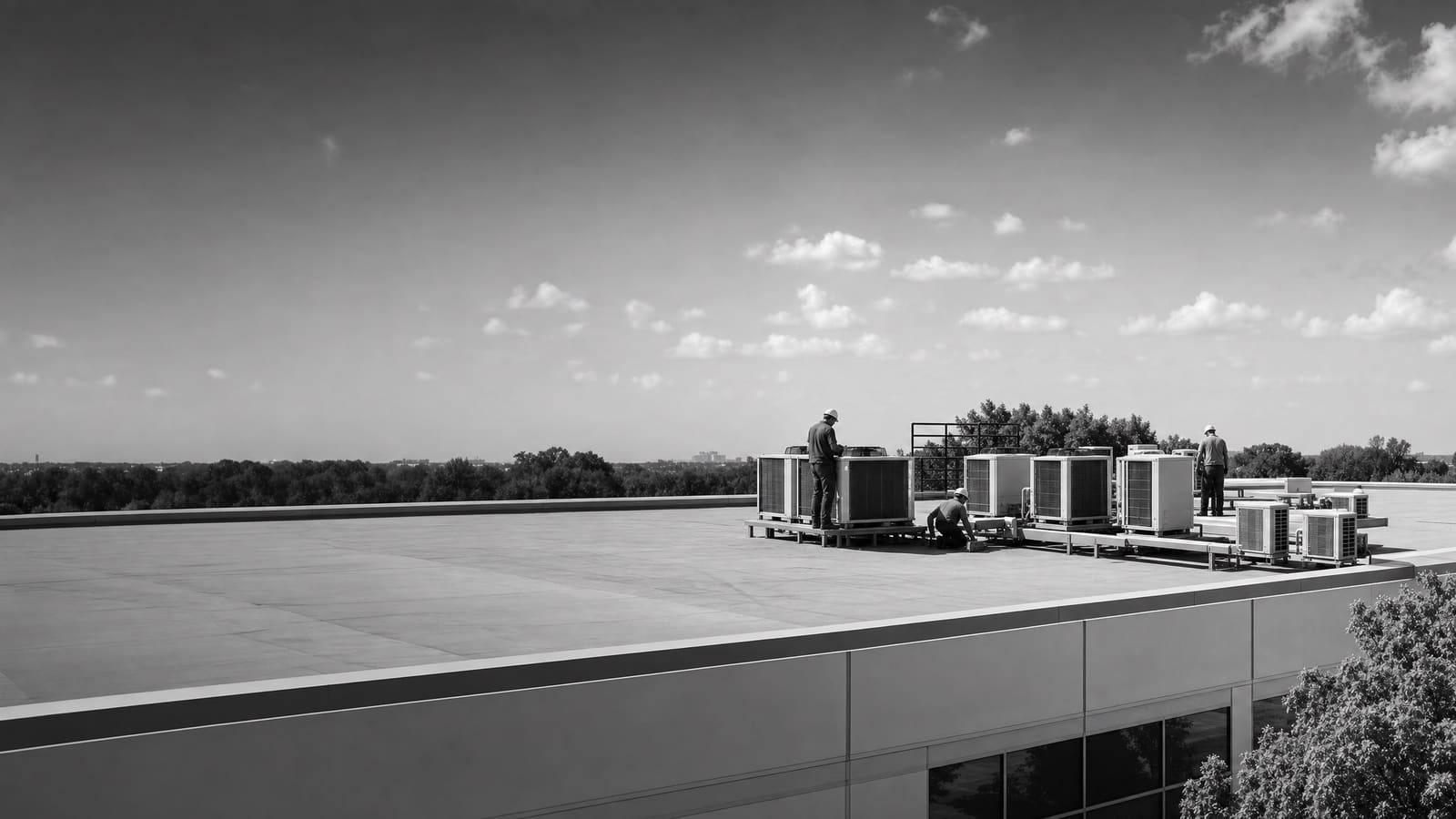
A commercial HVAC replacement means confirming the load the building carries today, selecting equipment against real availability, setting and connecting the unit, recovering the old refrigerant under federal rules, and commissioning the system before handoff. Replacement beats another repair once a unit is past roughly fifteen years and service calls are stacking up. Federal analysis is blunt about the math: an aging, inefficient rooftop unit can waste $900 to $3,700 a year on its own, every year you defer.
A site review still has to confirm tonnage against current occupancy, the curb and roof structure, available electrical capacity, and crane reach before any number is real.
THREE PATHS
Three ways to handle an aging rooftop unit
Most owners meet this decision at the worst possible moment, with a unit already down and a building getting warm. Federal guidance notes that facility managers usually delay replacement until the equipment stops conditioning the space adequately, needs frequent service, or fails outright. That timing is what makes replacement expensive: you take whatever unit is available that week instead of the unit you would have chosen with time to compare.
Deciding early gives you three honest paths. Which one is right depends on how long you plan to hold the building, how much the current unit costs you to run, and whether the space is used the way it was when the old unit was specified.
Age is the cleanest trigger. Rooftop units past fifteen years waste substantial energy compared with newer models, and repair frequency tends to climb at the same time. When both curves are moving, planned replacement is a stronger case than one more repair — and it is the only version where you control the schedule.
WHAT MOVES THE NUMBER
The lines that decide your price
These are the lines that move a commercial HVAC quote. Two projects with identical tonnage can land far apart because of the roof, the panel, and the parking lot. Ask for each item priced separately. A single bundled number hides which part of the job is driving your price, and it makes competing bids impossible to compare.
CHOOSING EQUIPMENT
Gas heat, heat pump, or dual fuel
The biggest equipment question on a replacement today is what heats the building. Federal guidance treats heat pump rooftop units as technically similar to standard air-conditioning rooftop units, with one difference that matters: they heat by running the refrigerant cycle in reverse instead of burning gas. Three versions exist — dual fuel, all-electric, and cold climate models — and the right one is a building question, not a preference.
Heat pump heating efficiency falls as outdoor temperature drops, and at the coldest hours it trends toward the same efficiency as electric resistance heat. That is why the design temperatures your engineer uses matter more than any brochure number. Buildings with mild-to-moderate winter heating demand are where heat pump equipment performs best. A building carrying a deep winter load usually keeps gas backup through a dual fuel unit.
Infrastructure decides the rest. Going all-electric means the panel has to carry the added load, and if it cannot, that service work belongs in the same budget conversation rather than as a surprise later. Keeping gas means the existing line and venting still have a job. Ask for both options priced side by side, with the electrical scope shown, before you commit.
COMPLEXITY
What makes a replacement simple or hard
Complexity is not about tonnage. Two identical units on two different roofs can be a one-morning job and a six-week project, and the difference shows up in the schedule long before it shows up in the price. Sorting your building into one of these columns early tells you what kind of project you are buying.
LOWER COMPLEXITY
Straight swap conditions
Same tonnage and heat type, an existing curb the new unit matches, adequate electrical capacity already at the roof, open lot for crane setup, and a space that can lose conditioning for part of one day.
HIGHER COMPLEXITY
Conditions that add scope
Changing tonnage or switching to electric heat, a curb needing an adapter and structural review, a panel with no spare capacity, tight crane access or tenant hours that limit closures, and spaces that cannot go without conditioning.
SCOPING
What the site review has to confirm
A price given before a site review is a guess with a number attached. The federal checklist for rooftop replacement asks about the same things a good contractor walks the roof to answer: electrical capacity, physical constraints, gas lines, equipment availability, and whether the local trade base actually installs and services the equipment class you are considering.
Start with the load. The nameplate on a twenty-year-old unit describes the building as it was when that unit was specified, not as it runs today. Occupancy changed, plug loads changed, and in many buildings the envelope was improved along the way. Sizing from the old nameplate carries forward whatever error was already there, and can leave you paying for tonnage you never use.
Then confirm access and infrastructure. Where does the crane set up, how many stalls close, and for how long. Does the roof structure take the new unit's weight. Is there panel capacity for electric heat, or does that become its own line item. Does your existing controls system speak to the new unit or need an interface.
Equipment availability belongs in the same conversation. A unit you cannot get for ten weeks is not really an option for a building that is already down.
Ask for this before you sign
A written scope showing tonnage and efficiency tier, curb and structural work, crane plan and closure hours, electrical scope, refrigerant recovery, and commissioning — each priced as its own line.
OWNERSHIP
Two questions that change the answer
Two buildings with the same failed unit can reach opposite decisions, and both can be right. What separates them is not the equipment. It is who holds the asset and how many units sit behind this one.
Utility savings accrue to whoever pays the bill, while the capital cost lands on whoever owns the roof. In a leased building, that split decides how much efficiency is worth chasing, and the lease is worth reading before the quote arrives. Portfolio owners face the opposite problem: the first replacement quietly sets a standard for every unit behind it, including the refrigerant, the controls platform, and the parts your service team has to stock. Neither question shows up on a bid sheet, which is exactly why it should be settled before the bids do.
OWNER-OCCUPIED VS LEASED
Who captures the savings
If you own and occupy, efficiency pays you back directly. If tenants pay utilities, the savings land on their side of the ledger, and the upgrade case has to rest on reliability, lease terms, or a cost-recovery clause instead.
ONE UNIT VS A FLEET
The precedent you are setting
A single replacement is a standalone decision. Across a fleet, the first unit sets the refrigerant, controls platform, and parts inventory your service team lives with for years, so it deserves a deliberate choice rather than an outage-pressure one.
PLANNING AHEAD
Phasing, procurement, and what the unit costs to run
The cheapest version of this project is the one you schedule. Federal analysis of rooftop replacement makes the point plainly: replacing an inefficient, underperforming unit proactively is usually the better business move compared with replacement-on-failure, or even with a like-for-like swap at the end of service life. The reason is not clever engineering. Planned work lets you compare equipment, wait for the right unit, and put the crane on the roof during a week that suits the building.
If several units are aging together, phase them instead of waiting for each one to fail. Group replacements so one crane mobilization covers more than one unit, and sequence by age and repair history rather than by which tenant complained loudest. That also gives your service team one platform to learn instead of four.
Then look past the install price. An old, inefficient rooftop unit can waste on the order of $900 to $3,700 a year in energy, and that figure repeats every year you defer. Utility and manufacturer incentives for higher-efficiency equipment can shift the math further, but availability varies by program, so confirm what actually applies to your building before assuming it into the budget.
THE QUOTE
Five things a comparable quote shows
Quotes are only comparable when they cover the same work. If one bidder folds the crane, permits, and startup into a single number while another lists them, you are not comparing prices — you are comparing formats. Ask every bidder to show these five.
01
Equipment, spelled out
Model, tonnage, efficiency tier, heat type, and refrigerant — plus a lead time in weeks, not the word available.
02
Roof and curb scope
Curb adapter, any structural work, and who confirmed the roof carries the new unit's weight.
03
Crane and access plan
Rigging plan, staging area, stalls closed, and how many hours the lot is affected.
04
Utilities and controls
Electrical, gas, and refrigerant line changes, plus how the unit ties into your existing controls.
05
Permits, startup, and warranty
Who pulls permits, who meets the inspector, what commissioning is documented, and what the warranty covers.
Get a defensible number
Price the equipment and the building together.
Send the address, operating target, and target opening date. Flux will identify what must be verified before the project can be priced.
Get a free estimateQuestions
Straight answers.
When does replacement beat another repair?
Age plus repair frequency is the cleanest test. Federal guidance flags rooftop units past fifteen years as heavy energy wasters, and an old, inefficient unit can burn $900 to $3,700 a year on its own. Once repairs are stacking on top of that, replacement usually wins.
How much does commercial HVAC installation cost?
There is no honest universal number. Tonnage, efficiency tier, curb and structural work, crane access, and electrical capacity move the price far more than brand does. Any figure quoted before someone confirms those on your roof is a placeholder, not a price.
Should we switch to a heat pump rooftop unit?
It depends on your winter heating load and your electrical capacity. Heat pump efficiency drops as outdoor temperature falls, so these units perform best where winter heating demand is mild to moderate. Dual fuel keeps gas backup for the coldest hours. Price both options.
How far ahead should we plan a replacement?
Equipment availability, not labor, usually sets the schedule. Federal guidance lists availability as a core planning consideration for rooftop replacement, which is why the lead time belongs on the quote in writing, next to the price.
What happens to the refrigerant in the old unit?
It has to be recovered properly. EPA regulations under Section 608 of the Clean Air Act govern how refrigerant is handled and recycled in stationary air-conditioning and heat pump equipment, so recovery should appear as a line on the scope.
Can we size the new unit from the old nameplate?
Only if the space and its use have not changed. Occupancy, plug loads, and envelope improvements all shift the load, and copying the nameplate carries forward whatever sizing error the old unit already had.
Sources used for this guide
- [1]betterbuildingssolutioncenter.energy.gov — DOE Advanced Rooftop Unit Replacement Guidance
- [2]betterbuildingssolutioncenter.energy.gov — DOE Commercial Heat Pump Rooftop Unit Replacement Guidance
- [3]betterbuildingssolutioncenter.energy.gov — DOE High-Efficiency Commercial Rooftop Unit Toolkit
- [4]energy.gov — DOE Efficient Commercial Rooftop Air Conditioner Program
- [5]epa.gov — EPA Stationary HVAC Refrigerant Management