THE SHORT VERSION
What a commercial HVAC replacement actually covers
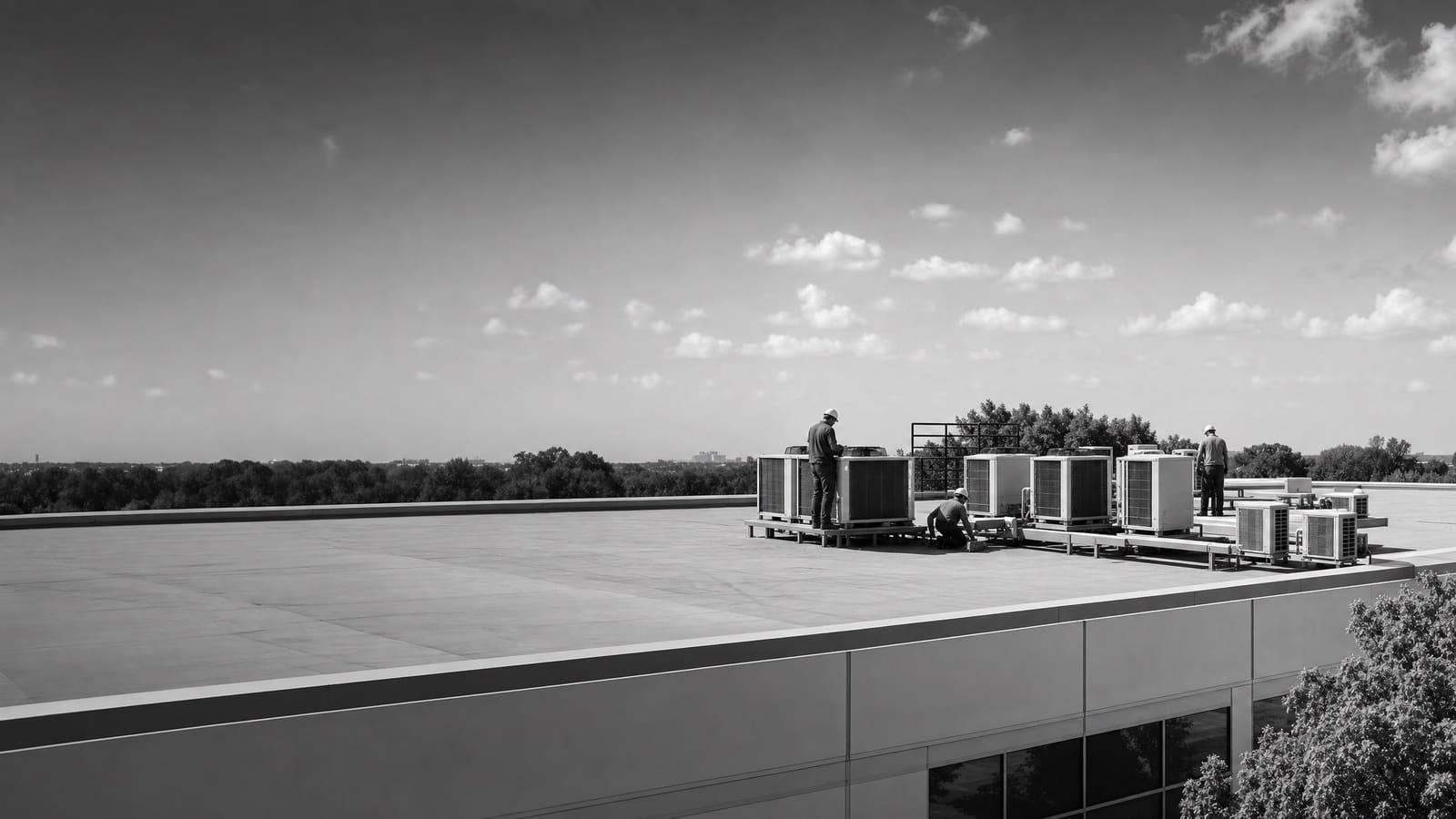
A commercial HVAC replacement covers confirming the load against how the space is used now, selecting equipment against real lead times, rigging and setting the unit, connecting power, gas, and refrigerant, and commissioning it before handoff. Replacement usually beats another repair once a unit is past roughly fifteen years and needs frequent service. DOE puts the annual energy waste of an old, inefficient rooftop unit at $900 to $3,700 — often more than the repair bought you.
A site review still has to verify the curb and roof structure, available electrical capacity, gas service, and crane access before any of that becomes a real quote.
THE DECISION
Repair, replace, or retrofit the controls
Most replacement conversations collapse into one question: is another repair buying real time, or just moving the same decision to a worse moment? DOE's guidance is blunt about the pattern — facility managers commonly delay until a unit no longer conditions the space, needs constant service, or fails outright, and that timing usually costs more than the repairs saved.
The useful test is age, plus service history, plus what the unit is doing to the utility bill. Rooftop units past fifteen years waste substantial energy compared with current models, and DOE's program work put that waste at $900 to $3,700 per unit each year. Two of those on one roof is a budget line, not a rounding error.
Below are the three paths a commercial owner actually chooses between. None is automatically right. A unit with genuine life left and a bad control sequence is a controls project. A twenty-year-old unit that already failed once this season is not.
WHAT MOVES THE NUMBER
The lines that decide your installed price
Installed price on commercial work is quoted per unit after someone looks at the roof, not pulled from a table. These are the lines that move the number most. Ask each bidder to price them separately, because that is the only way two quotes become comparable — and it is where a suspiciously low bid usually turns out to be missing something.
EQUIPMENT CHOICE
Gas heat or a heat pump rooftop unit
The equipment decision is more interesting than it was ten years ago. A packaged rooftop unit is still the default for most commercial buildings — DOE reports rooftop systems condition close to half of all U.S. commercial floor space — but the replacement now comes with a fork. You can install a conventional air-conditioning unit with gas heat, or a heat pump rooftop unit that reverses cycle to heat the space.
DOE frames that choice around a short list, and only part of it is the equipment. Climate and winter heating load come first. Then utility bill impact, emissions goals, building type, equipment availability, and infrastructure: electrical capacity, physical constraints on the roof, and what happens to the existing gas line. Contractor familiarity and available incentives close the list.
Heat pump rooftop units heat most efficiently in mild-to-moderate winter conditions, and their efficiency trends toward electric-resistance parity as outdoor temperatures fall. That is why dual-fuel and cold-climate versions exist. The honest way to settle it on your building is to price both, model the utility bill against your actual rates, and confirm the panel can carry the electric option before anyone commits to it.
SIDE BY SIDE
Simple swap versus a project
Two replacements with the same tonnage on the quote can be very different jobs. What separates them is almost never the equipment. It is access, what the roof can carry, and how much has to change on the way in.
LOWER COMPLEXITY
Same footprint, same fuel
Matching tonnage on the existing curb, gas and electric already sized correctly, clear crane reach from the lot, and no controls change. Set and connected in a morning, inspected on a normal timeline.
HIGHER COMPLEXITY
New footprint or new fuel
Larger tonnage, a curb adapter with structural review, an all-electric conversion that needs panel capacity, tight rigging over occupied space, or a building-automation tie-in. Each one adds review time before the crane can be booked.
SCOPING IT
What a real site review has to answer
A useful site review answers questions a nameplate cannot. Start on the roof: actual curb dimensions, the condition of the deck around it, and whether the existing opening matches the new unit's throat. Then the services — the electrical feed and available panel capacity, the gas line if there is one, and where condensate goes.
Next is access. Where does the crane set up, what does it have to reach over, and how many parking stalls disappear for the morning? On a leased property that is a tenant-notice question as much as an engineering one.
Then the operating side. How is the space used today versus when the original unit was specified? Fifteen or twenty years changes occupancy counts, plug loads, lighting heat, and sometimes the envelope itself. Sizing off the old nameplate quietly carries forward whatever was wrong the first time.
Finally, refrigerant. The existing charge has to be recovered and handled under EPA Section 608 rules, and new equipment arrives on a different refrigerant than a fifteen-year-old unit used. That matters less on day one than it does for your spare-parts and service plan across a mixed fleet.
What the walk should produce
A curb and structural verdict, confirmed electrical and gas service, a rigging plan with lot impact, a load number based on today's use, and a refrigerant handling plan. Anything a bidder skips here tends to reappear as a change order.
OWNERSHIP
Two questions the quote will not ask you
Two ownership questions decide more about the ten-year cost of this project than the purchase price does, and neither one shows up as a line on a quote.
The first is timing. A replacement you schedule is a different transaction from a replacement the equipment schedules for you. You pick the specification, you shop availability, and you set the crane day around your operating hours instead of around a failure.
The second is fleet consistency. A single unit chosen in isolation can quietly create a second standard on a roof that already had one — a different control interface, a different parts list, a different refrigerant to plan around. Sometimes the better unit is worth that trade. The point is to make it on purpose, not discover it in month three.
TIMING
Planned replacement beats replace-on-failure
DOE's guidance notes owners commonly wait until a unit needs frequent service or fails completely. Replacing proactively with a more efficient unit usually beats both failure replacement and a like-for-like swap at end of life.
FLEET
One roof, one standard
If five units share a roof, a one-off model adds a second parts inventory, a second control interface, and a second refrigerant to plan service around. Weigh that against what the different unit actually buys you.
PHASING AND PROCUREMENT
Doing several units without doing them the expensive way
When a roof carries several aging units, the temptation is to handle them one at a time as each one fails. That is the most expensive version of this project. Every emergency swap pays a premium on availability, takes whatever tonnage can be delivered fastest, and gives up the leverage that comes with ordering more than one unit at once.
The alternative is a replacement schedule built from age and service history, funded across two or three budget years, with the worst performer going first. DOE's Advanced RTU Campaign is a large-scale version of exactly that: more than 200 organizations upgraded over 43,000 rooftop units and now save a combined $37 million a year on energy. Those savings compound, because every year a wasteful unit stays on the roof it keeps spending.
On procurement, lead time is the variable that wrecks schedules. Get availability in writing next to the price, and ask what the bidder does if the quoted unit slips. On lifetime cost, ask anyone proposing a higher-efficiency unit to show the annual energy difference and the assumptions behind it. A number you can check is worth more than a claim you cannot.
COMPARING BIDS
Five things every quote should show
Bids only compare if they describe the same job. Ask every bidder to show these five things in writing, in the same units. When one quote comes in meaningfully cheaper, this is usually where the difference is hiding.
01
The equipment, spelled out
Manufacturer, model, tonnage, efficiency tier, refrigerant, and heating type — not just "replace RTU."
02
Curb and structural scope
Adapter, any steel, deck repair, and who owns the roofing patch and its warranty.
03
Rigging and site impact
Crane size, staging location, stalls closed, and the hours your lot is affected.
04
Services and controls
Electrical, gas, condensate, and how the unit ties into existing building automation.
05
Commissioning and closeout
Startup readings, airflow and charge verification, permits, inspections, and warranty registration.
Get a defensible number
Price the equipment and the building together.
Send the address, operating target, and target opening date. Flux will identify what must be verified before the project can be priced.
Get a free estimateQuestions
Straight answers.
How do you know replacement beats another repair?
Look at age, service history, and energy cost together. Units past fifteen years waste substantial energy against current models, and DOE puts the waste from an old, inefficient rooftop unit at $900 to $3,700 per unit annually. When repairs are recurring and that gap is real, replacement is the cheaper decision.
Should a replacement be like-for-like or resized?
Confirm the load either way. If the space and how it is used have not changed, like-for-like is often the right call and the simplest permit path. If occupancy, equipment, or the envelope changed since the original unit was specified, sizing off the old nameplate carries the original mistake forward.
Is a heat pump rooftop unit a good replacement?
It depends on winter heating load, electricity and gas pricing, and whether the building's electrical capacity can carry it. Heat pump rooftop units are most efficient in mild-to-moderate winter heating and lose efficiency as temperatures drop, which is why dual-fuel and cold-climate versions exist. Price both options before deciding.
How much does commercial HVAC installation cost?
It is quoted per unit after a look at the roof, because tonnage and efficiency tier, curb and structural work, crane access, and electrical or gas changes each move the number. Ask bidders to break those lines out separately so the quotes you receive are actually comparable.
What happens to the refrigerant in the old unit?
It has to be recovered and handled under EPA Section 608 rules, which govern refrigerant handling and recycling in stationary air-conditioning and heat pump equipment. New equipment also arrives on a different refrigerant than a fifteen-year-old unit used, so plan for it in service contracts across a mixed fleet.
Sources used for this guide
- [1]betterbuildingssolutioncenter.energy.gov — DOE Advanced Rooftop Unit Replacement Guidance
- [2]betterbuildingssolutioncenter.energy.gov — DOE Commercial Heat Pump Rooftop Unit Replacement Guidance
- [3]betterbuildingssolutioncenter.energy.gov — DOE High-Efficiency Commercial Rooftop Unit Toolkit
- [4]energy.gov — DOE Efficient Commercial Rooftop Air Conditioner Program
- [5]epa.gov — EPA Stationary HVAC Refrigerant Management