THE DIRECT ANSWER
What a commercial HVAC replacement actually includes
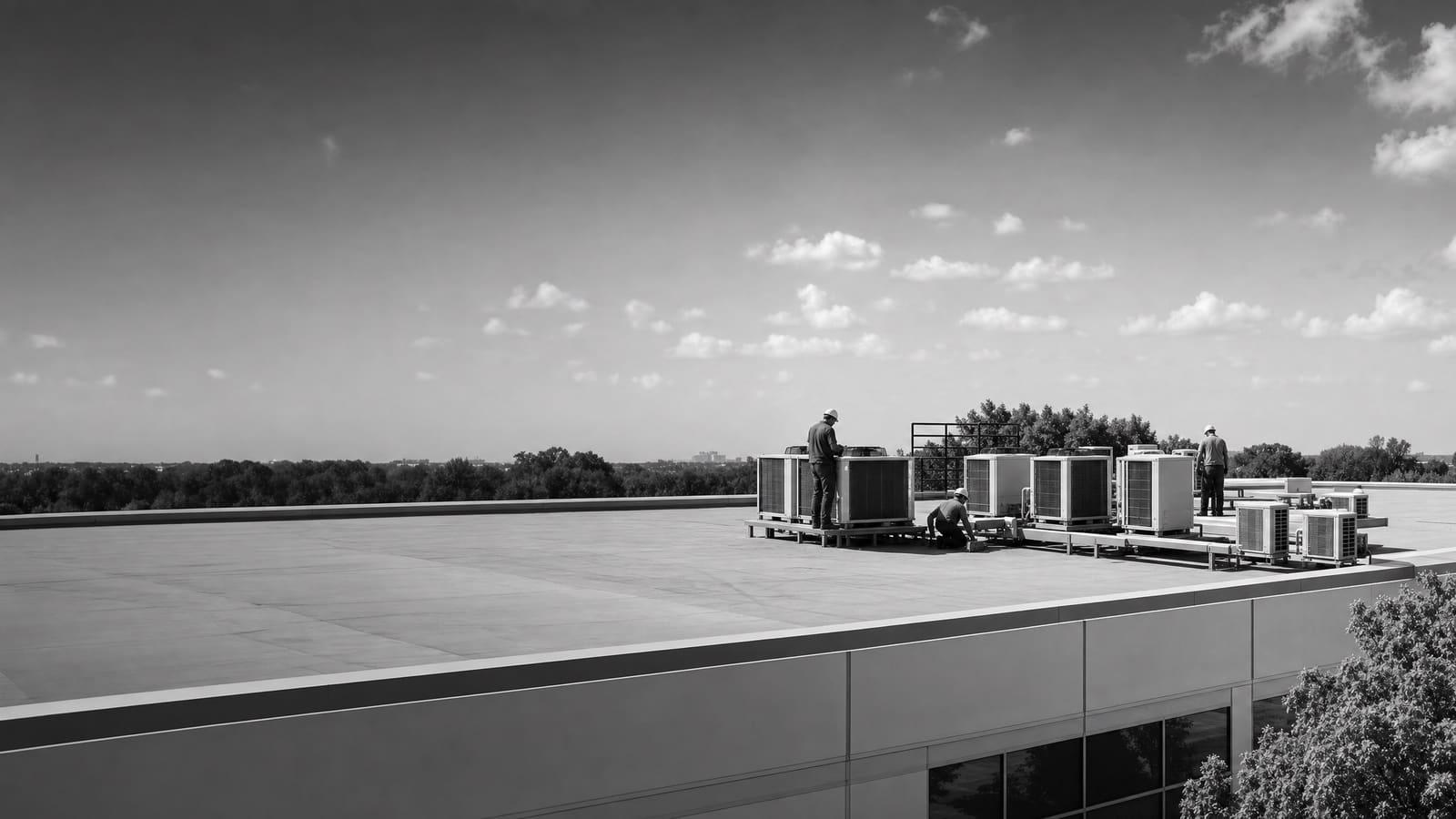
A commercial HVAC replacement is a scoped project, not a swap. It confirms the load for how the building is used today, selects equipment against real availability, handles the curb and any structural work, sets and connects the unit, integrates controls, clears permits and inspections, and commissions the result. Another repair stops making sense once a rooftop unit passes fifteen years. DOE reports that old, inefficient units waste roughly $900 to $3,700 per unit each year in energy alone.
A site review still sets the real number. It has to verify curb and roof condition, panel capacity and feeder size, gas service, refrigerant lines, and whether a crane can reach the unit from the lot.
THREE WAYS TO GO
Three replacement paths worth pricing
Most commercial replacements come down to three paths, and the right one depends on whether the building still uses its space the way it did when the old unit was sized.
Like-for-like is the fastest route back to conditioned air. It reuses the curb where possible and keeps engineering light, but it also carries forward whatever sizing mistake the old unit had.
A right-sized, high-efficiency replacement costs more to scope and usually more to buy. DOE's rooftop unit work showed that units built to its high-performance specification can cut energy use by up to half compared with the older minimum standard, so the payback shows up on every bill for the life of the equipment.
The third path is a heat pump rooftop unit. DOE treats climate zone as the first screen: heat pump heating efficiency falls as outdoor temperature drops and trends toward electric resistance, which is why cold-winter buildings look at cold-climate or dual-fuel models rather than a standard all-electric swap.
WHAT MOVES THE NUMBER
The lines that decide your installed price
No two roofs price the same, so read a quote line by line rather than as one number. These are the items that move most between buildings, and the ones a walkthrough exists to pin down before anyone orders equipment.
IN PRACTICE
Buying before the unit forces your hand
DOE's guidance is blunt about how these projects usually start: facility managers put off buying until the unit stops holding the space, needs constant service, or fails outright. Replacing on failure is the most expensive version of this project. You pay peak-season labor, you take whatever equipment is available, and you give up the chance to right-size.
Buying ahead changes the conversation. With a few months of runway you can compare a like-for-like unit against a high-performance one on installed cost plus energy, find out whether the roof needs structural work, and order before the season squeezes supply. DOE lists equipment availability as its own planning factor for a reason. The unit you want is not always the unit on the shelf.
The efficiency tier is where most owners leave money behind. A unit that has been running fifteen years or more was built to a much older standard, and the gap between it and current high-performance equipment is not a rounding error. When a replacement is happening anyway, the incremental cost of a better tier is the smallest it will ever be, because the crane, the curb work, and the connections are already paid for.
SCOPE CHECK
What makes one replacement simple and another complicated
Two buildings with identical tonnage can be very different projects. The difference is almost never the unit itself. It is everything around the unit. Sort your site into one of these before you set a budget.
LOWER COMPLEXITY
Straight swap conditions
The existing curb is sound and the new unit fits it. Gas and electrical service already match the load. A crane can set up in the lot without closing traffic, and controls are stand-alone. Permit and inspection are routine mechanical work.
HIGHER COMPLEXITY
Engineered replacement conditions
Tonnage or footprint grows, so the curb and roof framing get reviewed. Electrical service needs a capacity check, especially on an electric conversion. The unit sits over occupied tenant space, or the only workable crane position closes a drive lane.
BEFORE YOU BUY
What a real site review has to settle
A quote written from a nameplate photo is a starting number, not a price. The nameplate tells you tonnage, refrigerant, and voltage. It does not tell you whether the curb is square to the new unit, whether the roof deck under it is sound, or whether the panel has room for a larger load.
DOE's planning guidance for rooftop replacements puts infrastructure in three buckets, and they are the same three that surprise commercial owners: electrical capacity, physical constraints, and gas lines. Electrical capacity decides whether an electric or heat pump option is even on the table without a service upgrade. Physical constraints cover curb dimensions, clearances, roof access, and where a crane can reach. Gas lines matter when you are keeping combustion heat or adding a dual-fuel unit.
The next item on that list is the one owners rarely ask about: contractor availability and knowledge. Newer equipment types are not evenly supported everywhere, and a unit nobody nearby wants to service becomes an operating problem long after the install invoice clears.
Ask for these before you sign
Curb and structural findings in writing, panel capacity confirmed at the equipment, the crane position marked on a lot plan, and a stated equipment lead time. If a bidder never got on the roof, the price is provisional.
IN FARGO
Who pulls the permit and who calls for inspection
Fargo requires mechanical work to be done by a licensed contractor, and the city expects the licensed, insured mechanical contractor to obtain the permit from the Inspections office rather than leaving it to the building owner. The city says plainly that you should ask your contractor whether that has been done.
The permit starts with a Mechanical Permit Application filed with Inspections before work begins, with a working email and phone number on it so inspectors can reach the job. Inspections are not automatic either. The city asks that its mechanical inspectors be called to arrange inspection at the defined phases of the project. Commercial work also routes through the city's commercial permitting process, and the current HVAC permit fee schedule has been in effect since January 1, 2025.
One line to put in the contract
Make permit ownership explicit: the contractor pulls the Fargo mechanical permit, schedules each phase inspection, and hands you the permit number before crane day. Verify it instead of assuming it.
AFTER THE INSTALL
Two things that outlive the invoice
The install ends. The ownership does not. Two decisions made during the project quietly set your operating cost for the next fifteen years.
The first is what refrigerant is now sitting on your roof. EPA rules under Section 608 govern how refrigerant is handled and recovered in stationary air conditioning and heat pump equipment, so pulling the charge from the old unit is regulated work, and the charge in the new one shapes future service.
The second is incentives. DOE treats available incentives as a planning input rather than a bonus discovered afterward, because programs generally want paperwork started before equipment is ordered. Checking first can move you up an efficiency tier at the same net cost. Checking after the install usually means you missed it.
SERVICE PLANNING
Know what is in each unit
Track refrigerant type, charge, and install date per unit. Recovery on the old equipment is regulated work, and a fleet running several different refrigerants costs more to stock and service than one you standardize over time.
INCENTIVES
Check programs before ordering
Rebate and utility programs generally want the application in before equipment is purchased. Confirm eligibility while you are still comparing efficiency tiers, not after the crane has left the lot.
OVER TIME
Phasing a fleet instead of firefighting one unit
If you own more than one unit, the useful question is not which one to replace. It is what order to replace them in. Age is a decent first sort. Units past fifteen years are the ones DOE identifies as wasting real money, and the worst performer in a fleet almost always shows up in the service log before it shows up as a comfort complaint.
The organizations that have done this at scale treated it as a program, not a run of emergencies. Through DOE's rooftop unit campaign, more than 200 public and private organizations upgraded over 43,000 units and cut a combined $37 million a year from their energy bills. What made that work was sequencing across budget years and standardizing the spec so controls, filters, and parts matched across the fleet.
Practically, that means one decision made once. Pick the efficiency tier and control approach you want on every roof, replace to that standard as units come due, and save the emergency swap for genuine surprises. Procurement gets simpler, service gets cheaper, and you stop paying peak-season pricing to solve a problem your service history predicted.
QUOTE CHECK
Five things a comparable quote has to show
Two bids are only comparable when both show the same five things. If one is missing an item, you are not comparing price. You are comparing scope.
01
The load basis
How tonnage was determined: a load calculation from current use, or the old nameplate. The quote should say which.
02
Equipment and lead time
Model, efficiency tier, and a stated availability date sitting next to the price.
03
Curb, roof, and structural work
Curb adapter, any framing review, and who owns findings discovered once the old unit comes off.
04
Rigging and site plan
Crane position, lot closure hours, and the weather contingency.
05
Permits, inspections, commissioning
Fargo mechanical permit pulled by the contractor, phase inspections scheduled, refrigerant recovery documented, and startup readings handed over.
Get a defensible number
Price the equipment and the building together.
Send the address, operating target, and target opening date. Flux will identify what must be verified before the project can be priced.
Get a free estimateQuestions
Straight answers.
When does replacement beat one more repair?
Once a rooftop unit is past fifteen years and repairs are stacking up, the math usually flips. DOE reports old, inefficient units waste roughly $900 to $3,700 per unit each year in energy, which is a cost you pay whether or not the unit is currently broken.
Does a heat pump rooftop unit make sense in a cold climate?
DOE screens climate zone first. Heat pump heating efficiency drops as outdoor temperature falls and trends toward electric resistance, so cold-winter buildings should evaluate cold-climate or dual-fuel models rather than a standard all-electric swap, and confirm electrical capacity before committing.
Who pulls the mechanical permit in Fargo?
The licensed, insured mechanical contractor should obtain it from the city's Inspections office, and the city advises owners to ask whether it has been done. Inspections are arranged by calling the mechanical inspectors at the required phases of the project.
What is the advantage of planning a replacement instead of waiting?
Planning ahead lets you compare efficiency tiers on installed cost plus energy, find structural or electrical issues before ordering, and buy while the equipment you want is actually available. Replacing on failure removes all three of those options at once.
What happens to the refrigerant in the old unit?
EPA regulations under Section 608 of the Clean Air Act cover the handling and recycling of refrigerant in stationary air conditioning and heat pump equipment, so recovery is regulated work performed as part of the removal, and it belongs on the quote.
Sources used for this guide
- [1]betterbuildingssolutioncenter.energy.gov — DOE Advanced Rooftop Unit Replacement Guidance
- [2]betterbuildingssolutioncenter.energy.gov — DOE Commercial Heat Pump Rooftop Unit Replacement Guidance
- [3]betterbuildingssolutioncenter.energy.gov — DOE High-Efficiency Commercial Rooftop Unit Toolkit
- [4]energy.gov — DOE Efficient Commercial Rooftop Air Conditioner Program
- [5]epa.gov — EPA Stationary HVAC Refrigerant Management
- [6]fargond.gov — The City of Fargo - Heating, Ventilation & Air Conditioning (HVAC)