THE DIRECT ANSWER
What a commercial HVAC replacement actually covers
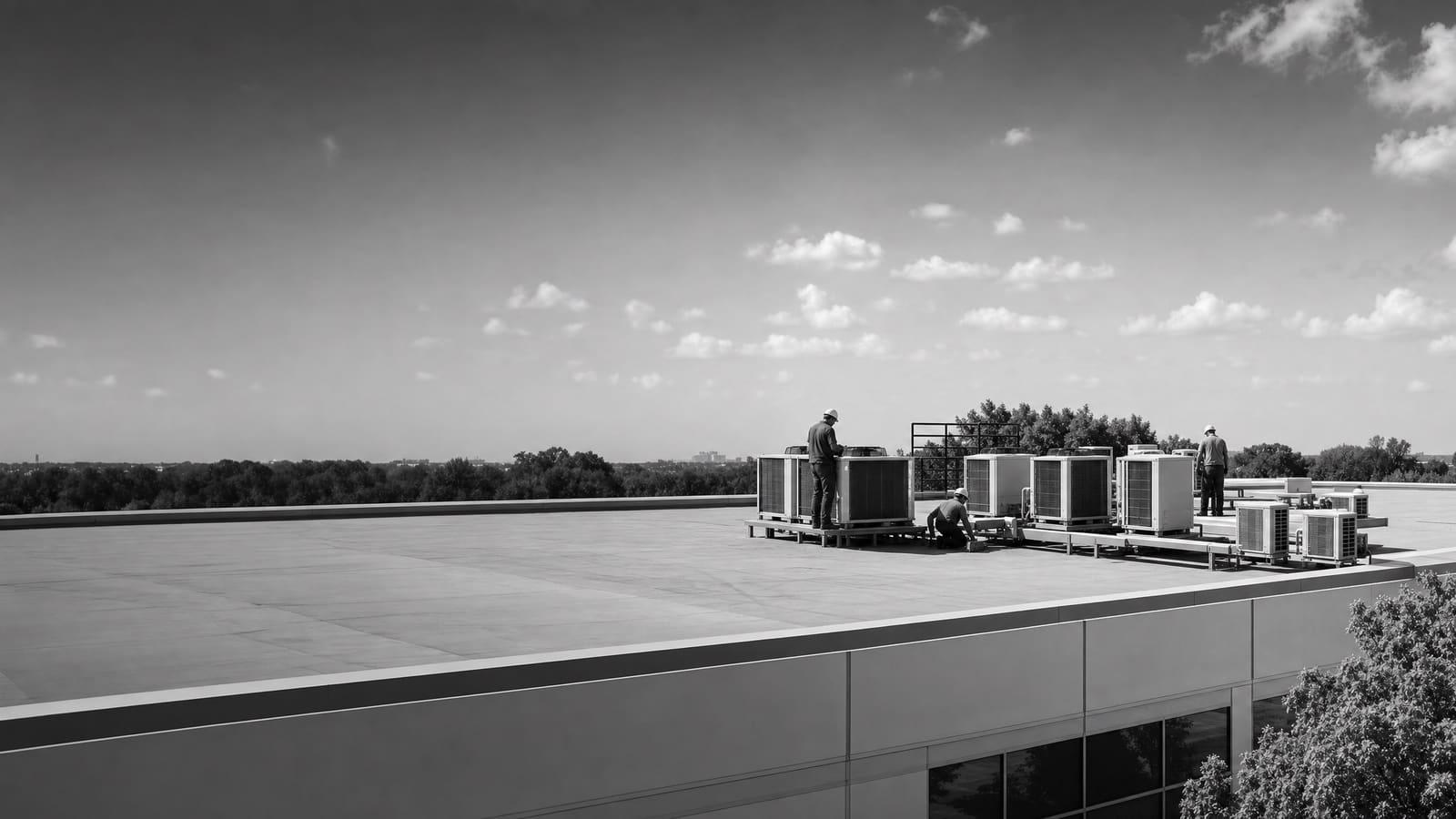
A commercial HVAC replacement covers load verification, equipment selection, rigging and set, connections for power, gas, and refrigerant, controls integration, and documented commissioning. Replacement usually beats another repair once a unit is past fifteen years and the failures repeat. An old, inefficient rooftop unit can waste $900 to $3,700 a year in energy alone, which is often more than the repair invoice you are weighing.
A site review still has to confirm the real load, the curb and roof structure, available electrical capacity, and crane access before any of those numbers mean anything for your building.
THE THREE CHOICES
Like-for-like, high-efficiency, or heat pump
Rooftop units condition close to half of all commercial floor space in the country, so for most buildings this is a rooftop decision before it is anything else. Start by asking what the old unit did wrong. If the space stayed comfortable and the bills stayed flat, a matching unit on the same curb is usually the cheapest good answer. If the bills crept up, an efficiency tier above the minimum can pay for itself over the service life. A federal minimum efficiency standard finalized a decade ago raised the floor for every new unit, and the high-performance specification that preceded it targeted equipment using up to half the energy of the older baseline. If fuel is also on the table, a heat pump rooftop unit puts reverse-cycle heating in the same box. Price all three the same way, because each one changes the permit path, the electrical scope, and the lead time differently.
WHAT MOVES THE NUMBER
The six lines that set the price
Nobody can price a roof from a search result. These are the lines that move the number most, and the ones worth asking about before a bid ever arrives.
REPAIR OR REPLACE
Why planned replacement beats waiting for the failure
Most buildings replace rooftop equipment the hard way. The unit limps, gets patched, limps again, and then quits during the hottest week of the year. Facility teams tend to wait until a unit no longer conditions the space, needs frequent service, or fails outright. That is understandable, and it is also the most expensive version of this project. Emergency replacement removes every choice worth having. You take whatever tonnage sits in the regional warehouse, you pay for the crane on someone else's schedule, and you skip the efficiency comparison entirely.
Planned replacement flips that. Swapping an aging, underperforming unit before it fails is often the smarter business move, and not only against replacement-on-failure. It can also beat a like-for-like swap at the end of the unit's useful service life, because you still have the leverage to price the efficiency tier properly.
The practical trigger is age plus pattern. Once a unit is past fifteen years and the service history shows repeat failures in the same season, another repair buys months, not years. At that point, weigh the repair invoice against the energy the old unit wastes every year it keeps running. The number that matters is not this repair. It is the next three years.
SIDE BY SIDE
What makes one roof simple and another complicated
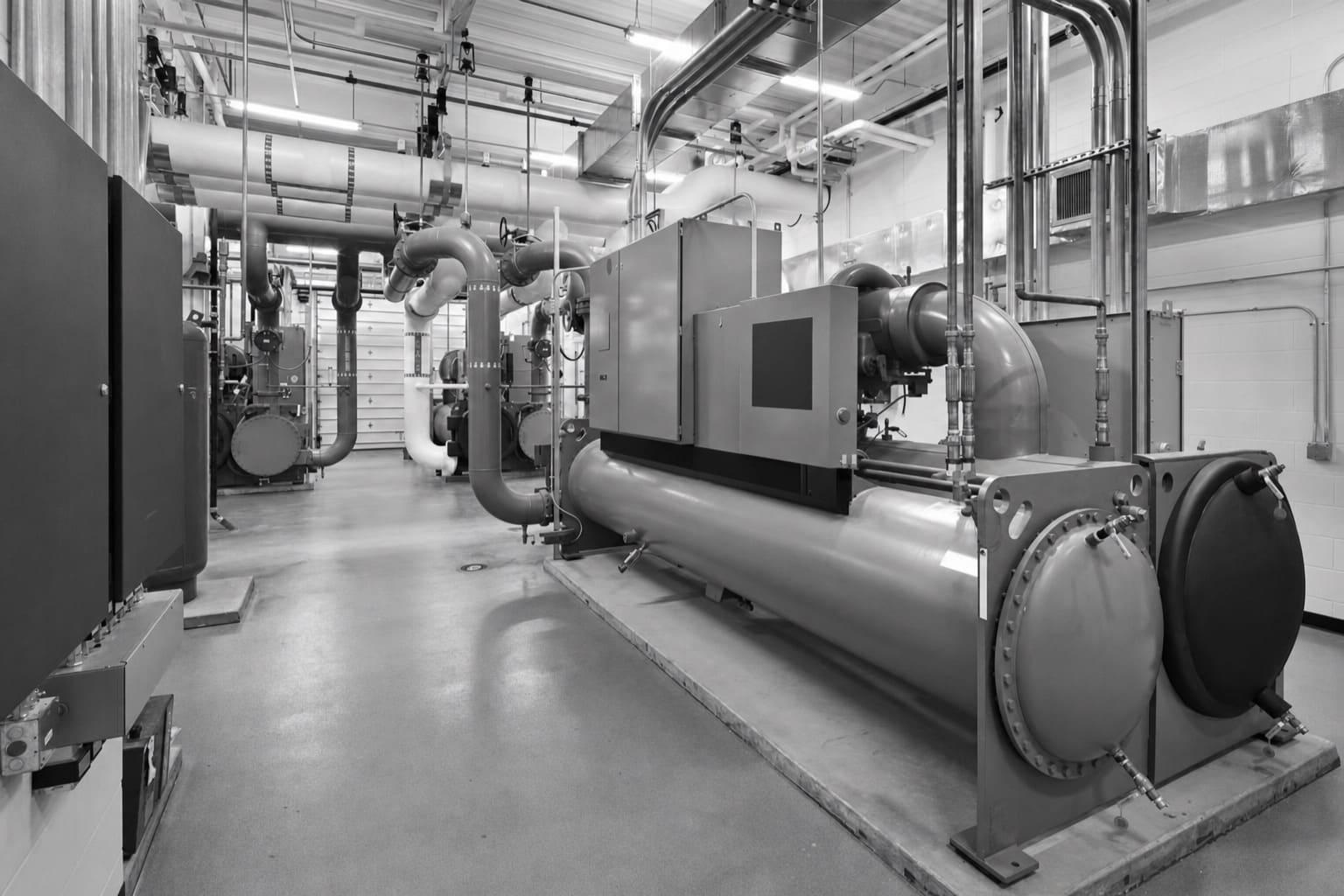
Two buildings on the same street can quote very differently. The difference is rarely the equipment itself. It is what the unit sits on, what feeds it, and how a crane reaches it.
LOWER COMPLEXITY
Straight swap conditions
Same tonnage and footprint, an existing curb in sound condition, adequate electrical capacity already at the roof, and open lot space for a crane. The permit path stays mechanical and electrical, and the set happens in a single visit.
HIGHER COMPLEXITY
What stretches the schedule
Larger tonnage, a different footprint, tight or shared parking, limited service capacity, or a fuel switch that adds electrical work. Structural review, longer equipment lead times, and phased outages all follow from those conditions.
SCOPING IT RIGHT
What a site review has to confirm
A quote that arrives without anyone visiting the roof is a guess with a dollar sign attached. The walk-through exists to answer a short list of questions, and every one of them can change the price or the schedule.
Load comes first, calculated from how the space is used now. Twenty years of tenant changes, added equipment, and envelope work rarely leave the original nameplate correct. Infrastructure comes next: available electrical capacity, physical constraints on the roof, and what happens to the existing gas line if the new unit no longer needs it. Then equipment availability, because a model that fits perfectly and ships in four months may lose to a good model that ships in three weeks. Utility bill impact belongs in the same conversation, since local electricity and gas prices decide whether an electric option actually saves money or simply moves the cost from one bill to another. Incentives and program applications belong at the front too, because most have to be lined up before purchase rather than after.
Refrigerant handling is not optional. EPA rules under the Clean Air Act govern how refrigerant is recovered and recycled when equipment is serviced or taken out of service, and that work belongs to certified technicians on the installing crew.
Ask for the checklist, not just the number
Before anyone prices equipment, get written answers on load, electrical capacity, curb and roof condition, quoted lead time, and refrigerant recovery. A contractor who can answer those five has actually looked at your building.
AFTER THE CRANE LEAVES
Two things owners underestimate
The installation is one morning of visible work. Ownership runs for the rest of the unit's service life. Two decisions made during the project quietly set how that whole period goes: who can service what you bought, and how well the equipment on your roof matches itself. Neither one shows up as a line on the invoice, and both show up in every service call afterward. Newer equipment types make this sharper, because contractor availability and technician knowledge are part of the buying decision, not an afterthought once the unit is running.
SERVICE DEPTH
Who maintains it after year one
Confirm that the people installing the unit also service that product line locally, and that parts move through a supply house you can reach during the season you actually need them.
FLEET STRATEGY
Mixed roofs get expensive
Older units on legacy refrigerant carry recovery and handling requirements whenever they are serviced or retired. A roof running mixed vintages needs a service contract and spare-parts plan that accounts for the split.
PHASING AND LIFETIME COST
How to sequence a multi-unit roof
Buildings with several units rarely need to replace them all at once, and the ones that try usually pay for the privilege. The better pattern is to rank the units by age, service history, and how much floor area each one serves, then replace the worst one or two per budget cycle while the rest stay on maintenance. Large organizations have run this play at scale. One national upgrade campaign reported more than two hundred public and private organizations replacing or retrofitting over forty-three thousand rooftop units, cutting a combined thirty-seven million dollars a year from their energy bills. That came from sequence and volume, not from a single heroic project.
Phasing also buys standardization. If the first replacement is specified well, the next two get easier: the same manufacturer line, the same controls approach, and a crew that already knows the roof. Purchasing gets simpler, and so does stocking parts.
The lifetime math is the part most budgets miss. Equipment price is a one-time line. Energy is a monthly line for the entire service life, and the annual waste figures above are per unit, every year, until the unit comes off the roof. Price the efficiency decision against a decade and a half of operation, not against this quarter.
COMPARING BIDS
Five things a comparable quote shows
Two bids for the same roof can differ widely and both be honest, because they are not scoping the same work. These five lines make them comparable.
01
Equipment, spelled out
Manufacturer, model, tonnage, efficiency tier, and heating type. Not just "new rooftop unit."
02
Lead time next to the price
Quoted availability for that exact model, plus the named alternate if the date slips.
03
Curb, structural, and rigging scope
Who supplies the curb adapter, who carries the structural review, and what the crane day includes.
04
Electrical, gas, and refrigerant work
Every connection change on the way in, including recovery and disposal of the old charge.
05
Commissioning and closeout
Documented startup, airflow and charge verification, controls setup, permits, inspections, and warranty registration.
Get a defensible number
Price the equipment and the building together.
Send the address, operating target, and target opening date. Flux will identify what must be verified before the project can be priced.
Get a free estimateQuestions
Straight answers.
When does replacement beat another repair?
Age plus pattern. Once a unit is past fifteen years and the same failures keep returning, repairs buy months. Weigh the repair against the energy an old, inefficient unit already wastes each year, which can run from $900 to $3,700 for a single rooftop unit.
Should we replace like-for-like or resize?
Confirm the load either way. If the space and its use have not changed, a matching unit on the same curb is often correct. If occupancy, equipment, or the envelope changed, right-sizing fixes comfort problems the old unit could never solve.
Is a heat pump rooftop unit the right call?
It depends on winter heating hours, local electricity and gas prices, and whether the building has the electrical capacity. Heat pump efficiency drops as outdoor temperatures fall, which is why dual-fuel and cold-climate versions exist for colder locations.
What actually drives the schedule?
Equipment lead time, not the set itself. A model that fits perfectly but ships months out can lose to a good model available in weeks. Availability belongs on the quote next to the price so the decision stays schedule-aware.
What happens to the refrigerant in the old unit?
EPA rules under the Clean Air Act govern how refrigerant is recovered and recycled when equipment is serviced or removed. Certified technicians handle it, and the recovery and disposal scope should appear on the installed price, not as a later add-on.
Sources used for this guide
- [1]betterbuildingssolutioncenter.energy.gov — DOE Advanced Rooftop Unit Replacement Guidance
- [2]betterbuildingssolutioncenter.energy.gov — DOE Commercial Heat Pump Rooftop Unit Replacement Guidance
- [3]betterbuildingssolutioncenter.energy.gov — DOE High-Efficiency Commercial Rooftop Unit Toolkit
- [4]energy.gov — DOE Efficient Commercial Rooftop Air Conditioner Program
- [5]epa.gov — EPA Stationary HVAC Refrigerant Management