THE DIRECT ANSWER
What a commercial HVAC replacement actually includes
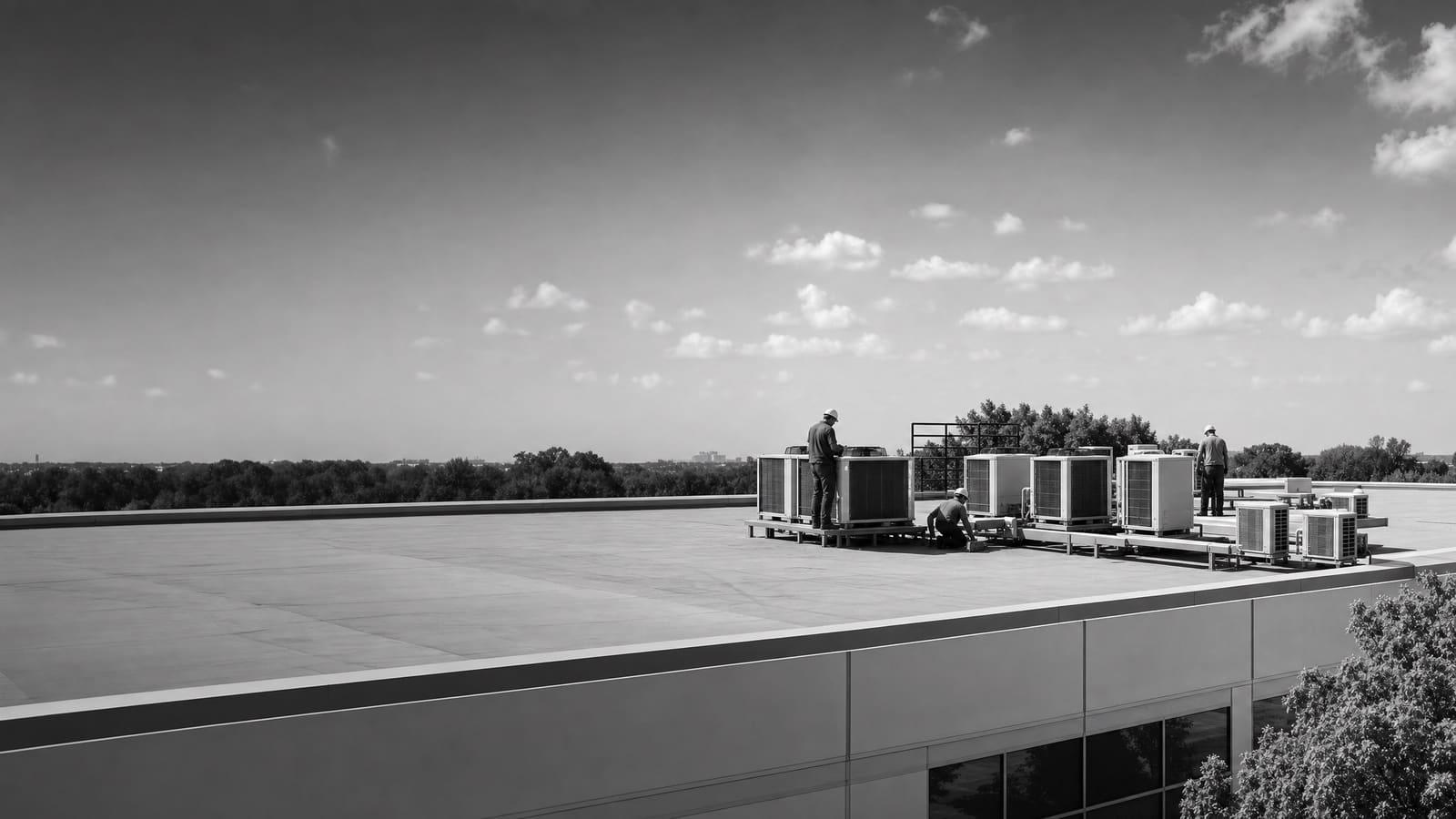
A commercial HVAC replacement covers load confirmation, equipment selection against real lead times, rigging and roof work, permits and inspection, and commissioning before handoff. Replacement beats another repair once a unit is past roughly fifteen years and still failing. Federal analysis puts the waste from an old, inefficient rooftop unit at $900 to $3,700 per unit each year. That is money the building spends whether or not the compressor holds.
A site review has to verify tonnage against today's occupancy, curb and structural condition, available electrical capacity, gas line status, and crane reach across your lot. Those five items decide the price more than the model number does.
THREE WAYS TO GO
Three replacement paths worth pricing
Most buildings have three honest options. The right one depends on how much the space changed since the last unit went in.
A like-for-like swap is the fastest way back to conditioned air. Same curb, same connections, simple permit. It also carries forward whatever sizing mistake the old unit had.
A right-sized replacement starts from a fresh load calculation. It costs more design time up front, and it fixes comfort complaints the old unit was never able to fix.
An electric or dual-fuel heat pump unit is the third path. DOE guidance says heat pump rooftop units are best suited to mild-to-moderate winter heating, and that in most of the West today's units can cover most or all of the winter heating demand. Fairfield sits in that mild-winter West. The real question is not whether the equipment works. It is whether your panel has spare capacity, whether the gas line stays or goes, and whether the incentive math holds on your rates.
WHAT MOVES THE NUMBER
Where a replacement budget actually goes
The unit itself is rarely the line that surprises anyone. The surprises come from what the roof, the panel, and the parking lot make you do to get it up there. Ask for these as separate lines so you can see which one is driving the total.
BUYING GUIDANCE
How to choose equipment without overpaying
Start with age and behavior, not the failure. DOE notes that rooftop units past fifteen years can waste substantial energy compared with newer models, and that most facility teams wait until a unit stops holding the space, needs constant service, or dies outright. Waiting is the expensive version. A unit replaced on your schedule gets competitive bids, a planned crane day, and an off-hours set. The same unit replaced in August gets whatever is on the truck.
Efficiency tier is the next real decision. DOE's high-performance rooftop specification pushed manufacturers to build units that cut energy use by up to half against the standard in place at the time, and more than twenty models now exceed that specification. The upgrade path is proven at scale: organizations in the DOE Advanced RTU Campaign upgraded more than 43,000 units and reported a combined $37 million a year in energy savings. That is the argument for buying above minimum on equipment you will own for two decades.
Then check what the tier costs you elsewhere. A higher tier often means a heavier unit and sometimes a larger footprint, and both land on the curb, the crane, and the structural review. Ask for the efficient option and the base option as two complete installed prices, not two equipment prices.
COMPLEXITY CHECK
What makes this job simple or hard
Two replacements at the same tonnage can sit a week apart on the calendar and far apart on price. The difference is almost never the unit. It is the roof, the power, and the access.
LOWER COMPLEXITY
Straight swap on a clear roof
Same tonnage and same fuel, an existing curb that takes a standard adapter, gas and electrical service already sized for the load, and a lot where the crane can set up without closing a drive aisle. The filing stays a routine mechanical and electrical permit.
HIGHER COMPLEXITY
Fuel switch, tight site, or growth
Going all-electric on a panel with no spare capacity, adding enough tonnage to need structural review, or a roof the crane can only reach from a street that needs a closure. Each one adds a trade, a review, and calendar time before anything gets set.
SCOPING THE JOB
What a real site review has to confirm
A quote written from a nameplate photo is a starting number. A quote you can hold someone to comes from a roof visit. DOE's heat pump rooftop guidance lists the items that decide feasibility: climate and heating load, utility bill impact, building type, equipment availability, electrical capacity, physical constraints, gas lines, contractor experience, and incentives. That list works just as well for a straight air conditioning replacement.
On the roof, the reviewer should confirm curb dimensions and condition, deck and structural support, clearances around the unit, and where condensate and gas lines actually run. Inside, they should open the panel and read available capacity instead of assuming it. In the lot, they should walk the crane path and count the stalls that come out of service on the set day.
The last item is the one buyers skip: refrigerant. EPA Section 608 rules govern how refrigerant is handled and recovered from stationary air conditioning and heat pump equipment, so the old charge has to be recovered by a certified technician and documented, not vented. New equipment also ships on newer low-GWP refrigerants, which matters for how you stock parts and write service contracts across a mixed fleet.
Ask for the panel reading in writing
Available electrical capacity is the single item most likely to turn a clean swap into a change order. Have the contractor record measured spare capacity at the panel, the feeder size, and the disconnect rating in the proposal, before you sign anything with an electric unit on it.
IN FAIRFIELD
Permits, and the roof work to pull at the same time
California building divisions require a permit for mechanical work, and separately for electrical and plumbing upgrades or repairs. A rooftop replacement usually touches at least two of those, so plan on a mechanical permit plus an electrical permit rather than one filing. Confirm current requirements and fees with the City of Fairfield building division before your contractor sets a date, and make the contractor responsible for pulling and closing them as part of the installed price.
One scheduling decision follows from that. Re-roofing is separately permitted, for both overlay and tear-off. If your roof is anywhere near its own replacement, do not set new equipment and then re-roof around it a year later. Sequence the roof first, or run both under one coordinated schedule. Setting a unit on a roof that is about to come off means paying for the crane twice.
One question for the building division
Ask whether your replacement is treated as a like-for-like change-out or as new work once tonnage or footprint grows. The answer decides how much review the filing needs, and it can move your start date by weeks.
OWNERSHIP MATH
Two things to settle before you sign
Replacement is a twenty-year decision usually made in about two weeks. The two items below get decided by default if nobody raises them, and both are expensive to revisit after the crane leaves.
The first is who carries schedule risk. Equipment availability is a real variable, and a quote that names a price without naming a lead time has quietly moved that risk to you. The second is who owns performance after startup. A unit that turns on is not a unit that performs to spec. Charge, airflow, and control setpoints all have to be verified and written down, or you inherit the gap as a comfort complaint in month two and a warranty argument in year three.
LEASED SPACE
Who pays and who approves
In a leased building, the replacement usually needs landlord approval and may be recoverable through operating expenses. Settle approval, cost allocation, and who holds the warranty before the equipment is ordered, not after it lands.
MULTI-UNIT ROOFS
Replace one or stage the fleet
If several units share an age, replacing one at a time means repeating mobilization, crane setup, and permits. Staging two or three in a single window usually costs less per unit and gives you one inspection cycle.
PHASING AND LIFETIME COST
Replacing a roof full of units without one big bill
Most buildings do not have one dying unit. They have four units of the same age, and one of them went first. That is a procurement problem more than a mechanical one.
Start by putting each unit's age, tonnage, refrigerant, and service history on one page. Anything past fifteen years goes on the replace list whether or not it is failing today, because DOE guidance is clear that units in that range waste money against current equipment, and because replacement on failure is the most expensive version of the same purchase. Anything younger goes on a watch list with a controls check instead.
Then group the replace list into windows. Two units in one crane day is cheaper than two crane days. A shoulder-season window in spring or fall keeps crews off the roof during peak load and usually buys better contractor availability than August does.
Finally, price the fleet instead of the unit. Ask for a single proposal covering the full replace list with per-unit pricing, current lead times, and a price hold for a defined period. That gives you a budget number you can take to ownership and a schedule you control, rather than one the equipment picks for you.
QUOTE CHECKLIST
Five lines every comparable quote must show
Two bids that look thousands apart are usually just scoped differently. Make every bidder show these five lines in the same order, and the comparison becomes an actual comparison instead of a guess.
01
Equipment, tier, and lead time
Model, tonnage, efficiency tier, refrigerant, and the quoted lead time in weeks. A price without a date is not a quote.
02
Curb, structural, and roof scope
Adapter or new curb, any structural review, and who patches and flashes the roof around the opening.
03
Electrical and gas scope
Measured panel capacity, feeder and disconnect work, and whether the gas line is reused, capped, or removed.
04
Crane, access, and hours
Crane size, staging location, stalls closed, and whether the set happens off-hours or during business hours.
05
Permits, commissioning, and closeout
Which permits are pulled and by whom, refrigerant recovery documentation, startup verification, and the closeout package you receive.
Get a defensible number
Price the equipment and the building together.
Send the address, operating target, and target opening date. Flux will identify what must be verified before the project can be priced.
Get a free estimateQuestions
Straight answers.
How much does a commercial HVAC replacement cost in Fairfield?
There is no single installed price, because tonnage, curb work, electrical scope, and crane access move the number more than the unit does. The figure worth anchoring on is the operating side: federal analysis puts the annual waste from an old, inefficient rooftop unit at $900 to $3,700 per unit. Get two complete installed prices, base tier and high tier, and weigh them against that.
When is replacement better than one more repair?
When the unit is past about fifteen years, needs frequent service, or no longer holds the space. DOE guidance is direct about this pattern: teams that wait for total failure pay more than teams that replace proactively, because a dead unit removes your leverage on price, equipment choice, and schedule all at once.
Does a rooftop replacement need a permit?
Plan on it. California building divisions require permits for mechanical work, and separately for electrical and plumbing upgrades or repairs, so a typical replacement is at least two filings. Confirm current requirements with the City of Fairfield building division, and make the contractor responsible for pulling, scheduling, and closing the permits.
Should we switch to a heat pump rooftop unit?
It is usually worth pricing here. DOE guidance says heat pump rooftop units suit mild-to-moderate winter heating, and that in most of the West today's units can cover most or all of the winter heating load. The deciding factors are spare capacity at your panel, what happens to the gas line, and current incentive terms.
What happens to the refrigerant in the old unit?
It gets recovered by a certified technician, not vented. EPA Section 608 rules govern refrigerant handling and recovery for stationary air conditioning and heat pump equipment, and that recovery should be documented in your closeout package. New equipment ships on newer low-GWP refrigerants, which changes parts stocking on a mixed fleet.
Sources used for this guide
- [1]betterbuildingssolutioncenter.energy.gov — DOE Advanced Rooftop Unit Replacement Guidance
- [2]betterbuildingssolutioncenter.energy.gov — DOE Commercial Heat Pump Rooftop Unit Replacement Guidance
- [3]betterbuildingssolutioncenter.energy.gov — DOE High-Efficiency Commercial Rooftop Unit Toolkit
- [4]energy.gov — DOE Efficient Commercial Rooftop Air Conditioner Program
- [5]epa.gov — EPA Stationary HVAC Refrigerant Management
- [6]californiacity-ca.gov — HVAC Permits