THE DIRECT ANSWER
What a commercial HVAC replacement actually includes
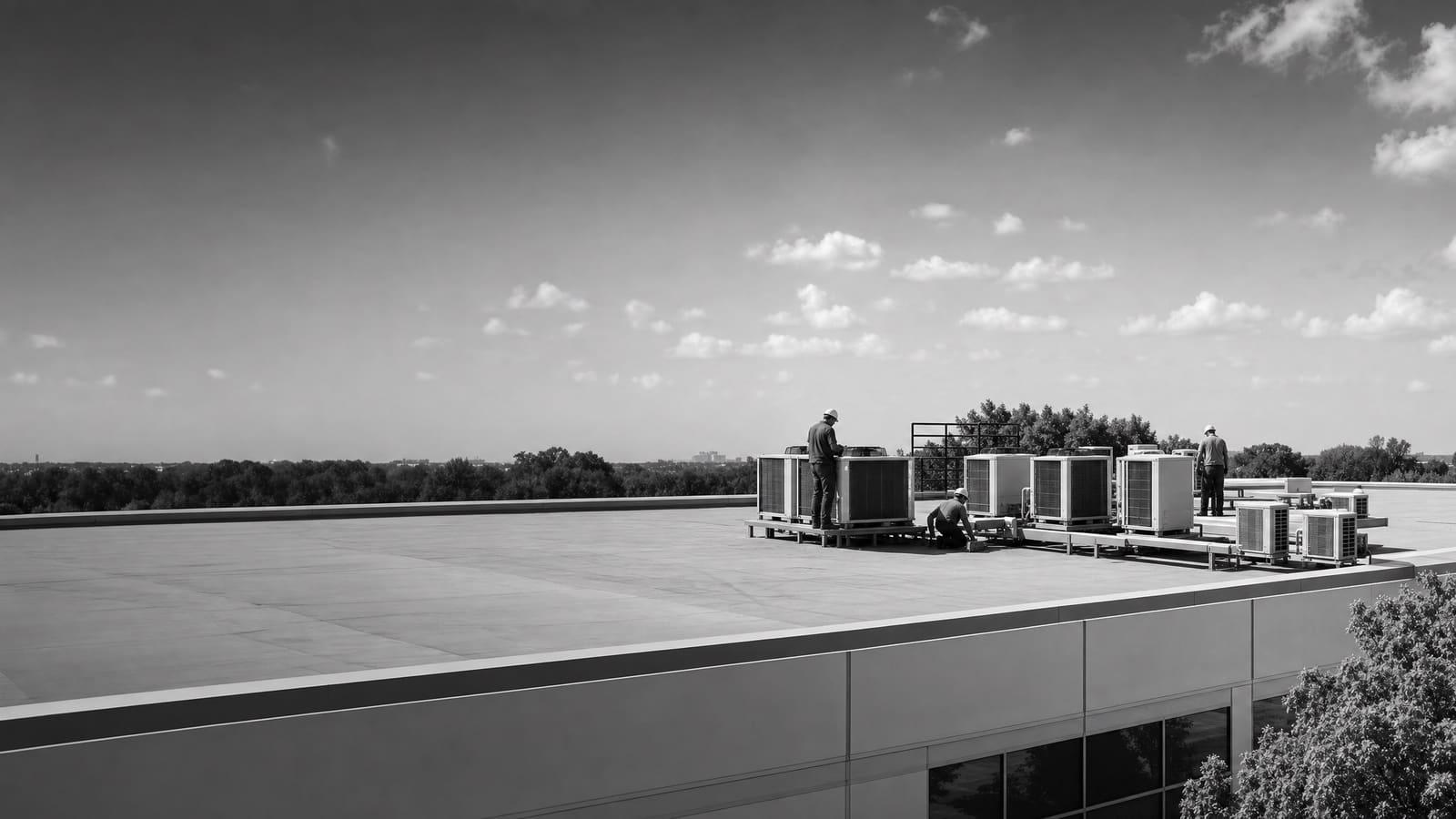
A commercial HVAC replacement covers load verification, equipment selection, permits, rigging and set, gas or electrical connections, controls integration, and commissioning. Replacement beats another repair once a unit is past about fifteen years and the faults keep returning — federal guidance notes those units waste substantial energy, and an old, inefficient rooftop unit can burn an estimated $900 to $3,700 a year on its own. Rooftop equipment conditions close to half of all U.S. commercial floor space, so for most buildings this is a rooftop decision.
A site review still has to confirm the actual load, the curb and roof structure, available electrical capacity, the gas service, and crane access before any of those numbers mean anything for your building.
THREE PATHS
Three ways to handle a unit at end of life
Federal guidance describes the same pattern in most buildings: teams delay replacing a rooftop unit until it can no longer hold the space, needs constant service, or fails outright. Replacing proactively with a more efficient unit is usually the better business move — better than replacement-on-failure, and often better than a like-for-like swap at the end of service life. There is a middle option too. A unit that still has life left can sometimes be retrofitted with advanced controls instead, and DOE treats that as a straight financial comparison rather than a rule. Which path fits comes down to three things: how old the unit is, how much of your maintenance budget it eats, and whether you still get to pick the install date. Once the unit picks the date for you, every other variable gets worse.
WHAT MOVES THE NUMBER
The budget lines that actually swing
Nobody can price a commercial unit from a phone call, because the equipment is often the smaller half of the job. These are the lines that separate two quotes written on the same building.
EQUIPMENT CHOICE
Choosing the equipment before you choose the price
The biggest equipment decision is whether the new unit heats with gas, with a compressor, or with both. A heat pump rooftop unit is mechanically close to a standard air-conditioning rooftop unit — it runs the refrigerant cycle in reverse to heat — so it fits the same general footprint. Manufacturers build three broad versions: dual-fuel units that pair heat pump heating with a gas furnace, all-electric units, and cold-climate units designed to hold capacity further down the temperature scale.
Heat pump efficiency falls as the outdoor temperature drops, and near the bottom of the range it trends toward parity with electric resistance heat. Ask which winter design temperature the contractor modeled, what the unit delivers at that temperature, and what the backup heat costs when it runs. Federal guidance lists the gates that settle this before economics do: electrical capacity, physical space on the roof, the existing gas line, real equipment availability, and whether the installing crew has done the technology before.
Efficiency tier matters as much as fuel. Units built to the high-performance specification DOE developed with manufacturers were designed to cut rooftop energy use by up to half against the older standard, and more than twenty models now exceed that spec.
TWO KINDS OF PROJECT
What makes one replacement simple and another complicated
Two replacements on the same block can be a week apart in effort. The gap is almost never the unit itself — it's what the unit has to land on and connect to.
LOWER COMPLEXITY
Same size, same fuel, open roof
The load hasn't changed, the new unit matches the existing curb and connections, the crane has a clear setup spot, and the space can go part of a day without conditioning.
HIGHER COMPLEXITY
New footprint, new fuel, tight site
Resizing, an electric path that outgrows the panel, structural work under the curb, night-only crane access, or a tenant who cannot lose a shift. Each one adds trades, permits, and calendar.
THE SITE REVIEW
What a scoping visit has to settle
A replacement quote is only as good as the visit behind it. The first thing to settle is load. Sizing off the old nameplate assumes nothing about the building has changed in fifteen or twenty years, and something almost always has — occupancy, plug loads, lighting, partitions, hours. An oversized unit short-cycles and never fixes the comfort complaint that started the conversation.
The second is infrastructure. The reviewer should open the panel and read the available capacity, look at the roof structure under the curb, trace the gas line, and confirm where refrigerant lines and condensate run. On an all-electric path, this step decides the project. A unit that needs more service than the building has is not an equipment problem; it is a switchgear and utility problem with its own schedule and its own number.
The third is access and timing. Crane position, lot closure, delivery staging, allowable work hours, and the weather call belong in the scope, not in a change order. So does commissioning: startup, charge, airflow, and control settings verified against spec and documented, because that record is what holds the warranty.
Ask for the load calculation, not the nameplate
If a contractor quotes tonnage without measuring or modeling the current load, you are buying the last owner's assumptions. Ask which method was used, what occupancy and schedule went into it, and what the result was — then compare prices.
OWNERSHIP REALITIES
Two things that outlive the install
Two costs land after the crane leaves. The first is refrigerant. New commercial equipment ships on newer low-GWP refrigerants, and EPA rules under Section 608 of the Clean Air Act govern how refrigerant is handled, recovered, and recycled in stationary air-conditioning and heat pump equipment. That applies to the unit coming off the roof as much as the one going on. The second is fleet consistency. Once one unit is replaced, the building runs a mixed fleet — two refrigerants, two control platforms, two parts shelves — until the others catch up. Neither is a reason to delay. Both are reasons to decide deliberately instead of unit by unit.
REFRIGERANT
Recovery is regulated work
Section 608 rules cover handling, recovery, and recycling on stationary AC and heat pump equipment. The removal side belongs in the written scope and on the invoice, with documentation you keep.
FLEET
Mixed fleets cost attention
Different refrigerants and control platforms on one roof mean two service procedures and two parts strategies. Worth setting a standard now, even if the remaining units get replaced years apart.
PHASING AND PROCUREMENT
When you own more than one aging unit
If the roof holds several units near the end of their lives, sequencing is worth more than shopping the price. DOE's Advanced RTU Campaign tracked more than 200 organizations that upgraded over 43,000 rooftop units, and the reported result was a combined $37 million saved on energy bills every year. Numbers at that scale come from treating replacement as a program with a schedule, not as a string of emergencies.
Rank the fleet by three things: age, service spend over the last two years, and how badly the space suffers when that specific unit stops. Units past fifteen years with a repair history are the ones quietly draining the budget — an old, inefficient rooftop unit can waste somewhere between $900 and $3,700 a year by itself. Multiply that across a roof and the payback math changes.
Procurement follows the same logic. Equipment availability is a real constraint, so lock the specification early and let lead time set the install date instead of discovering it the week something fails. Where a unit is newer than the fleet average but underperforming, DOE frames an advanced controls retrofit as a legitimate alternative to replacement — a financial comparison, not a philosophy.
BEFORE YOU SIGN
Five things a comparable quote shows
Two quotes are only comparable when both show the same things. Ask for these five in writing, then weigh price against price.
01
Model, efficiency tier, refrigerant, and availability
The exact unit, its rated efficiency, the refrigerant it uses, the load calculation the tonnage came from, and when it can actually ship.
02
Curb, adapter, and structural scope
Whether the unit lands on the existing curb, what adapter or framing is included, and who carries the cost if the roof needs work.
03
Electrical and gas scope
Panel capacity confirmed in writing, feeder or service work included or excluded, and what happens to the existing gas line.
04
Rigging, access, and outage window
Crane plan, lot closure hours, staging, and how long the space goes without conditioning.
05
Commissioning and documentation
Startup, charge, airflow, and control settings verified against spec, with a written record and refrigerant recovery documented.
Get a defensible number
Price the equipment and the building together.
Send the address, operating target, and target opening date. Flux will identify what must be verified before the project can be priced.
Get a free estimateQuestions
Straight answers.
When does replacement beat one more repair?
When the faults keep returning and the unit is past about fifteen years, a repair is buying time on a machine that is already expensive to run. Federal guidance is that replacing proactively usually beats waiting for failure, because failure takes away your choice of unit, date, and price. If the unit is newer but underperforming, price an advanced controls retrofit against replacement before deciding.
Should the new unit be a heat pump?
Heat pump rooftop units are mechanically similar to standard air-conditioning rooftop units and add reverse-cycle heating. Their efficiency falls as outdoor temperature drops, and near the bottom of the range it approaches electric resistance heat, so the answer depends on the winter design temperature used in the model and what backup heat costs to run. Electrical capacity is the other gate: all-electric and cold-climate units often need more service than the building currently has.
How much does a commercial rooftop replacement cost?
There is no honest universal number, because tonnage, efficiency tier, curb and structural work, electrical capacity, and crane access each move it independently. What can be said is what the old unit costs you: an inefficient rooftop unit wastes an estimated $900 to $3,700 a year. Get an installed price tied to a real site review and to confirmed equipment availability, not a phone estimate.
What happens to the refrigerant in the old unit?
EPA rules under Section 608 of the Clean Air Act cover the handling, recovery, and recycling of refrigerant in stationary air-conditioning and heat pump equipment, including the unit being removed. Recovery is regulated work and should appear in the scope with documentation you keep. New equipment ships on newer low-GWP refrigerants, which matters for parts and service planning across a mixed fleet.
Is it better to replace several units at once?
Often yes — one mobilization, one crane day, one permit cycle, and a consistent fleet afterward. Rank candidates by age, recent service spend, and how much the space suffers when that unit fails. Where budget forces phasing, set the specification once so units installed years apart still share parts, controls, and service procedures.
Sources used for this guide
- [1]betterbuildingssolutioncenter.energy.gov — DOE Advanced Rooftop Unit Replacement Guidance
- [2]betterbuildingssolutioncenter.energy.gov — DOE Commercial Heat Pump Rooftop Unit Replacement Guidance
- [3]betterbuildingssolutioncenter.energy.gov — DOE High-Efficiency Commercial Rooftop Unit Toolkit
- [4]energy.gov — DOE Efficient Commercial Rooftop Air Conditioner Program
- [5]epa.gov — EPA Stationary HVAC Refrigerant Management