THE DIRECT ANSWER
What a commercial HVAC replacement actually includes
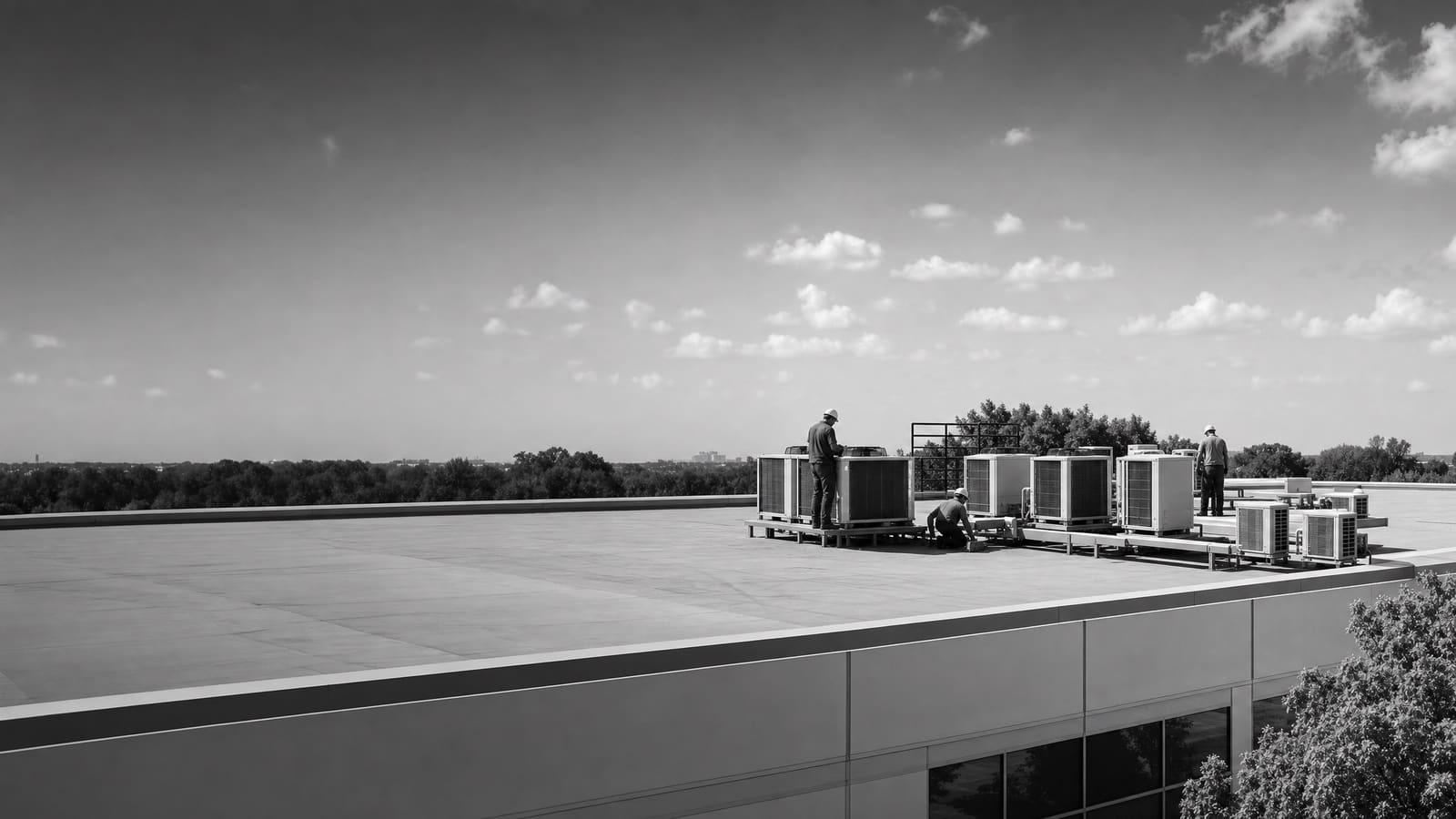
A commercial HVAC replacement covers load verification, equipment selection, rigging and set, the curb or curb adapter, gas, electrical and refrigerant connections, controls integration, permits, and commissioning. Replacement starts beating another repair once a unit is past roughly fifteen years and failing often, because old and inefficient rooftop units waste an estimated $900 to $3,700 per unit each year. Rooftop equipment conditions nearly half of all U.S. commercial floor area, so most buildings face this decision more than once.
A site review has to confirm actual load against how the space is used now, the curb and the roof structure under it, available electrical capacity, and how a crane reaches the unit.
THREE PATHS
The three real choices when a unit reaches end of life
Most owners land on one of three paths, and the right one depends on how the unit is failing and how long you plan to hold the building. Federal guidance is blunt about the common default: facility teams delay until the unit no longer conditions the space, needs constant service, or quits entirely, then buy whatever ships fastest. That is the most expensive way to decide, because the emergency removes every option that needed lead time. Choosing a season early keeps all three paths open. Repair still wins when a single component failed on a unit with years of service left. Straight replacement wins when the failure pattern repeats and the unit is old enough that the waste shows up in the bill. The upgrade path wins when you hold the building long enough to collect the savings, and when the roof, the panel, and the existing service can support the change without turning into a second project.
WHAT MOVES THE NUMBER
The lines that separate two quotes on the same roof
Two quotes on the same building rarely differ much on the equipment. They differ on what each contractor assumed about everything around it. Force these lines into writing before you compare anything.
IN PRACTICE
How to choose equipment without guessing
Start with the load, not the nameplate. A unit installed twenty years ago was sized for that building's occupancy, lighting, and equipment. If the space has been re-tenanted, subdivided, or filled with different equipment since, copying the old tonnage copies an old assumption. Right-sizing is a short exercise that either confirms the existing capacity or finally explains a comfort complaint no repair ever fixed.
Then pick the fuel path on purpose. Federal heat pump rooftop guidance walks the same checklist a good contractor should: heating load and climate, local electricity and gas prices, building type, equipment availability, electrical capacity, physical constraints on the roof, existing gas lines, incentives, and whether contractors in your market install and service the technology fluently. Heat pump rooftop units come in dual-fuel, all-electric, and cold-climate versions. Heating efficiency drops as outdoor temperatures fall, trending toward parity with electric resistance in the coldest hours, which is exactly why the dual-fuel version exists.
Availability is the third input, and it quietly decides projects. High-efficiency models are widely offered now, with more than twenty models exceeding the federal high-performance specification, but a specific tonnage in a specific configuration can still carry weeks of lead time. Ask for availability next to price on every option you are shown.
SCOPE CHECK
What keeps this simple, and what makes it complicated
Before you budget, sort the project into one of two buckets. The difference is rarely tonnage. It is how much has to change around the unit.
LOWER COMPLEXITY
Same footprint, same fuel
The replacement matches tonnage and fuel, lands on the existing curb or a straightforward adapter, and reuses the gas and electrical service already there. Access is open. The work is a planned set, a controls tie-in, and commissioning.
HIGHER COMPLEXITY
New footprint, new power, or a fuel change
Capacity changes, the footprint grows, or the building moves from gas heat toward electric. Now roof structure, panel capacity, and service size all get verified before anyone can price it honestly. Expect engineering time in the schedule.
THE SITE REVIEW
What a walk of your roof should produce
A useful site review ends with a document, not a verbal number. The walk should record the existing unit's nameplate data, age, and failure history, the curb dimensions and condition, the structure underneath it, and the routing of gas, electric, condensate, and refrigerant lines. It should note how a crane reaches the unit, where it sets up, which lanes or stalls close, and for how long.
The review should also test the assumption behind the replacement. If the building has comfort complaints, the reviewer should be able to say whether the complaint is a capacity problem, a distribution problem, or a controls problem, because a new unit only solves the first one. Replacing equipment to fix a duct or damper issue buys an expensive version of the same complaint.
Finally, it should capture the electrical picture even if you are not converting to electric heat today. Spare capacity, service size, and open breaker positions determine whether an electric option exists on the next replacement cycle. Learning that during a planned walk costs an hour. Learning it during a failure costs you the option.
Ask for this in writing
Nameplate and age, curb condition and dimensions, a structural note, gas and electrical capacity, the crane setup and closure plan, controls integration scope, and the commissioning steps included. A quote missing these is a price on equipment, not on a finished installation.
OWNERSHIP MATH
Two questions that change the answer more than price does
Two owners can read identical quotes and correctly choose differently. The variables are how long you hold the building and who pays the utility bill.
Hold period sets how much of the efficiency gain you actually collect. An owner-occupant planning another decade in the building captures every dollar of the reduced operating cost, so the higher tier is often the cheaper decision overall. An owner selling within a year or two captures a better building rather than a lower bill, which is real but smaller.
Lease structure decides whether the savings ever reach you. If tenants are separately metered, an efficiency upgrade improves their operating cost and your building's marketability, not your bottom line. That does not make it wrong. It changes how you justify it, and it usually changes which budget it comes out of.
HOLD PERIOD
How long you keep the building
Efficiency premiums pay back over years of operation. If the hold period is shorter than the payback, the case shifts from utility savings to asset condition, tenant retention, and not having a failure during a sale.
WHO PAYS THE BILL
Lease structure and metering
In a triple-net or separately metered building, the savings land with tenants. The owner's return shows up as fewer service calls, fewer complaints, and equipment that will not quit in the middle of a lease term.
PHASING AND PROCUREMENT
Replacing several units without replacing them all at once
If you own more than one unit, the fleet is the project, not the individual box. List every unit with its age, tonnage, refrigerant, and repair history, then rank by risk instead of by age alone. A twelve-year-old unit over a server room outranks an eighteen-year-old unit over storage.
From there, phase on your calendar rather than on failures. Two planned replacements a year, ordered ahead of season, cost less per unit than the same two done mid-summer with overtime and whatever equipment happens to be on the ground. Ordering identical units together also simplifies spare parts, controls, and training for whoever services them. Map the refrigerant in each unit while you are at it, since recovery from the old equipment is regulated and knowing what is in the fleet keeps service planning clean.
The large-scale version of this is well documented. Through the federal Advanced RTU Campaign, more than 200 organizations upgraded over 43,000 rooftop units and reported a combined $37 million in annual energy savings. The lesson for one building is not the total. It is that those savings came from replacing on a plan, at a chosen efficiency tier, instead of on the day the unit quit.
QUOTE CHECKLIST
Five things a comparable quote has to show
Ask every bidder for the same five items. Once they are all on the page, the quotes can be compared on the same basis, and the cheapest number usually explains itself.
01
Equipment, tier, and availability
Make, model, tonnage, efficiency tier, and the lead time quoted today rather than a general estimate.
02
Rigging and access plan
Crane size, setup location, which lanes or stalls close, and the hours the work occupies your lot.
03
Everything between the curb and the unit
Curb adapter, any structural work, and the gas, electrical, condensate, and refrigerant scope included in the price.
04
Permits, inspections, and refrigerant recovery
Who pulls permits, who meets inspectors, and how the old charge is recovered and documented under EPA rules.
05
Commissioning and closeout
Startup readings, airflow and charge verification, controls setup, warranty registration, and the documents handed to you at the end.
Get a defensible number
Price the equipment and the building together.
Send the address, operating target, and target opening date. Flux will identify what must be verified before the project can be priced.
Get a free estimateQuestions
Straight answers.
When does replacement beat one more repair?
When the failures repeat, the unit is past roughly fifteen years, and the waste is showing up in the bill. Old and inefficient rooftop units are estimated to waste $900 to $3,700 per unit annually. At that point another repair buys time, not value.
Should a gas rooftop unit be replaced with a heat pump?
Sometimes. Federal guidance says to check heating load, local electricity and gas prices, building type, equipment availability, electrical capacity, roof constraints, existing gas lines, incentives, and local contractor familiarity. Dual-fuel units exist because heat pump efficiency falls in the coldest hours.
Should we match the old tonnage?
Only after confirming the load against how the space is used now. If occupancy, layout, or equipment changed since the original install, matching the nameplate carries an old assumption forward and can preserve a comfort complaint you have been paying to chase.
What decides the schedule?
Equipment lead time, almost always. The set itself is a planned day on the roof. Getting the right tonnage and configuration on the ground is the long pole, which is why availability belongs on the quote next to the price.
What happens to the refrigerant in the old unit?
It has to be recovered by certified technicians. EPA Section 608 regulations under the Clean Air Act govern handling and recycling of refrigerant in stationary air-conditioning and heat pump equipment, and that work should appear in the scope rather than being assumed.
Sources used for this guide
- [1]betterbuildingssolutioncenter.energy.gov — DOE Advanced Rooftop Unit Replacement Guidance
- [2]betterbuildingssolutioncenter.energy.gov — DOE Commercial Heat Pump Rooftop Unit Replacement Guidance
- [3]betterbuildingssolutioncenter.energy.gov — DOE High-Efficiency Commercial Rooftop Unit Toolkit
- [4]energy.gov — DOE Efficient Commercial Rooftop Air Conditioner Program
- [5]epa.gov — EPA Stationary HVAC Refrigerant Management