THE SHORT ANSWER
What a commercial HVAC replacement actually covers
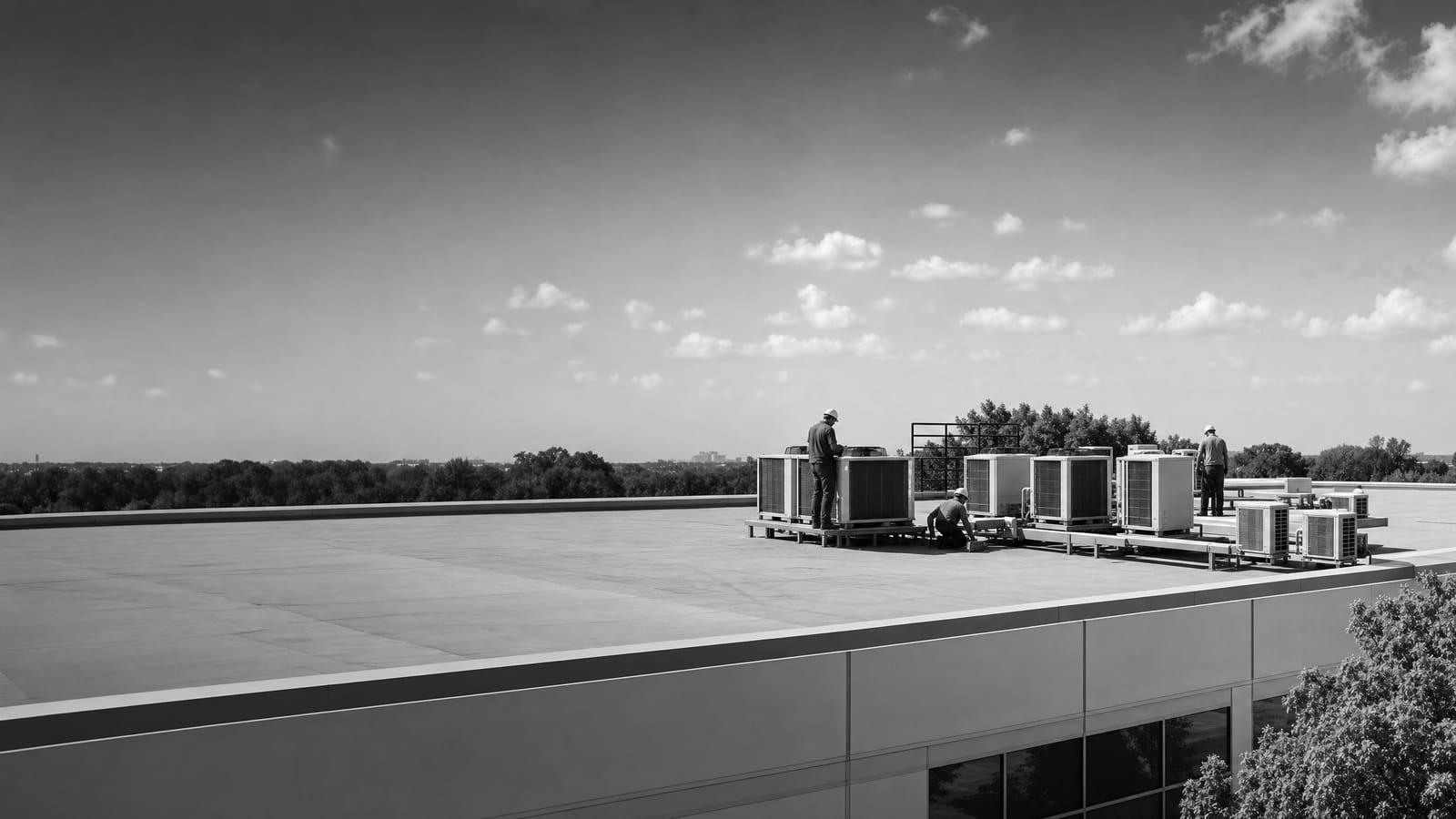
A commercial HVAC replacement covers the load calculation, the unit, the curb adapter, the crane set, the gas and electrical connections, permits, and commissioning. Replacement beats another repair once a unit is past roughly fifteen years and the service calls are stacking up. DOE has put the annual energy waste from a single old, inefficient rooftop unit at $900 to $3,700, and planned replacement almost always costs less than replacement on failure.
A site review still has to confirm the roof structure, the existing unit's Btu rating and footprint, panel capacity, and crane access before any of that becomes a firm number.
THREE WAYS TO GO
The choice is usually one of three
Most commercial replacements come down to three options, and the right one depends on whether the space still uses the building the way it did when the old unit went in.
A like-for-like swap is the fastest path back to conditioned air and keeps the permit scope small. It also carries forward whatever sizing mistake the original unit had.
A right-sized, high-efficiency replacement adds a step at the front. DOE's high-performance rooftop challenge produced units that cut energy use by up to half against the standard in place at the time, and a later federal standard raised the minimum efficiency for new commercial units across the board.
A heat pump rooftop unit adds reverse-cycle heating to the same package. DOE treats it as a strong fit where winter heating is mild to moderate, and as a dual-fuel or supplemental-heat decision where it isn't. Electrical capacity usually decides it.
WHAT MOVES THE NUMBER
Where the money actually goes
Nobody can quote a rooftop replacement from a phone call, and the spread between two honest bids usually comes from these lines rather than from the unit itself. They are listed roughly in the order they surprise people.
IN PRACTICE
How to choose the equipment
Start with the question DOE puts first: how old is the unit, and what is it costing you to keep. Rooftop units condition close to half of all commercial floor space in the country, and units past fifteen years old waste a meaningful amount of energy compared with current equipment. Most facility teams still wait for a failure, which is how a planned capital project becomes an emergency one in August.
The second question is whether the building changed. Occupancy, plug load, lighting, and envelope work all move the load, and a nameplate from twenty years ago knows none of it. If the space is used the same way, like-for-like is usually honest. If it isn't, a recalculated load fixes comfort complaints the old unit was never sized to solve.
The third question is whether you need a new unit at all. DOE's own guidance treats advanced controls as a legitimate alternative on units that still have service life left. That path is cheaper, and it is right often enough that a contractor who never brings it up is not showing you the full menu.
SIDE BY SIDE
Simple swap or a real project
Two replacements on the same block can price very differently. Oregon's plan review triggers are a useful proxy for where that line sits, because they describe exactly how far a replacement can drift from the original before the paperwork changes.
LOWER COMPLEXITY
A swap that stays inside tolerance
Same fuel type, Btu rating within ten percent of the old appliance, same footprint and weight, same location on the roof, adequate existing service, and a clear crane setup in the lot.
HIGHER COMPLEXITY
Anything that moves the unit or the load
A different fuel, a larger unit, a new position on the roof, added weight, or reframing. Each of those pulls in plan review, and usually structural and electrical scope along with it.
SCOPING
What a real site review looks at
The walk should produce numbers, not impressions. Nameplate data on the existing unit: model, tonnage, Btu input, refrigerant type, and voltage. Physical dimensions and weight, because Oregon's exemption test compares the new equipment against the old within tight tolerances. Roof structure and curb condition. Panel capacity and available breaker space. Gas line size and location if the unit is fired. Duct connections and where the transitions land. Then the access story: where the crane sets up, what it has to reach over, which stalls close, and for how long.
DOE's heat pump checklist adds two items owners routinely skip. Equipment availability is one, because the best unit on paper is the wrong unit if it arrives after your busy season. Contractor familiarity with the specific equipment is the other, and it matters most on all-electric and dual-fuel packages that behave differently in commissioning than the gas unit they replaced.
Bring these to the first walk
The existing nameplate, unit dimensions and weight, a photo of the electrical panel, and your operating hours. That combination tells you within a day whether this is a straight swap or a plan review project, and that changes the schedule more than it changes the price.
EUGENE, OREGON
What Oregon's mechanical code changes about your replacement
In Oregon, a commercial mechanical permit generally comes with a mechanical plan review. The state's Building Codes Division publishes a checklist that determines whether a project can meet the exemption criteria instead, and a rooftop replacement stays on the simpler path only if it answers no to every item.
Plan review is triggered when the new appliance's Btu rating is more than ten percent off the existing one, when the fuel type changes, when the unit's size or shape falls outside ten percent of the original, when it lands anywhere other than the previous location, or when any dimension grows by more than six inches or ten percent of the existing equipment, whichever is less. Modifying structural elements triggers it as well.
None of that is a reason to install the wrong unit. It is a reason to know which path you are on before the equipment is ordered.
Don't undersize to dodge the review
If right-sizing pushes the new unit past those tolerances, take the right-sized unit and put plan review in the schedule. Choosing a worse unit to keep the paperwork small costs you every month the building runs.
OWNERSHIP
Two things to settle before the unit ships
A rooftop replacement is a fifteen-year decision usually made in about a week, under pressure. Two items tend to get settled after the fact, when they are much harder to fix.
The first is refrigerant. EPA regulations under Section 608 of the Clean Air Act govern how refrigerant is handled and recycled in stationary air conditioning and heat pump equipment, which makes recovery from the old unit a compliance step performed by a certified technician, not a line item to shop on price.
The second is who benefits. If the tenant pays the utility bill and the owner buys the equipment, an efficiency upgrade only pencils if the lease says it does.
REFRIGERANT
Recovery and mixed fleets
The old charge has to be recovered under EPA Section 608 rules. If your roof runs several vintages, plan parts and service around that mix instead of assuming one refrigerant covers everything.
LEASE STRUCTURE
Who pays, who saves
Efficiency savings land on whoever pays the meter. Settle that before you pick an efficiency tier, or the cheapest unit will always look like the smart one on paper.
PROCUREMENT
Phase the roof, don't just replace the unit
If you have more than one unit up there, treat them as a fleet with staggered ages rather than a series of unrelated emergencies. DOE's Advanced RTU Campaign is the large-scale version of that idea: more than 200 organizations upgraded over 43,000 rooftop units and cut a combined $37 million a year from their energy bills. The mechanism is unglamorous. They replaced on a plan instead of on failure.
For a single building, phasing means ranking units by age, run hours, and repair history, then replacing the worst one or two per budget cycle while the rest stay on maintenance. It also means ordering ahead of the season you can least afford an outage in. Equipment availability is a real constraint, and a unit you can get is worth more in July than a better unit you have to wait for.
Lifetime cost is where the argument usually ends. A single old, inefficient unit can waste $900 to $3,700 a year on its own. Multiply that across the units on your roof and the years you plan to wait, and the phasing conversation gets short.
COMPARING QUOTES
Five lines a comparable quote should show
Two quotes are only comparable when both describe the same scope. Ask for these five, and most of the gap between bidders explains itself before you have to negotiate anything.
01
Equipment specifics
Make, model, tonnage, efficiency tier, heating type, and refrigerant, so you are comparing units instead of totals.
02
Curb and structural scope
Adapter or new curb, any framing work, roof patching, and who signs off on the structure.
03
Rigging and access plan
Crane size, setup location, stalls closed, the work window, and the weather contingency.
04
Permits and plan review
Which permits get pulled, who pulls them, and whether mechanical plan review is assumed or excluded.
05
Startup and commissioning
Refrigerant recovery, charge and airflow verification, controls setup, and the documentation that keeps the warranty valid.
Get a defensible number
Price the equipment and the building together.
Send the address, operating target, and target opening date. Flux will identify what must be verified before the project can be priced.
Get a free estimateQuestions
Straight answers.
When does replacement beat one more repair?
Once a unit is past roughly fifteen years and repairs are repeating, the math usually flips. DOE has put the annual energy waste from an old, inefficient rooftop unit at $900 to $3,700, and that runs whether or not the unit is currently broken. Replacing on a plan also costs less than replacing on failure in season.
Does a rooftop replacement in Oregon need a plan review?
Assume yes unless the project clears the exemption checklist. Plan review is triggered by a Btu rating more than ten percent off the old appliance, a fuel type change, a size or shape outside ten percent of the original, a new location on the roof, or structural modification. Confirm which side you are on before ordering.
Is a heat pump rooftop unit the right replacement?
It depends on heating load and electrical capacity. DOE guidance says heat pump rooftop units fit best where winter heating is mild to moderate, since efficiency drops toward electric resistance as outdoor temperatures fall. Dual-fuel and cold-climate versions exist for that reason. Panel capacity should be verified before the equipment is specified.
How much does commercial HVAC installation cost?
There is no honest universal number, because tonnage, curb work, structural scope, electrical capacity, and crane access all move it independently. What you can insist on is a quote that itemizes those lines separately, so the price difference between two bidders traces to scope rather than to optimism.
What happens to the refrigerant in the old unit?
It gets recovered. EPA rules under Section 608 of the Clean Air Act govern how refrigerant is handled and recycled in stationary air conditioning and heat pump equipment, so recovery is a compliance task for a certified technician. On a roof running several equipment vintages, plan service and spare parts around the refrigerant mix.
Sources used for this guide
- [1]betterbuildingssolutioncenter.energy.gov — DOE Advanced Rooftop Unit Replacement Guidance
- [2]betterbuildingssolutioncenter.energy.gov — DOE Commercial Heat Pump Rooftop Unit Replacement Guidance
- [3]betterbuildingssolutioncenter.energy.gov — DOE High-Efficiency Commercial Rooftop Unit Toolkit
- [4]energy.gov — DOE Efficient Commercial Rooftop Air Conditioner Program
- [5]epa.gov — EPA Stationary HVAC Refrigerant Management
- [6]oregon.gov — Inspector Training Program Registration