THE SHORT ANSWER
What a commercial HVAC replacement actually covers
A commercial replacement covers far more than the unit. It covers the load check, equipment selection, the curb and rigging, gas, electrical and refrigerant connections, permit and inspection, controls, and commissioning. Replacement beats one more repair once a unit is running past its useful life. Federal guidance puts the annual waste from an old, inefficient rooftop unit at $900 to $3,700 per unit, and units over fifteen years old are where that waste concentrates.
A site review still has to confirm tonnage against current occupancy, the curb and roof structure, available electrical capacity, and crane access before any quoted number holds.
THREE PATHS
The three replacement decisions worth pricing
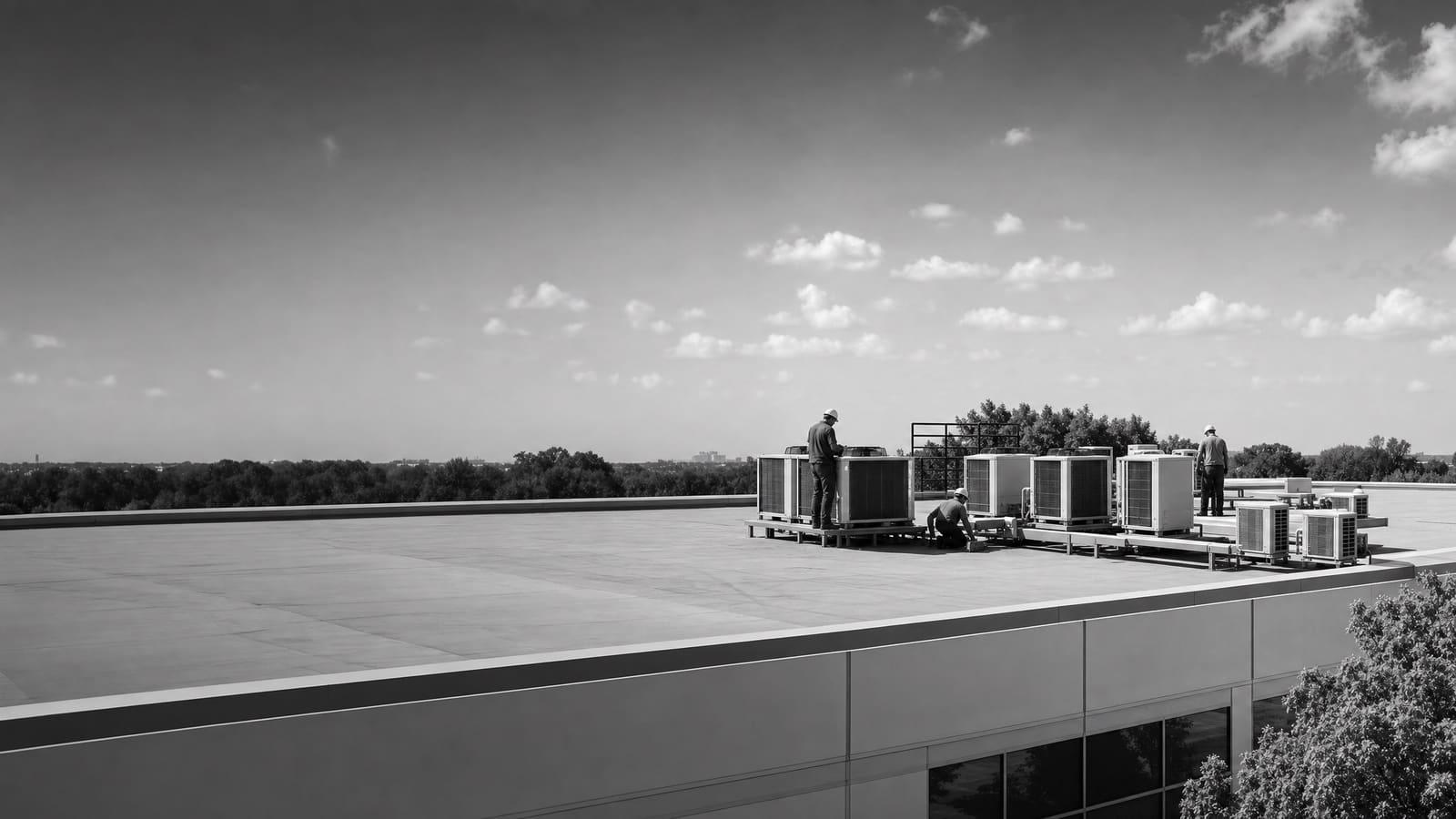
Most commercial buildings here condition space with packaged rooftop units, and rooftop units cool close to half of all commercial floor area in the country. That keeps the decision narrow in practice. You are choosing between putting the same kind of unit back, putting a better one back, or changing the heating source while the crane is already on the roof.
The cheapest decision on paper is rarely the cheapest over the unit's life. Department of Energy guidance is blunt about the pattern: waiting until a unit fails and then replacing like-for-like is usually worse business than replacing a tired unit on purpose. Failure removes your options. Whatever is available that week becomes your equipment for the next fifteen years or more, at whatever efficiency it happens to carry.
Pick the path while the old unit is still limping, not during the outage.
WHAT MOVES THE NUMBER
Where the money actually goes
These lines move the price more than the equipment brand does. Ask for each one separately, so you can tell an equipment decision from a site condition when you compare bids.
HOW TO BUY IT
Buying the replacement instead of reacting to it
Facility managers usually delay a rooftop replacement until the unit stops holding the space, needs constant attention, or quits outright. Federal guidance names that pattern directly, and the reason it matters is money rather than principle. An old, inefficient rooftop unit wastes somewhere between $900 and $3,700 a year, every year, while the decision waits. Planned replacement also buys the one thing a failure never gives you: time to compare equipment, confirm access, and schedule the lift when the building is empty.
The market moved, too. When the Department of Energy pushed manufacturers toward a high-efficiency rooftop specification, the target was cutting unit energy use by up to half against the standard of the day, and more than twenty models now exceed that specification. Replacing a twenty-year-old unit with current equipment is not a marginal upgrade.
The scale of the shift is documented. Through the national rooftop unit campaign, more than two hundred organizations upgraded over 43,000 units and cut a combined $37 million a year from their energy bills. Your building is one roof, not a portfolio, but the arithmetic is identical. The unit you keep running costs you on a schedule. The replacement costs you once.
SCOPE CHECK
What makes a changeout simple or complicated
Two buildings on the same street can produce very different prices for the same tonnage. The difference is almost never the unit. It is what the roof, the electrical service, and the parking lot allow.
LOWER COMPLEXITY
Straight swap conditions
Same tonnage and same fuel, a curb that can be reused or adapted, clear crane reach from the lot, electrical service that already supports the unit, and controls the new equipment can join without a translator.
HIGHER COMPLEXITY
Where the scope grows
Tonnage or footprint changes, structural review on the curb, a service that has to be increased, tight or shared access that forces a night lift, or a tenant who cannot lose conditioning for a full day.
BEFORE THE QUOTE
What a site review has to settle
A quote written from a nameplate photo is a starting number, not a price. It is genuinely useful when a unit is down and you need options the same day. It is not the document you sign.
The site review turns it into one. Tonnage gets checked against how the space is used now, because twenty years of tenant changes rarely leave the original load intact. The curb gets measured and the roof structure gets looked at, since a larger or heavier unit is a structural question before it is a mechanical one. The electrical service gets verified, which matters most if all-electric equipment is on the table: electrical capacity, physical constraints, and existing gas lines are the three infrastructure items that decide whether a heat pump rooftop unit is realistic at a given building. Crane reach and staging get walked, because access sets the length of the closure and the cost of the lift.
Contractor familiarity with the specific equipment counts as well. It sits on the same national adoption checklist as the hardware, for good reason.
Three things the review must verify
Whether the current load matches the old nameplate, whether the roof and curb can carry the unit you actually want, and whether the electrical service supports it. Anything left unresolved on that list is a change order waiting to happen.
IN ESCONDIDO
What Escondido changes about the decision
Escondido sits inland in North San Diego County, so buildings here run a cooling-dominated year with mild winter heating. That is the profile national guidance describes as well suited to heat pump rooftop units. Across most of the U.S. South and West, current heat pump rooftop units are considered capable of carrying most or all of the winter heating demand on their own. If your existing unit has a gas section that fires a handful of weeks a year, the fuel question is worth asking during this replacement rather than the next one.
Permitting is the other local step to plan around. California building departments treat mechanical upgrades and repairs as permit work, so a rooftop changeout here is a permitted job with an inspection attached, not a maintenance visit.
Decide the fuel question before you order
Equipment lead time makes this a now decision rather than a later one. If the mild-winter case for a heat pump rooftop unit holds at your building, confirm electrical capacity during the site review, while changing the order still costs nothing.
OWNERSHIP
Two things that outlive the install
The install ends in a morning. What it creates lasts fifteen years or more. Two items belong in your operating plan before the crane is scheduled, because both cost less to settle on day one than in year three. The first is refrigerant: what comes out of the old unit is regulated, and what goes into the new one changes how you stock parts and write service contracts. The second is the split between the party paying for the unit and the party paying to run it, which is where lease language quietly decides whether efficiency was worth buying at all.
REFRIGERANT
Recovery and fleet planning
EPA Section 608 rules govern how refrigerant is handled and recycled when equipment comes out, so recovery is certified work. New units also arrive on newer refrigerants, which means a mixed roof needs a parts and service plan.
LEASE STRUCTURE
Who pays, who benefits
If tenants pay the utilities and the owner buys the unit, an efficiency upgrade saves someone else money. Settle that before the efficiency tier is chosen, not after the first bill arrives.
PHASING AND MONEY
Phasing, incentives, and the cost of waiting
If you own several units, replace them in a planned order rather than in the order they fail. Rank by age, by service history, and by how hard each one is to reach with a crane. The oldest unit on the hardest corner of the roof is the one you want scheduled deliberately, not improvised at nine at night in August with whatever equipment can be trucked in.
Incentives change the arithmetic, and they change often. The Department of Energy maintains guidance on financial incentives for rooftop unit replacement, and utility programs open and close on their own calendars. Confirm in writing what is actually available before equipment is ordered. An incentive assumed at quoting time and discovered to be closed at invoicing time is just a price increase with extra steps.
Lifetime cost is the number that should decide this. A unit bought on lowest first cost and sized off a twenty-year-old nameplate carries both of those decisions for its entire service life, along with the annual waste that comes with running mismatched or dated equipment. Order on your schedule, size against the building you have now, and the replacement stays a one-time cost instead of a recurring one.
QUOTE CHECK
Five things a comparable quote shows
Two quotes are only comparable when both show these five items. If one is missing a line, it is not cheaper. It is less complete.
01
Equipment identified
Make, model, tonnage, efficiency tier, and refrigerant. Not just "new rooftop unit, same size."
02
The load basis
Whether the size came from a current load calculation or from the old nameplate.
03
Roof and curb scope
Curb adapter, any structural work, and who patches and warranties the roof penetration.
04
Crane day plan
Rigging, lot closure, working hours, and whether a night or weekend lift is priced in.
05
Permits and commissioning
Who pulls the permit, who meets the inspector, and what startup documentation you receive.
Get a defensible number
Price the equipment and the building together.
Send the address, operating target, and target opening date. Flux will identify what must be verified before the project can be priced.
Get a free estimateQuestions
Straight answers.
When does replacement beat one more repair?
When the unit is past fifteen years, needs frequent attention, or no longer holds the space. Old, inefficient rooftop units are estimated to waste $900 to $3,700 per unit each year, which usually outruns the repair savings within a season or two.
Is a heat pump rooftop unit realistic in Escondido?
Often yes. Escondido runs a cooling-dominated year with mild winters, and current heat pump rooftop units are considered capable of covering most or all of the winter heating demand across the West. Electrical capacity at your building decides whether it pencils.
Does a rooftop changeout need a permit?
California building departments treat mechanical upgrades and repairs as permit work, so a commercial changeout is permitted and inspected. The installing contractor should pull the permit, meet the inspector, and carry both inside the installed price.
What happens to the refrigerant in the old unit?
It is recovered, not vented. EPA Section 608 rules govern how refrigerant is handled and recycled when stationary equipment is serviced or removed, which makes recovery certified work with documentation behind it.
Why do two quotes for the same tonnage differ so much?
Usually site conditions rather than equipment. Curb adapters, structural work, crane reach, electrical capacity, and controls integration all vary by building. Ask for those as separate lines and the difference becomes obvious.
Sources used for this guide
- [1]betterbuildingssolutioncenter.energy.gov — DOE Advanced Rooftop Unit Replacement Guidance
- [2]betterbuildingssolutioncenter.energy.gov — DOE Commercial Heat Pump Rooftop Unit Replacement Guidance
- [3]betterbuildingssolutioncenter.energy.gov — DOE High-Efficiency Commercial Rooftop Unit Toolkit
- [4]energy.gov — DOE Efficient Commercial Rooftop Air Conditioner Program
- [5]epa.gov — EPA Stationary HVAC Refrigerant Management
- [6]californiacity-ca.gov — HVAC Permits