THE SHORT ANSWER
What a commercial HVAC replacement includes
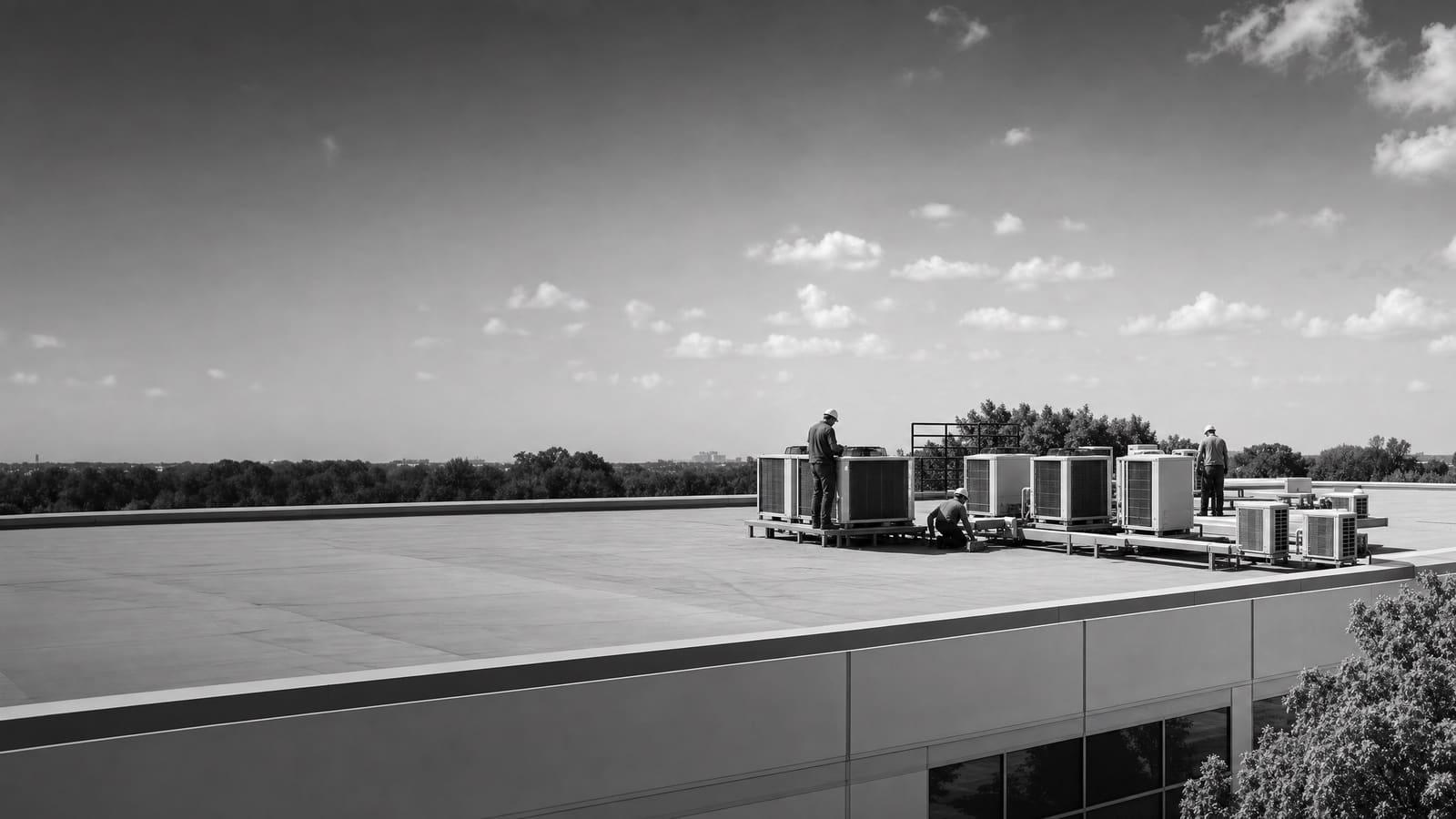
A commercial HVAC replacement covers the load check, equipment selection, removal of the old unit, curb and connection work, the crane set, controls, and commissioning. Replacement usually beats another repair once a unit is past fifteen years, failing in season, or no longer holding the space. Department of Energy figures put the yearly energy waste of an old rooftop unit between $900 and $3,700, and that penalty repeats every year you keep it.
A site review still has to confirm tonnage against how the space is used now, the curb and roof condition, and whether the existing electrical service can carry the unit you want.
THREE WAYS TO GO
Your three real replacement options
Most Erie buildings land on one of three paths. The cheapest is a like-for-like swap: same fuel, same curb, same connections, back in service fast. The middle path is a right-sized replacement, where the load is recalculated against how the space is used today instead of what the nameplate said twenty years ago. The third is an electric or dual-fuel heat pump rooftop unit.
That third one deserves a straight answer here. Heat pump heating gets less efficient as the outdoor temperature drops, and in deep cold it trends toward the efficiency of plain electric resistance heat. The Department of Energy points at the South and West as the regions where a standard heat pump rooftop unit can carry most or all of the heating season. Erie is not one of those places. That does not rule the technology out. It means the honest options here are a dual-fuel unit or a cold-climate model, sized around the coldest design day rather than the shoulder season.
WHAT MOVES THE NUMBER
The lines that decide your installed price
No two roofs price the same, so read a quote by its lines instead of its total. These are the six that move the number most, roughly in order of how far they can swing.
IN PRACTICE
Buy the installation, not the box
Two quotes can name the same model number and still land far apart, because the model number is the smallest part of the job. What separates them is everything around the unit: the curb adapter, the roof work found underneath it, the crane plan, the electrical, and who owns the permit.
So read quotes in that order. Start by confirming both bidders sized the unit the same way. If one priced the old nameplate and the other priced a fresh load calculation, you are not comparing anything yet. Twenty years changes occupancy, plug loads, lighting heat, and often the envelope itself. An oversized unit short-cycles, dehumidifies poorly, and wears out early, which is how a comfort complaint outlives the equipment that caused it.
Then look at what each quote assumes it will find. Curb condition, roof deck condition, and existing electrical capacity are the three items most often written as assumptions rather than findings. An assumption becomes a change order the morning the old unit comes off. Ask each bidder which of the three they actually verified on site, and get that answer before you sign, not after the crane is booked.
SIDE BY SIDE
Simple swap or engineered project
Before you budget, figure out which kind of project you have. The dividing line is whether the new unit stays inside what the building already supports: same footprint, same power, same duct capacity. Once any one of those has to grow, the job changes category and so does the schedule.
LOWER COMPLEXITY
Stays inside what exists
Same tonnage class, same fuel, a curb adapter handles the footprint, and the existing feed and overcurrent protection carry the unit. Permitting is usually straightforward and the on-site work is a morning, not a week.
HIGHER COMPLEXITY
Anything that has to grow
More tonnage, a bigger electrical feed, structural work at the curb, duct changes, or a move to all-electric heat. Expect engineering, a fuller permit review, and longer lead time on equipment.
BEFORE THE QUOTE
What a real site review settles
A site review that takes an hour saves weeks later. There is a short list it has to close out.
First, the load. Not the nameplate, the load, built from current occupancy, hours, equipment, and envelope. Second, the curb and the deck underneath it. Third, electrical capacity: what the panel has today, what the new unit draws, and whether the existing overcurrent protection stays. The Department of Energy's own heat pump checklist puts electrical capacity, physical constraints, and gas lines in the same tier as climate and cost, which is a fair signal of how often infrastructure decides these projects.
Fourth, access. Where the crane sets up, what it has to reach over, which stalls close, and for how long. Fifth, controls: what the new unit has to talk to, and who programs it.
Last, schedule. Equipment availability is a real constraint, not a footnote, and it belongs on the quote next to the price. A unit that is right on paper but far out may lose to a good unit available now, depending on the season you are standing in.
Ask for findings, not assumptions
Every one of those six items should come back as something a person checked, with a note on what they saw. Anything returned as a standard assumption is a change order waiting for the crane day.
PENNSYLVANIA RULES
How the permit path changes with your scope
Pennsylvania's Uniform Construction Code decides how much review your replacement gets, and the scope you pick decides which lane you land in.
The state's Level 1 alterations permit path covers alterations to supply and exhaust HVAC systems when the work does not exceed the capabilities of the existing system. A straight replacement often fits. The same list allows altering existing electrical branch circuits only when overcurrent protection devices are not modified or added, and allows one new circuit no larger than 208V/30A. A rooftop unit needing a bigger feed clears that bar immediately.
That list also requires work affecting the building envelope, mechanical systems, or power and lighting to include a narrative showing how it satisfies the energy conservation code. The state's Level 1 guidance names the 2015 International Energy Conservation Code, so confirm the edition in force when you apply, and put the paperwork owner in the contract.
One decision this changes
If you are weighing an all-electric unit, price the permit path along with it. Holding the existing feed and overcurrent protection can keep the job in the lighter lane. A larger new circuit moves it into fuller review, and that shows up in schedule before it shows up in cost.
AFTER THE CRANE LEAVES
Two things that outlive the install
The install is a week. The decisions made during it run for fifteen or twenty years, and two of them show up on every invoice after handoff.
Commissioning is the first. Charge, airflow, economizer operation, and control setpoints verified against spec and written down. Skip it and the problems surface in month two as comfort complaints nobody can trace, usually after the warranty conversation has already gotten harder.
Refrigerant is the second. EPA rules under Section 608 govern how refrigerant is handled and recycled when equipment is serviced or taken out of service, so the old charge leaves the roof with a certified technician and a record behind it.
OPERATIONS
Who runs it on day one
A unit with better controls is only better if someone knows the sequences. Get setpoints, schedules, and economizer logic documented and handed to whoever answers the too-hot calls.
FLEET STRATEGY
One unit or a roof full
If the new unit runs a different refrigerant or control platform than the rest of your roof, your service contract and spare-parts plan just changed. Decide that on purpose instead of discovering it at the next failure.
PLANNING AHEAD
Replace on your schedule, not the equipment's
Rooftop units cool close to half of all commercial floor space in the country, and the ones past fifteen years old are quietly expensive. Department of Energy figures put the annual energy waste of an old unit between $900 and $3,700. That is per unit, per year, whether or not it has failed yet.
Most owners still wait for failure. It is understandable, and it is the most expensive way to buy. Failure picks the worst week, removes your leverage on lead time, and often forces a like-for-like swap because there is no time to engineer anything better. Planned replacement gets you competitive bids, a crane date you chose, and the option to right-size.
If you own several units, phase them. Rank by age, service history, and what each one costs to run, then replace one or two a year on a schedule you set. A federal minimum-efficiency standard finalized in December 2015 raised the floor for commercial rooftop equipment, so baseline units today already beat much of what is still turning on older roofs. Confirm which utility incentives are actually open before you order. The Department of Energy treats incentives as a planning input, and program terms change.
APPLES TO APPLES
Five things a comparable quote shows
Ask every bidder for the same five lines. If one quote is missing three of them, it is not cheaper. It is just less complete.
01
The sizing basis
Old nameplate or a fresh load calculation. Say which one, and show the number it produced.
02
Equipment and lead time
Model, tonnage, efficiency tier, and a real availability date sitting next to the price.
03
Curb, roof, and rigging
Curb adapter, any deck work, the crane plan, lot closure hours, and who coordinates tenants.
04
Electrical, gas, and permits
Feed size, overcurrent protection, gas work, the permit path, and who writes the energy-code narrative.
05
Commissioning and closeout
Startup readings, control setpoints, warranty registration, and the documents you receive at handoff.
Get a defensible number
Price the equipment and the building together.
Send the address, operating target, and target opening date. Flux will identify what must be verified before the project can be priced.
Get a free estimateQuestions
Straight answers.
When does replacement beat one more repair?
Watch for three signals together: the unit is past about fifteen years, it has failed more than once in season, and it can no longer hold the space on a design day. Department of Energy figures put the yearly energy waste of an old rooftop unit between $900 and $3,700, so a unit that keeps limping is still charging you every month.
Should you swap like-for-like or right-size?
Confirm the load either way. If the space and its use have not changed, like-for-like is often the right call and the fastest path back to service. If occupancy, plug loads, or the envelope changed, right-sizing fixes complaints the old unit created and usually trims the bill for the life of the equipment.
Do heat pump rooftop units make sense in Erie?
In the right configuration, yes. Heat pump efficiency falls as outdoor temperature drops and trends toward electric resistance heat in deep cold, and the Department of Energy points to the South and West as the regions where a standard unit covers most of the heating season. Here, that means a dual-fuel or cold-climate model, and an electrical capacity check before anyone quotes it.
Does a rooftop replacement need a permit?
Plan on it. Pennsylvania's Uniform Construction Code includes a Level 1 alterations path for HVAC work that does not exceed the existing system's capabilities, which many straight replacements fit. Adding a larger circuit or new overcurrent protection pushes past that path, and work touching mechanical or power systems has to come with an energy-code narrative.
What happens to the refrigerant in the old unit?
It gets recovered, not vented. EPA rules under Section 608 govern how refrigerant is handled and recycled when equipment is serviced or taken out of service, so recovery is done by a certified technician and documented. That line should appear on the quote rather than showing up as a surprise.
Sources used for this guide
- [1]betterbuildingssolutioncenter.energy.gov — DOE Advanced Rooftop Unit Replacement Guidance
- [2]betterbuildingssolutioncenter.energy.gov — DOE Commercial Heat Pump Rooftop Unit Replacement Guidance
- [3]betterbuildingssolutioncenter.energy.gov — DOE High-Efficiency Commercial Rooftop Unit Toolkit
- [4]energy.gov — DOE Efficient Commercial Rooftop Air Conditioner Program
- [5]epa.gov — EPA Stationary HVAC Refrigerant Management
- [6]pa.gov — Apply for a Uniform Construction Code Alterations Level 1 Permit | Commonwealth of Pennsylvania