THE SHORT ANSWER
What a commercial HVAC replacement actually covers
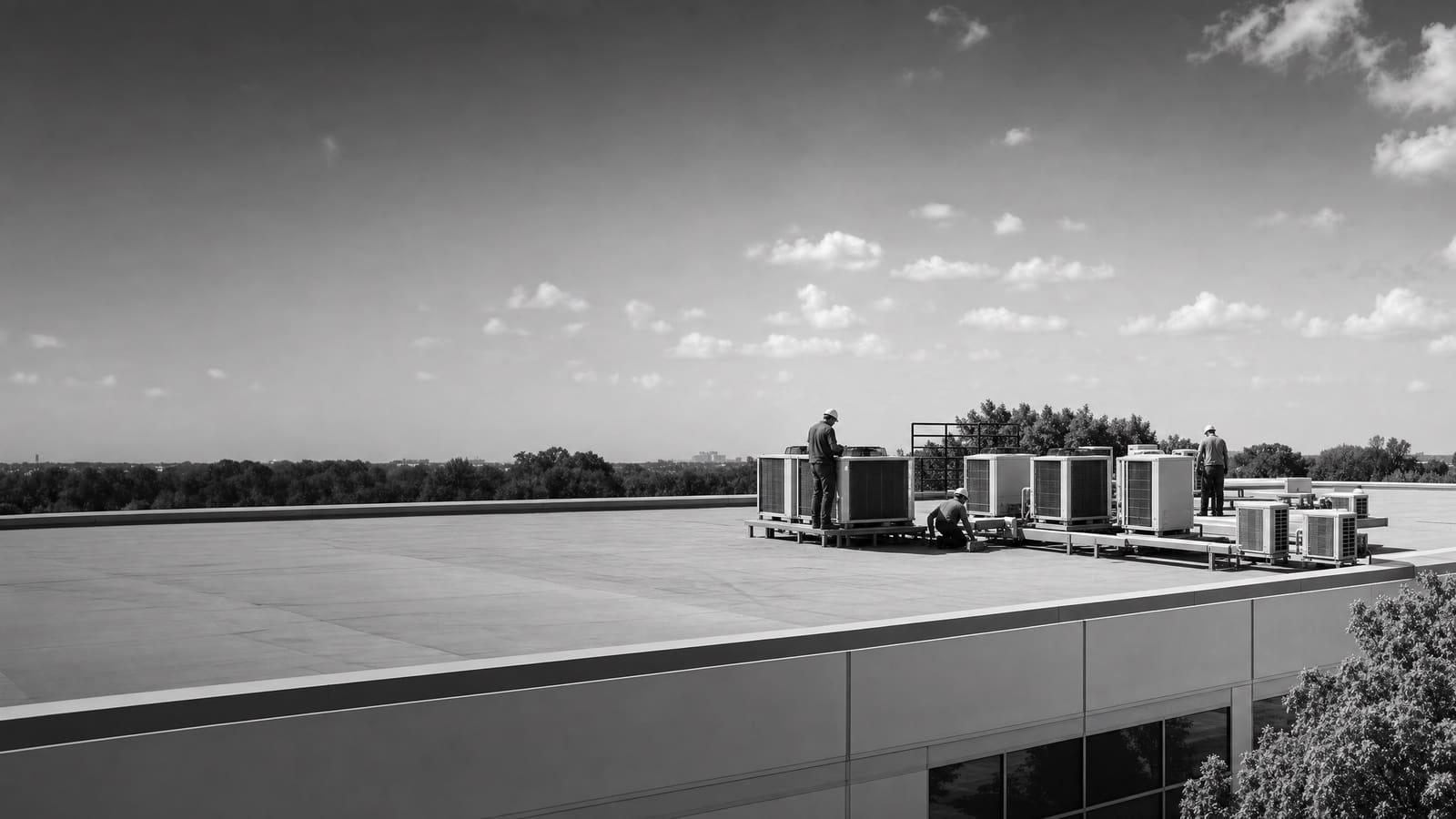
A commercial HVAC replacement covers load verification, equipment selection, removal and rigging of the old unit, curb and duct connections, gas or electrical work, controls integration, permits, and commissioning. Replacing beats another repair once a rooftop unit passes about 15 years. Units that age waste substantial energy compared with current models, and federal analysis puts the annual waste on old, inefficient rooftop units at $900 to $3,700 each, before the next compressor bill arrives.
A site review still has to verify tonnage against how the space is used now, curb size and roof structure, available electrical capacity, crane reach across the lot, and what the permit review adds.
THE THREE CHOICES
Repair, replace in kind, or change the system
Most buildings land on one of three choices, and the right one depends on the unit's age and what the space does today. Repairing keeps cash in the bank, and it is the correct call on a younger unit with one failed part. Once a rooftop unit passes roughly 15 years, the math shifts. Older units burn far more energy than current equipment, and each repair buys less time than the last one did. From there the choice is between a like-for-like replacement, which is fastest because it reuses the curb and the existing connections, and a heat pump rooftop unit, which handles heating and cooling on one electric system. Federal guidance finds heat pump rooftop units best suited to mild-to-moderate winter heating and fully capable of covering most or all winter demand across the West, so that option is a real one here rather than a stretch.
WHAT MOVES THE NUMBER
The lines that decide a rooftop replacement price
These are the items that actually move the number on a commercial replacement. Ask a bidder which ones they verified on the roof and which are still assumptions carried from the nameplate.
HOW TO BUY IT
Start with the load, not the old nameplate
The nameplate on a twenty-year-old unit describes a building that no longer exists. Occupancy changed, plug loads changed, and lighting probably changed twice. Sizing from that plate carries the original guess forward for another two decades. Confirm the load against current use first, then let the equipment decision follow it.
The second decision is fuel. Rooftop units condition close to half of all commercial floor area in the country, so this is the most common replacement in the building stock, and the heat pump version of it is now ordinary equipment rather than a pilot. The honest test is infrastructure. A heat pump rooftop unit needs electrical capacity at the panel and the feeder, physical room on the curb, and a plan for the abandoned gas line. If the service is already tight, the upgrade cost belongs in the comparison from day one, not as a change order in week three.
The third decision is timing. Waiting for failure removes every option except whatever is on a truck this week. Planning the replacement lets you compare equipment, take a real lead time, and pick a shutdown window that does not fall on your busiest day.
SCOPE CHECK
Simple swap versus a project
Two replacements can carry the same tonnage and cost very different money. What separates them is how much of the building has to change to accept the new unit.
LOWER COMPLEXITY
Same unit, same curb
One packaged unit, matched tonnage, existing curb and connections reused, gas stays gas, and a lot with open crane access. Permit scope is mechanical and electrical, and the visible work is a single morning.
HIGHER COMPLEXITY
The building changes too
Tonnage moves, the footprint needs an adapter or structural review, an electric conversion requires panel or service work, tenants need continuous conditioning, or the crane has one narrow window and a long reach.
BEFORE YOU BID IT
What a real site review has to confirm
A quote written from a photo is a guess with a dollar sign on it. The review that makes a number trustworthy takes an hour on the roof and in the electrical room, and it answers a short list of questions.
On the roof: the curb dimensions and condition, the structure under it, the state of the membrane around the opening, and how the ductwork transitions. If the roof itself is near the end of its life, that changes the sequence, because doing the membrane after a new unit lands costs more than doing it in the same window.
In the electrical room: available capacity, breaker and feeder sizing, and whether the existing service has headroom for a different unit. This is the single question that decides whether an all-electric option is a modest upgrade or a service project.
In the lot: where a crane can set up, what it has to clear, and how many stalls close and for how long. Then the operating side. When can the space go without conditioning, who needs notice, and which tenants have equipment that cannot ride out a warm afternoon.
The refrigerant step is not optional
EPA rules under Section 608 govern how refrigerant in stationary air-conditioning and heat pump equipment is handled and recycled. The charge in the old unit has to be recovered by certified technicians, and that step should appear in the scope rather than being assumed.
IN ELK GROVE
Permits, and one sequencing decision worth making early
In California, HVAC work is permitted in its own right. Mechanical upgrades and repairs require a permit, electrical work is reviewed alongside it, and re-roofing is a separate permit again, whether it is an overlay or a tear-off. That last detail matters more than it sounds. If your membrane is within a few years of replacement, setting a new rooftop unit first means paying to work around it later, and it means a second round of roof access on the same building.
The climate side favors your options. Federal guidance finds heat pump rooftop units suited to mild-to-moderate winter heating and capable of covering most or all winter demand across the West, so an all-electric replacement is worth pricing here rather than dismissing.
Confirm the permit path before the crane date
Ask your installer to file with the Elk Grove building division and confirm the required inspections before equipment is ordered. A crane booked ahead of an approved permit is the most expensive kind of scheduling error on this job.
OWNERSHIP AND OPERATIONS
Two things that change the answer
The technical decision is only half of it. Who pays, and how many units you own, shape the choice as much as tonnage does. A single owner-occupied building can take the efficiency upgrade and keep the savings. A leased building splits the capital and the utility bill between two parties, which is exactly why replacements get deferred until something fails. Fleet size matters the same way. One unit is a purchase; six units on a roof is a program, and the sequencing decision is worth more than the unit price.
WHO CAPTURES THE SAVINGS
Owner-occupied versus leased
If tenants pay utilities, the owner funds the equipment and the tenant collects the lower bill. Sort that out in the lease or the capital request before you compare efficiency tiers, not after.
RUNNING A MIXED FLEET
Standardize what you can
Matching manufacturers and control platforms across a roof cuts spare-parts sprawl and service confusion. Confirm the refrigerant on the new unit so your service contract and parts plan cover it.
OVER THE LIFE OF THE ASSET
Planned replacement beats replacement on failure
The strongest argument for planning this work is what it costs not to. When a unit fails in August, the building takes whatever equipment is available, at whatever price, on whatever schedule the crane can offer. Efficiency tier stops being a choice. Sizing stops being a choice. The only variable left is how fast someone can get cooling back on.
The scale of the opportunity is documented. Through the federal Advanced RTU Campaign, more than 200 public and private organizations upgraded over 43,000 rooftop units, and those upgrades save a combined $37 million a year on energy bills. That is not a promise about your roof. It is evidence that proactive replacement of aging units, done as a program rather than an emergency, returns real money at scale.
For a multi-unit roof, the practical approach is to rank units by age and repair history, replace the worst two in the first window, and use what you learn about curb condition, electrical capacity, and crane access to price the rest accurately. Phasing spreads the capital, keeps the building conditioned throughout, and lets each round of work benefit from the last one.
COMPARE APPLES TO APPLES
Five things a comparable quote should show
If two bids differ by a wide margin, the gap is almost always in what one of them left out. Ask both to show these five items in writing.
01
Equipment and lead time
Make, model, tonnage, efficiency rating, and the quoted availability date, not a general range.
02
Curb, roof, and structure
Adapter, flashing, penetration work, and any structural review, priced rather than noted as an allowance.
03
Rigging plan
Crane size, staging location, stall closures, and the hours the lot is affected.
04
Utility connections and refrigerant
Electrical, gas, and refrigerant scope, including certified recovery of the charge from the old unit.
05
Permits and commissioning
Permit filing, inspections, startup readings, control setpoints, and documented handoff so the warranty stands.
Get a defensible number
Price the equipment and the building together.
Send the address, operating target, and target opening date. Flux will identify what must be verified before the project can be priced.
Get a free estimateQuestions
Straight answers.
When does replacing a commercial rooftop unit beat repairing it?
Age and repair history decide it. Units past about 15 years waste substantial energy compared with current equipment, and federal analysis puts the annual waste on old, inefficient rooftop units at $900 to $3,700 each. Add the next repair to that and replacement usually wins.
How long does a commercial HVAC installation take?
The visible work on a single packaged unit is short. The real variable is equipment lead time, plus permit approval. Ask for the availability date and the permit path in writing before anyone books a crane.
Should we switch to a heat pump rooftop unit?
It is worth pricing. Federal guidance finds heat pump rooftop units well suited to mild-to-moderate winter heating and capable of covering most or all winter demand across the West. The deciding factor is usually electrical capacity at the panel and feeder.
Do we need a permit for a like-for-like replacement in Elk Grove?
Plan on it. In California, mechanical upgrades and repairs require a permit, with electrical reviewed alongside. Re-roofing is permitted separately, so confirm both scopes with the building division if the roof is also due.
What happens to the refrigerant in the old unit?
It has to be recovered, not vented. EPA rules under Section 608 govern the handling and recycling of refrigerant in stationary air-conditioning and heat pump equipment, and recovery by certified technicians should be a named line in the scope.
Sources used for this guide
- [1]betterbuildingssolutioncenter.energy.gov — DOE Advanced Rooftop Unit Replacement Guidance
- [2]betterbuildingssolutioncenter.energy.gov — DOE Commercial Heat Pump Rooftop Unit Replacement Guidance
- [3]betterbuildingssolutioncenter.energy.gov — DOE High-Efficiency Commercial Rooftop Unit Toolkit
- [4]energy.gov — DOE Efficient Commercial Rooftop Air Conditioner Program
- [5]epa.gov — EPA Stationary HVAC Refrigerant Management
- [6]californiacity-ca.gov — HVAC Permits