THE SHORT ANSWER
What a commercial HVAC replacement includes
A commercial HVAC replacement covers the load calculation, the equipment selection, the curb and rigging work, the electrical and gas connections, recovery of the old refrigerant, controls integration, and commissioning at startup. Replacement beats one more repair once the unit is old enough that failure sets the schedule. Rooftop units past fifteen years can waste substantial energy, and old, inefficient units are estimated to waste $900 to $3,700 per unit each year — money that leaves whether or not the compressor is running.
A site review has to confirm three things before that price is real: what the building actually loads today, whether the roof and curb can carry the new unit, and whether the electrical service supports the equipment you want.
THE MAIN DECISION
Three ways to replace a rooftop unit
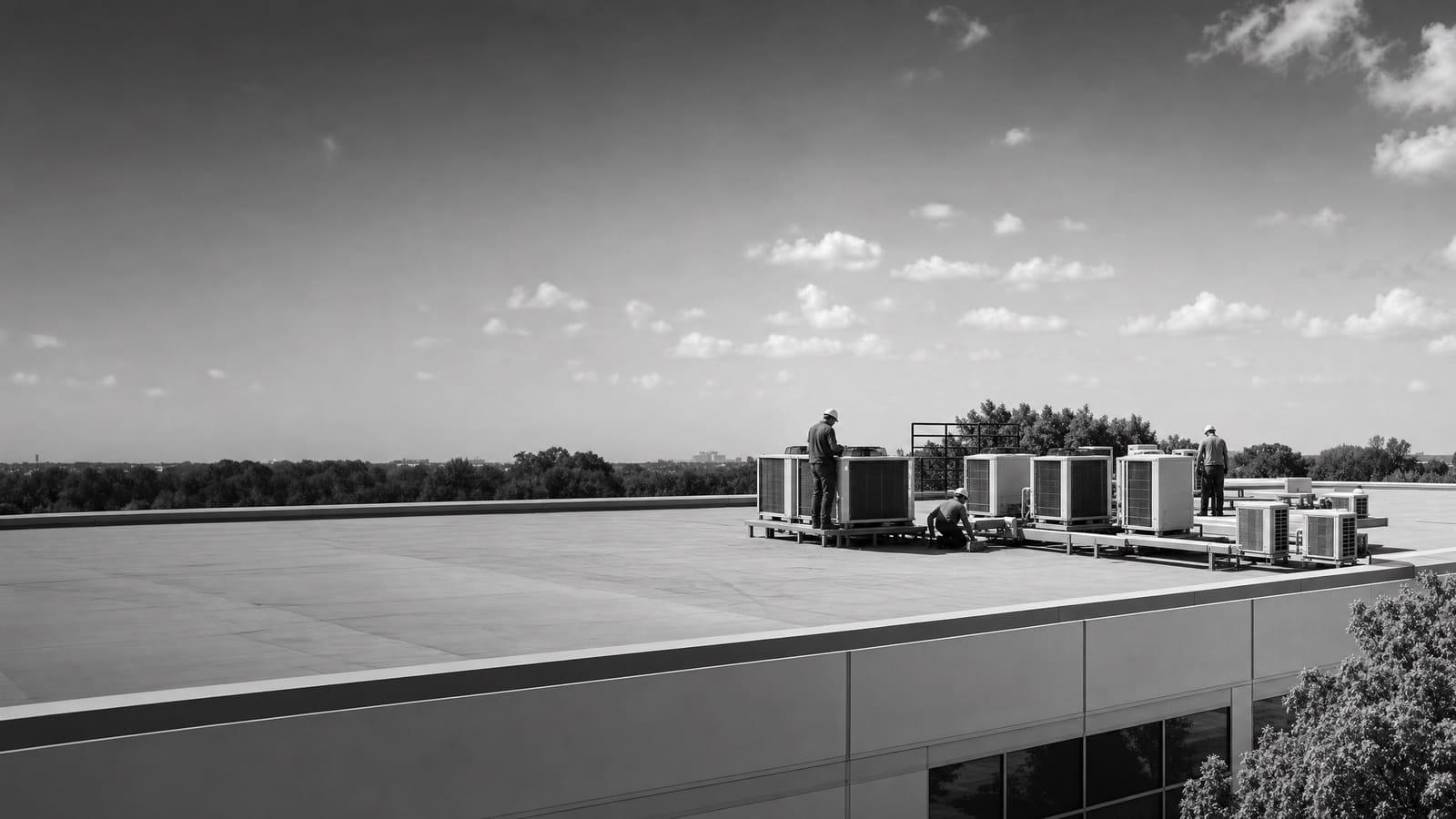
Rooftop units cool close to half of all commercial floor space in the country, so most replacement decisions in a commercial building come down to what goes back on the curb. There are three realistic answers, and the right one depends on how the building is used and what the site can physically support.
Federal work with manufacturers produced high-efficiency rooftop models built to cut energy use by up to half against the older standard, and more than twenty models now exceed that specification. That changed the math on this decision. The cheapest unit on the roof is rarely the cheapest unit to own.
A fourth path is worth knowing even though it is not a replacement. An existing unit can be retrofitted with advanced controls when the cabinet and coil still have real life left in them. That is the honest option when the unit is only ten years old and the complaint is scheduling and control rather than capacity. Once a unit is failing in season, controls will not save it, and the choice narrows to the three below.
WHAT MOVES THE NUMBER
Where a replacement budget actually goes
No two roofs price the same, and the equipment is only one line on the sheet. These are the items that separate a clean swap from a project, listed roughly in the order they tend to surprise people.
BUYING GUIDANCE
Buying the unit you will own for fifteen years
Most rooftop units get replaced the same way. The facility waits until the unit no longer holds the space, needs constant service, or fails outright. That is understandable, and it is also the most expensive version of the project. An emergency replacement takes the equipment choice away from you. You buy what is available that week, at that week's price, with no time to check whether the electrical service could have supported something better.
Federal guidance is direct about this. Replacing an inefficient, underperforming unit on purpose is usually the better business move than replacing it on failure, and it is often better than a like-for-like swap at the end of the old unit's service life. The reason is plain arithmetic. An old unit carries an energy penalty that repeats every single year you keep it, while the price difference between a standard unit and a better one is paid once.
The scale of that has been demonstrated rather than argued. Through a national rooftop campaign, more than two hundred organizations upgraded over forty-three thousand units and cut a combined thirty-seven million dollars a year from their energy bills. Those were ordinary commercial buildings making an ordinary equipment decision earlier than they strictly had to.
COMPLEXITY CHECK
When it is a swap and when it is a project
The same tonnage can be a one-morning swap on one roof and a multi-week project on another. The difference is almost never the equipment itself. It is what the replacement touches on the way in.
LOWER COMPLEXITY
Same fuel, same footprint
The new unit matches the old one's fuel, capacity, and footprint. The existing curb works or takes a standard adapter, the electrical service is untouched, and the roof has clear crane reach. Scope is predictable, and most of the remaining risk sits in equipment availability rather than in the building.
HIGHER COMPLEXITY
Different fuel or different load
Capacity changes, the footprint grows, or the unit switches fuel. Now the curb, the roof framing, the panel, the gas line, and the controls are all in scope. Federal guidance flags electrical capacity, physical constraints, and gas lines as the three infrastructure items that decide whether an electric option is feasible at all.
SCOPING THE JOB
What a real site review looks at
A quote written from a nameplate photo is a starting point, not an answer. The nameplate tells you what somebody sized twenty years ago for a building that has since changed occupancy, lighting, plug load, and operating hours. Carrying that number forward carries the original sizing mistake forward with it.
A real review starts with how the space is used now, then moves to what the site can physically support. Federal guidance lists the same short set every time: electrical capacity, physical constraints, and gas lines. Those three decide whether an all-electric or dual-fuel unit is on the table at all, or whether the honest recommendation is a better version of what is already up there.
Two more items belong on that list and are easy to skip. The first is equipment availability, because a model that pencils out perfectly is worthless if the delivery date lands after your season. The second is contractor familiarity with the specific equipment being proposed. Newer heat pump rooftop units are not installed or commissioned the same way a standard unit is, and that gap shows up in performance rather than in the price. Incentive programs are worth checking before selection too, since they change which tier is affordable and their terms change over time.
Ask for the load basis, not the nameplate
If a proposal does not show how the capacity was determined, you are buying the previous owner's assumptions. Ask for the load basis, the electrical service check, and the delivery date in writing before you compare two numbers side by side.
OWNERSHIP CONSIDERATIONS
Who pays, and who lives with it
Two questions decide more replacement outcomes than the equipment spec does: who carries the cost, and who carries the consequences. In a leased building those are often different parties, and the split is usually written into the lease long before the unit ever fails.
The second question is portfolio shape. One unit on one roof is an isolated decision. Five units on one roof, or forty across a group of buildings, is a standard worth setting once. Federal guidance frames the heat pump question the same way, as a site-by-site evaluation inside a portfolio, because building type, infrastructure, and local energy prices can make the answer different at two properties owned by the same company.
LEASED SPACE
The capital versus operating split
When the landlord buys the unit and the tenant pays the utility bill, nobody is rewarded for the efficient choice. Getting past that usually means agreeing on the recovery mechanism before equipment is selected, not after the invoice arrives.
MULTI-UNIT SITES
Standardize before the second failure
Once a roof carries several units of similar age, treat the first replacement as the template. One specification for tonnage, efficiency tier, controls, and refrigerant makes later swaps faster, keeps spare parts sane, and stops the roof turning into five different service relationships.
PHASING AND PROCUREMENT
Replacing a fleet without replacing it all at once
When several units are near end of life, the instinct is to wait and handle each failure as it arrives. That produces the worst version of every decision: emergency pricing, whatever equipment sits in the warehouse that week, and a roof that ends up carrying five different systems.
The alternative is to rank the roof. Age is the first sort, since units past fifteen years are the ones carrying real energy waste. Service history is the second. A unit that has taken three compressor visits in two years is not a candidate for another season of hope. Consequence is the third: the unit over the server room or the kitchen line is not the one to leave to chance.
Then replace in a planned order across seasons, with the specification set once and the pricing agreed once. Procurement gets easier because you are buying a known model instead of reacting to a failure. Lead time stops being a crisis and becomes a calendar item. For an owner running several buildings in and around Elizabeth, that ordering is the whole difference between a capital plan and a series of emergencies.
The comparison that matters in the end is not this quote against that quote. It is fifteen years of operating cost against fifteen years of operating cost.
QUOTE CHECKLIST
Five things a comparable quote shows
Two quotes are only comparable when both of them show the same five things. If one is missing an item, it is not cheaper. It is less complete, and the gap tends to reappear as a change order after the crane leaves.
01
The capacity basis
Tonnage tied to a current load calculation, not copied from the old unit's nameplate.
02
Equipment tier and refrigerant
Model, efficiency tier, and refrigerant named, so you know what you are servicing for the next decade.
03
Curb, rigging, and access
Adapter or new curb, structural check, crane size, lot closure time, and who coordinates all of it.
04
Utility connections in scope
Electrical, gas, and controls work stated as included or excluded, with nothing left implied.
05
Delivery date and commissioning
A real lead time, plus startup, charge, airflow, and controls verified and documented at handoff.
Get a defensible number
Price the equipment and the building together.
Send the address, operating target, and target opening date. Flux will identify what must be verified before the project can be priced.
Get a free estimateQuestions
Straight answers.
When is replacement better than one more repair?
Once the unit is old enough that failure sets your schedule instead of you setting it. Rooftop units past fifteen years carry substantial energy waste, and old, inefficient units are estimated to burn $900 to $3,700 each per year. A fourth repair does not change that annual number.
Should a gas rooftop unit be replaced with a heat pump?
It depends on winter heating hours, electrical capacity, and the existing gas lines. Heat pump rooftop units heat most efficiently in mild-to-moderate winter conditions, and their efficiency drops toward electric resistance as outdoor temperatures fall, which is why dual-fuel and cold-climate versions exist. Evaluate it building by building rather than as a blanket rule.
How much does commercial HVAC installation cost?
There is no universal installed price, and any number given before someone looks at the roof is a guess. Tonnage, efficiency tier, curb and structural work, crane access, and electrical or gas changes each move it. The figure you can pin down early is what the old unit costs you every year it stays.
Is a controls retrofit an alternative to replacing the unit?
Sometimes. Federal guidance treats advanced controls as a legitimate alternative to replacement when the existing unit still has service life in it. If the complaint is scheduling and control rather than capacity or reliability, controls can be the better spend. If the unit is failing in season, it is not.
What happens to the refrigerant in the old unit?
It gets recovered, not vented. EPA rules under the Clean Air Act govern how refrigerant is handled and recycled in stationary refrigeration, air-conditioning, and heat pump equipment. Recovery belongs to the installing contractor, so ask for it to appear in the written scope rather than assuming it.
Sources used for this guide
- [1]betterbuildingssolutioncenter.energy.gov — DOE Advanced Rooftop Unit Replacement Guidance
- [2]betterbuildingssolutioncenter.energy.gov — DOE Commercial Heat Pump Rooftop Unit Replacement Guidance
- [3]betterbuildingssolutioncenter.energy.gov — DOE High-Efficiency Commercial Rooftop Unit Toolkit
- [4]energy.gov — DOE Efficient Commercial Rooftop Air Conditioner Program
- [5]epa.gov — EPA Stationary HVAC Refrigerant Management