THE DIRECT ANSWER
What a commercial HVAC replacement actually covers
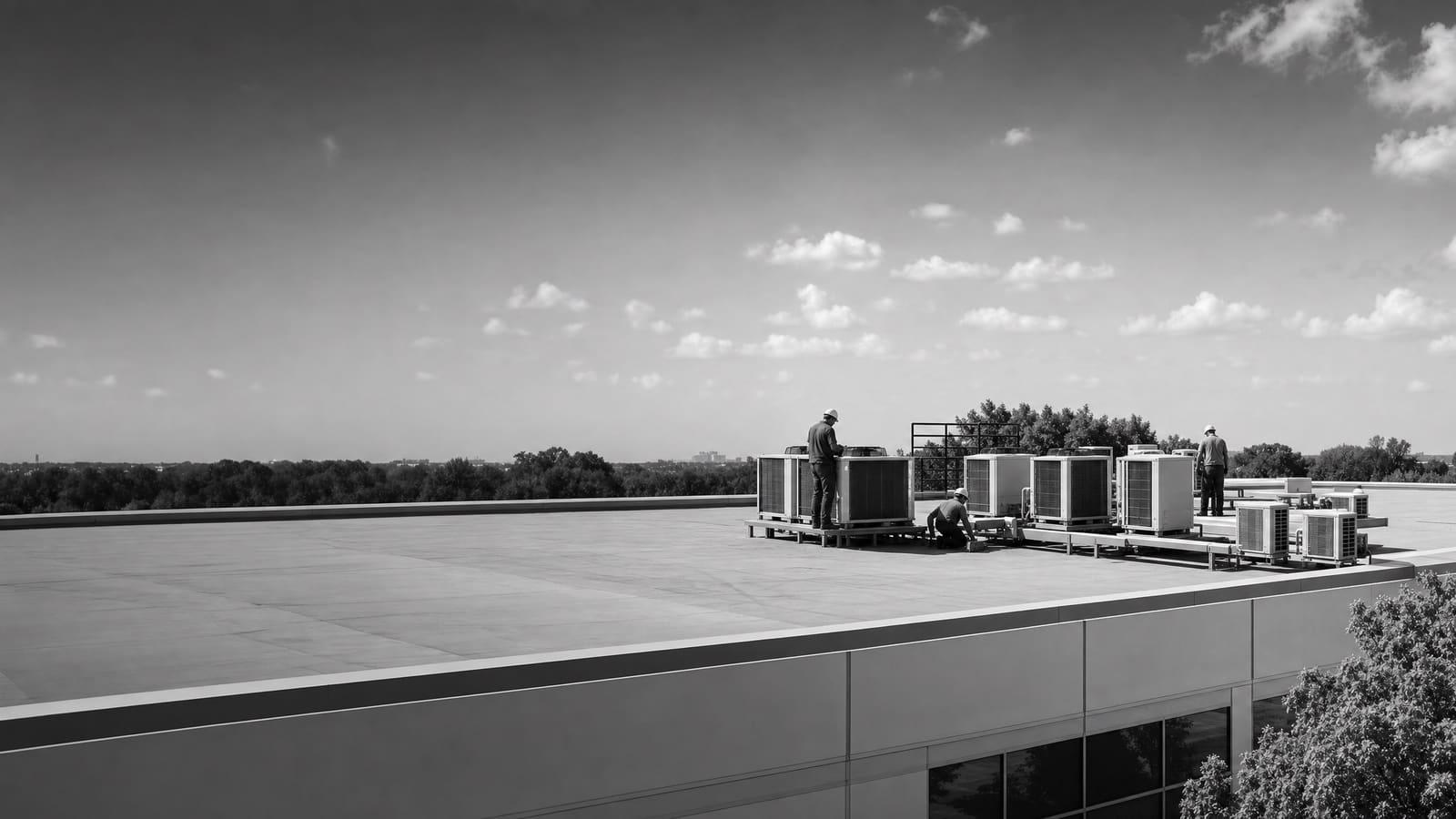
A commercial HVAC replacement covers load verification, equipment selection, rigging and set, connections to gas, power and controls, permitting, and commissioning — not just the unit itself. Replacement beats another repair once equipment is past about fifteen years, because units that old waste real energy every hour they run. Department of Energy work on rooftop units puts that waste between $900 and $3,700 per unit each year, which is often the number that decides the project.
A site review still has to confirm the load against how the space is used today, the roof curb and the structure under it, and whether existing electrical and gas service supports the unit you actually want.
THREE WAYS TO GO
The three replacement paths worth pricing
Most buildings are choosing between three paths, and the right one depends on how much the space has changed and what the roof can support.
Like-for-like keeps the same fuel and roughly the same capacity. It is the fastest path back to conditioned air and the cheapest to engineer, but it carries forward any sizing mistake the old unit had.
A high-efficiency replacement uses the same footprint but buys down operating cost. The Department of Energy's high-performance rooftop challenge produced units built to cut energy use by as much as half against the older baseline, and more than twenty models now exceed that specification.
An electric or dual-fuel heat pump changes the heating source. DOE guidance is clear that heat pump efficiency falls as outdoor temperature drops, so in a northern Illinois winter the honest options are cold-climate equipment or a dual-fuel machine that keeps gas heat for the coldest hours. That decision hinges on electrical capacity at the roof, gas line status, and whether your contractor has installed the equipment before.
WHAT MOVES THE NUMBER
The budget lines that actually swing
Two quotes for the same building can land far apart, and the gap is almost never the unit itself. Compare these lines before you compare totals.
IN PRACTICE
How to buy this without overpaying
Start with the load, not the nameplate. A unit installed twenty years ago was sized for the occupancy, lighting, and equipment of that era. If the space became an office, added density, or got a new roof and new glass, the old capacity is a guess rather than a spec. Confirming the load is cheap next to buying tonnage you do not need, or tonnage that still cannot hold the space.
Then decide whether this is a replacement or an upgrade. The Department of Energy worked with manufacturers and building owners to define a high-efficiency rooftop specification, and more than two hundred organizations have since upgraded over forty-three thousand units under the resulting campaign, saving a combined thirty-seven million dollars a year on energy. Those savings came out of measured field performance, not a brochure. That same campaign also found that retrofitting advanced controls onto a serviceable unit is sometimes the better financial call, which is worth asking before you condemn a machine that still has life in it.
Finally, price availability alongside the equipment. DOE guidance names equipment availability and contractor familiarity as real constraints on rooftop projects, not footnotes. A unit that ships in three weeks and a unit that ships in three months are different products when the building is uncomfortable now.
SCOPE CHECK
What makes this project simple or hard
Complexity is set by the building, not the unit. Before you commit to a schedule, work out which side of this line your roof sits on. It changes the permit path, the crane day, and the price.
LOWER COMPLEXITY
Straight swap on an unchanged building
Same capacity, same fuel, an existing curb that fits, and clear lot access for a crane. Use has not changed, service is adequate, and the work does not trigger a plan review. These jobs move on equipment lead time alone.
HIGHER COMPLEXITY
New capacity, new fuel, or a tight site
Different tonnage or footprint, a fuel change that needs new electrical capacity at the roof, structural questions about the curb, or a lot where the crane has exactly one place to stand. These need engineering, sealed plans, and a phased schedule.
BEFORE YOU BID IT
What a real site review has to answer
A walk-through that only reads the nameplate is not a site review. The DOE checklist for rooftop replacement decisions asks a specific set of questions, and they are the same questions that keep a bid from turning into a change order.
Electrical capacity comes first on any project that adds tonnage or drops gas heat. The panel, the feeder, and the capacity available at the roof decide whether an all-electric option is a real option or an expensive discovery in week six. Physical constraints come next: curb size, roof structure, clearances, and the path a crane can actually reach. Gas line status matters even when you keep gas, because an abandoned or undersized run shows up at startup rather than at bid.
Then look at the operating picture. What hours does the building run, what does the space actually do now, and which comfort complaints has the current system never solved? Those answers move equipment selection more than any efficiency table will.
Get all of it in writing before quotes go out. When every bidder is pricing the same scope, the comparison is honest. When they are not, the low number usually means somebody left something out.
Ask for the electrical answer in writing
Available capacity at the roof is the single item most likely to change an all-electric or higher-tonnage price after award. Have each contractor state what the existing service supports and what the new unit requires before you compare bids.
IN ELGIN
The city's mechanical permit shapes who can bid
Elgin sets a real bar for mechanical work, and it is worth checking before you shortlist anyone. A mechanical permit in Elgin requires a $20,000 permit bond in favor of the City of Elgin, a notarized letter of intent, and a contractor's registration from a city in Illinois that gives a written HVAC examination. There is one alternative written into the rule: registration is not required if the project plans are sealed by an Illinois licensed architect or engineer who accepts responsibility for the work.
That single requirement decides two things on your project. It narrows the bidder list to firms already carrying the bond and registration, and it makes an engineered, sealed-plan approach a legitimate path when the contractor you want is not registered. Smaller scopes that need no plan review can run through the city's quick permit application, so confirm early which path your job takes.
Confirm bond and registration before award
Ask each bidder for proof of the $20,000 Elgin permit bond and a current registration, or confirm that your design will be sealed by an Illinois licensed architect or engineer. Sorting this out after award is what stalls a permit.
OWNERSHIP MATH
Two things to settle before you sign
Rooftop units condition close to half of all commercial floor space in this country, which means most owners are not making a one-time decision. They are making the same decision every few years across a fleet, and the choices compound.
The first question is timing: replace on your schedule, or on the equipment's. DOE guidance is blunt about this — facility managers routinely wait until a unit no longer conditions the space, needs constant service, or fails outright, and replacing proactively often beats replacement-on-failure and even a like-for-like swap at end of life. The second question is what happens after the crane leaves. New equipment arrives on newer refrigerant, and EPA rules under the Clean Air Act govern how refrigerant is handled and recycled in stationary equipment. On a mixed roof, that shapes your service contract and spare-parts thinking, not your day-one comfort.
TIMING
Planned beats reactive
Waiting for failure means paying emergency premiums, taking whatever unit is available, and losing the space in the meantime. A planned replacement lets you price options, hold a lead time, and choose the week the crane comes.
AFTERWARD
Service the fleet you now have
A new unit runs on newer refrigerant while older units on the same roof do not. EPA rules require proper handling and recovery either way, so build the service agreement around a mixed fleet from the start.
OVER TIME
Phasing a roof full of units
If you have more than one unit up there, resist treating each failure as its own emergency. Sort the fleet by age and condition first. Units past fifteen years are the ones burning money, and DOE puts the annual waste from an old, inefficient rooftop unit between $900 and $3,700 apiece. Multiply that by the number of aging units you own and the phasing plan writes itself.
A phased approach also buys purchasing leverage. Ordering two or three units together, ahead of the season, gets better pricing and better availability than a single panicked order in July. It also lets you standardize — same manufacturer, same controls platform, same filter sizes — which quietly lowers maintenance cost for the next fifteen years.
Where a unit is still serviceable, ask about controls before you replace it. The same DOE campaign that pushed high-efficiency equipment found that retrofitting advanced controls can be the better financial move, and it may carry a decent machine long enough to fold into the next planned phase.
Then budget the whole life, not the invoice. Efficiency tier, refrigerant, controls compatibility, and how easily the unit can be serviced all show up in the operating column for well over a decade. The cheapest install on the roof is rarely the cheapest unit to own.
QUOTE CHECKLIST
Five things a comparable quote shows
If two bids do not show these five items the same way, you are not comparing them — you are guessing. Ask for each in writing before you decide.
01
Equipment, tier, and lead time
Make, model, tonnage, efficiency level, and the date it ships. Availability belongs next to the price, not in a follow-up call.
02
Load basis
Whether capacity came from a calculated load or the old nameplate, and what that calculation assumed about how the space is used today.
03
Curb, structure, and rigging
Adapter or new curb, any structural work, crane size, lot closure hours, and who coordinates with tenants.
04
Service changes
Electrical, gas, and refrigerant line work included in the price, with anything conditional called out as a stated allowance.
05
Permits and commissioning
Elgin permit and inspection handling, plus startup, airflow, charge, and controls verification documented at handoff.
Get a defensible number
Price the equipment and the building together.
Send the address, operating target, and target opening date. Flux will identify what must be verified before the project can be priced.
Get a free estimateQuestions
Straight answers.
When is replacing better than repairing again?
Age is the clearest signal. Rooftop units past about fifteen years waste substantial energy compared with current models, and old inefficient units can burn $900 to $3,700 a year each. If the machine is that old and needs regular service, replacement usually wins on operating cost alone.
Does a heat pump make sense in Elgin?
Sometimes, but not in the simple all-electric form. Heat pump efficiency drops as outdoor temperature falls, so northern Illinois points toward cold-climate or dual-fuel equipment that keeps gas heat for the coldest stretch. Electrical capacity at the roof decides whether it is on the table at all.
What does Elgin require of the contractor?
A mechanical permit calls for a $20,000 permit bond in favor of the City of Elgin, a notarized letter of intent, and a contractor's registration from an Illinois city that gives a written HVAC examination. Registration is waived when an Illinois licensed architect or engineer seals the plans and accepts responsibility for the work.
Should we replace the unit or add controls?
Ask both ways. The DOE rooftop unit campaign let owners either replace old units or retrofit advanced controls, depending on which made better financial sense. On a machine with real life left, controls can carry it to the next planned phase.
What happens to the refrigerant in the old unit?
It has to be recovered, not vented. EPA rules under the Clean Air Act govern how refrigerant is handled and recycled in stationary air-conditioning equipment, so proper recovery is a compliance item and a line on the quote, not an option.
Sources used for this guide
- [1]betterbuildingssolutioncenter.energy.gov — DOE Advanced Rooftop Unit Replacement Guidance
- [2]betterbuildingssolutioncenter.energy.gov — DOE Commercial Heat Pump Rooftop Unit Replacement Guidance
- [3]betterbuildingssolutioncenter.energy.gov — DOE High-Efficiency Commercial Rooftop Unit Toolkit
- [4]energy.gov — DOE Efficient Commercial Rooftop Air Conditioner Program
- [5]epa.gov — EPA Stationary HVAC Refrigerant Management
- [6]elginil.gov — elginil.gov