THE DIRECT ANSWER
What a commercial HVAC replacement includes
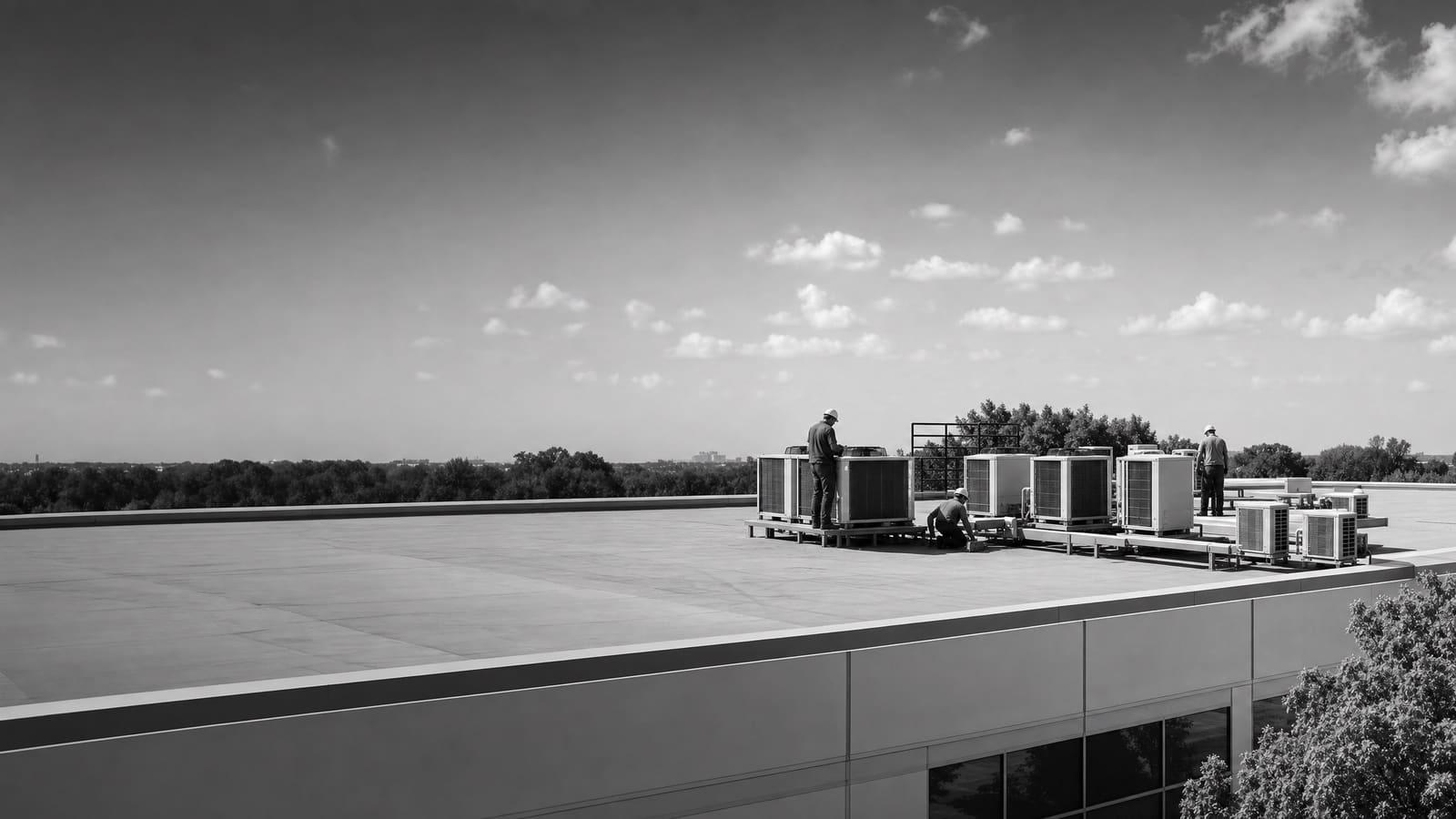
A commercial HVAC replacement is the whole job, not the box: confirming the load the building carries today, selecting equipment against real availability, setting the unit, tying in power, gas, and controls, and commissioning it before handoff. Replacement beats another repair once a rooftop unit is past 15 years, needs service often, or can no longer hold the space. An old, inefficient unit can waste $900 to $3,700 a year in energy alone, and that meter keeps running after the repair.
A site review has to confirm the roof structure and curb footprint, the electrical capacity at the panel, and whether the existing ductwork and controls can carry the unit you actually need.
THREE OPERATING CHOICES
Three ways to replace a rooftop unit
Most commercial replacements come down to three paths, and the right one depends on what the building does now rather than what it did when the last unit was set.
The fastest path is like-for-like. Same tonnage, same fuel, same curb, so engineering is light and the permit is simple. It is honest work when the space and its schedule have not changed.
The second path keeps the same fuel but moves up in efficiency and corrects the size. Rooftop units cool close to half of all commercial floor area in the country, so the efficiency tier you pick shows up on the bill every month for the life of the unit.
The third path changes the heating source. A heat pump rooftop unit is mechanically similar to a standard air-conditioning unit but heats by running the cycle in reverse, which suits mild Western winters and takes gas out of that part of the load.
WHAT MOVES THE NUMBER
Where the money actually goes
No two roofs price the same, and the spread usually comes from a short list. Read a quote against these lines and you can tell whether a low number is genuinely leaner or just missing scope.
CHOOSING EQUIPMENT
How to choose between the equipment options
Start with what the building actually needs, not what is on the old nameplate. Fifteen or twenty years changes occupancy, plug loads, lighting, and sometimes the envelope, so a unit sized for the building's past can be oversized and short-cycling now. A load calculation is a few hours of work that decides the next two decades of comfort complaints.
Then compare tiers honestly. High-efficiency rooftop units were developed under a federal challenge to cut rooftop energy use by up to half against the older standard, and manufacturers have since offered more than twenty models that exceed that specification. The premium is real, but so is the difference on the bill, and utility incentives often close part of the gap.
Heat pumps deserve a serious look here. Heat pump rooftop units are technologically similar to air-conditioning units and add reverse-cycle heating, and they perform best where winter heating is mild to moderate. Across most of the West, current heat pump rooftop units can carry most or all of the winter heating demand. The question is rarely capability. It is electrical capacity, equipment availability, and whether your rates make the switch pay.
COMPLEXITY
What makes one changeout simple and another hard
Two buildings on the same block can quote very differently, and it is rarely the equipment itself. It is what the unit has to connect to, how the crane reaches the roof, and how much of the building has to keep running while the work happens.
LOWER COMPLEXITY
Straight swap on an accessible roof
Same tonnage and fuel, the curb matches or takes a simple adapter, the lot has room for a crane, and the building can give up a few parking stalls for a morning.
HIGHER COMPLEXITY
Conversion, growth, or a tight site
Tonnage grows, the heating source changes, the panel is near capacity, or the only crane position closes a drive aisle. Each one adds engineering, permit scope, and schedule.
SCOPING
What a real site review covers
A quote written from a nameplate photo is a starting number, not a price. It is useful when a unit is down and you need options the same day, but the firm number comes after someone stands on the roof.
The review should confirm the curb: dimensions, condition, and whether the new unit lands on it or needs an adapter. It should confirm the roof itself, since a heavier or larger unit can trigger structural review. It should open the panel and check the electrical capacity available, which is the most common surprise on any project that adds electric heat or steps up tonnage. It should check gas line size and routing if gas stays in the picture. It should look at the ductwork and the outside-air arrangement, because the new unit has to work with the duct system the building already has. And it should check the crane position, the reach, and which stalls or aisles come out of service.
Ask for the findings in writing. A contractor who can hand you that list has actually looked.
The one item to check first
Electrical capacity. If the panel cannot carry a larger compressor or electric heat, the cheapest-looking option on paper becomes the most expensive one on site, and the schedule stretches while the service upgrade catches up.
IN EL MONTE
Permits, roofing, and the mild-winter question
Two local realities shape the schedule here.
The first is permitting. California building departments treat this as permitted work, and the standard list of permit-required jobs covers any mechanical or electrical upgrade or repair, which a rooftop changeout is on both counts. Re-roofing is permitted separately. If your roof is within a few years of a tear-off, sequence the two projects together so the curb and flashing get set once instead of twice. Confirm current requirements with El Monte's building division before you lock a crane date.
The second is climate. Heat pump rooftop units are best suited to mild-to-moderate winter heating, and across most of the West they can carry most or all of the heating demand. That makes an all-electric or dual-fuel unit a real option here rather than a compromise.
Decide the roof before the crane
If a re-roof is coming, do it before or with the changeout. Setting a new unit on a roof you plan to tear off means paying twice for the same curb work and flashing, and pulling two rounds of permits you could have pulled once.
OWNERSHIP
Two things owners underestimate
The purchase decision gets all the attention. These two items decide what the unit costs you after the crane leaves.
Refrigerant is the first. Federal rules govern how refrigerant is handled and recycled in stationary air-conditioning and heat pump equipment, so the old charge has to be recovered properly rather than vented. New equipment also arrives on newer refrigerants, which matters for parts, service contracts, and technician training if you run a mixed fleet across several roofs.
Timing is the second. Many facility teams wait until a unit fails outright or stops holding the space. Replacing on failure means taking whatever equipment is available, at whatever lead time, in the season you can least afford an outage.
REFRIGERANT
Recovery and mixed fleets
The old charge comes out under federal handling and recycling rules. New units arrive on newer refrigerants, so update service contracts and spare-parts planning before the second and third roofs get done.
TIMING
Planned beats replace-on-failure
Waiting for failure hands the decision to whatever is in stock. Replacing an inefficient unit proactively is usually the better business move, and it keeps the outage out of peak season.
PHASING
Sequencing a multi-unit roof
Few buildings need every unit replaced at once, and few budgets want that. The usual approach is to rank the roof: the oldest and least efficient units first, then anything that has been serviced repeatedly, then the rest on a schedule that fits capital planning.
Age is a fair first cut. Rooftop units past fifteen years can waste substantial energy compared with newer models, and a single old unit can burn $900 to $3,700 a year more than it should. Put two or three of those on one roof and the annual waste starts to look like a down payment on the first replacement.
The broader data supports the phased approach. Through a national campaign, more than 200 organizations upgraded over 43,000 rooftop units and cut a combined $37 million a year from their energy bills. Those were not single-building heroics. They were portfolios working through a list.
Order early either way. Equipment availability, not labor, usually sets the date, so locking the selection and placing the order is the part worth rushing.
THE QUOTE
Five things a comparable quote shows
Bids only compare when they describe the same job. Ask every contractor to put these five items in writing, then read the lowest number against the list before you assume it is the better deal.
01
Equipment, tier, and availability
Model, tonnage, efficiency tier, heating type, and the real lead time rather than a placeholder week.
02
Curb and structural scope
Whether the unit lands on the existing curb, needs an adapter, or triggers framing or structural review.
03
Electrical and gas work
Panel capacity, any service upgrade, disconnect work, and gas line changes, priced rather than excluded.
04
Rigging and site plan
Crane position, reach, which stalls or aisles close, and the hours the work happens.
05
Commissioning and closeout
Startup readings, charge and airflow verification, controls setup, permits pulled, inspections passed, and documents handed over.
Get a defensible number
Price the equipment and the building together.
Send the address, operating target, and target opening date. Flux will identify what must be verified before the project can be priced.
Get a free estimateQuestions
Straight answers.
When is replacement better than one more repair?
Once a unit is past fifteen years, needs service often, or can no longer hold the space, the repair is buying time on a machine that is already costing you. An old, inefficient rooftop unit can waste $900 to $3,700 a year in energy on its own, which frequently outruns the repair invoice.
Should we replace like-for-like or resize?
Confirm the load either way. If the space, the schedule, and the equipment inside have not changed, like-for-like is often the right call and the simplest permit. If occupancy or plug loads shifted, right-sizing fixes the comfort complaints the old unit was never able to solve.
Does a heat pump rooftop unit make sense in El Monte?
It is worth pricing. Heat pump rooftop units are technologically similar to standard air-conditioning units and add reverse-cycle heating, and they work best where winters are mild to moderate. Across most of the West they can carry most or all of the heating load. The real gate is electrical capacity.
Who pulls the permits?
The installing contractor should own permits, inspections, and the rigging plan as part of the installed price, and the quote should say so. A rooftop changeout is mechanical and electrical work, and re-roofing is permitted separately, so confirm scope with the city before scheduling the crane.
What usually sets the schedule?
Equipment availability, not crew availability. Once the selection is locked and the order is placed, the on-site work is short and predictable. That is why lead time belongs on the quote next to the price, and why planned replacements beat waiting for a failure in August.
Sources used for this guide
- [1]betterbuildingssolutioncenter.energy.gov — DOE Advanced Rooftop Unit Replacement Guidance
- [2]betterbuildingssolutioncenter.energy.gov — DOE Commercial Heat Pump Rooftop Unit Replacement Guidance
- [3]betterbuildingssolutioncenter.energy.gov — DOE High-Efficiency Commercial Rooftop Unit Toolkit
- [4]energy.gov — DOE Efficient Commercial Rooftop Air Conditioner Program
- [5]epa.gov — EPA Stationary HVAC Refrigerant Management
- [6]californiacity-ca.gov — HVAC Permits