THE SHORT ANSWER
What a commercial HVAC replacement in Edmond actually includes
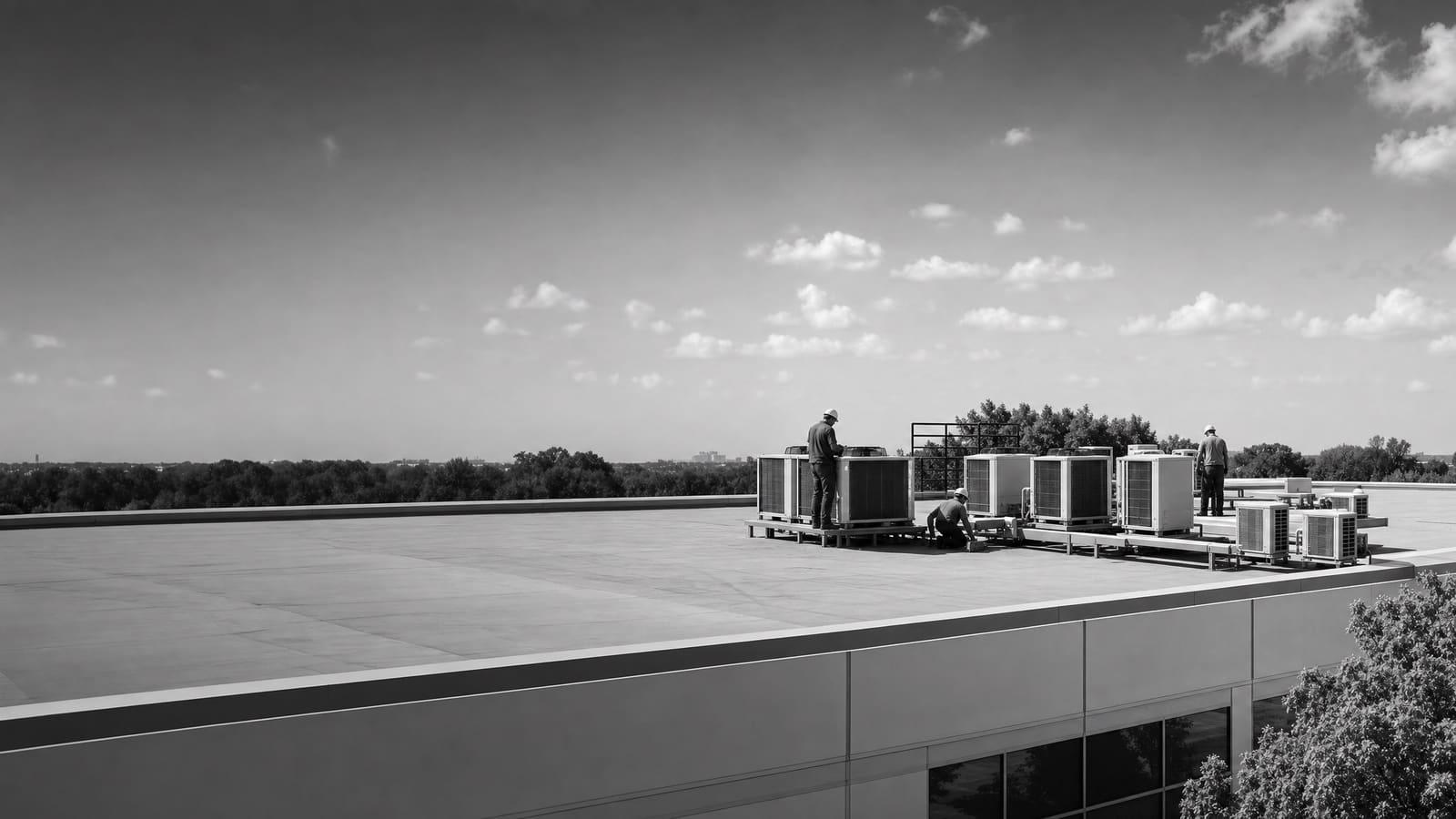
A commercial HVAC replacement is a load check, an equipment selection, a rigging and permit plan, and a commissioned startup. Most Edmond jobs are packaged rooftop units, the equipment that cools close to half of all U.S. commercial floor space. Replacement beats another repair once a unit is past about fifteen years and leaning on service calls — DOE puts the waste from an old, inefficient rooftop unit at roughly $900 to $3,700 a year, and that meter runs whether you replace it or not.
A site review still has to confirm the real load, the curb and roof structure, available electrical capacity and gas service, and crane access before any price means anything.
THREE WAYS TO GO
Replace in kind, right-size, or upgrade the controls
Not every failing rooftop unit needs the same answer. The choice usually comes down to how much the building has changed since the last unit went in, and how much life the existing cabinet still has.
Waiting for total failure is its own choice, and it is the expensive one. DOE's guidance is blunt about it: facility managers often delay until the unit no longer conditions the space, needs constant service, or dies outright, and a proactive replacement usually beats replacement-on-failure. A unit past about fifteen years is the one to plan around, because that is where the energy waste and the service calls start compounding.
The three paths below are real options, not a good-better-best ladder. A small office with stable occupancy and a young cabinet is a controls candidate. A building that added tenants, kitchen equipment, or server load since the last install is a right-sizing candidate. A unit down in July, in a space that has not changed, is a like-for-like candidate.
WHAT MOVES THE NUMBER
The lines that decide what a replacement costs
Nobody can price a roof from a phone call. What a bidder can do is show which lines carry real risk, so you can tell a thin number from a complete one. These are the items that move most between two quotes on the same building.
IN PRACTICE
How the buying decision actually gets made
The equipment decision is mostly a decision about the next fifteen years, not about set day. DOE's rooftop guidance lists the questions that decide it: the climate and heating load, the utility bill impact, the building type, what equipment you can actually get, and the infrastructure already at the roof — electrical capacity, physical constraints, and existing gas lines. If a higher-efficiency or electric option needs panel capacity the building does not have, that cost belongs in the comparison from the start, not as a change order in week three.
Efficiency is worth real money here, and it is one of the few numbers with a hard federal source behind it. An old, inefficient rooftop unit wastes somewhere between $900 and $3,700 a year. Across a roof carrying four or five of them, that is the difference between a replacement that pays for part of itself and one that only restores cooling.
The other half of the decision is availability. A unit you can get in three weeks and a unit you can get in three months are not the same product when the space is already uncomfortable. Ask for lead times next to prices, on every option, before you rank them.
SCOPE CHECK
What makes a replacement simple or complicated
Two buildings on the same street can get very different numbers, and the difference is rarely the unit itself. It is what the replacement drags in behind it — structure, power, access, and the scope the code adds once the job is open.
LOWER COMPLEXITY
Straight swap conditions
The new unit matches the old footprint and weight. The existing curb takes an adapter. Electrical service and gas are already sized for it. The crane can reach from the lot with a few stalls coned off, and the space is used the same way it was when the last unit went in.
HIGHER COMPLEXITY
What pushes scope up
Bigger tonnage, a new footprint, or added weight that pulls in structural review. Not enough panel capacity for a higher-efficiency or electric option. A tight lot that forces a larger crane or a closure. Occupied space that has to stay conditioned, which means temporary cooling and a phased set.
BEFORE YOU PRICE IT
What a real site review has to answer
A site review is not a formality, and it is not a sales visit. It is the step where a bidder converts guesses into scope. Done properly it answers a short list of questions, and every one of them can change the price.
Start with load. The old nameplate tells you what someone sized years ago for a building that no longer exists in the same form. Occupancy, lighting, plug loads, kitchen equipment, and envelope work all move the number. Sizing from today's use is what fixes the comfort complaints the old unit could never fix.
Then the roof itself: curb dimensions, structural capacity for the new weight, and the condition of the deck and flashing around the opening. Then infrastructure — DOE puts electrical capacity, physical constraints, and gas lines on its checklist for a reason, because those items quietly rule an option in or out. Then access: where the crane sets up, what it can reach, how long the lot loses stalls, and whether the building can operate through it.
Last, the handoff. Startup, refrigerant charge, airflow, and control settings get verified and documented, or the warranty argument later is yours to lose.
What to ask for in writing
Ask for the load calculation basis, the curb and structural finding, the confirmed electrical and gas capacity, and the commissioning documents handed over at closeout. If a bidder will not put those four in writing, the number is an estimate.
EDMOND AND OKLAHOMA CODE
The code your Edmond quote gets designed against
Commercial mechanical work in Edmond is designed against a statewide floor. The Oklahoma Uniform Building Code Commission adopted the 2018 International Mechanical Code, as amended by the commission, as the statewide minimum code for commercial mechanical construction. Local jurisdictions can go further, but only through the process Oklahoma law and the commission's rules allow. So the right question for a bidder is which edition and which local amendments the design is built to.
One Oklahoma amendment matters directly on a rooftop. The commission modified the code's wind-resistance section so equipment and appliances exposed to wind may be designed and installed in accordance with SMACNA duct construction standards or other approved methods. On a roof in this part of the country, that is not paperwork. It decides how the unit and its rooftop duct get anchored, and it belongs in the submittal rather than in a conversation on set day.
The state also left the code's appendices out of the statewide minimum, though individual jurisdictions may adopt them — one more reason to confirm local requirements before drawings go in.
Ask before the submittal
Have the bidder state the code edition, any local amendments that apply in Edmond, and the wind-anchoring method for the new unit and its rooftop duct. Confirming that before submittal is far cheaper than correcting it at inspection.
OWNING THE OUTCOME
Two decisions that outlive the install
Two choices on a replacement outlast set day by years. Both are easier to make now than to unwind later.
The first is fuel. A heat pump rooftop unit is mechanically close to a standard air-conditioning rooftop unit, with the added ability to heat by reversing the cycle. DOE splits the options into dual-fuel, all-electric, and cold-climate machines, and notes that heat pump heating efficiency falls as outdoor temperature drops, trending toward electric resistance at the bottom. Across most of the South and West, current heat pump rooftop units handle most or all of the winter heating demand — and the same guidance points at southern cold snaps as the reason dual-fuel exists.
The second is refrigerant. EPA rules under Section 608 of the Clean Air Act govern how refrigerant is handled and recycled in stationary air-conditioning and heat pump equipment, starting the day the old unit comes off.
FUEL
Electric, gas, or both
If the old unit burned gas, the replacement is a fork in the road. Price the dual-fuel and all-electric options side by side with any electrical capacity work included, and let heating hours and utility math decide instead of habit.
SERVICE
A mixed fleet is a plan, not a problem
New equipment will sit beside older units for years. Decide now who holds the recovery and recycling obligation, what spare parts you stock, and how the service contract covers two refrigerant generations at once.
PHASING AND PROCUREMENT
Replacing several units without replacing them all at once
Most buildings do not replace a whole roof at once, and they should not have to. The useful move is to rank the units by age and service history, replace the worst one properly, and let that project set the standard the rest follow — same controls approach, same commissioning documents, same contractor who now knows your roof.
Phasing also gives you procurement leverage. Once the first unit is specified, the second and third are a quoted repeat rather than a fresh design, and lead times can be scheduled around your season instead of around a failure. DOE's rooftop campaign is the portfolio-scale version of the same idea: more than two hundred organizations upgraded over 43,000 units and cut a combined $37 million a year from their energy bills, one project at a time.
Lifetime cost is where this pays. The purchase price shows up once. The efficiency tier, the sizing accuracy, and the quality of the commissioning show up every month for the life of the unit. When two bids land close together, the deciding question is not which is cheaper on set day. It is which one leaves you with a correctly sized, properly documented machine you are not fighting in year three.
THE QUOTE
Five things a comparable quote has to show
Two quotes are only comparable if both show their work. Ask every bidder to break out these five, in writing, before you compare totals. A number that arrives without them is not a lower price — it is an incomplete one.
01
Tonnage, efficiency tier, and sizing basis
The selected unit, its efficiency rating, and whether the size came from a current load calculation or from the old nameplate.
02
Curb, structural, and roof work
Adapter or new curb, any structural review the weight or footprint triggers, and how the roof opening gets flashed and sealed.
03
Rigging, access, and lot impact
Crane size, staging location, stalls out of service, and the hours the work happens. It should also say who coordinates tenants.
04
Permits, inspections, and code-triggered scope
Which permits are pulled, who pulls them, and any ventilation, anchoring, or other scope the replacement adds under the adopted code.
05
Commissioning and closeout documents
Startup readings, refrigerant charge, airflow, control settings, refrigerant recovery records, and warranty registration handed over at the end.
Get a defensible number
Price the equipment and the building together.
Send the address, operating target, and target opening date. Flux will identify what must be verified before the project can be priced.
Get a free estimateQuestions
Straight answers.
When does replacing a rooftop unit beat another repair?
Once a unit is past about fifteen years it starts wasting real money — DOE puts an old, inefficient rooftop unit at roughly $900 to $3,700 a year. Add frequent service calls and spaces that never hold setpoint, and a planned replacement usually beats waiting for the failure.
Does Edmond use a different mechanical code than the rest of Oklahoma?
Oklahoma's building code commission adopted the 2018 International Mechanical Code, as amended, as the statewide minimum for commercial mechanical construction. Local jurisdictions can add to that floor through the process state law allows, so ask your bidder to confirm the edition and any local amendments before submittal.
Should the replacement be a heat pump?
It depends on heating hours, electrical capacity, and utility rates. DOE treats heat pump rooftop units as capable of most or all winter heating across most of the South and West, with dual-fuel available where cold snaps are a concern. Price both options with any electrical work included.
What happens to the refrigerant in the old unit?
It gets recovered by a certified technician. EPA rules under Section 608 of the Clean Air Act govern handling and recycling for stationary air-conditioning and heat pump equipment. Ask for the recovery record as part of the closeout paperwork.
Can we keep the existing units and just add controls?
Sometimes. DOE's rooftop campaign gave owners both paths — replace the unit or retrofit advanced controls — depending on which made better financial sense. Controls are worth pricing when the cabinet still has service life and the original sizing was right.
Sources used for this guide
- [1]betterbuildingssolutioncenter.energy.gov — DOE Advanced Rooftop Unit Replacement Guidance
- [2]betterbuildingssolutioncenter.energy.gov — DOE Commercial Heat Pump Rooftop Unit Replacement Guidance
- [3]betterbuildingssolutioncenter.energy.gov — DOE High-Efficiency Commercial Rooftop Unit Toolkit
- [4]energy.gov — DOE Efficient Commercial Rooftop Air Conditioner Program
- [5]epa.gov — EPA Stationary HVAC Refrigerant Management
- [6]oklahoma.gov — Oklahoma Uniform Building Code Commission - IMC 2018