THE SHORT VERSION
What a commercial HVAC replacement actually covers
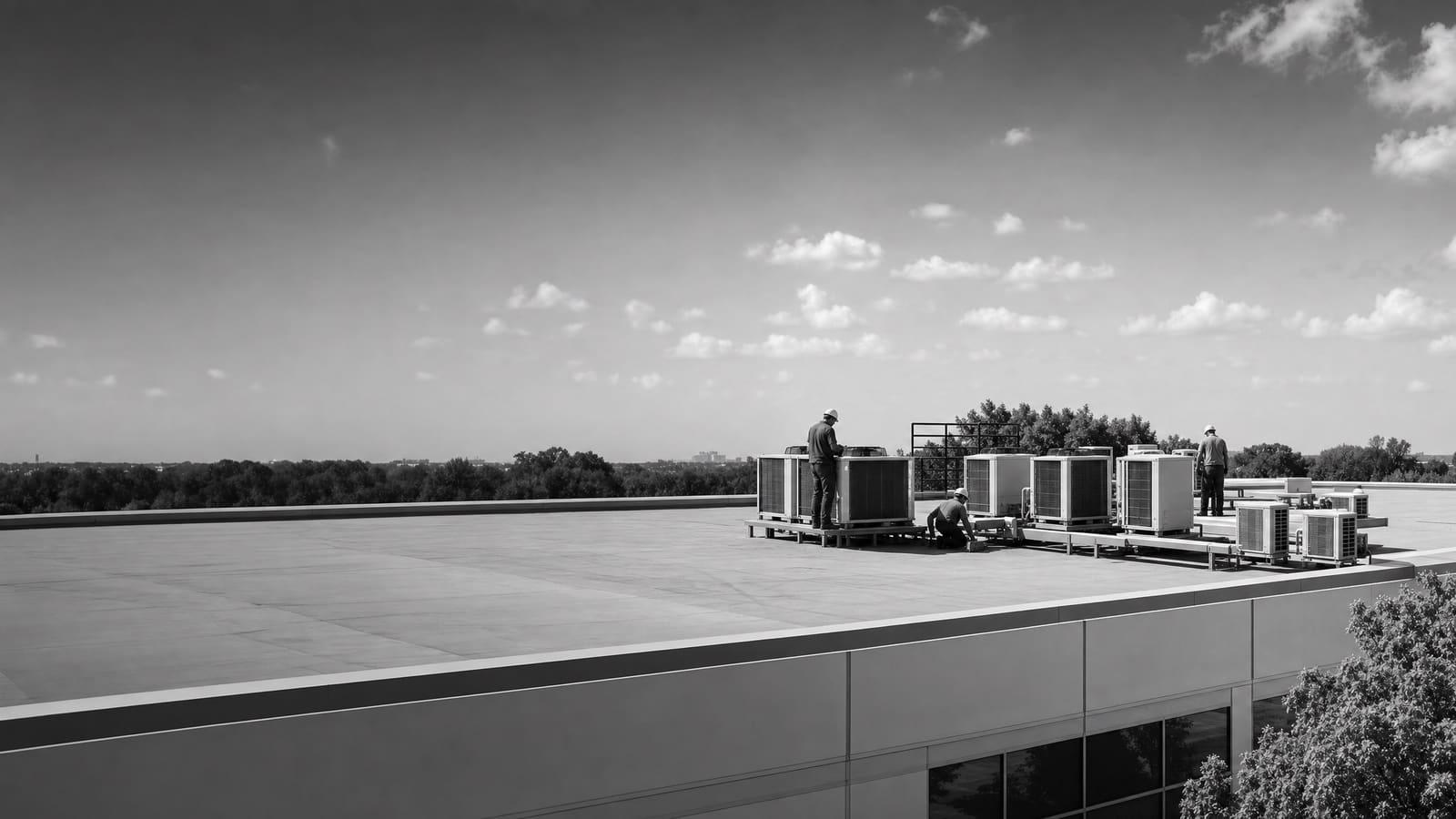
A commercial HVAC replacement covers a confirmed load calculation, equipment selection, rigging and set, curb or adapter work, gas, electrical, and refrigerant tie-ins, controls integration, permits, and commissioning. Replacement usually beats another repair once a unit is past fifteen years and no longer holding the space. Department of Energy figures put the yearly energy waste of an old, inefficient rooftop unit at roughly $900 to $3,700, before you count what the service calls cost.
A site review still has to verify roof structure, curb footprint, available electrical capacity, and crane access before anyone can price the job. Those four items move the number more than the tonnage on the nameplate.
THE REAL CHOICE
Three ways owners handle an aging rooftop unit
Most buildings pick the first option below without ever deciding on it. Federal guidance is blunt about that habit: managers tend to wait until the unit stops holding the space, needs constant service, or fails outright, and proactive replacement with a more efficient unit usually beats both replacement-on-failure and a like-for-like swap at the end of service life. So the question is not really repair versus replace. It is whether you pick the date or the equipment picks it for you. Rooftop units condition close to half of all commercial floor area in the country, which means this same decision repeats across offices, retail, restaurants, and schools alike. Choose the path before the first hot week, and equipment availability, crane scheduling, and tenant notice all become line items instead of emergencies.
WHAT MOVES THE NUMBER
The lines that separate two bids
Nobody can quote a rooftop replacement from a tonnage number alone. These are the items that make one bid look cheaper than another on the same building, and the ones worth asking about before you compare totals.
BUYING GUIDANCE
Choosing between gas heat and a heat pump
The biggest fork in a modern replacement is whether the new unit heats with gas or reverses the cooling cycle. Heat pump rooftop units are close technical cousins of the air conditioning units already sitting on most roofs, so the change is rarely exotic. What changes is the infrastructure behind it. Federal guidance tells owners to check electrical capacity, physical constraints on the roof, and existing gas lines before committing, because those three items decide whether an all-electric unit is a straight swap or a service upgrade.
Climate drives the rest. Heat pumps are most efficient in mild-to-moderate winter heating, and Department of Energy guidance places most of the U.S. South and West in the range where today's heat pump rooftop units can carry most or all of the winter load. The same guidance is careful about assuming that holds every single year. The February 2021 Texas freeze is the reference case: as outdoor temperatures fall, heat pump efficiency trends toward parity with electric resistance heat, and the backup element carries the building. Ask what that backup draws and whether your service can support it.
Between the two extremes sits the dual-fuel unit, which runs the heat pump in normal conditions and switches to gas when it stops paying. For a building with healthy gas service and a hard comfort requirement, that is often the least dramatic path forward.
SIDE BY SIDE
What makes a replacement simple, and what makes it complicated
Two buildings with identical tonnage can be a half-day job or a three-week project. The difference is almost never the equipment itself. It is everything surrounding it.
STRAIGHTFORWARD
Same use, same footprint
The space is used the way it was when the original unit went in, the new unit lands on the existing curb or a standard adapter, the crane has clear lot access, and gas and electric service are unchanged. The scope stays mechanical and electrical.
PLAN FOR MORE
New load, new infrastructure
Occupancy or plug loads changed, tonnage or footprint grew, the roof needs structural review, or an all-electric unit needs more panel capacity than the building has. Add controls integration across a mixed fleet and the schedule stretches well past the crane day.
SCOPING
What the site review has to settle
A useful site review answers questions in a specific order. First, what does the space need now? Fifteen or twenty years changes occupancy, plug loads, lighting heat, and sometimes the envelope, so the old nameplate is a starting point rather than an answer. Second, what is physically possible? Curb dimensions, roof structure, and crane reach from the parking lot decide whether this is a set or an engineering exercise.
Third, what does the existing unit contain? Old equipment holds refrigerant that must be recovered and handled under EPA Section 608 rules instead of vented, and that work belongs to certified technicians. It is a small line on the quote and a real liability when someone skips it.
Fourth, what does the building feed it? Panel capacity, breaker space, and gas service all get confirmed on paper before anyone orders equipment. Skipping this step is what turns a clean swap into a change order.
Finally, what does the replacement trigger? Ask directly which permits, inspections, and code items apply to your scope and get the answer in writing. A contractor who has done this work before will answer in a sentence.
Ask this before you compare bids
Which items here are allowances rather than priced work? Curb adapters, structural repair, and electrical upgrades are the three that most often move after the crane has already left the lot.
OWNERSHIP
Two things owners underweight
The replacement decision does not end when the new unit runs. Two follow-on choices shape what the next several years actually cost you.
Standardizing across a portfolio pays back in parts, technician familiarity, and service response time. Mixed fleets running different refrigerants and different control platforms cost more to maintain than their purchase prices suggest. Incentives, meanwhile, are paperwork with deadlines attached. Programs like these are the reason more than 200 organizations upgraded over 43,000 rooftop units through the Advanced RTU Campaign, saving a combined $37 million a year on energy. Applications almost always have to be filed before work starts, which is exactly why the money gets left on the table when a unit fails first.
PORTFOLIO
One platform beats five
If you own more than a few units, matching manufacturers, refrigerants, and control platforms lowers the cost of every service call afterward. Equipment availability is worth confirming early too, since lead time rather than labor sets most schedules.
TIMING
Incentives close before failures happen
Most programs require pre-approval and tie the money to efficiency tiers you have to specify before ordering. A planned replacement can capture that. A Friday afternoon emergency almost never can.
PLANNING AHEAD
How to phase a multi-unit replacement
If your roof carries several units, replacing all of them at once is rarely the right call, and waiting for each one to fail is worse. The workable middle is a ranked plan. Sort the fleet by age, service history, and how much the space each unit serves matters to the business, then replace in that order across two or three budget cycles.
Age is the cheapest screen you have. Units past fifteen years waste substantial energy compared with current models, and Department of Energy figures put the annual waste of an old, inefficient rooftop unit at roughly $900 to $3,700 each. Multiply that by the number of units in that bracket and the phasing plan usually justifies its own schedule.
Procurement follows the same logic. Ordering two or three units together buys one crane mobilization, one permit cycle, and one round of controls work instead of three. It also gives you leverage on lead time, which is the variable most likely to break a seasonal deadline.
The last piece is documentation. Commissioning records, submittal packages, and warranty registrations should land in your hands at closeout, not in a contractor's file. When the next unit comes up, that paperwork is what turns the next bid into an apples-to-apples comparison instead of a fresh discovery process.
BEFORE YOU SIGN
Five things a comparable quote has to show
Bids that differ by tens of percent usually differ in scope, not in price. These five lines are what make two quotes comparable. If a bid leaves any of them out, ask for it in writing before deciding.
01
The equipment, spelled out
Make, model, tonnage, efficiency tier, refrigerant, and heating type. Not just a line that says new rooftop unit.
02
Availability, not just price
Quoted lead time for that specific unit, and what happens to the schedule if the ship date slips.
03
Rigging and site work
Crane size, lot closure hours, curb or adapter work, and who is responsible for pulling permits.
04
Tie-ins and controls
Electrical, gas, and refrigerant line work, plus integration with the building automation system you already run.
05
Commissioning and closeout
Startup, charge, airflow, and control settings verified against spec, documented, with warranty registration included.
Get a defensible number
Price the equipment and the building together.
Send the address, operating target, and target opening date. Flux will identify what must be verified before the project can be priced.
Get a free estimateQuestions
Straight answers.
When does replacement beat one more repair?
Age plus behavior is the test. Units past fifteen years waste substantial energy compared with current models, and federal figures put that waste at roughly $900 to $3,700 per unit each year. When a unit that old also needs frequent service or can no longer hold the space, another repair is buying time on an asset that is already costing you money every month.
Is a heat pump rooftop unit a realistic replacement?
For much of the southern and western United States, yes. Department of Energy guidance says today's heat pump rooftop units can handle most or all of the winter heating demand in those regions, and they are technically similar to the air conditioning units already installed. The deciding factors are electrical capacity, roof constraints, existing gas lines, and how the backup heat is sized.
How much does a commercial rooftop replacement cost?
There is no honest universal number, because tonnage, curb work, crane access, and electrical scope move the total more than the equipment does. What you can price today is the other side of the equation: an old, inefficient unit wastes roughly $900 to $3,700 a year in energy. Get an installed price after a real look at the roof, with allowances identified separately.
What happens to the refrigerant in the old unit?
It gets recovered, not released. EPA Section 608 rules under the Clean Air Act govern how refrigerant is handled, recovered, and recycled in stationary air conditioning and heat pump equipment, and that work is done by certified technicians. It should appear as its own line on the quote so you know it was planned rather than improvised.
Can the work happen without closing the building?
Usually. The visible disruption is the crane day, and most of it is parking, not conditioning. Curb adapters, permits, rigging plans, and tie-in details are settled weeks earlier, so the set itself is short. Tenants typically notice coned-off stalls more than they notice the outage.
Sources used for this guide
- [1]betterbuildingssolutioncenter.energy.gov — DOE Advanced Rooftop Unit Replacement Guidance
- [2]betterbuildingssolutioncenter.energy.gov — DOE Commercial Heat Pump Rooftop Unit Replacement Guidance
- [3]betterbuildingssolutioncenter.energy.gov — DOE High-Efficiency Commercial Rooftop Unit Toolkit
- [4]energy.gov — DOE Efficient Commercial Rooftop Air Conditioner Program
- [5]epa.gov — EPA Stationary HVAC Refrigerant Management