THE DIRECT ANSWER
Commercial HVAC replacement and installation in Doral.
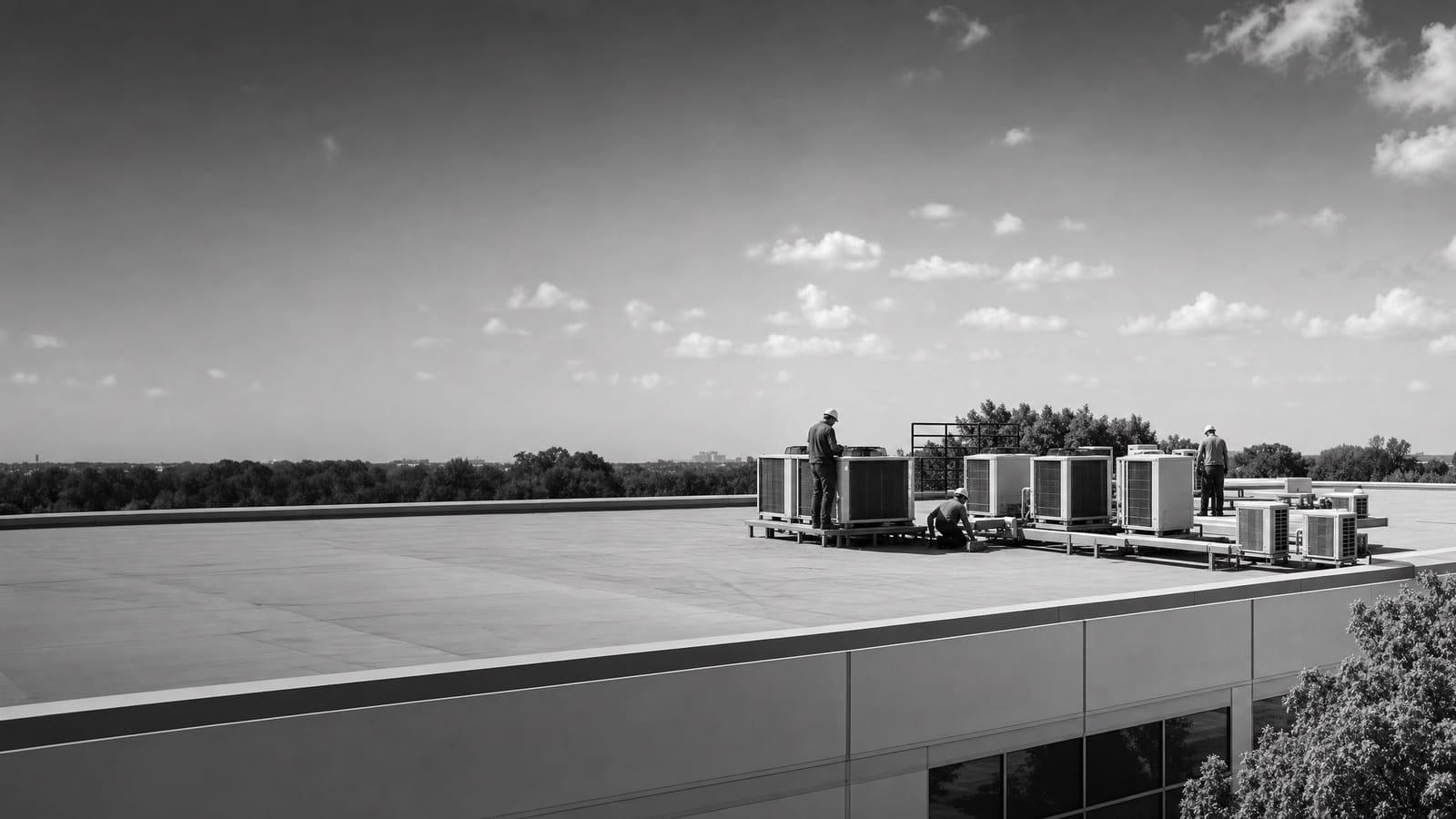
A commercial HVAC replacement includes load review, equipment selection, permits, removal, rigging, utility connections, controls, startup, and commissioning. Replacement is usually more useful than another repair when an older unit fails often, cannot hold temperature, or needs major work while still wasting energy. DOE guidance notes that rooftop units over 15 years old may be strong candidates for planned replacement.
A site review must verify the actual load, curb dimensions, roof condition, crane access, electrical service, heating source, controls, ventilation, drainage, and equipment availability.
THREE OPERATING CHOICES
Choose the project path before choosing a model
The first choice is whether to repair, replace like-for-like, or redesign around the building’s current needs. A repair can make sense when the equipment is otherwise sound and the failed part is available. A like-for-like replacement can shorten design work when the old capacity, heating method, curb, and controls still fit.
Right-sizing deserves more study when occupancy, hours, internal equipment, ventilation, or space use has changed. A heat pump rooftop unit adds another choice. DOE guidance says heat pump RTUs are well suited to mild-to-moderate winter heating, but the decision still depends on electric capacity, utility rates, emissions goals, physical limits, and equipment availability.
Do not let the old nameplate settle the decision by itself. It tells you what was installed, not what the building needs now. Compare each option by comfort, outage risk, first cost, expected energy use, service support, and work required outside the unit.
BUDGET STRUCTURE
What moves an installed commercial HVAC price
The supplied research does not support one universal installed price. A useful budget separates the equipment from the labor, access work, building changes, and closeout services required to deliver a working system.
EQUIPMENT SELECTION
Compare systems by how the building operates
Packaged rooftop units combine cooling, air movement, controls, ventilation, and often heating in one cabinet. They are common across commercial buildings and can simplify replacement when the roof curb and utility connections remain usable. A standard air-conditioning RTU may use gas or electric resistance for heat. A heat pump RTU provides reverse-cycle heating and may be all-electric or paired with another heat source.
Efficiency is important, but it is not the only selection rule. Ask how the proposed unit performs at the building’s normal load, not only at its rated peak. Staged or variable operation can better match changing occupancy. Controls should support real schedules, temperature setbacks, ventilation, alarms, and any existing building automation system. Service access and locally available parts also affect the ownership experience.
DOE reports that RTUs condition nearly half of U.S. commercial floor area. Its older efficiency work found large savings opportunities in aging units, but those historical program results are not a promise for one Doral building. Build the business case from this facility’s run hours, present energy use, repair history, heating needs, and quoted options.
PROJECT COMPLEXITY
A box swap and a building change are different projects
Two units with similar capacity can require very different installation scopes. The quote should state which existing conditions are assumed to remain and which will be changed.
LOWER COMPLEXITY
Compatible replacement
The load remains suitable, the curb can be reused with a listed adapter, utilities have capacity, controls are simple, and the crane can reach the unit without unusual staging.
HIGHER COMPLEXITY
Modified system
Capacity or heating type changes, roof framing needs work, electrical service is limited, ventilation must be corrected, or the new unit must join an existing automation system.
DORAL PROJECT CONTROL
Confirm the permit path before equipment is released
Do not assume that ordering a matching rooftop unit removes plan review or permit work. The required package can change when equipment moves, capacity changes, roof framing is altered, electrical work expands, or a different heating method is selected. Before release, the project team should confirm the current requirements with the authority that governs the Doral property.
The supplied municipal example is from another Florida jurisdiction, so it does not establish Doral rules. It does show why scope matters: that guide calls for mechanical plans when HVAC equipment is installed or relocated, energy calculations for HVAC work, equipment locations, and framing details when roof structure changes. Use that as a checklist prompt, then verify the actual Doral requirements in effect when the permit is filed.
Put responsibility in writing
The proposal should identify who prepares plans, files permits, answers review comments, schedules inspections, pays listed fees, and corrects work needed for final approval.
OWNERSHIP VIEW
Balance outage risk with lifetime value
A failed unit forces the buyer to work around available equipment, emergency conditions, tenant pressure, and immediate comfort needs. Planned replacement creates room to verify the load, compare heating options, coordinate capital work, and schedule the outage. DOE guidance specifically notes that proactive replacement of inefficient, underperforming RTUs can be a sound business move compared with waiting for failure.
The lifetime decision should include expected energy use, maintenance access, controls, filter needs, warranty terms, parts support, and the effect of mixing equipment across a portfolio. Refrigerant also belongs in the plan. EPA rules govern the handling and recycling of refrigerants in stationary air-conditioning and heat-pump equipment. The quote should define recovery, documentation, and disposal work instead of treating removal as an unexplained allowance.
REPLACE ON FAILURE
Speed leads the decision
Availability and temporary cooling may control the choice. Protect against rushed assumptions by documenting capacity, utilities, curb fit, controls, and every exclusion.
PLANNED REPLACEMENT
Value leads the decision
Use the available time to compare right-sizing, efficiency, heat-pump options, controls, phasing, permit needs, and the cost of another unplanned outage.
INSTALLATION PLAN
Make the outage short by doing the hard work early
A strong project starts before the old unit is disconnected. The contractor confirms dimensions, orders the unit and accessories, prepares submittals, completes permit work, checks the curb or adapter, plans the lift, and stages electrical, gas, drain, duct, control, and roofing materials. The owner approves the outage window and tells tenants what spaces will be affected.
On replacement day, the team isolates power and fuel, recovers refrigerant as required, disconnects the old unit, lifts it away, sets the replacement, seals the curb connection, and completes utilities and controls. Weather protection and roof safety should already be planned. If the building cannot lose conditioning, the proposal should explain temporary service or phased work.
Startup is not the finish line. Commissioning should verify rotation, refrigerant setup, airflow, temperature change, drainage, heating, outside air, sensors, safeties, schedules, alarms, and automation points that are part of the scope. The owner should receive startup records, inspection status, warranty information, equipment data, control instructions, filter details, and a clear list of remaining items.
QUOTE CHECKLIST
Five items every comparable proposal should show
Compare the same installed outcome, not five different equipment prices. Ask each bidder to state assumptions, included work, exclusions, schedule, and acceptance tests in plain language.
01
Exact equipment selection
List model, capacity, efficiency, heating type, voltage, refrigerant, controls, accessories, warranty, and current availability.
02
Complete building scope
Define curb, roof, duct, drain, electrical, gas, ventilation, controls, automation, fire-interface, and structural work.
03
Access and outage plan
State crane scope, staging, closures, roof protection, temporary cooling, shutdown length, weather limits, and owner duties.
04
Permits and compliance
Name the party responsible for plans, calculations, filing, fees, inspections, corrections, refrigerant handling, and final approval.
05
Startup and closeout
Require commissioning results, training, warranties, manuals, equipment records, inspection status, and resolution of incomplete work.
Get a defensible number
Price the equipment and the building together.
Send the address, operating target, and target opening date. Flux will identify what must be verified before the project can be priced.
Get a free estimateQuestions
Straight answers.
When should a commercial rooftop unit be replaced instead of repaired?
Consider replacement when the unit is older, fails often, cannot maintain the space, has serious coil or compressor problems, or no longer fits the building load. DOE guidance says RTUs over 15 years old can waste substantial energy compared with newer models. Age alone does not settle the choice; compare repair cost, reliability, energy use, parts support, and outage risk.
Should a Doral business replace its HVAC unit with the same capacity?
Not automatically. Confirm how the space is used now, including occupancy, hours, ventilation, internal equipment, exhaust, and any comfort or humidity problems. Like-for-like can be reasonable when those conditions have not changed, but it can also repeat an old sizing error.
Is a commercial heat pump rooftop unit worth considering?
Yes, especially when the owner wants to compare an all-electric option. DOE says modern heat pump RTUs are generally appropriate for mild-to-moderate winter heating, including much of the South. The final choice still requires a review of electric capacity, utility impact, heating needs, controls, physical limits, equipment availability, and service support.
What should be included in a commercial HVAC installation price?
The price should identify the exact unit and include removal, refrigerant recovery, rigging, curb work, duct connections, drainage, electrical and fuel work, controls, ventilation, permits, inspections, startup, commissioning, warranty documents, and stated exclusions. Allowances should explain what condition causes the price to change.
How long will the building be without cooling?
The supplied research does not establish a universal outage time. Duration depends on equipment availability, curb fit, crane access, utility changes, controls, permits, weather, and the number of units. Ask for separate dates for equipment release, preconstruction, shutdown, startup, inspection, and final closeout.
Who should handle refrigerant from the old system?
The installation scope should assign refrigerant recovery and documentation to properly qualified personnel. EPA Section 608 rules address refrigerant handling and recycling for stationary air-conditioning and heat-pump equipment. The proposal should also explain how the old equipment and recovered material will be managed.
Sources used for this guide
- [1]betterbuildingssolutioncenter.energy.gov — DOE Advanced Rooftop Unit Replacement Guidance
- [2]betterbuildingssolutioncenter.energy.gov — DOE Commercial Heat Pump Rooftop Unit Replacement Guidance
- [3]betterbuildingssolutioncenter.energy.gov — DOE High-Efficiency Commercial Rooftop Unit Toolkit
- [4]energy.gov — DOE Efficient Commercial Rooftop Air Conditioner Program
- [5]epa.gov — EPA Stationary HVAC Refrigerant Management
- [6]tampa.gov — Permit Application Guide Commercial Alteration