THE DIRECT ANSWER
What a commercial HVAC replacement actually includes
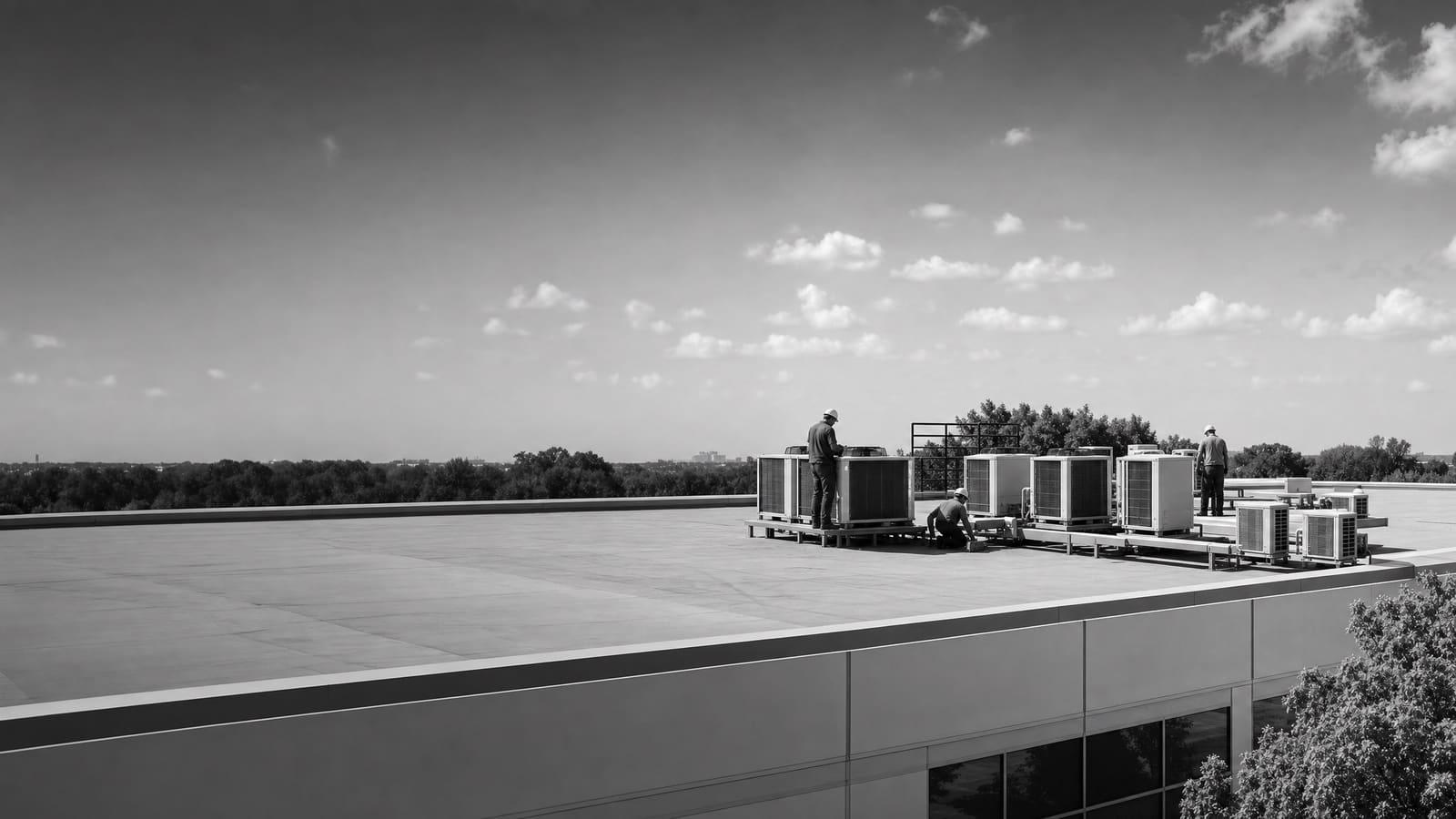
A commercial HVAC replacement covers load confirmation, equipment selection, refrigerant recovery from the old unit, permitting, rigging and set, connections, and commissioning. Replacement usually beats another repair once a rooftop unit passes fifteen years and service calls start repeating. The Department of Energy puts the annual waste from old, inefficient rooftop units at $900 to $3,700 each, which often exceeds the repair invoice under discussion.
A site review has to verify curb size and roof structure, available electrical capacity, gas line status, crane access, and whether today's occupancy still matches the old nameplate tonnage.
THREE PATHS
Repair, retrofit, or replace
Every failing rooftop unit gives you three honest options, and the right one depends on the unit's age, its condition, and how long you plan to hold the building.
The Department of Energy frames this as a straight financial comparison: keep repairing, retrofit the existing unit with advanced controls, or replace it with a high-efficiency unit. Retrofitting controls is the option most owners forget. It leaves the cabinet and the ductwork in place and improves how the unit runs, which can make sense when the equipment itself still has years left.
Replacement wins when the unit is old enough that efficiency losses compound. Its campaign work counted more than 200 organizations upgrading over 43,000 rooftop units, together saving about $37 million a year on energy. That is the pattern worth borrowing: treat the decision as a portfolio question, not a single emergency, and you stop paying failure-day prices.
WHAT MOVES THE NUMBER
The lines that decide your installed price
No one can quote a commercial replacement from a tonnage number alone. These are the lines that separate two quotes on the same building, and the ones worth asking about before you compare totals.
BUYING GUIDANCE
How to choose the equipment, not just the price
The biggest equipment question on a Florida replacement is whether the new unit should be a straight air-conditioning rooftop or a heat pump rooftop. They are technologically similar machines; the heat pump adds reverse-cycle heating. Department of Energy guidance is direct about where that works: heat pump rooftop units are best suited to mild-to-moderate winter heating, and across most of the South and West they are fully capable of covering most or all of the winter heating demand. Deltona sits squarely in that category, so an all-electric unit is a real option rather than a stretch.
That does not make it automatic. The same guidance lists what has to line up first: electrical capacity at the building, physical constraints on the roof, the status of any existing gas line, local electricity prices, equipment availability, and contractors who know the technology. Any one of those can turn a good idea into a bad project.
The second question is efficiency tier. High-performance rooftop units were developed to cut energy use by up to half against the older standard, and the gap is widest on units that run long hours. A building open seven days a week earns back a higher tier faster than one running a five-day office schedule.
TWO KINDS OF PROJECT
What makes a replacement simple or hard
Two replacements on the same street can run very differently. The variable is rarely the equipment. It is what the old install left behind and what the building can still support.
LOWER COMPLEXITY
Same footprint, same fuel
The replacement matches the existing curb and tonnage, the roof structure is unchanged, electrical service is untouched, and the lot gives the crane an easy set. Permitting stays a straightforward mechanical and electrical package.
HIGHER COMPLEXITY
New size, new fuel, tight site
Tonnage changes, the curb needs an adapter or the roof needs reinforcement, a gas unit becomes all-electric and the panel has to grow, or the only crane position closes a drive aisle a tenant depends on.
SCOPING THE WORK
What a real site review checks before anyone quotes
A quote written from a nameplate photo is a placeholder. It is useful for triage when a unit is down in season, but it is not a number you should sign against. The site review is where the surprises get priced instead of discovered.
Start on the roof. The reviewer confirms the curb dimensions and condition, whether the structure carries the new unit's weight, how the condensate and refrigerant lines run, and what clearance the new cabinet needs. Then the review moves to the services: electrical capacity and panel space, the gas line if one exists, and how the unit talks to the building's controls.
The last piece is the lot. Crane position, boom reach, staging space for the old and new units, and which stalls close and for how long. On a multi-tenant property this is the part that generates complaints, and it is the part most easily fixed by scheduling the set for a low-traffic morning.
The reviewer should also confirm the load against how the space is used today. Twenty years of tenant changes usually means the old nameplate tonnage is telling you about a building that no longer exists.
The refrigerant line item
Refrigerant in the old unit is regulated. Federal Clean Air Act rules govern how refrigerant is handled and recovered rather than released, so removing the old charge is a real line on the quote and the technician's certification belongs in the records you keep.
IN DELTONA
Plan the permit package before you order equipment
In Florida, the paperwork is often the slowest part of a rooftop replacement, and it is the part owners forget to schedule.
Florida commercial alteration permit guidance shows what a mechanical scope pulls in. Mechanical plans are required whenever the work includes installing or relocating equipment such as HVAC. Those plans must be signed and sealed by a Florida-licensed architect or engineer. Energy calculations are required when the scope includes heating, ventilation, or air conditioning. The submittal also has to show equipment location. If the work touches roof framing, framing plans with sections and details come in as well.
Requirements are set jurisdiction by jurisdiction, so confirm the exact package with the building department reviewing your Deltona permit before you assume.
Sequence it this way
Get the sealed mechanical drawings and energy calculations started while you are still comparing equipment. Plan review runs on its own clock, and a unit sitting on a truck while drawings are in queue is the most avoidable delay in the project.
OWNERSHIP QUESTIONS
Two things to settle before the crane is booked
Two questions decide more about the outcome than the brand on the cabinet.
The first is who owns the equipment decision. In a leased building, the lease usually determines whether the landlord replaces or the tenant pays, and whether an efficiency upgrade is a capital improvement or a pass-through. Settle that before anyone specifies a unit, because the answer changes what tier makes financial sense to whoever is writing the check.
The second is how long you are holding the building. A high-efficiency unit pays back through operating cost, and that payback needs years to land. An owner-occupant planning a decade in the building buys differently than one preparing a sale, and both are reasonable. What is not reasonable is picking the tier without answering the question.
LEASED SPACE
Who pays, who benefits
The party paying for the unit is often not the party paying the power bill. When those are split, nobody has a reason to fund a higher efficiency tier unless the lease is written to share the savings.
MULTIPLE UNITS
One roof, several ages
Most commercial roofs carry units installed in different years. Replacing them one failure at a time costs the most. Mapping ages and planning the sequence turns emergencies into scheduled work you can budget.
OVER TIME
Phasing, procurement, and what the unit costs to own
The most expensive way to run a commercial roof is to replace units only when they die. Failure-day replacement gives up every advantage you have: no time to compare equipment, no leverage on scheduling, no chance to right-size, and an occupied building without cooling while you wait.
Planned replacement flips all four. You can compare units on availability as well as price, book the crane for a morning that suits your tenants, and confirm the load properly instead of copying an old nameplate. Department of Energy guidance makes the same point plainly: proactively replacing inefficient, underperforming rooftop units is usually a smarter business move than replacement on failure, and often better than a like-for-like swap at the end of an old unit's service life.
Lifetime cost is where the tiers separate. The purchase price is one year's decision; the energy bill is every year the unit runs. With old, inefficient units documented at $900 to $3,700 per unit in annual waste, the difference between tiers compounds quietly on every invoice. Ask any quote to show the efficiency rating alongside the price, and ask what incentive programs the equipment qualifies for while the specification is still open, since terms change.
BEFORE YOU SIGN
Five things a comparable quote has to show
Two quotes are only comparable when they show the same things. If one is missing a line the other includes, you are not looking at a price difference, you are looking at a scope difference. Ask for these five before you compare.
01
Equipment, spelled out
Model, tonnage, efficiency rating, heating type, and the availability the installer is actually promising.
02
Curb, roof, and rigging
Curb adapter or new curb, any structural work, and who owns the crane and the lift plan.
03
Services and connections
Electrical, gas, condensate, and controls work included, with anything excluded named out loud.
04
Permits and inspections
Sealed drawings, energy calculations, permit fees, and inspection coordination, priced in rather than passed along later.
05
Startup and commissioning
Charge, airflow, and control settings verified against spec and documented, so the warranty holds up.
Get a defensible number
Price the equipment and the building together.
Send the address, operating target, and target opening date. Flux will identify what must be verified before the project can be priced.
Get a free estimateQuestions
Straight answers.
When does replacement beat another repair?
Age and repeat visits are the tell. Rooftop units past fifteen years lose efficiency steadily, and the Department of Energy puts the annual waste from old, inefficient units at $900 to $3,700 each. When repairs are stacking up on a unit in that range, the repair is buying time on an asset that already costs you money every month.
How much does a commercial HVAC replacement cost in Deltona?
There is no honest per-unit number without a look at your roof. Tonnage and efficiency tier set the base, then curb work, structural review, electrical changes, refrigerant recovery, crane access, and permit drawings move it. Anyone quoting a commercial replacement from a phone call is pricing a scope they have not seen.
Does a heat pump rooftop unit make sense here?
Often, yes. Heat pump rooftop units work best where winter heating demand is mild to moderate, and Department of Energy guidance says today's units are fully capable of covering most or all of the winter heating demand across most of the South. The gating items are electrical capacity, roof constraints, the existing gas line, and equipment availability.
What permit drawings does a commercial HVAC replacement need in Florida?
Florida commercial alteration permit guidance shows mechanical plans are required when the scope includes installing or relocating HVAC equipment, signed and sealed by a Florida-licensed architect or engineer. Energy calculations are required for HVAC scope, and the submittal must show equipment location. Confirm the exact list with the building department reviewing your permit.
Can the old unit's refrigerant just be released?
No. Federal Clean Air Act rules govern how refrigerant is handled and recovered from stationary air-conditioning and heat pump equipment. Recovery is done by certified technicians and shows up as a line on the quote, not as a free step at the end of the day.
Is retrofitting controls a real alternative to replacing?
Sometimes. Department of Energy work treats retrofitting an existing unit with advanced controls as a legitimate alternative to replacement, chosen on whichever makes better financial sense. It suits units with real service life left. It does not rescue a unit that is already past its useful life.
Sources used for this guide
- [1]betterbuildingssolutioncenter.energy.gov — DOE Advanced Rooftop Unit Replacement Guidance
- [2]betterbuildingssolutioncenter.energy.gov — DOE Commercial Heat Pump Rooftop Unit Replacement Guidance
- [3]betterbuildingssolutioncenter.energy.gov — DOE High-Efficiency Commercial Rooftop Unit Toolkit
- [4]energy.gov — DOE Efficient Commercial Rooftop Air Conditioner Program
- [5]epa.gov — EPA Stationary HVAC Refrigerant Management
- [6]tampa.gov — Permit Application Guide Commercial Alteration