THE DIRECT ANSWER
What a commercial HVAC replacement actually includes
A commercial HVAC replacement covers load verification, equipment selection against real lead times, curb and roof work, rigging, permitting, and commissioning. Replacement beats another repair once a unit is past roughly fifteen years and service calls are stacking up. DOE puts the energy an old, inefficient rooftop unit wastes at $900 to $3,700 per unit every year, which quietly outruns the repair invoices you keep paying to avoid the project.
A site review has to confirm the curb and roof structure, available capacity at the serving electrical panel, gas or refrigerant line routing, and whether today's occupancy still matches the old nameplate tonnage.
THE THREE PATHS
What goes back on the curb
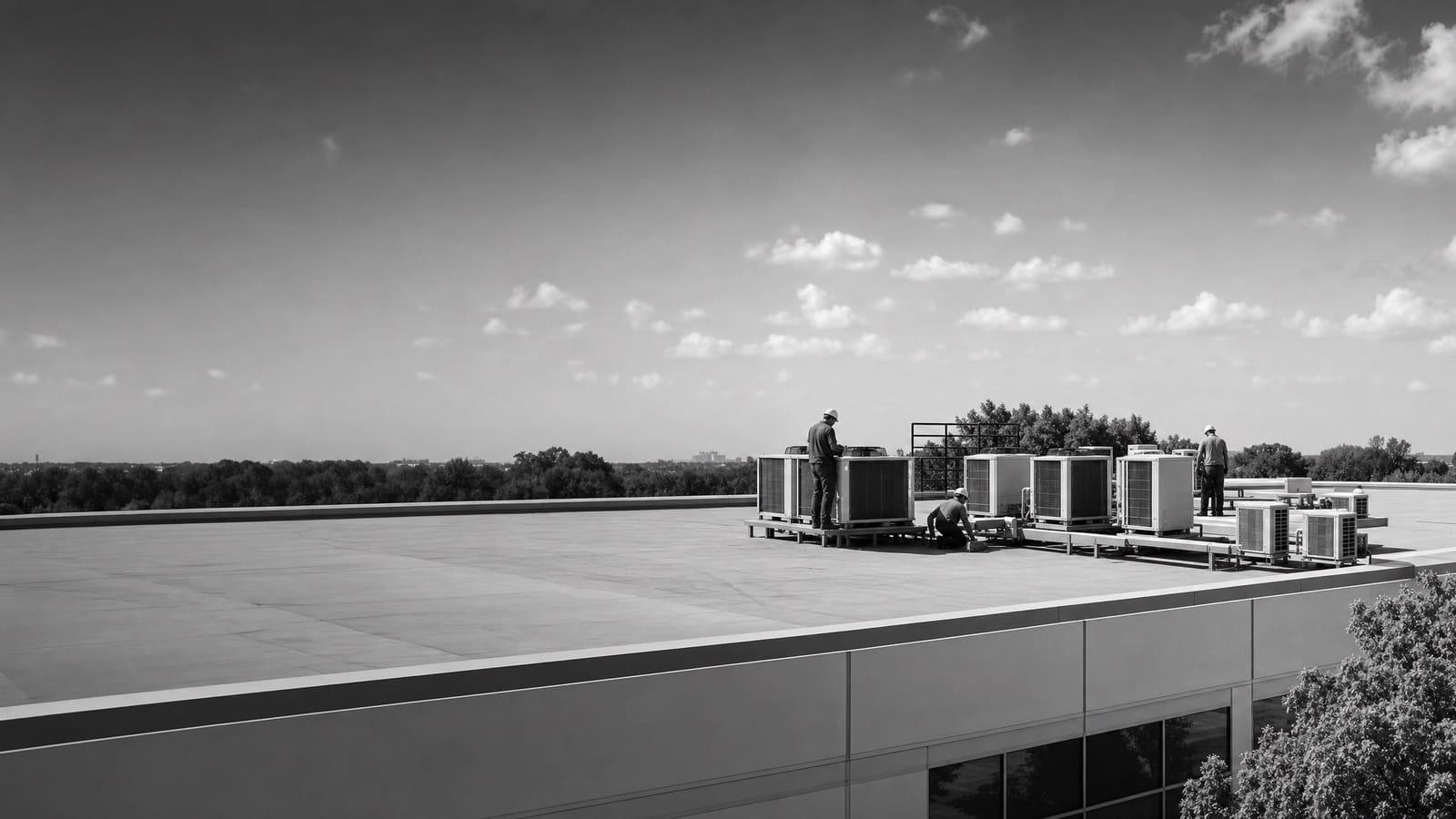
Rooftop units cool close to half of all commercial floor space in the United States, so most replacement decisions in Deerfield Beach come down to a single question: what goes back on the curb. DOE's guidance frames three practical paths. Repeat what is there. Step up to a high-efficiency unit of the same type. Or move to a heat pump rooftop unit and put heating and cooling in one electric machine. None of the three is automatically right. The Advanced RTU Campaign has tracked more than 43,000 upgrades across over 200 organizations, saving a combined $37 million a year on energy, so the efficiency path is well-worn rather than experimental. What decides it for your building is run hours, the capacity at your electrical panel, and whether gas heat is part of the picture at all.
WHAT MOVES THE NUMBER
The lines that separate two bids
No two roofs price the same, so read a quote as a set of line items rather than one number. These are the lines that move most between bidders on the same building.
HOW TO BUY IT
Choosing equipment without guessing
Start with the load, not the nameplate. A unit installed twenty years ago was sized for the occupancy, lighting, and plug loads of that era. If the space has been re-tenanted, subdivided, or filled with different equipment since, repeating the old tonnage repeats an old mistake. Oversizing shortens cycles and makes humidity harder to hold, which is exactly the complaint most owners are trying to fix.
Then decide how long you plan to own the building. DOE's framing is blunt: units past fifteen years waste substantial energy compared with newer models, and waiting for total failure removes every option except whatever is on a truck that week. Proactive replacement lets you compare efficiency tiers, negotiate lead times, and schedule the crane for a Sunday morning instead of a Tuesday in August.
Efficiency is usually where the choice gets made. The federal high-performance specification was written around cutting rooftop energy use by up to half against the old standard, and more than twenty models now exceed it. On a building running long hours, that gap compounds every month. On a low-hour warehouse office, it may not. Ask each bidder to show the run-hour assumption behind whatever they recommend.
SCOPE CHECK
What makes this project simple or hard
Two replacements at the same tonnage can land a long way apart on price and schedule. The difference is almost always what surrounds the unit rather than the unit itself.
LOWER COMPLEXITY
Straight swap on an open roof
Same tonnage and footprint, an existing curb that takes an adapter, clear crane reach from the lot, adequate electrical service already at the unit, and no change in how the space is occupied. Permits stay narrow and the set happens in a morning.
HIGHER COMPLEXITY
Tight site, changed load, or fuel switch
A larger footprint that triggers structural review, a shielded roof that forces longer crane reach or a lane closure, an electrical service that needs upgrading to carry electric heat, or ductwork and controls that have to be reworked because the zoning changed.
BEFORE YOU BID
What a real site review has to verify
A useful quote starts with somebody on the roof and somebody at the electrical panel. DOE's heat pump guidance lists infrastructure as one of the make-or-break considerations and splits it three ways: electrical capacity, physical constraints, and gas lines. Those three answers decide whether the equipment you want is installable at your building without a second project attached to it.
Electrical capacity is the one that surprises owners. Moving heating from gas to electric adds load at the panel, and a service that has been fine for thirty years can turn a good equipment choice into an expensive one. Physical constraints cover curb size, roof structure, clearances, and whether a crane can reach the unit at all. Gas lines matter in both directions, whether you are keeping them, capping them, or sizing a dual-fuel arrangement.
The review should also confirm what refrigerant the existing unit holds and how it will be recovered. EPA Section 608 governs the handling and recycling of refrigerant in stationary air conditioning equipment, so recovery is part of the demolition scope rather than an afterthought.
Ask for these four in writing
Measured curb dimensions, available amperage at the serving panel, the crane setup location, and the refrigerant recovery plan. A bidder who priced your roof without all four priced a guess, and the correction shows up as a change order.
DEERFIELD BEACH, FL
Florida permitting puts engineering at the front of the schedule
Florida treats commercial HVAC replacement as engineered work. Published Florida commercial alteration permit guidance requires mechanical plans to be signed and sealed by a Florida licensed architect or engineer whenever the scope includes installing or relocating equipment such as HVAC. Energy calculations are required when the scope includes heating, ventilation, or air conditioning, and the submittal has to show equipment location. Roof framing plans and wall sections come into play when the work touches structure.
That changes sequencing more than it changes cost. Sealed drawings and energy calculations take design time, and design time only runs in parallel with equipment lead time if you start it early. Confirm the exact submittal package with the Deerfield Beach building department before you place the equipment order.
Start the drawings with the order, not after it
If you wait for equipment to land before engaging an engineer, the sealed mechanical plans and energy calculations become the critical path and a paid-for unit sits in a warehouse. Run design and procurement on parallel tracks.
OWNERSHIP MATH
Two decisions that outlive the install
The install is a week. The consequences run for the service life of the equipment, and two of them are worth deciding deliberately instead of inheriting by default. The first is refrigerant, because a roof with units of different ages is a mixed fleet with mixed service requirements. The second is how you decide to replace the next one, because a building that replaces on failure takes whatever is available that week, at whatever price, on whatever schedule the failure dictates.
REFRIGERANT
Mixed fleets need a plan
EPA Section 608 regulates how refrigerant is handled and recycled in stationary refrigeration, air conditioning, and heat pump equipment. When your roof spans several refrigerant generations, spare parts, technician certification, and service contracts all have to account for the mix.
REPLACEMENT TIMING
Planned beats reactive
DOE notes that facility managers usually delay until a unit fails, needs frequent service, or stops holding the space. It also notes that proactive replacement with efficient equipment often beats both failure replacement and a like-for-like swap at end of life.
PHASING AND PROCUREMENT
When you are replacing more than one unit
If you own a roof carrying four or six units of similar age, the temptation is to replace the worst one and revisit the rest later. That works, but it costs more per unit over time. A crane mobilizes once whether it sets one unit or three. Permitting, engineering, and roof patching all carry fixed components that get cheaper per unit when the work is grouped.
The counterweight is capital and disruption. Grouping means a bigger single check and a longer window of coned-off parking. A workable middle path is to rank units by age, run hours, and repair history, then replace in planned batches on a schedule you choose. In a climate with a long cooling season, anything not already failing is easier to stage outside peak demand.
Procurement deserves the same discipline. Equipment availability is an explicit consideration in DOE's guidance, and the unit that is right on paper is not always the one you can get in six weeks. Ask each bidder for two options: the recommended unit and the best available unit, each with a lead time attached. Seeing those side by side usually makes the decision obvious.
QUOTE CHECKLIST
Five things a comparable quote must show
Bids only compare when they cover the same scope. Before you line three of them up on price, confirm each one puts these five things in writing.
01
Equipment, tonnage, and efficiency tier
Model number, tonnage, heating type, and efficiency rating, so every bid is being read on the same basis.
02
Lead time and availability
A dated lead time for the specific unit quoted, not a general range for that product family.
03
Roof and rigging scope
Curb adapter, any structural work, crane size, staging location, and how long the lot stays closed.
04
Permits, sealed drawings, and inspections
Who prepares and seals the mechanical plans and energy calculations, and who carries the permit through inspection.
05
Refrigerant recovery and commissioning
Recovery of the old charge, plus documented startup covering airflow, charge, and control settings.
Get a defensible number
Price the equipment and the building together.
Send the address, operating target, and target opening date. Flux will identify what must be verified before the project can be priced.
Get a free estimateQuestions
Straight answers.
When does replacement beat another repair?
DOE points to fifteen years as the age where rooftop units begin wasting substantial energy compared with newer models, and puts the annual waste of an old, inefficient unit at $900 to $3,700. When repair frequency is climbing and the unit is past that mark, the replacement math usually already works, even before the next failure.
Does a heat pump rooftop unit make sense in a South Florida climate?
DOE's guidance says today's heat pump rooftop units are fully capable of handling most or all winter heating demand across the South and West, since heat pump efficiency only trends toward electric resistance parity in sustained cold. The gating question here is rarely heating capability. It is whether your electrical service can carry the change.
What does Florida permitting require for a commercial HVAC replacement?
Florida commercial alteration permit guidance requires mechanical plans signed and sealed by a Florida licensed architect or engineer when the scope includes installing or relocating HVAC equipment, plus energy calculations and drawings showing equipment location. Confirm the exact submittal package with the Deerfield Beach building department before you order equipment.
Should the new unit match the old one or be resized?
Confirm the load either way. If the occupancy, layout, and internal equipment have not changed, like-for-like is often correct and keeps the curb and connections intact. If the space has been re-tenanted or subdivided, repeating the old tonnage carries the old sizing error forward for another twenty years.
What happens to the refrigerant in the old unit?
It is recovered, not vented. EPA Section 608 regulations govern the handling and recycling of refrigerants in stationary refrigeration, air conditioning, and heat pump equipment. Recovery belongs in the demolition line of the quote, and the certification of whoever performs it should be on file before the crane day.
Sources used for this guide
- [1]betterbuildingssolutioncenter.energy.gov — DOE Advanced Rooftop Unit Replacement Guidance
- [2]betterbuildingssolutioncenter.energy.gov — DOE Commercial Heat Pump Rooftop Unit Replacement Guidance
- [3]betterbuildingssolutioncenter.energy.gov — DOE High-Efficiency Commercial Rooftop Unit Toolkit
- [4]energy.gov — DOE Efficient Commercial Rooftop Air Conditioner Program
- [5]epa.gov — EPA Stationary HVAC Refrigerant Management
- [6]tampa.gov — Permit Application Guide Commercial Alteration