THE SHORT ANSWER
What a commercial HVAC replacement includes
A commercial HVAC replacement covers load verification, equipment selection, rigging the old unit off, curb and connection work, controls integration, and commissioning. Replacement usually beats another repair once a unit is past fifteen years and losing capacity: an old, inefficient rooftop unit wastes roughly $900 to $3,700 a year in energy alone, and that cost repeats every season you keep it.
A site review still has to confirm tonnage against current occupancy, the curb and roof structure, available electrical capacity and gas service, and crane access before any number is real.
THREE WAYS TO GO
Three equipment paths for a commercial replacement
Most commercial replacements are packaged rooftop units, which condition close to half of all commercial floor space in the country. That makes the first real decision easy to state: do you keep heating the building the way you heat it now, or change it?
A like-for-like gas-heat unit is the lowest-friction path. A dual-fuel heat pump rooftop unit runs the heat pump in mild weather and switches to gas when it gets cold. An all-electric or cold-climate heat pump unit drops the gas connection entirely.
The trade-off is heating efficiency at low outdoor temperatures. Heat pump efficiency falls as it gets colder outside and trends toward parity with electric resistance heat, so the honest question for any building is how many hours it spends in that range and what electricity and gas cost you there. Equipment availability and electrical capacity decide the rest.
WHAT MOVES THE NUMBER
The budget lines that actually swing
No two roofs price the same, so read a quote line by line rather than as one number. These are the items that move it most, roughly in the order they surprise owners after the walk.
IN PRACTICE
How to buy the replacement, not just the box
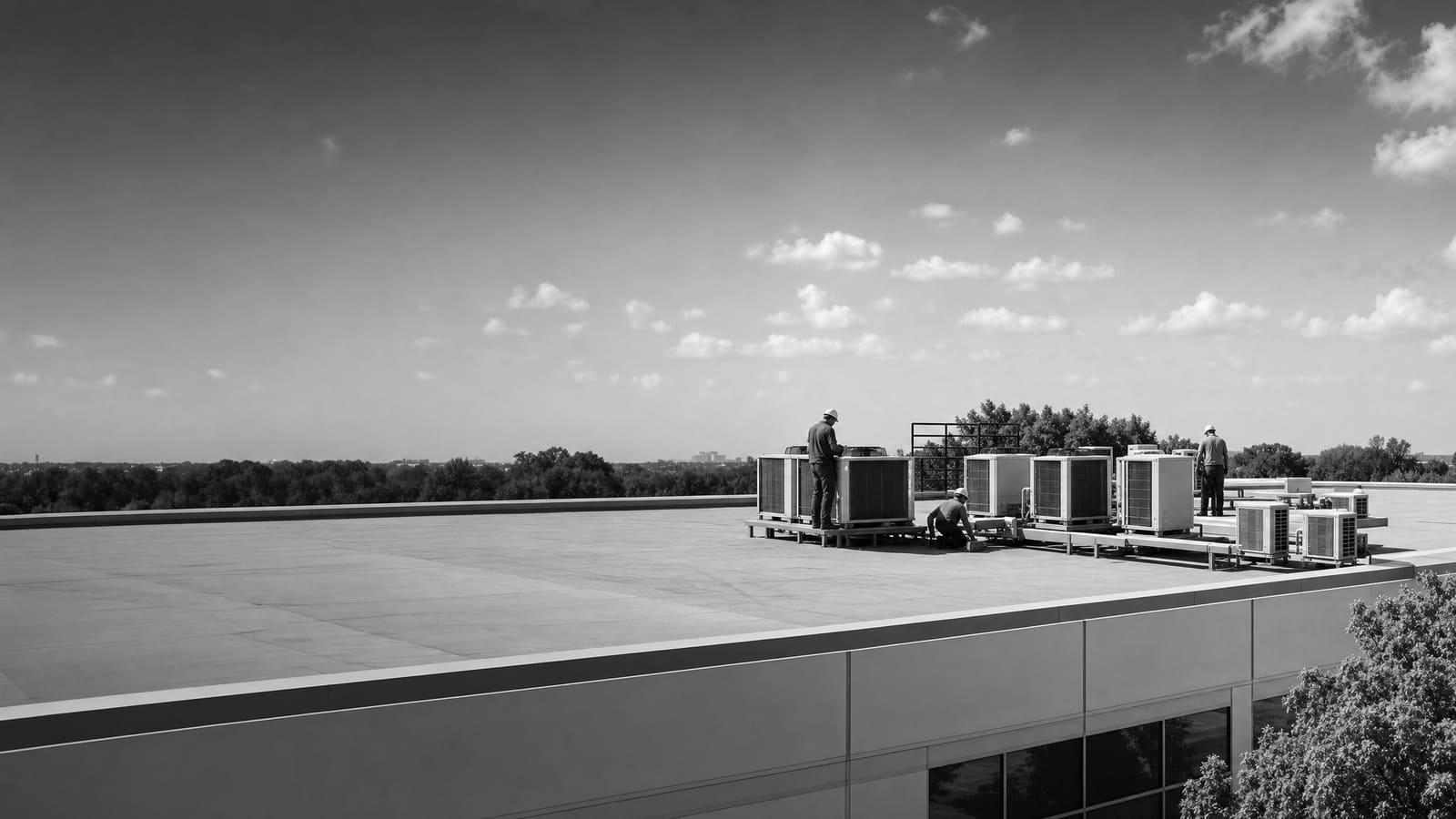
The visible part of the job is one morning. The crane sets up, stalls get coned, the old unit comes off, and the new one lands on an adapter that was measured weeks earlier. Everything that makes that morning uneventful happened before it.
The part worth your attention is the specification. Sizing should come from how the building is used today, not from the nameplate on a unit installed twenty years ago. Occupancy changes, plug loads change, and lighting retrofits change the cooling load. Carrying old tonnage forward without checking it locks in whatever mistake was already there, and an oversized unit short-cycles, dehumidifies poorly, and wears itself out early.
Efficiency tier is the second lever. High-performance rooftop units were developed specifically to cut energy use by up to half compared with the older baseline, and that operating gap is wide enough that the cheapest unit on the quote is often the most expensive one to own. Ask for the efficiency tier in writing next to the price, then compare the options over the years you plan to hold the building rather than over the invoice.
SCOPE CHECK
What makes a replacement simple or complicated
Two projects with identical tonnage can price very differently. Before you compare bids, work out which column your building sits in. It explains most of the spread.
LOWER COMPLEXITY
Same fuel, same footprint
The new unit matches the existing curb, the use of the space has not changed, gas and electric service stay as they are, and the lot gives a crane clean reach. Permitting is usually mechanical and electrical, and the on-site work is measured in days.
HIGHER COMPLEXITY
Fuel switch, size change, or tight access
Going all-electric, adding tonnage, or changing the footprint pulls in electrical capacity review, possible structural work, and a longer equipment lead. Tight access or a roof a crane cannot reach cleanly adds staging cost and can push the set to off-hours.
BEFORE YOU BUY
The site review that makes a quote real
A quote is only as good as the walk behind it. The checks that matter are physical and boring: what the roof structure carries, whether the existing curb can take an adapter or needs replacing, where the crane can set up and how long the lot stays closed, and what the electrical service has left in it.
Infrastructure is where fuel-switch projects get expensive after the fact. Electrical capacity, physical constraints on the roof, and existing gas lines all have to be verified before an all-electric unit is specified, not after the equipment is ordered. The same goes for availability. The model you want has a real lead time, and a quote that leaves it blank is hiding your biggest schedule risk.
Refrigerant is the other item to settle up front. Handling and recycling of refrigerant in commercial equipment is federally regulated, so recovery from the old unit is part of the job and belongs in the written scope. On a mixed fleet, ask what refrigerant the new unit ships with so service and spare parts stay planned.
Ask for these before you sign
Confirmed tonnage with the load basis, the named efficiency tier, curb and structural scope, the crane and lot plan, electrical and gas verification, equipment lead time in writing, refrigerant recovery, and a commissioning report at handoff.
OWNING THE DECISION
Two things that outlast the install
The install takes a week of your attention. The unit is the next decade or more of your operating budget, so the two questions below deserve more time than a bid comparison usually gets. Neither one is really about the equipment. The first is about when you choose to do the work. The second is about who keeps the system performing after the crane leaves. Owners who settle both early tend to pay less over the life of the unit than owners who settle them during a failure in July.
TIMING
Planned versus replace-on-failure
Waiting for total failure removes every option you had: equipment choice, efficiency tier, lead time, and negotiating room. Replacing proactively is usually the better business move, and it puts the work on your schedule instead of the season's.
AFTERCARE
Who owns performance in year two
Most comfort complaints after an install trace back to charge, airflow, or control settings rather than the equipment itself. Decide before handoff who verifies those, who holds the documentation, and what the service agreement actually covers.
PLANNING AHEAD
Phasing a roof instead of replacing one unit at a time
If you own several units on one roof or several buildings in a portfolio, the unit-by-unit approach quietly costs money. Each emergency swap pays for its own mobilization, its own crane, and whatever equipment happens to be available that week. Grouping replacements into a planned phase spreads one crane day and one permit cycle across more than one unit.
Phasing also lets you sort the roof by age and condition. Units past fifteen years are the ones burning the most energy and generating the most service calls, so they go first. Newer units can wait, or take controls work instead of full replacement where that pencils better.
The scale of this is not theoretical. More than 200 organizations have upgraded over 43,000 rooftop units through a national efficiency campaign, and those upgrades cut a combined $37 million a year from their energy bills. The lesson holds at a smaller scale: the savings come from replacing deliberately, on a schedule you set, with the efficiency tier chosen on purpose. Ask any bidder to price the roof as a program, not just the unit that failed.
QUOTE CHECKLIST
Five things a comparable quote shows
Bids that look far apart usually differ in scope, not in price. Make every bidder show these five items in the same place and the comparison gets simple.
01
Tonnage and the load basis
The selected size, plus whether it came from a current load calculation or the old nameplate.
02
Efficiency tier, named
The specific model and rating, not just "high efficiency," so operating cost can be compared.
03
Equipment lead time
A real availability date for the model quoted, and the alternate if it slips.
04
Rigging, permits, and lot plan
Who owns the crane, closures, permits, and inspections inside the installed price.
05
Commissioning and documentation
Startup, charge, airflow, and controls verified and handed over in writing.
Get a defensible number
Price the equipment and the building together.
Send the address, operating target, and target opening date. Flux will identify what must be verified before the project can be priced.
Get a free estimateQuestions
Straight answers.
Should you replace a rooftop unit or repair it again?
Once a unit is past fifteen years, losing capacity, or taking repeated service calls, replacement usually wins. Old, inefficient rooftop units waste roughly $900 to $3,700 each per year in energy, and that number repeats every year you defer the decision.
Is a heat pump rooftop unit the right choice?
It depends on winter hours and infrastructure. Heat pump efficiency drops as outdoor temperature falls and approaches electric resistance heat at the bottom, which is why dual-fuel and cold-climate models exist. Verify electrical capacity before specifying all-electric.
How much does a commercial HVAC installation cost?
The number follows tonnage and efficiency tier, curb and structural work, crane access, and any electrical or gas changes. That is why a credible price comes after a roof walk rather than from a per-ton rule of thumb.
What usually delays a commercial HVAC installation?
Equipment availability, not labor. The set itself is a short, planned event. Ask for the lead time on the exact model quoted and what the alternate is if that date moves.
What happens to the refrigerant in the old unit?
Handling and recycling of refrigerant in commercial equipment is federally regulated, so recovery is done by certified technicians and should appear in the written scope. On a mixed fleet, confirm what refrigerant the new unit ships with.
Can replacement improve comfort, or only energy cost?
Both, if the load is recalculated. Many complaints come from a unit sized for a building that no longer exists. Right-sizing, plus verified airflow and control settings, fixes problems repairs never could.
Sources used for this guide
- [1]betterbuildingssolutioncenter.energy.gov — DOE Advanced Rooftop Unit Replacement Guidance
- [2]betterbuildingssolutioncenter.energy.gov — DOE Commercial Heat Pump Rooftop Unit Replacement Guidance
- [3]betterbuildingssolutioncenter.energy.gov — DOE High-Efficiency Commercial Rooftop Unit Toolkit
- [4]energy.gov — DOE Efficient Commercial Rooftop Air Conditioner Program
- [5]epa.gov — EPA Stationary HVAC Refrigerant Management