THE SHORT ANSWER
What a commercial HVAC replacement actually includes
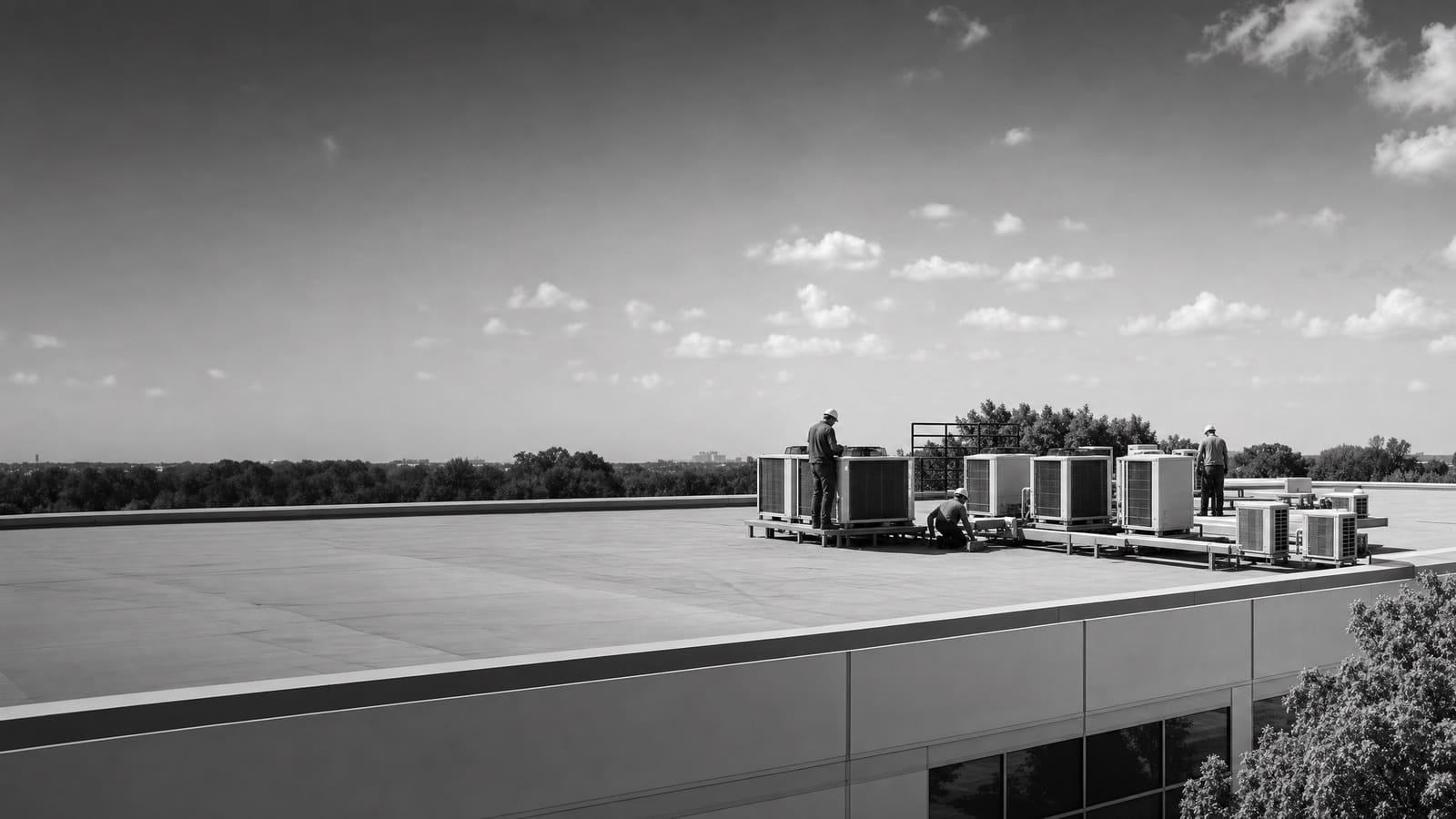
A commercial HVAC replacement covers a load check, equipment selection, removal of the old unit, curb and connection work, the crane set, and commissioning. Replacement starts beating another repair once a rooftop unit passes about fifteen years. Federal estimates put the annual energy waste of an old, inefficient rooftop unit between $900 and $3,700 against current equipment. Past that point, repair dollars buy uptime, not performance.
A site review still has to confirm tonnage against how the space is used now, the roof structure under the curb, and whether the electrical service can carry the unit you actually want.
THE FORK IN THE ROAD
Three versions of the same project
Almost every commercial HVAC replacement is one of three projects, and the difference is mostly timing.
The expensive version picks itself. A unit fails mid-season, the building needs cooling now, and you buy whatever is available in the region. You keep the old sizing, skip the efficiency comparison, and pay a premium for speed.
The planned version gives the choices back. Same building, same decision, made in a month when nobody is uncomfortable. Federal guidance on rooftop units makes this point plainly: replacing an underperforming unit on purpose usually beats replacing it on failure, and often beats a like-for-like swap at the end of its service life.
The third version treats the replacement as an upgrade. Confirm the load against how the space is used today, look at a heat pump unit and a higher efficiency tier, and price the electrical work honestly. It costs more on day one, and it is the only version that changes your operating cost.
WHAT MOVES THE NUMBER
Where the cost actually lives
The equipment is the anchor, but it is rarely what blows up a budget. The surprises live in the roof, the panel, and the controls — the parts nobody looks at until the unit is already ordered.
EQUIPMENT
Choosing what goes back on the roof
Rooftop units cool close to half of all commercial floor space in the country, so for most buildings this decision starts with what kind of rooftop unit goes back up there.
The first fork is fuel. A standard air-conditioning rooftop unit cools and, if it heats, usually burns gas. A heat pump rooftop unit is the same machine with reverse-cycle heating, so one piece of equipment covers both seasons. Heat pumps lose efficiency as outdoor temperatures fall, which makes them a weak fit in hard winters and a strong fit here. Federal guidance is direct about it: across most of the South and West, today's heat pump rooftop units can handle most or all of the winter heating demand on their own. In Davie, heating hours are the small part of the year, and the cooling season is what decides the utility bill.
The second fork is efficiency tier. High-performance rooftop units were built to a federal specification targeting up to half the energy use of the old standard, and more than twenty models now exceed that spec. That premium is real money on day one, and it only pays back if the unit is sized to the actual load and commissioned properly.
SCOPE
Simple swap or engineered project
Two replacements on the same street can be completely different projects. What separates them is not tonnage. It is how much of the existing installation the new unit can reuse.
LOWER COMPLEXITY
Same tonnage, same curb
The new unit matches the old footprint and weight, roof access is open, the electrical service already carries the load, and the controls are simple. Drawings are straightforward and the set is a short, planned outage.
HIGHER COMPLEXITY
New sizing, new fuel, or tight access
Tonnage changes, the unit gets heavier, gas heat comes out for all-electric, or the crane cannot reach without closing a drive aisle. Each one adds engineering, review time, and coordination before anything gets lifted.
SITE REVIEW
What has to be verified before a real price exists
A quote written from a nameplate photo is a starting point, not a price. Four things have to be checked on site before the number means anything.
Electrical capacity comes first, especially if an all-electric heat pump unit is on the table. The question is not whether the panel has a spare slot. It is whether the service can carry the new load. Finding that out at rough-in is expensive.
Physical constraints come second. The existing curb, the roof structure under it, clearances around the unit, and the crane's path and reach all get confirmed. A heavier unit can turn a mechanical permit into a structural review.
Gas lines come third. If gas heat is coming out, the line gets properly capped. If it stays, it has to suit the new unit's requirements.
Refrigerant comes fourth. Federal rules require refrigerant in the old equipment to be recovered by certified technicians rather than released, and that work belongs in the written scope. New equipment also ships on newer refrigerants, which matters for parts stocking and service contracts on a roof with mixed-age units.
Three checks before the quote
Ask the contractor to open the electrical panel and confirm available capacity, measure the existing curb, and walk the crane path. If a bidder skips all three, you are holding an estimate, not a price.
IN DAVIE
Permitting is a schedule item, not paperwork
Published Florida commercial alteration permit guidance is consistent about what an HVAC scope triggers. Installing or relocating HVAC equipment requires mechanical plans, and those plans have to be signed and sealed by a Florida-licensed engineer or architect. Energy calculations are required whenever the scope includes heating, ventilation, or air conditioning. The submittal also has to show equipment location, and framing work at the roof brings its own drawings.
None of that is a problem once you plan for it. It becomes one when a unit fails in August and the design work starts after the equipment is ordered. Confirm the exact submittal list with Davie's building division for your address before a date gets promised to a tenant.
Start the drawings early
Sealed mechanical plans and energy calculations take design time. Run them in parallel with equipment pricing so plan review and manufacturer lead time overlap instead of stacking end to end.
BEFORE YOU BID IT
Two ownership questions that change the scope
Two questions shape the quote before anyone talks about equipment: who pays, and how long the building can go without cooling.
Ownership structure decides the first. If the landlord buys the unit and the tenant pays the utility bill, the efficiency upgrade costs one party and rewards the other. That split is solvable, but it has to be solved before the tier is chosen, not after the invoice lands.
Operating schedule decides the second. A building that runs one shift can absorb a crane day with cones and a few closed stalls. A building that cannot lose conditioned air at all needs temporary cooling planned and priced from the start, which is a very different quote.
LEASE STRUCTURE
Who pays, who benefits
Capital cost usually sits with the owner while energy savings land on whoever pays the utility bill. Settle that before picking an efficiency tier, or the cheapest unit wins by default.
DOWNTIME
What the building can tolerate
Server rooms, labs, and anything with inventory that cannot warm up need temporary cooling written into the scope. Adding it after the schedule is set costs more and pushes the set date.
THE LONG VIEW
Phasing, procurement, and lifetime cost
First cost is the easy number to compare, which is why it gets compared. The number that decides whether this was a good project is what the unit costs to run for the next fifteen years.
Start with what the old equipment costs today. An aging, inefficient rooftop unit wastes somewhere between $900 and $3,700 a year in energy against current equipment. One unit is annoying. Six units on the same roof, all installed the same year by the same developer, is a budget line hiding in plain sight.
That is the argument for treating a rooftop as a fleet instead of a series of emergencies. Rank the units by age and service history, replace the worst first, and keep the controls platform consistent so your service contractor is not learning three systems. Order early, because equipment availability rather than crew availability is usually what sets the calendar.
Incentives are worth checking, and worth checking yourself. Utility and manufacturer programs for high-efficiency and heat pump rooftop equipment open and close on their own timelines. Get current terms in writing before any of it counts toward a payback you plan to defend to ownership.
COMPARING BIDS
Five lines every quote should show
Quotes are only comparable when they cover the same scope. When one bid comes in noticeably cheaper, one of these five lines is usually missing from it.
01
The exact equipment
Make, model, tonnage, efficiency rating, and whether it is an air-conditioning unit or a heat pump unit.
02
Availability in writing
The quoted lead time for that specific model, not a general estimate for the category.
03
Curb, structural, and roofing scope
Adapter or new curb, any structural work the added weight triggers, and who patches the roof afterward.
04
Crane day and site plan
Lift date, staging area, stalls closed, and how long the lot is affected.
05
Permits, engineering, and commissioning
Sealed drawings, energy calculations, inspections, startup, and documented commissioning included in the installed price.
Get a defensible number
Price the equipment and the building together.
Send the address, operating target, and target opening date. Flux will identify what must be verified before the project can be priced.
Get a free estimateQuestions
Straight answers.
When does replacement beat another repair?
Once a rooftop unit is past about fifteen years, repairs start buying time rather than performance. Units that old waste substantial energy against current equipment, so a second or third significant repair is usually money spent to delay a decision you have already made.
Does a heat pump rooftop unit make sense in Davie?
Usually. Heat pumps lose efficiency as outdoor temperatures drop, which is why they struggle in hard winters. Federal guidance is that across most of the South, today's heat pump rooftop units can cover most or all of the winter heating demand. The real gate here is electrical capacity, not climate.
What sets the schedule on a commercial replacement?
Equipment availability and plan review, not the installation itself. The crane day is short and planned well in advance. Sealed mechanical drawings, energy calculations, and manufacturer lead time are the parts that stretch, which is why they should run in parallel instead of one after the other.
What does the permit package include in Davie?
Florida commercial alteration guidance calls for mechanical plans signed and sealed by a Florida-licensed engineer or architect whenever the scope includes installing or relocating HVAC equipment, energy calculations for HVAC work, and drawings showing equipment location. Confirm the exact submittal list with Davie's building division for your address.
What happens to the refrigerant in the old unit?
Federal rules require it to be recovered by certified technicians rather than released, and that recovery belongs in the written scope. New equipment ships on newer refrigerants, which does not change day-one operation but does affect parts stocking and service contracts on a roof with mixed-age units.
Sources used for this guide
- [1]betterbuildingssolutioncenter.energy.gov — DOE Advanced Rooftop Unit Replacement Guidance
- [2]betterbuildingssolutioncenter.energy.gov — DOE Commercial Heat Pump Rooftop Unit Replacement Guidance
- [3]betterbuildingssolutioncenter.energy.gov — DOE High-Efficiency Commercial Rooftop Unit Toolkit
- [4]energy.gov — DOE Efficient Commercial Rooftop Air Conditioner Program
- [5]epa.gov — EPA Stationary HVAC Refrigerant Management
- [6]tampa.gov — Permit Application Guide Commercial Alteration