THE DIRECT ANSWER
What a commercial HVAC replacement includes
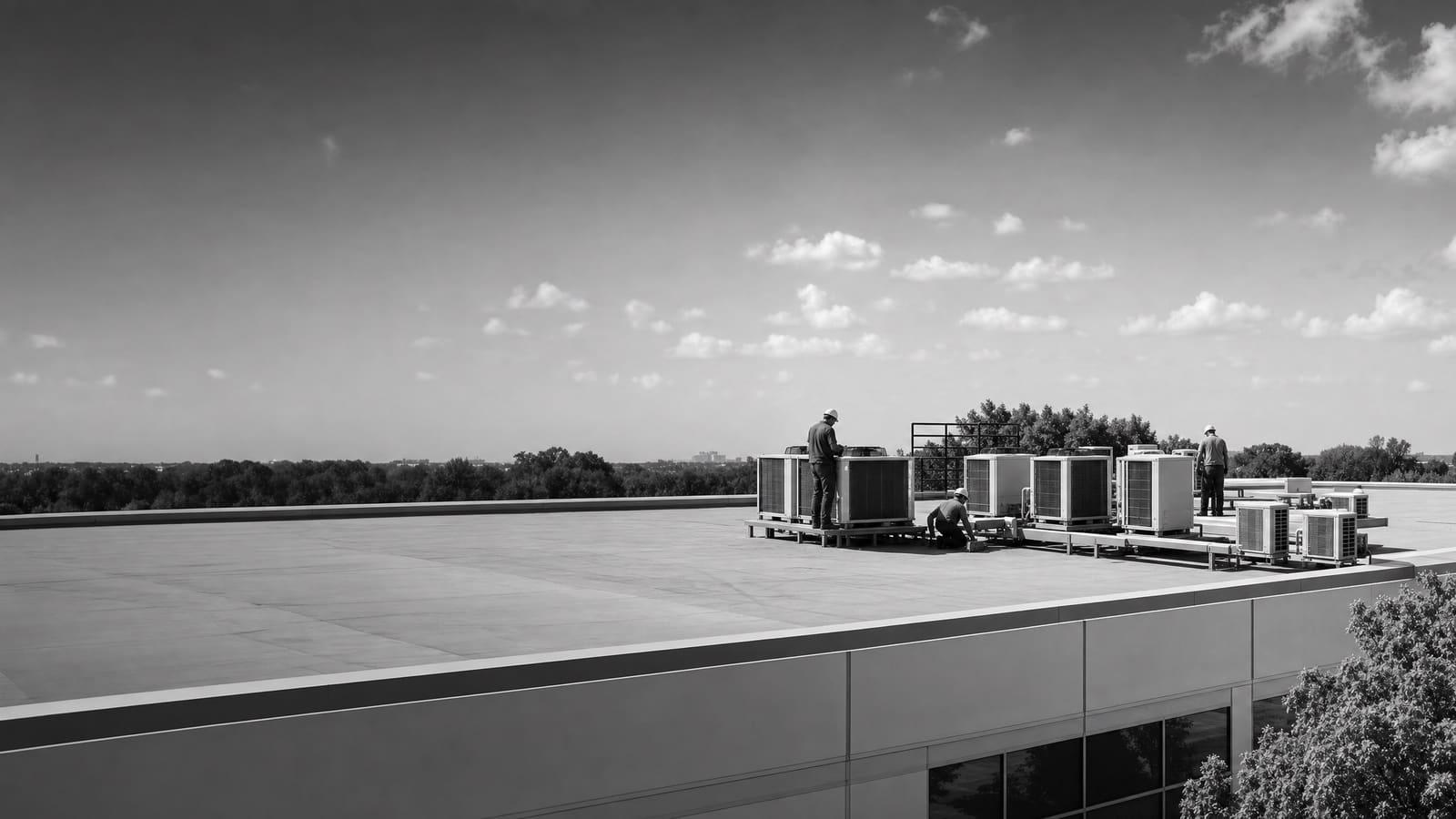
A commercial replacement is a load check, an equipment selection matched to real lead times, a curb and rigging plan, the licensed gas, electric, and controls work, certified recovery of the old refrigerant, and commissioning against spec. Replacement usually beats another repair once a unit is past fifteen years and the service calls keep coming. DOE has put the annual waste from an old, inefficient rooftop unit at $900 to $3,700.
A site review has to confirm the actual load, the roof curb and structure, crane access, and whether the electrical service and gas lines support the unit being proposed.
THE THREE PATHS
Three ways a replacement can go
Before tonnage or price, a replacement has to pick a heating path, because that choice drives the infrastructure work behind it. DOE frames the decision around a short list of screens: climate zone and heating load, local electricity and gas prices, building type and operating hours, equipment availability, and the infrastructure already on site.
The short version is that heat pump rooftop units are most efficient in mild-to-moderate winter heating, and their efficiency falls as outdoor temperatures drop, trending toward parity with electric resistance heat at the cold end. That does not rule them out where winters are real. It is exactly why dual-fuel and cold-climate configurations exist. It does mean the winter design condition and the backup heat strategy have to be modeled honestly instead of assumed.
Run all three against your actual building before settling on one. The cheapest install and the cheapest decade are frequently not the same option.
WHAT MOVES THE NUMBER
The lines that move a replacement quote
None of these are lines you can negotiate away. They are the parts of the job that vary most from building to building, which is why two roofs carrying identical units can price very differently.
IN PRACTICE
Buying the unit versus buying the outcome
The equipment line is the easy part of a replacement to compare. Two contractors quoting the same tonnage at the same efficiency tier will land close together. The gap between their bids almost always sits somewhere else: who owns the rigging plan, who pulls the permits, who handles the refrigerant in the old unit, and who proves the new one performs before the final invoice goes out.
That last item matters more than it sounds. DOE's push on high-efficiency rooftop units leaned on third-party verification in occupied buildings, not datasheets, because owners were reasonably skeptical that lab numbers would ever show up on a utility bill. The same logic applies to one roof. A unit charged wrong, moving the wrong airflow, or left on default control settings will hit none of the numbers it was sold on. The symptom rarely looks like an install failure on day one. It looks like a comfort complaint in month two, and by then the crew is on another job.
So read the bid for scope, not just for price. A low number that leaves out curb work, controls integration, or commissioning is not a lower price. It is a smaller job, and the rest of it comes back as change orders after the crane has left.
SIDE BY SIDE
Simple swaps and complicated ones
Not every replacement carries the same risk. The difference is usually whether anything about the building or the equipment class is changing along with the unit.
LOWER COMPLEXITY
Same fuel, same footprint
The space is used the way it always was, the new unit fits the existing curb, and heating stays on the same fuel. Scope is mostly rigging, connections, and commissioning.
HIGHER COMPLEXITY
New load or new fuel
Occupancy changed, tonnage moves, or heating shifts to electric. Now the job can include structural review, service or panel work, gas line changes, and a control sequence your vendor has never run.
BEFORE YOU BUY
What a real site review checks
DOE's checklist for rooftop replacement is a good scoping model, because it forces the questions that change the answer before anyone quotes a unit. Climate zone and heating load come first, since they decide whether an electric, dual-fuel, or cold-climate configuration is even a candidate. Then utility rates, because identical equipment can save money in one location and cost more to run in another. Then building type and operating hours, which set how much of the year the system runs at part load rather than at design.
Infrastructure is where scoping usually breaks down. Electrical capacity, physical constraints on the roof, and existing gas lines all have to be checked against the specific unit under consideration, not against a general model family. A panel with no spare capacity turns an all-electric option into an electrical project with an HVAC unit attached to it.
Equipment availability and contractor familiarity round out the list. A unit nobody can get for four months is not a real option in July, and a controls platform your service vendor has never touched is a maintenance problem you are choosing on purpose.
Four things to get in writing
Ask for the load calculation, the electrical capacity check, the curb and structural note, and the equipment lead time. If a bid arrives without those four, it is a price on a box, not a price on the project.
OWNERSHIP
Two things that outlast the install week
The first is refrigerant. Federal rules under Section 608 of the Clean Air Act govern how refrigerant is handled and recycled in stationary air-conditioning and heat pump equipment, so the charge in the old unit has to be recovered properly rather than vented, and the documentation belongs in the job file. If the new unit runs a different refrigerant than the one it replaces, your service contract and spare-parts plan should reflect that before it becomes a surprise on a mixed fleet.
The second is service. DOE lists contractor availability and knowledge as a genuine barrier to adopting newer rooftop technology, which makes it a fair thing to ask about directly. Whoever answers the two-in-the-morning call needs to know the equipment, the controls, and the sequence the unit was commissioned to run.
REFRIGERANT
Handling is regulated work
Recovery from the removed unit falls under EPA Section 608 rules for stationary equipment. Confirm the quote includes it, and keep the paperwork with the commissioning file.
SERVICE
Who supports it later
Newer heat pump and controls platforms need a vendor who has actually worked on them. Ask which techs are trained on the model before it is ordered, not after it is running.
PLANNING AHEAD
Phasing, procurement, and the cost of waiting
Most commercial rooftop replacements happen the worst possible way: on failure, in season, with a tenant on the phone. DOE is direct about the alternative. Replacing an inefficient, underperforming unit proactively is often the better business move than replacement-on-failure, and often better than a like-for-like swap at the end of service life, because you get to choose the equipment, the timing, and the price instead of taking whatever is on the truck.
That argues for treating a roof full of aging units as a schedule rather than a series of emergencies. Walk the roof, record the age, tonnage, and condition of each unit, and rank them. Anything past fifteen years with a rising service history moves to the front of the line. Since an old, inefficient unit can waste $900 to $3,700 a year on its own, the units you defer are not free to defer, and rooftop equipment conditions roughly half of all U.S. commercial floor space, so this is rarely a one-unit conversation.
Procurement follows the same logic. Lead times set the calendar, so equipment gets selected early and ordered against a planned window. If incentives are part of the math, confirm what is currently offered and what the program requires before the order goes in, because eligibility rules and funding levels change.
THE QUOTE
Five things a comparable quote shows
If two bids show all five of these, you can actually compare them. If one is missing them, you are comparing a complete project against a partial one and calling the difference savings.
01
Tonnage, fuel type, and efficiency tier
The specific model and configuration quoted, plus the load calculation it was sized from.
02
Curb, structure, and roof work
Adapter or new curb, any structural review, and how penetrations and flashing get closed out.
03
Rigging and access plan
Crane size, lot closure window, staging area, and who coordinates it with your tenants.
04
Mechanical and electrical scope
Gas, electrical, and refrigerant line work, plus certified recovery from the unit being removed.
05
Commissioning and lead time
Startup readings, controls setup, documented handoff, and the equipment availability date the schedule assumes.
Get a defensible number
Price the equipment and the building together.
Send the address, operating target, and target opening date. Flux will identify what must be verified before the project can be priced.
Get a free estimateQuestions
Straight answers.
When does replacement beat another repair?
Once a rooftop unit is past fifteen years, needs frequent service, or no longer holds the space, the repair is buying time rather than performance. DOE's point is that waiting for total failure removes your ability to choose the equipment, the timing, and the price.
Should a gas rooftop unit be replaced with a heat pump?
It depends on the heating load and the infrastructure. Heat pump rooftop units are most efficient in mild-to-moderate winter heating and lose efficiency as temperatures drop. Where winters are demanding, dual-fuel or cold-climate configurations exist for that reason. Check electrical capacity and utility rates before deciding.
What actually delays a commercial HVAC installation?
Usually equipment availability, not labor. A unit that cannot ship for months is not a real option during a cooling emergency. Structural review on a changed footprint and electrical service work are the other two common holds.
What does an aging rooftop unit cost to keep running?
DOE has put the annual waste from old, inefficient commercial rooftop units at roughly $900 to $3,700 per unit. That is energy alone, before service calls, and it is why deferring a marginal unit is not a free decision.
What happens to the refrigerant in the old unit?
It has to be recovered by qualified hands under EPA Section 608 rules covering stationary refrigeration, air-conditioning, and heat pump equipment. Venting it is not an option. Confirm recovery is in the scope and keep the documentation with the project file.
Sources used for this guide
- [1]betterbuildingssolutioncenter.energy.gov — DOE Advanced Rooftop Unit Replacement Guidance
- [2]betterbuildingssolutioncenter.energy.gov — DOE Commercial Heat Pump Rooftop Unit Replacement Guidance
- [3]betterbuildingssolutioncenter.energy.gov — DOE High-Efficiency Commercial Rooftop Unit Toolkit
- [4]energy.gov — DOE Efficient Commercial Rooftop Air Conditioner Program
- [5]epa.gov — EPA Stationary HVAC Refrigerant Management