THE SHORT VERSION
What a commercial HVAC replacement includes
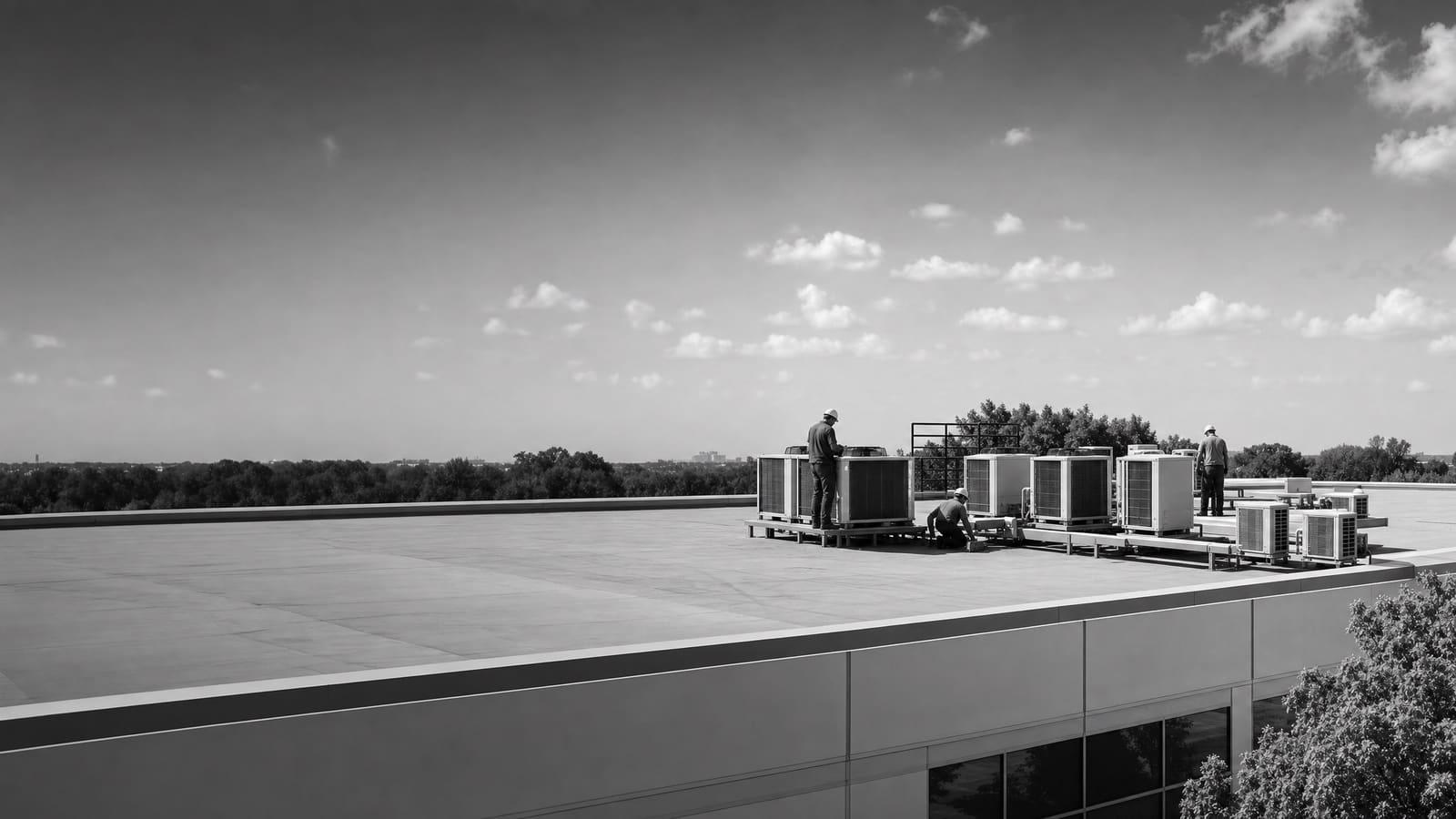
A commercial HVAC replacement covers the load calculation, the equipment, rigging and set, curb work, gas, electrical and control connections, refrigerant recovery from the old unit, permits, and commissioning. Replacement usually beats another repair once a unit passes about 15 years. The Department of Energy puts the waste from old, inefficient rooftop units at roughly $900 to $3,700 per unit each year, so a second compressor repair on a tired unit often buys an expensive year.
A site review has to confirm tonnage against how the space is used now, roof and curb condition, crane access, and whether the electrical service can carry the unit you want.
THREE PATHS
Choosing what goes back on the roof
Most buildings are choosing between three paths, and the right one depends on what changed since the last unit went in. If the space is used the same way and the bills are steady, a like-for-like swap is the fastest way back to conditioned air. If occupancy, layout, or plug load moved, the load should be recalculated before anything is ordered, because a unit sized for a 2005 floor plan will short-cycle or run long in a 2026 one.
The third path is the electric one. The Department of Energy rates heat pump rooftop units as a good fit across the West, where mild winters let them cover most or all of the heating demand. Southern California qualifies. What decides it on your roof is not the climate but the panel: an all-electric unit needs the service and breaker space to support it, and that answer comes from a walk of the electrical room, not a catalog.
WHAT MOVES THE NUMBER
The lines that decide your price
No one can price a roof from a phone call, but the same handful of items move the number on almost every commercial replacement. Ask which of these your quote includes and which are excluded. Exclusions are where a clean-looking bid grows a change order.
IN PRACTICE
Planned replacement costs less than an emergency
The most expensive commercial HVAC replacement is the one nobody planned. When a unit fails in August, you take whatever equipment is available, at whatever price, on whatever day the crane has open. Plan the same replacement in spring and you compare two or three units, you have time to right-size, and you can hold the set for a Sunday morning when the lot is empty.
The Department of Energy makes this point directly. Facility managers usually wait until a rooftop unit stops holding the space, needs constant service, or fails outright, and proactively replacing an inefficient unit often beats both replacement-on-failure and a like-for-like swap at end of life. That is not a sales argument. It is arithmetic about equipment that is already burning money it does not need to.
For a multi-unit roof, rank the fleet. Pull the nameplate year and tonnage on every unit, note which ones needed compressor or coil work in the last two seasons, and put the oldest and sickest at the top. Replace one or two a year on your calendar. A staged plan spreads the capital, keeps a crane mobilization from being spent on a single unit, and means you never negotiate during an outage.
SIDE BY SIDE
What makes one replacement harder than another
Two replacements at the same tonnage can be weeks and thousands apart. The difference is almost never the equipment itself. It is what the equipment has to connect to and how hard it is to get up there.
LOWER COMPLEXITY
Straight swap on an accessible roof
Matching curb, same tonnage, adequate electrical service, and a lot the crane can set up in. Gas and control connections land where they did before. Permits are routine, the set is a morning, and most of the schedule risk sits in equipment availability.
HIGHER COMPLEXITY
Tonnage change, tight site, or fuel switch
A larger or heavier unit can trigger structural review and a new curb. An all-electric conversion can require service upgrades. Tight lots, occupied tenants, and units set far from the roof edge stretch the rigging plan and often push work to a night or weekend.
BEFORE YOU BID IT
The site review that prevents change orders
A useful site review answers questions in a fixed order, and you can run most of it yourself before anyone quotes.
Start with the unit: nameplate tonnage, model year, refrigerant, and whether it has an economizer. Then the roof: curb dimensions, deck condition around the curb, and whether the last replacement left an adapter stacked underneath. Then the load: how many people use the space now, what hours it runs, what equipment throws heat, and whether anyone complains about a specific zone. Then infrastructure, which is where electric conversions live or die. Panel capacity, available breaker space, feeder size, and the location of any gas line that is staying.
The Department of Energy's checklist for heat pump rooftop units covers the same ground: climate, utility bill impact, building type, equipment availability, electrical capacity, physical constraints, gas lines, and whether local contractors know the equipment. Work through it before you compare bids, not after. Every item on that list is cheap to answer on a walkthrough and expensive to discover on crane day.
Have this ready before the first visit
A nameplate photo, the model year, a picture of the roof showing access, your normal operating hours, and last summer's utility bills. That packet is usually enough for a contractor to scope real options before anyone climbs a ladder.
COSTA MESA SPECIFICS
Permits are the local step people underestimate
California city building departments publish HVAC permit requirements, and mechanical upgrades and repairs sit squarely on the list of work that needs one, alongside electrical and plumbing changes and re-roofing. A rooftop replacement usually touches more than one of those categories at once, so more than one permit can apply to a single crane day.
For a Costa Mesa building, confirm current requirements with the city's building division before you sign, and make the contractor's obligation explicit in the contract. They apply for the permits, they meet the inspector, and the price accounts for both. Two problems come from skipping this. Inspections nobody scheduled hold things up after the unit is already running, and unpermitted mechanical work resurfaces later during a sale or a tenant improvement.
Put permit responsibility in writing
The quote should name who applies for the mechanical and electrical permits, who meets the inspector, and whether fees are included or passed through. Verify current requirements with the Costa Mesa building division, since local rules and fees change.
OWNERSHIP QUESTIONS
Two things to settle before the order goes in
A replacement decision does not end when the crane leaves. Two questions shape what the unit costs you over its life, and both are easier to settle early than to argue about later.
The first is who actually pays. In a triple-net or modified-gross lease, capital replacement and routine maintenance often sit with different parties, and a rooftop unit is exactly the item that turns that ambiguity into a dispute.
The second is what happens to service. New commercial equipment ships with different refrigerants than units installed a decade ago, so a mixed roof means mixed parts, mixed recovery equipment, and mixed technician certifications for whoever holds the maintenance contract.
COST RESPONSIBILITY
Owner, tenant, or split
Leases divide capital replacement and maintenance differently. Settle who funds the unit, who holds the warranty, and who carries the service contract before the equipment is ordered. Work done under an unclear lease gets argued about for years.
REFRIGERANT HANDLING
The old charge is regulated
EPA Section 608 rules govern how refrigerant is handled and recovered from stationary air conditioning and heat pump equipment. Recovery from the removed unit is certified, documented work, not something a crew improvises on the roof.
PROCUREMENT
Buying the schedule and the decade, not just the unit
Procurement is where a commercial replacement quietly gets cheaper or more expensive. Three habits help.
Buy the schedule. Ask for the equipment's actual availability in writing, next to the price. A unit that ships in two weeks and one that ships in three months are not the same purchase even at the same number, and the gap shows up as rented cooling and thin tenant patience.
Bundle the crane. If two units on the same roof are both near end of life, setting them on one mobilization costs less than two separate days a year apart. The same logic applies to curb fabrication and roof patching.
Price the decade. The Advanced RTU Campaign, a Department of Energy effort run with industry partners, reported more than 200 organizations upgrading over 43,000 rooftop units and saving a combined $37 million a year in energy costs. That is the shape of the trade: a higher installed number that pays back across operating years. Whether it pays back on your roof depends on your run hours and rates, which is why a bid comparison should include an estimated annual operating cost for each option, not just the install price.
QUOTE CHECKLIST
Five things every comparable bid should show
Bids stop being comparable the moment one includes something another leaves out. Ask every contractor to show these five items in the same order so the numbers line up.
01
Equipment and efficiency tier
Manufacturer, model, tonnage, efficiency rating, refrigerant, and heating type, plus the quoted availability for that exact unit.
02
Curb, structural, and roofing scope
Whether the existing curb is reused, an adapter is fabricated, or the deck needs reinforcement, and who patches the roof afterward.
03
Rigging and site plan
Crane size, staging location, how much of the lot closes, expected hours, and which day and shift the set happens on.
04
Utility connections
Electrical, gas, condensate, and controls work included, with any panel or feeder upgrade priced as its own visible line.
05
Permits, startup, and closeout
Which permits are pulled and by whom, refrigerant recovery on the old unit, commissioning readings, and the warranty documents you receive.
Get a defensible number
Price the equipment and the building together.
Send the address, operating target, and target opening date. Flux will identify what must be verified before the project can be priced.
Get a free estimateQuestions
Straight answers.
When does replacement beat one more repair?
Look at three things together: age past about 15 years, repeat compressor or coil work in recent seasons, and what the unit wastes while it runs. The Department of Energy estimates old, inefficient rooftop units waste roughly $900 to $3,700 per unit annually, which often exceeds the repair you are about to authorize.
Does a heat pump rooftop unit make sense here?
The climate supports it. The Department of Energy considers today's heat pump rooftop units capable of covering most or all winter heating demand across the West, where winters are mild. The deciding factor is usually electrical capacity at your building, so check panel and feeder capacity before you commit to an all-electric unit.
Who pulls the permit for a commercial HVAC replacement?
The installing contractor should, and the contract should say so. Mechanical upgrades and repairs require a permit, and a replacement that touches electrical work can require more than one. Confirm current requirements with the Costa Mesa building division before signing.
How much does a commercial HVAC replacement cost?
There is no honest universal number, because tonnage, efficiency tier, curb and structural work, crane access, and utility connections all move it independently. Ask for those as separate lines on every bid so you can see which contractor priced the roof and which one priced the equipment.
What happens to the refrigerant in the old unit?
It is recovered under EPA Section 608 rules, which govern handling and recycling of refrigerant in stationary air conditioning and heat pump equipment. Recovery is certified work and should appear on the quote rather than being assumed.
Sources used for this guide
- [1]betterbuildingssolutioncenter.energy.gov — DOE Advanced Rooftop Unit Replacement Guidance
- [2]betterbuildingssolutioncenter.energy.gov — DOE Commercial Heat Pump Rooftop Unit Replacement Guidance
- [3]betterbuildingssolutioncenter.energy.gov — DOE High-Efficiency Commercial Rooftop Unit Toolkit
- [4]energy.gov — DOE Efficient Commercial Rooftop Air Conditioner Program
- [5]epa.gov — EPA Stationary HVAC Refrigerant Management
- [6]californiacity-ca.gov — HVAC Permits