THE SHORT ANSWER
What commercial HVAC replacement and installation includes
A commercial HVAC replacement covers a load check, equipment selection, permits, rigging, the crane set, and commissioning. Replacement usually wins over one more repair once a rooftop unit passes fifteen years, because failures stack up and the waste never stops. Federal estimates put the energy a single old, inefficient rooftop unit wastes at roughly $900 to $3,700 every year. That number runs whether you fix it again or not.
A site review still has to confirm tonnage against how the space is used now, plus curb condition, roof access, and the electrical and gas service already at the unit.
THREE WAYS TO GO
Three replacement paths, and when each one fits
Most Corona buildings land on one of three paths. The first is a matching replacement on the existing curb, the quickest way back to cooling. The second is a right-sized, high-efficiency unit chosen from today's load rather than the old nameplate; a federal efficiency challenge pushed manufacturers to build rooftop units that use up to half the energy of the older baseline, and those tiers are widely available now. The third is a heat pump rooftop unit, one electric machine for both heating and cooling. Federal guidance is direct about where that fits: across most of the U.S. South and West, today's heat pump rooftop units can cover most or all of the winter heating demand. Corona sits in that range. The deciding factors are usually how long you plan to hold the building and how much downtime the space can absorb.
WHAT MOVES THE NUMBER
The budget lines that actually swing the price
Nobody can price a commercial rooftop unit by tonnage alone. These are the lines that separate a clean swap from a project, and they are the ones worth settling before you compare bids.
IN PRACTICE
How to buy the unit instead of the emergency
The worst time to choose a rooftop unit is the week it dies. Under pressure, the only real option is whatever a distributor has on the shelf, and that decision follows the building for the rest of the unit's service life. Federal guidance on rooftop replacement makes the same point: waiting for total failure usually costs more than a planned replacement, and often more than a like-for-like swap at end of life.
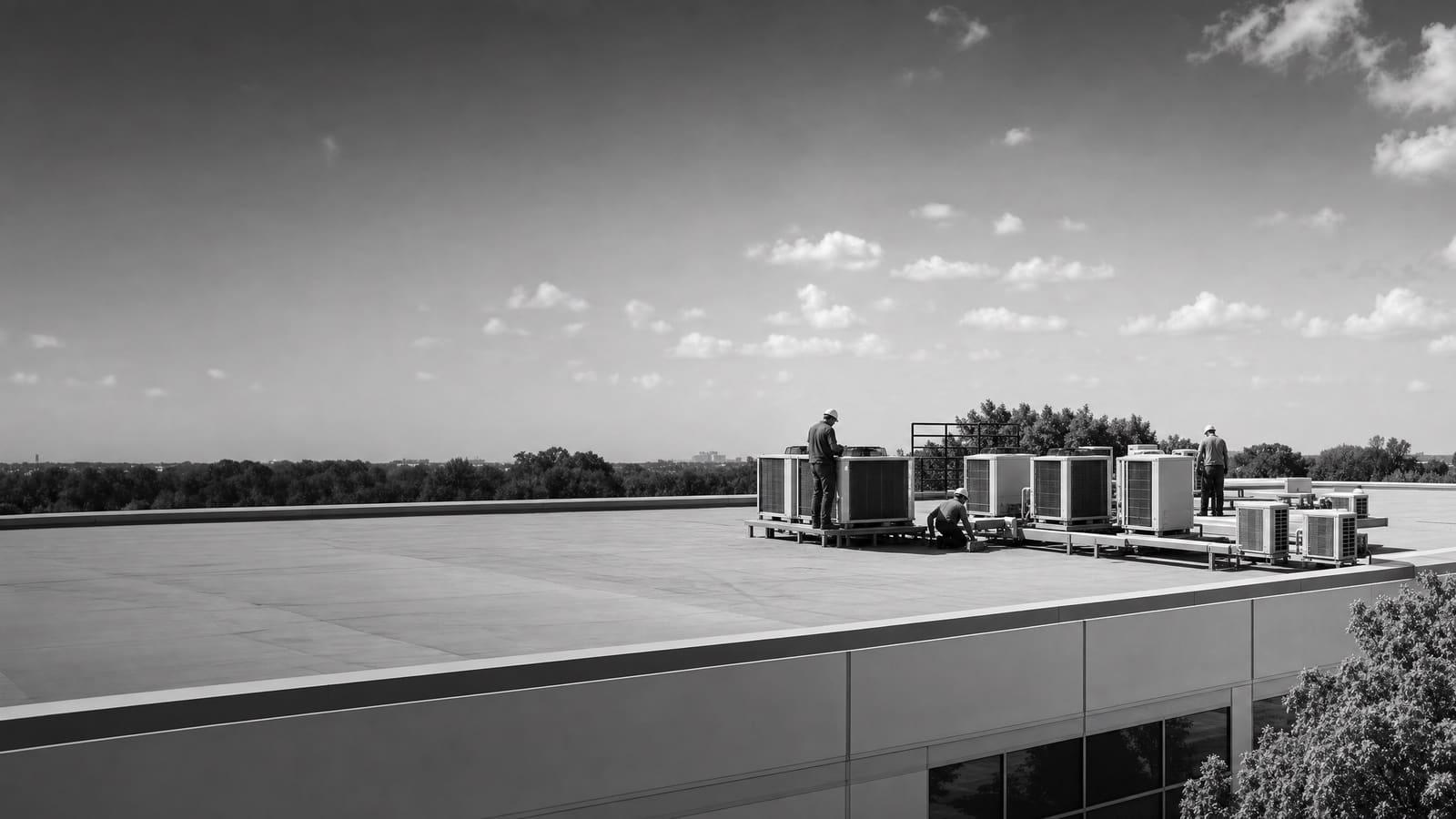
The practical fix is knowing your fleet before it forces the issue. Walk the roof, write down the model, tonnage, and year on every unit, and sort them. Anything past fifteen years belongs on a replacement list with a rough budget attached, running or not.
That list changes how you buy. You get to compare efficiency tiers instead of taking what is available. You can time the crane for a slow week instead of a Tuesday in August. And when a unit does fail early, you already know what replaces it, so the call takes an hour instead of a week.
TWO KINDS OF PROJECT
The simple swap and the one that needs engineering
Two buildings can order the same tonnage and end up with very different projects. What separates them is almost never the unit. It is the curb, the roof structure, the electrical service, and how a crane reaches the spot.
LOWER COMPLEXITY
Same size, same fuel, open lot
The replacement matches the old unit's tonnage and fuel type, lands on the existing curb, and the lot has room for the crane to set up away from traffic. Permitting is routine and the set is a normal day on the roof.
HIGHER COMPLEXITY
New size, new fuel, tight access
Tonnage changes, the footprint grows, or the unit goes all-electric. That can add a curb adapter, a structural review, new panel capacity, and a longer crane reach that takes more of the lot out of service for the day.
BEFORE THE QUOTE
What a site review has to confirm
A number given over the phone is a guess. A number given after someone stands on the roof is a quote. The visit is short, but it settles the things that otherwise become change orders.
Start with the load. Years of tenant changes, added equipment, new lighting, and envelope work mean the old nameplate is a historical record, not a specification. Size the replacement from how the space is used today.
Then the physical side. Is the curb sound, and will the new unit sit on it or need an adapter? Can the roof carry the weight? Where does the crane set up, how many stalls does it take, and is anything in the swing path?
Then the services. What electrical service already lands at the unit, how much panel capacity is spare, and where does the gas line run? Federal heat pump guidance treats electrical capacity, physical constraints, and gas lines as the three infrastructure checks that decide whether an all-electric unit is even a candidate at a given site. That question is far cheaper to answer in an afternoon than after equipment is ordered.
Ask for this in writing
Before you compare bids, get each contractor's stated tonnage, efficiency tier, curb plan, and the electrical service they assumed. Two quotes that differ by thousands usually differ on one of those four lines, not on labor rates.
IN CORONA
Pull the permit before you book the crane
In California, a commercial changeout is permitted work. City building department permit lists cover any mechanical, electrical, or plumbing upgrade or repair, and a rooftop replacement is usually at least two of those at once. Verify the current requirements with the City of Corona building division before you set a crane date, because inspection has to land in the same window as the equipment.
Re-roofing sits on those same permit lists, both overlay and tear-off. That matters more than it sounds. If your membrane is within a few years of replacement, doing the roof and the rooftop units as one coordinated project keeps you from craning new equipment onto a surface that gets torn off later.
One call that saves a week
Confirm with Corona's building division which permits your changeout needs and how inspection gets scheduled, then build the crane date around that. A new unit sitting on a roof waiting for sign-off is the most avoidable delay in the whole job.
AFTER IT IS RUNNING
Two things that outlive the install
The install is a week. The consequences run for the life of the unit. Two of them are worth deciding before you sign, because both are much harder to change later. The first is refrigerant. New commercial equipment ships on newer, lower-GWP refrigerants, and federal Clean Air Act rules govern how refrigerant is handled, serviced, and recovered on stationary equipment. If your roof holds a mix of old and new units, your service contract and spare-parts plan now cover two refrigerant families at once. The second is who owns commissioning. A unit that starts is not the same as a unit that performs, and the gap between them shows up as comfort complaints in month two.
REFRIGERANT
Plan for a mixed fleet
Federal rules require certified handling and recovery of refrigerant on stationary equipment. A roof carrying two refrigerant families needs a service contract and parts plan that covers both, not just the newest unit.
COMMISSIONING
Make performance the deliverable
Charge, airflow, and control settings verified against spec and documented at handoff. That report is what you point to when performance drifts, and it is usually what keeps the manufacturer's warranty intact.
THE LONGER VIEW
Phasing, procurement, and the long-hold number
If the roof holds several aging units, replacing them one emergency at a time is the most expensive way to get where you are going. Each failure buys whatever is available that week, each crane day gets billed on its own, and the fleet ends up a set of unrelated machines with unrelated service needs.
Phasing fixes most of that. Group the units by age and condition, replace the worst two or three in one mobilization, and let the crane, the permit work, and the controls integration carry across the group. Standardizing on one manufacturer and one control platform pays off every year after, in parts, in training, and in how fast a tech diagnoses a problem at six in the morning.
Procurement deserves as much attention as price. Equipment availability is a real constraint, and a quote without a lead time is only half a quote. Ask what is in the regional pipeline before you settle on a tier.
Then run the long-hold number instead of the invoice. An old, inefficient unit can burn $900 to $3,700 a year in wasted energy by itself. Skipping an efficiency tier to save money on install day is usually the more expensive decision.
THE QUOTE
Five lines every comparable bid should show
Two bids on the same roof can differ widely and both be honest. Usually they assumed different scopes. These five lines are what make them comparable.
01
Equipment, spelled out
Manufacturer, model, tonnage, efficiency tier, and refrigerant. Not the phrase "like for like."
02
Lead time, in writing
Quoted availability for that exact model, and what the plan is if it slips.
03
Curb and roof scope
Adapter or new curb, patching, and who carries the cost if structural work is found.
04
Crane and lot plan
Rigging, reach, closure hours, and which day of the week the set happens.
05
Permits and commissioning
Who pulls permits, who meets the inspector, and what startup documentation you receive.
Get a defensible number
Price the equipment and the building together.
Send the address, operating target, and target opening date. Flux will identify what must be verified before the project can be priced.
Get a free estimateQuestions
Straight answers.
When is replacing a rooftop unit better than one more repair?
Once a unit is past about fifteen years, the math usually turns. Old, inefficient rooftop units waste roughly $900 to $3,700 per unit a year in energy, and that loss continues after every repair. Federal guidance also notes that planned replacement often beats waiting for total failure, and beats a like-for-like swap made under pressure.
Does a heat pump rooftop unit make sense in Corona's climate?
Federal guidance says that across most of the U.S. South and West, today's heat pump rooftop units can handle most or all of the winter heating demand. Corona's mild winters sit in that range. The real gate is infrastructure: electrical capacity, physical constraints, and existing gas lines all have to be checked before the unit is specified.
Do I need a permit to replace a commercial rooftop unit in Corona?
Plan on it. California building departments treat mechanical and electrical upgrades or repairs as permitted work, and a rooftop changeout is generally both. Confirm the specific requirements and inspection process with the City of Corona building division before you book the crane, so the sign-off does not become the thing holding up the job.
Should the new unit match the old unit's tonnage?
Only if the space and the way it is used have not changed. A nameplate from fifteen or twenty years ago reflects the occupancy, lighting, and equipment of that time. If any of those shifted, matching tonnage carries forward whatever sizing error the old unit had, along with the comfort complaints that came with it.
What happens to the refrigerant in the old unit?
Federal Clean Air Act rules govern how refrigerant in stationary air conditioning equipment is handled and recovered, so removal is certified work, not something to leave loose in a scope of work. New equipment ships on newer, lower-GWP refrigerants, which is worth planning into service contracts and spare parts if your roof runs a mixed fleet.
Sources used for this guide
- [1]betterbuildingssolutioncenter.energy.gov — DOE Advanced Rooftop Unit Replacement Guidance
- [2]betterbuildingssolutioncenter.energy.gov — DOE Commercial Heat Pump Rooftop Unit Replacement Guidance
- [3]betterbuildingssolutioncenter.energy.gov — DOE High-Efficiency Commercial Rooftop Unit Toolkit
- [4]energy.gov — DOE Efficient Commercial Rooftop Air Conditioner Program
- [5]epa.gov — EPA Stationary HVAC Refrigerant Management
- [6]californiacity-ca.gov — HVAC Permits