THE DIRECT ANSWER
What a commercial HVAC replacement actually includes
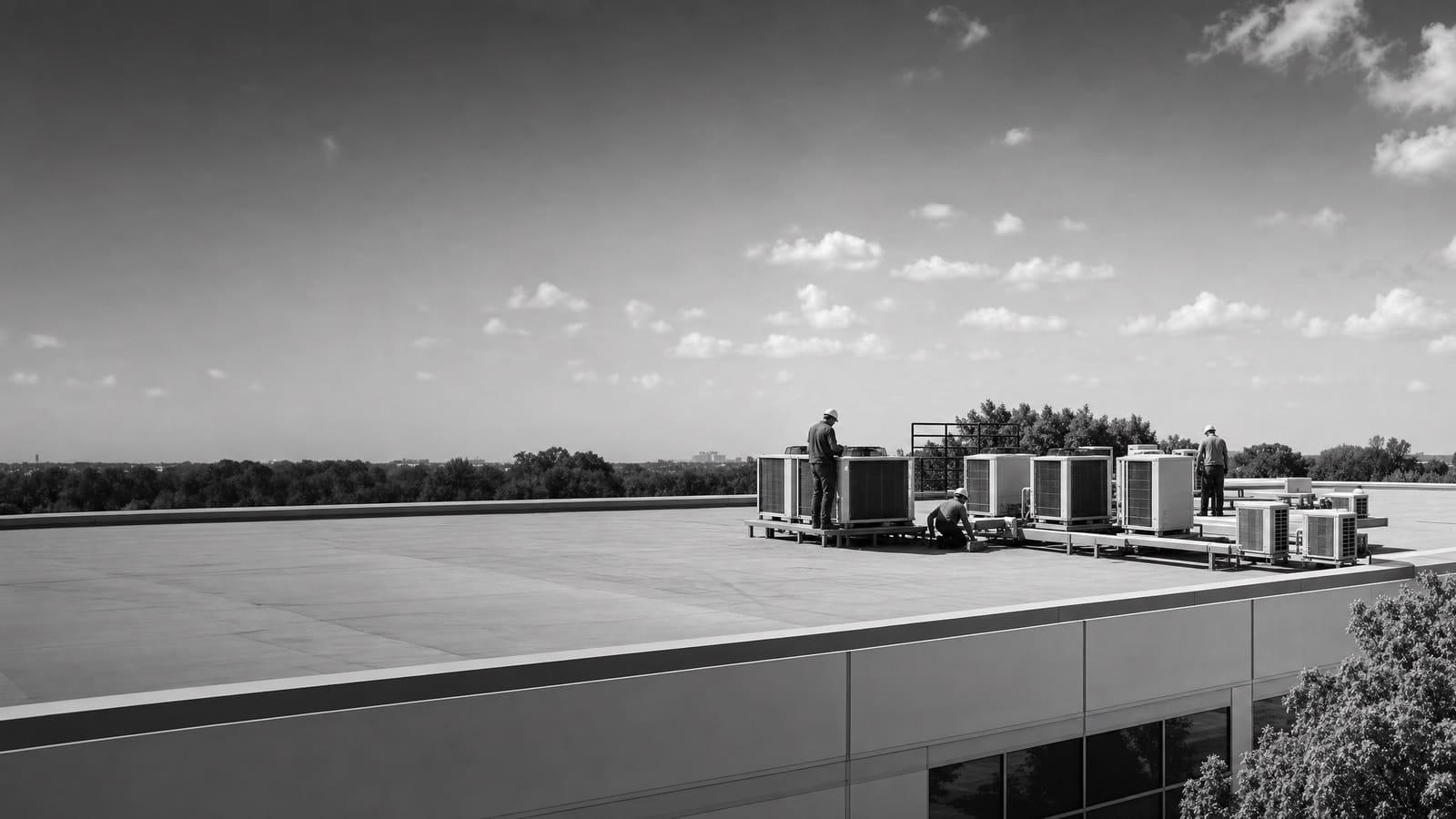
A commercial HVAC replacement covers the load calculation, equipment selection, permit drawings, rigging and set, refrigerant recovery from the old unit, controls, and commissioning. Replacement usually beats one more repair once a rooftop unit is past 15 years and no longer holds the space. Department of Energy figures put the annual energy waste of an old, inefficient rooftop unit at $900 to $3,700, which is enough that a second major repair on a tired unit rarely pays back.
A site review still has to confirm the real load, the curb and roof structure, available electrical capacity, and crane access before any of that becomes a price.
THREE WAYS TO GO
Three replacement paths, and when each one is right
Most commercial replacements land on one of three paths. The right one depends on whether the building still uses the space the way it did when the old unit was specified.
Like-for-like is the fastest route back to cooling. Same tonnage, same curb, same connections, simplest permit. It is the right call when occupancy and use have not changed, and the wrong call when the old unit was already oversized or short on capacity, because that mistake gets bought again for another fifteen years.
A right-sized replacement starts with a fresh load calculation against today's occupancy, plug load, lighting, and envelope. It costs a little more engineering up front and returns it in comfort complaints that stop and utility spend that drops.
A high-efficiency or heat pump replacement is the third path. The federal rooftop unit specification was written around units that cut energy use by up to half against the older baseline, and heat pump rooftop units are well matched to mild southern winters, where reverse-cycle heating covers most or all of the heating demand.
WHAT MOVES THE NUMBER
The budget lines that decide a rooftop replacement price
Two quotes for the same building can land far apart, and the gap usually sits in these lines rather than in the equipment itself. Ask for each one priced separately so the bids that come back are actually comparable.
HOW TO BUY IT
Buy the project, not just the box
The equipment is the easy part of the decision. What separates a good replacement from an expensive one is whether the contractor priced the whole job or only the unit. Ask for the load calculation, the rigging plan, the permit package, and the commissioning scope as line items in the same document as the price. If those live in a verbal promise, they are not in the number.
Timing matters as much as scope. Facility teams often wait until a unit fails outright, which puts the decision in the worst possible week: peak season, no leverage, and whatever the supply house happens to have. Federal guidance on rooftop replacement makes the same point plainly. Replacing an inefficient, underperforming unit proactively usually beats replacement-on-failure, and often beats a like-for-like swap at the end of service life. A unit past fifteen years with a second major repair on the record is a planning problem, not yet an emergency.
The last piece is who owns the outcome. A quote should name the party responsible for permits, inspections, crane coordination, and startup documentation. When one contractor owns all four, a failed inspection or a bad charge is their problem to fix. When they are split, the building owner ends up managing the seams.
COMPLEXITY CHECK
What makes this project simple, and what makes it hard
Before you budget, work out which version of this project you have. The difference between the two is usually visible from the roof and the electrical room in a single afternoon.
LOWER COMPLEXITY
Straight swap on an existing curb
Same tonnage as the outgoing unit, an existing curb an adapter fits, a lot with room to set the crane, and adequate power already at the disconnect. Permitting is routine and the on-site work is a set-and-connect.
HIGHER COMPLEXITY
Changed load, changed power, or tight access
Tonnage or footprint changes, a heavier unit over an opening that needs structural review, a gas-to-electric conversion that needs new feeder capacity, controls tied into a building automation system, or a roof only reachable from a street that has to be closed.
THE SITE REVIEW
What a real site review has to confirm
A quote written from a nameplate photo is a starting number, not a price. Before it becomes a commitment, someone needs to stand on the roof and open the electrical room.
The load comes first. Twenty years changes occupancy, plug load, lighting, and sometimes the envelope, so the old nameplate is evidence of what the building needed then, not what it needs now. Next is physical fit: curb dimensions, roof structure under the opening, clearances, and how the new unit's footprint compares to the old one. Then infrastructure. Federal rooftop guidance treats electrical capacity, physical constraints, and gas service as the three items that most often decide whether a planned replacement is actually buildable. An all-electric or heat pump unit is where this bites hardest, because a panel that carried a gas unit's blower may not carry electric heat.
Access is the last piece and the one most often skipped. Crane setup location, reach over the building, which stalls close and for how long, and whether tenants need notice. That same review is what makes the permit drawings correct on the first submittal, which matters more than it sounds when plans have to be sealed before they are filed.
Ask for this before you sign
A load calculation, curb and structural notes, the electrical capacity check, and a rigging plan with a lot layout. If a bidder will not produce those, the number they handed you has an unpriced change order sitting inside it.
IN CORAL SPRINGS
Start the permit package with the equipment order
Florida commercial permit packages ask for more paper than many owners expect, and that changes your schedule more than your price. When the scope includes installing or relocating HVAC equipment, mechanical plans have to be signed and sealed by a Florida licensed architect or engineer. Energy calculations are required whenever the scope includes heating, ventilation, or air conditioning. The drawings also have to show equipment location, and if the work touches roof framing, framing plans and details come with it.
The practical effect is that your design professional needs to be engaged early, not after the unit is ordered. On a like-for-like swap that is a short exercise. On a right-sized or all-electric replacement, where tonnage, footprint, or electrical service changes, the sealed drawings and energy calculations become the long pole. Confirm the exact submittal list with the Coral Springs building department for your address, since local review can add items to the state baseline.
The scheduling rule
Order equipment and open the permit package in the same week. Lead time and plan review run on separate clocks, and the crane day can only be booked once both are cleared.
OWNERSHIP QUESTIONS
Two decisions that outlive the install
A rooftop unit is a long-horizon decision usually made under time pressure. Two questions are worth settling while the quote is still open, because both get expensive to revisit after the crane leaves.
The first is fuel. In a mild-winter southern climate, heat pump rooftop units are a straightforward fit. Reverse-cycle heating covers most or all of the winter demand, and the deep cold hours that punish a heat pump elsewhere barely exist here. Whether it pencils for your building still depends on local electricity price against gas and on whether the service can carry the added electrical load.
The second is fleet consistency. If you run several units, replacing them one failure at a time leaves you with mixed refrigerants, mixed controls, and mixed service requirements. A staged plan that groups replacements by age keeps the fleet coherent and gives you purchasing leverage that an emergency call never will.
FUEL CHOICE
Electric, dual fuel, or like-for-like
South Florida's mild winters make heat pump rooftop units a practical default, but the call still turns on electricity price against gas and whether the panel can carry electric heat.
FLEET STRATEGY
One unit or the whole roof
Replacing on failure produces a mixed fleet. Grouping by age standardizes controls, refrigerant, and parts, and turns a run of emergencies into a purchase you can negotiate.
OVER THE LIFE OF THE UNIT
Phasing, procurement, and what the unit costs after day one
Purchase price is the smallest number in this decision across a fifteen-year life. Energy is the largest. That is the entire argument behind the federal push on rooftop efficiency: units built to the high-performance specification cut energy use by up to half against the older baseline, and the campaign that followed tracked more than 43,000 upgraded units saving a combined $37 million a year. Those are portfolio figures, not a promise for your roof, but the direction is not in dispute. An old rooftop unit is a recurring bill, and replacing it converts part of that bill into a fixed cost you have already paid.
Procurement is where owners give away their advantage. Equipment lead time and plan review each run on their own clock, and neither speeds up because your unit died. Building a two or three year replacement schedule off unit age and repair history lets you bid several units together, order ahead of season, and take a crane day when the lot is empty rather than on a Saturday under pressure.
If phasing is the plan, sequence by risk rather than age alone. The unit conditioning the space you cannot afford to lose goes first, even when it is not the oldest one on the roof.
THE QUOTE CHECKLIST
Five things a comparable quote should show
Bids only compare when they cover the same scope. Ask every bidder to put these five items in writing, in the same document as the price.
01
Equipment, tonnage, and efficiency tier
Model number, capacity, efficiency rating, and refrigerant, so every bid is priced on the same machine.
02
Lead time with a date
Quoted availability as an actual date, not "standard lead time." This is the line that sets your schedule.
03
Curb, structural, and roof work
Adapter or new curb, framing or roof repair around the opening, and who is responsible for flashing and weatherproofing.
04
Permits, sealed drawings, and inspections
Who prepares the mechanical plans and energy calculations, who pulls the permit, and who meets the inspector.
05
Crane day and commissioning
Rigging plan and lot closure hours, plus startup with charge, airflow, and control settings verified and documented.
Get a defensible number
Price the equipment and the building together.
Send the address, operating target, and target opening date. Flux will identify what must be verified before the project can be priced.
Get a free estimateQuestions
Straight answers.
When is replacing a commercial rooftop unit better than another repair?
Once a unit is past about fifteen years, needs frequent service, or can no longer hold the space, replacement usually wins. Old, inefficient rooftop units waste roughly $900 to $3,700 a year each in energy, and planned replacement generally costs less than replacement after a failure in peak season.
How much does commercial HVAC installation cost in Coral Springs?
There is no honest universal number. Installed cost tracks tonnage, efficiency tier, curb and structural work, crane access, and any electrical service change. Ask for those as separate lines so competing quotes actually compare, and expect a firm price only after a site review.
Do I need sealed drawings to replace a rooftop unit in Florida?
When the scope includes installing or relocating HVAC equipment, mechanical plans have to be signed and sealed by a Florida licensed architect or engineer, and energy calculations are required for HVAC scope. Confirm the full submittal list with the Coral Springs building department for your address.
Does a heat pump rooftop unit make sense in South Florida?
Often, yes. Heat pump rooftop units are best suited to mild-to-moderate winter heating, and in southern climates they can cover most or all of the winter demand. The real checks are electricity price against gas and whether the electrical service can carry the unit.
What happens to the refrigerant in the old unit?
It has to be recovered, not vented. Federal rules under Section 608 of the Clean Air Act govern how refrigerant is handled and recycled in stationary air-conditioning equipment, and recovery belongs in the installer's scope rather than showing up as a surprise line later.
Sources used for this guide
- [1]betterbuildingssolutioncenter.energy.gov — DOE Advanced Rooftop Unit Replacement Guidance
- [2]betterbuildingssolutioncenter.energy.gov — DOE Commercial Heat Pump Rooftop Unit Replacement Guidance
- [3]betterbuildingssolutioncenter.energy.gov — DOE High-Efficiency Commercial Rooftop Unit Toolkit
- [4]energy.gov — DOE Efficient Commercial Rooftop Air Conditioner Program
- [5]epa.gov — EPA Stationary HVAC Refrigerant Management
- [6]tampa.gov — Permit Application Guide Commercial Alteration