THE SHORT ANSWER
What a commercial HVAC replacement actually includes
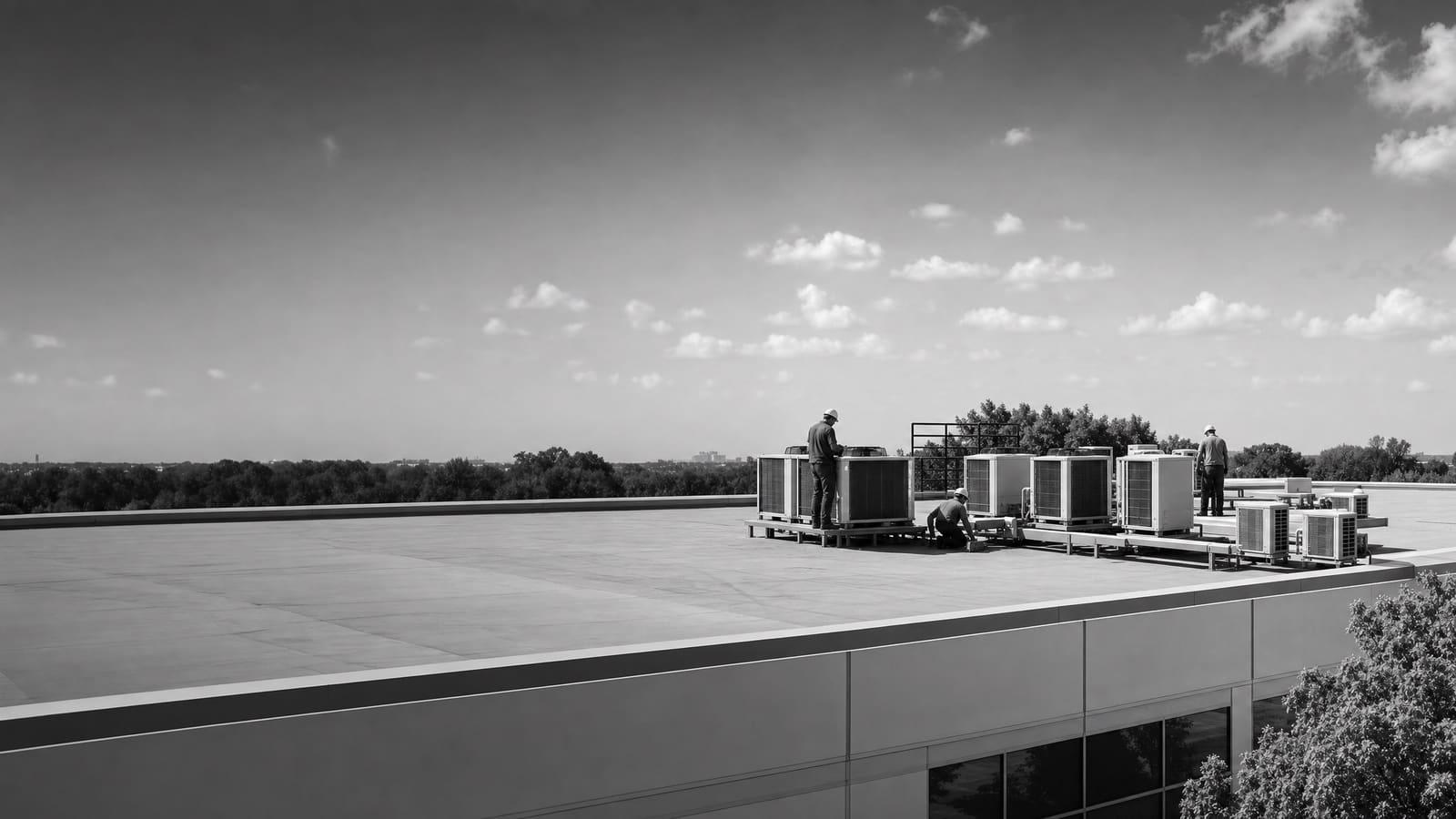
A commercial HVAC replacement is a load check, an equipment selection, a rigging plan, and a documented startup. Replacement beats one more repair once a unit's wasted energy and downtime outrun the repair bill. Federal guidance puts that waste at roughly $900 to $3,700 a year for a single old, inefficient rooftop unit, and flags units past fifteen years as the ones to plan around rather than nurse.
A site review still has to confirm the real load, the curb and the structure under it, available electrical capacity, gas service, and crane access before any of that becomes a price.
THREE WAYS TO GO
Three replacement paths worth comparing
Most commercial replacements come down to three choices, and they are not equally easy to reverse.
The like-for-like swap is the fastest path back to cooling. It also carries forward whatever sizing mistake the old unit had, so it makes sense mainly when the building is used the way it was when that unit went up.
The high-efficiency air-conditioning unit costs more up front and usually takes longer to get. The federal high-performance rooftop specification was built to cut energy use by up to half compared with the older minimum standard, and more than twenty models now exceed it. On a unit that runs most of the year, that gap shows up on every bill.
The heat pump unit adds reverse-cycle heating to the same box. Federal guidance treats today's heat pump rooftop units as capable of handling most or all winter heating demand across the South and West. The catch is infrastructure: electrical capacity, physical constraints, and the existing gas line all get checked before you commit.
WHAT MOVES THE NUMBER
Where a replacement budget actually goes
No two roofs price the same, so treat these as the lines that move most between one bid and the next. Ask every bidder to show them separately. A number that arrives as one lump sum is hiding at least one of them.
IN PRACTICE
Choosing between one more repair and a new unit
The honest version of this decision is not dramatic. Most facility managers wait until a unit stops holding the space, needs constant attention, or dies outright. Federal guidance is blunt about why that is expensive: replacing an inefficient unit proactively usually beats replacing it on failure, and often beats a like-for-like swap at end of service life too.
The reason is that waiting is not free. An old, inefficient rooftop unit can burn through $900 to $3,700 a year more than it needs to. Multiply that across a fleet and across the three or four years most owners spend deciding, and the premium for a better unit stops looking like a premium.
Age is the cleanest first filter. Past fifteen years, a unit belongs on a replacement plan even if it is still running. That does not mean replacing it tomorrow. It means knowing the tonnage, the curb, the electrical service, and the lead time before the compressor decides for you.
The second filter is how the space gets used now. Twenty years changes occupancy, plug load, lighting heat, and sometimes the envelope itself. If any of those moved, the old nameplate is a starting guess, not an answer.
COMPLEXITY CHECK
What makes one replacement simple and another not
Two projects with the same tonnage can price very differently. The gap is almost always access, infrastructure, and how much has to change on the way in. Knowing which side you are on before you request bids makes the numbers you get back easier to trust.
LOWER COMPLEXITY
Straight swap on an existing curb
Same fuel and same capacity. The curb takes an adapter, the electrical service is already sized, and the crane has a clear shot from the lot. Most of the risk sits in equipment lead time rather than in the work itself.
HIGHER COMPLEXITY
Fuel switch, resize, or tight access
Going all-electric, growing tonnage, or lifting over an occupied space. Electrical capacity has to be verified and sometimes upgraded, the gas line gets abandoned or kept for dual fuel, and the roof structure needs a second look. Expect design time before anyone quotes a real number.
THE SITE REVIEW
What a scoping visit has to confirm
A quote written from a nameplate photo is a starting point, not a price. Before anyone commits to a number, someone should stand on the roof.
The load comes first. Sizing should be calculated from how the building is used today, not copied off the failing unit. The curb comes next: dimensions, condition, and whether the structure underneath takes the new weight. Then infrastructure. The federal heat pump guidance lists three things that decide whether an electric option is even on the table — electrical capacity at the panel, physical constraints on the roof and in the chases, and what happens to the existing gas line. Those three answers move the price more than the unit selection does.
Access is the last piece and the one most often skipped. Where does the crane set up, what does it close, for how long, and can any of it happen outside operating hours? A lift that has to happen at four in the morning is a different number than one that happens Tuesday.
Installer familiarity matters too. Contractor availability and knowledge is called out as a real constraint on heat pump adoption, because the commissioning and controls work differs from a standard air-conditioning unit.
Ask for the scoping notes, not just the price
A bidder who walked the roof can tell you the curb dimensions, the panel capacity, the crane setup point, and the lead time on the exact model quoted. If a proposal cannot answer those four questions, it is an estimate wearing a quote's formatting.
OWNERSHIP QUESTIONS
Two things owners underestimate
Buying the unit is the visible decision. These two shape what the unit costs you for the next fifteen years, and both are far easier to settle before signing than after.
The first is refrigerant. New commercial equipment ships on newer low-GWP refrigerants, while EPA Section 608 rules govern how refrigerant is handled and recovered on the equipment you already own. On a mixed fleet, that means two service realities running side by side for years.
The second is what happens after startup. Commissioning is where charge, airflow, and control settings get verified against spec and written down. It is also the first thing quietly dropped when a bidder is squeezing a number.
REFRIGERANT
Plan for a mixed fleet
Old units stay on their original refrigerant until they go. New ones arrive on low-GWP. Your service contract, spare parts, and technician certifications need to cover both, and federal handling rules apply to the old equipment the entire time.
COMMISSIONING
Verified startup protects the warranty
Charge, airflow, and controls confirmed against spec, then documented. Skipping it does not show up on day one. It shows up as comfort complaints in month two, with no record of what the settings were supposed to be.
PLANNING AHEAD
Phasing a fleet instead of reacting to it
If you own more than one unit, the useful question is not which one to replace. It is which order to replace them in.
Start with age and run hours. Anything past fifteen years goes on the list. Then sort by how hard each one is to do. The straightforward swaps can happen in a slow season with almost no disruption, while the ones needing electrical upgrades or a structural look need design time booked well ahead. Doing the easy ones first buys the budget and the calendar for the hard ones.
Procurement follows the same logic. Equipment availability is a real variable, listed alongside cost and infrastructure as a factor in whether a given technology is practical for a given site. Specifying early and ordering early is how you avoid paying the emergency premium for whatever happens to be on the shelf.
Lifetime cost is where the argument usually gets settled. Across the federal Advanced RTU Campaign, more than 200 organizations upgraded over 43,000 rooftop units and cut a combined $37 million a year from their energy bills. That is real money per unit, every year, for the life of the equipment. A phased plan captures it. Replacement on failure does not.
COMPARING QUOTES
Five things a comparable quote shows
Bids get hard to compare when each one draws the line in a different place. Ask every bidder to show these five. Anything missing is not a discount — it is a line that comes back later as a change order.
01
Equipment, named exactly
Make, model, tonnage, efficiency tier, and refrigerant. Not "a comparable 20-ton unit."
02
Lead time, in writing
Quoted availability for that specific model, and what changes if it slips.
03
Curb, structure, and rigging
Adapter or new curb, any structural work, crane size, staging point, and closure window.
04
Electrical, gas, and refrigerant scope
Panel and feeder work, gas line disposition, and recovery of the old charge under federal rules.
05
Commissioning and documentation
Startup, charge and airflow verification, controls integration, and the report you keep for warranty.
Get a defensible number
Price the equipment and the building together.
Send the address, operating target, and target opening date. Flux will identify what must be verified before the project can be priced.
Get a free estimateQuestions
Straight answers.
When is replacement better than one more repair?
Once a unit is past fifteen years, another repair usually stops being the cheaper option. An old, inefficient rooftop unit can waste $900 to $3,700 a year on its own. Add the downtime and the emergency premium on whatever is available, and planned replacement wins.
What drives the schedule on a rooftop replacement?
Equipment lead time, not the lift. That is why availability for the exact model quoted belongs on the proposal next to the price, along with what happens to the date if that model slips.
Should we switch to a heat pump rooftop unit?
Federal guidance treats heat pump rooftop units as an appropriate solution across the South and West, capable of handling most or all winter heating demand. The decision turns on electrical capacity at the panel, physical constraints on the roof, and what you do with the existing gas line.
What is a dual-fuel unit for?
It pairs heat pump heating with a gas backup. Southern climates can still see sharp winter heating demand — the February 2021 Texas freeze is the reference case — so dual fuel is the hedge when you want electric efficiency without giving up gas heat entirely.
Does a new unit change our refrigerant situation?
New commercial equipment ships on newer low-GWP refrigerants. Day-one operation is the same. What changes is service planning: federal handling and recovery rules still apply to your older units, so a mixed fleet needs both covered in the contract.
Do rooftop units really matter that much to our energy bill?
Rooftop systems cool close to half of all U.S. commercial floor area, and units over fifteen years old waste a substantial share of what they use. On most commercial buildings, they are the largest controllable line you have.
Sources used for this guide
- [1]betterbuildingssolutioncenter.energy.gov — DOE Advanced Rooftop Unit Replacement Guidance
- [2]betterbuildingssolutioncenter.energy.gov — DOE Commercial Heat Pump Rooftop Unit Replacement Guidance
- [3]betterbuildingssolutioncenter.energy.gov — DOE High-Efficiency Commercial Rooftop Unit Toolkit
- [4]energy.gov — DOE Efficient Commercial Rooftop Air Conditioner Program
- [5]epa.gov — EPA Stationary HVAC Refrigerant Management