THE SHORT VERSION
What a commercial HVAC replacement actually covers
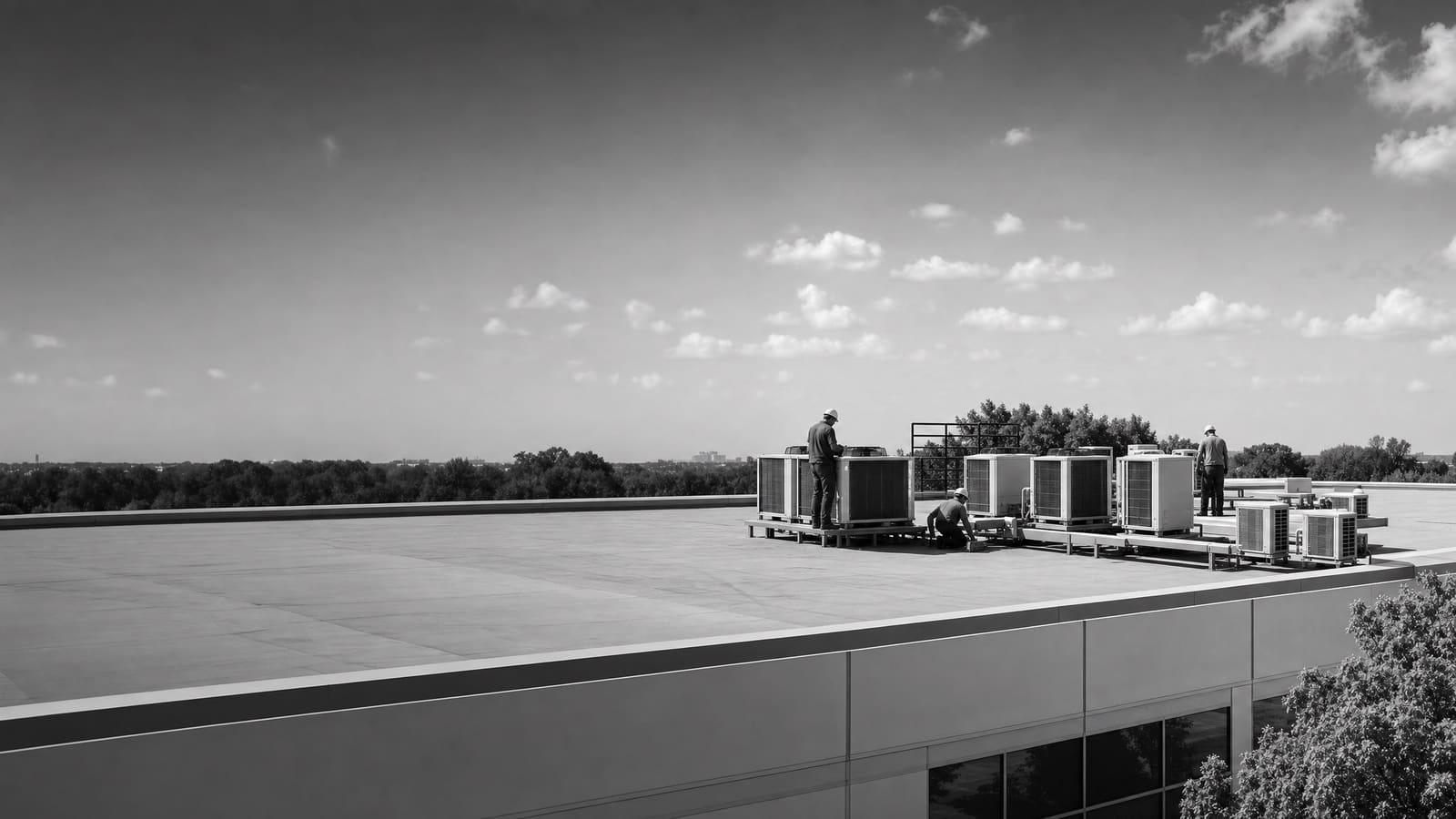
A commercial HVAC replacement covers the whole path, not just the box: confirming the load the building carries today, selecting equipment, recovering refrigerant and removing the old unit, rigging and setting the new one, tying in fuel, power, and controls, then commissioning it. Replacement beats another repair once a unit is past about fifteen years and failing often — units that old are the ones estimated to waste $900 to $3,700 each per year, whether or not they run well.
A site review still has to verify the real load, the curb and roof condition, electrical capacity at the unit, and crane access before any of this becomes a price.
THE CHOICE
Three ways to replace a rooftop unit
Almost every commercial replacement lands in one of three lanes, and the lane gets chosen before anything is priced.
The first is a like-for-like swap: same capacity, same fuel, same footprint. It is the fastest path back to conditioned air and the cheapest to engineer, and it quietly carries forward whatever the old unit got wrong about sizing.
The second is a right-sized, high-efficiency replacement. The load is recalculated against how the space is used now, and the unit is picked a step or two up the efficiency ladder. High-efficiency rooftop units were developed specifically to cut energy use sharply against the older standard, and the annual waste from an aging unit is what pays for the difference.
The third is a heat pump rooftop unit, either all-electric or dual fuel. Mechanically it is close to an air-conditioning unit with reverse-cycle heating added. Whether it fits depends on heating load, electrical capacity, and what electricity and gas cost you — not on preference.
WHAT MOVES THE NUMBER
Where a rooftop replacement budget actually goes
Six lines carry most of the movement between one quote and another. The equipment is the largest of them, but it is rarely the one that surprises people.
IN PRACTICE
Choose the equipment before you argue about the price
The equipment decision comes first, because the price is mostly a consequence of it. Rooftop units condition close to half of all commercial floor space in the country, which is why the replacement question is usually "which rooftop unit" rather than "what kind of system." Within that, the real fork is fuel. An air-conditioning unit with gas heat and a heat pump unit are close cousins mechanically; the heat pump adds reverse-cycle heating and takes the gas burner out of the picture.
Whether that trade works at your building depends on things a catalog cannot tell you. Winter heating load matters, because heat pump efficiency falls as outdoor temperature drops and trends toward parity with electric resistance heat at the cold end. Electrical capacity at the roof matters, because an all-electric unit draws current the old gas unit never did. Local electricity and gas prices matter, because they decide whether the change shows up as a saving or a wash on the bill. Dual-fuel units exist precisely for buildings where the honest answer is "mostly heat pump, with gas for the coldest hours."
Ask for both paths priced on the same roof. Not as a formality — the two quotes will differ in places that have nothing to do with the box, and those differences are the actual decision.
SIDE BY SIDE
What makes one replacement simple and another one long
Two buildings can buy the same unit and run completely different projects. The difference is almost never the equipment.
LOWER COMPLEXITY
A clean swap
Same capacity and fuel, the curb matches or takes a standard adapter, the roof already carries the weight, power is adequate at the disconnect, and there is a clear crane position. These jobs price tightly, and most of the schedule risk sits in equipment availability rather than in the work.
HIGHER COMPLEXITY
Scope that grows
Capacity changes, the unit is heavier or larger, gas is coming out and electrical service has to grow, controls tie into a building automation system, or the only crane setup sits over an occupied entrance. Each of those adds a trade, a review, or a night shift to the plan.
BEFORE YOU PRICE IT
What the site review has to settle
The nameplate on the old unit is a record of a decision someone made a long time ago, under conditions that may no longer exist. Occupancy changes. Lighting gets replaced. Server rooms appear and disappear. A load confirmed against the building as it runs today is the most useful thing a site review produces, because it sets capacity, and capacity sets most of the price.
Past that, the review is a list of physical facts. What is the curb, and will the new footprint land on it or need an adapter? Can the roof carry the new weight, and does that pull in structural review? What is available at the disconnect, and does the panel have room if the replacement is all-electric? Where can a crane set up, how far does it have to reach, and how many parking stalls disappear for how long? Which permits and inspections apply, and who is pulling them?
None of this is exotic. It is just work that either happens before the quote or turns into a change order after the crane leaves.
Ask for the findings, not the reassurance
The load calculation, the curb and structural findings, the electrical capacity check, and the rigging plan should arrive as documents you can keep. A contractor who has actually done the review can hand them over without a delay.
OWNERSHIP
Two decisions owners tend to make by default
Two things usually get decided by circumstance rather than on purpose, and both of them cost money.
The first is timing. Most facilities wait until a unit stops holding the space, then buy under pressure, in season, from whatever is available. Replacing on plan instead of on failure changes who controls the schedule and what you are able to compare.
The second is money from outside the project. Rebates and incentive programs are a normal part of the rooftop replacement picture, and they can move a marginal upgrade into an obvious one. They also change, expire, and run out of funding.
TIMING
Plan the replacement or inherit it
A unit that fails in August gets replaced with whatever can be delivered in August. A unit replaced on plan gets competing options, a scheduled crane day, and off-hours work that tenants never notice.
INCENTIVES
Confirm the rebate before you count it
Verify that a program is open, funded, and applicable to the exact equipment and efficiency tier before it enters your payback math. Confirm it in writing, and confirm whether pre-approval is required before work begins.
THE LONGER VIEW
Phasing, standardizing, and the cost you pay monthly
If you own more than one unit, you own a schedule, not a project. Roofs tend to hold units of similar age, which means they tend to fail in clusters. Grouping replacements across two or three budget years — worst performer first, then the next — buys you one rigging mobilization instead of three, one round of permitting, and a fleet that ages on a curve instead of a cliff.
Standardizing helps more than it looks like it should. One manufacturer, one controls platform, a shorter spare-parts list, and technicians who already know the equipment. Mixed fleets are manageable, but they cost more in service contracts and in the small delays that come with unfamiliar units.
Lifetime cost is where the argument settles. The purchase price is one number, visible once. The energy bill is a smaller number that arrives every month for the life of the unit, and the waste from an aging rooftop — as much as several thousand dollars a year on a single unit — accrues the entire time. Across a national upgrade effort, more than 200 organizations replaced or retrofitted over 43,000 rooftop units and took a combined $37 million a year off their energy bills. That is the same arithmetic repeated across a lot of roofs. Price the decade, not the invoice.
THE QUOTE
Five things a comparable quote shows
A quote you can hold against another quote answers all five of these on the page. When one is missing, the gap between two prices is not a difference you can actually read.
01
The exact equipment
Manufacturer, model, capacity, efficiency tier, and heating type — not "a rooftop unit of equal capacity."
02
Availability with a date
When the unit ships and what the price does if that date moves. Availability belongs next to the number, not in a phone call.
03
The roof scope
Curb adapter, any structural work, roofing patch and flashing, and who is responsible for each of them.
04
Rigging, permits, and inspections
Crane day, lot closure and duration, permit filings, and inspection scheduling stated as included or excluded.
05
Commissioning and handover
Startup readings, charge and airflow verification, controls setpoints, warranty registration, and the documents you receive.
Get a defensible number
Price the equipment and the building together.
Send the address, operating target, and target opening date. Flux will identify what must be verified before the project can be priced.
Get a free estimateQuestions
Straight answers.
When does replacement beat another repair?
Age plus repair frequency is the honest test. Units past roughly fifteen years are the ones that quietly waste an estimated $900 to $3,700 each per year, so a repair that buys another season on an old unit is often the more expensive choice over two or three years.
Should we consider a heat pump rooftop unit?
It is worth pricing. The decision turns on your winter heating load, the electrical capacity available at the roof, and what electricity and gas actually cost your building. Dual-fuel units cover the middle ground when all-electric heating is not the right fit for every hour.
What happens to the refrigerant in the old unit?
It is recovered by a certified technician and handled under federal Clean Air Act rules covering the handling and recycling of refrigerants in stationary equipment. Venting is not an option, and recovery should appear on the scope of work rather than being assumed.
Who handles the crane, permits, and inspections?
The installing contractor should own the rigging plan, the lot coordination, the permit filings, and the inspection scheduling as part of the installed price. Get that stated on the quote before you sign, because it is a common place for scope to quietly fall out.
Why do two quotes for the same roof differ so much?
Usually because they are not scoping the same project. One may include the curb adapter, electrical work, and controls integration while the other prices the unit and the lift. Compare the five quote items above line by line before comparing totals.
Sources used for this guide
- [1]betterbuildingssolutioncenter.energy.gov — DOE Advanced Rooftop Unit Replacement Guidance
- [2]betterbuildingssolutioncenter.energy.gov — DOE Commercial Heat Pump Rooftop Unit Replacement Guidance
- [3]betterbuildingssolutioncenter.energy.gov — DOE High-Efficiency Commercial Rooftop Unit Toolkit
- [4]energy.gov — DOE Efficient Commercial Rooftop Air Conditioner Program
- [5]epa.gov — EPA Stationary HVAC Refrigerant Management