THE SHORT ANSWER
What a commercial HVAC replacement actually includes
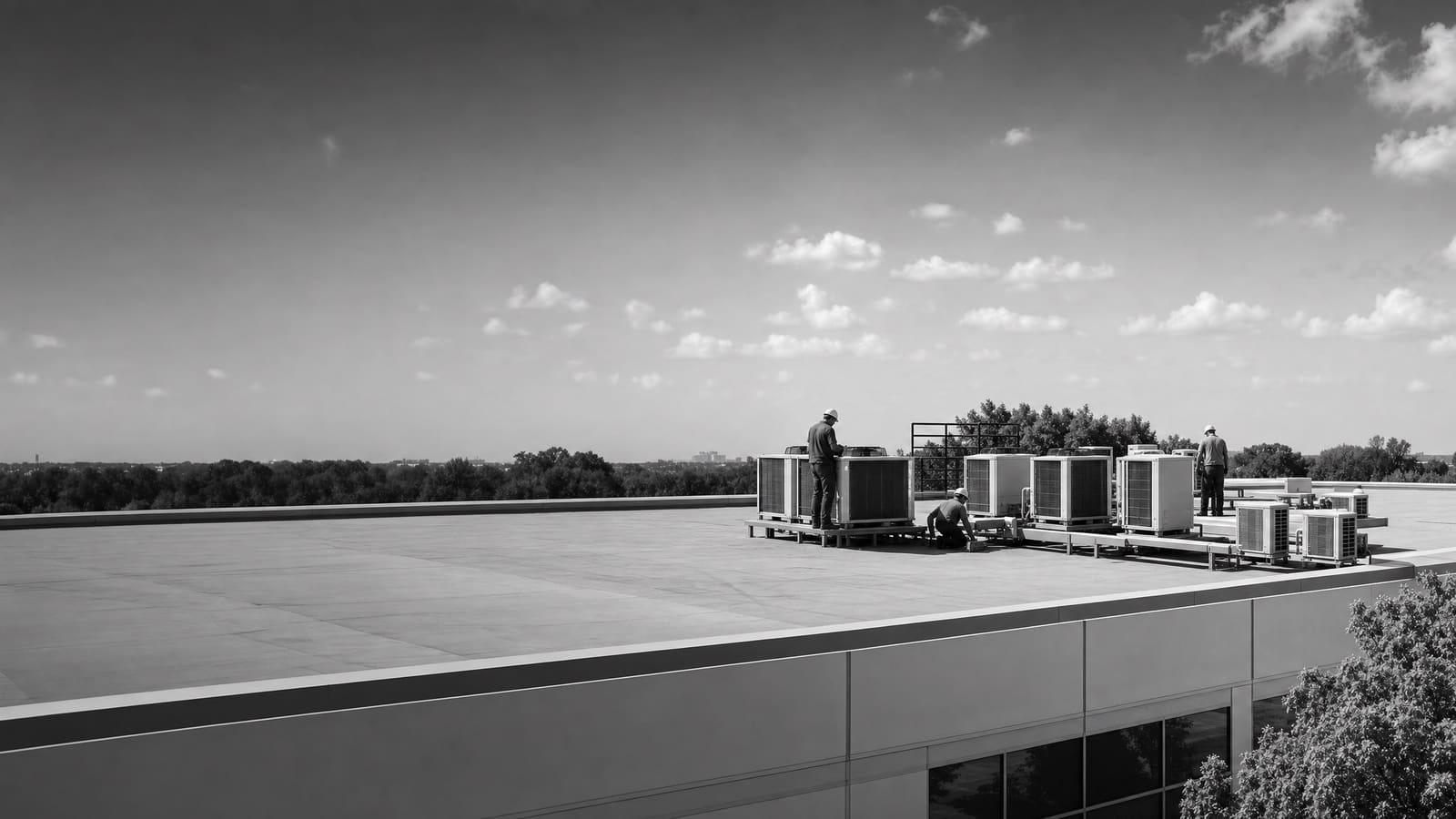
A commercial HVAC replacement is a load check, equipment selection against real availability, rigging and set, curb and utility connections, permits and inspection, then commissioning before handoff. Replacement beats one more repair when the waste has turned structural. An old, inefficient rooftop unit burns $900 to $3,700 a year in energy alone, and units past fifteen years old waste substantially more than current models. Waiting for total failure removes both your choice of equipment and your choice of schedule.
A site review still has to confirm tonnage against current use, curb and structural condition, available electrical capacity, and crane reach before any number holds.
THE REAL CHOICE
Three ways to replace a rooftop unit
Most replacements come down to three paths, and the right one depends on what the building already has on the roof and in the panel. Rooftop units condition close to half of all commercial floor space in the country, so this is the decision most owners actually face.
Heat pump rooftop units are technologically similar to the air conditioning units they replace, with reverse-cycle heating added. What changes is the infrastructure question. All-electric units lean on the electrical service and usually carry electric resistance backup heat. Dual-fuel units keep the gas line for the coldest hours and run the heat pump the rest of the season.
Climate works in your favor here. Heat pump rooftop units are best suited to mild-to-moderate winter heating, and across most of the West today's units handle most or all of the winter demand. The question is less whether the equipment can do the job and more whether your electrical capacity, gas service, and roof will support the version you pick.
WHAT MOVES THE NUMBER
The lines that separate two quotes
No two roofs price the same, but the swings come from a short list. These are the items that separate a quote you can compare from a number that keeps moving after the crane leaves.
IN PRACTICE
Buying the replacement instead of waiting for it
Most facility teams put off a rooftop unit until it stops holding the space, needs constant service calls, or fails outright. That is understandable, and it is also the most expensive way to buy equipment. Replacing proactively usually beats replacement-on-failure, and it often beats a like-for-like swap at the end of a unit's service life, because you get to choose the efficiency tier, the fuel, and the week the crane shows up.
Age is the cleanest trigger. Units past fifteen years waste substantially more energy than current models, and the federal high-efficiency specification that reshaped the rooftop market was written to cut unit energy use by as much as half against the older standard. That spread is why one building can run two units that look identical and see very different bills.
The practical move is to inventory the roof before anything fails. Nameplate, age, tonnage, refrigerant, and heating fuel for every unit up there. Then rank them by age and by how often each has landed on a service ticket. Whatever sits at the top of that list is your next project, and you can scope it in a quiet month instead of scoping it in August with tenants calling.
SCOPE CHECK
What makes a replacement simple or complicated
Two replacements on the same street can be a short job and a long one. The difference is rarely the unit itself. It is what the building now asks the equipment to do differently, and what has to change on the roof or in the panel to allow it.
LOWER COMPLEXITY
Straight swap on a healthy roof
Same tonnage, same fuel, same curb, and the existing electrical service already covers it. Access is open, the roof structure is sound, and the permit is a routine mechanical and electrical pull. Sizing carries over because the space is used the way it always was.
HIGHER COMPLEXITY
New load, new fuel, or a tight site
Occupancy or equipment changed, so the load has to be recalculated. Going all-electric raises capacity questions, and dropping the gas line changes the heating strategy. Add a larger footprint, a crane with no clear reach, or a roof due for tear-off, and sequencing matters more than the equipment.
BEFORE THE QUOTE
What a site review has to settle
A quote that arrives without anyone looking at the roof is a placeholder. The site review is where the price becomes real, and it works through a short list that does not change much from building to building.
Infrastructure comes first. Electrical capacity decides whether an all-electric unit is even a candidate. Physical constraints — curb size, roof structure, clearances, and how a crane can actually reach the setting point — decide the rigging plan and often narrow the equipment list. Gas service decides whether dual-fuel stays on the table. None of that can be answered from a nameplate photo, though a nameplate photo is a fine way to start the conversation.
Then the operating side. How the space is used today, not twenty years ago, drives the load calculation. Occupancy, plug loads, lighting, and envelope work all shift what the building needs. Availability matters too: a unit that fits your scope but ships in ten weeks is a different project than one sitting in a regional warehouse. So does contractor familiarity with the equipment type, especially on heat pump conversions where startup and controls setup differ from a standard AC unit.
Five things to confirm on site
Electrical capacity, curb and structural condition, crane reach and staging, gas service, and the load the space actually carries today. Settle those five and the quote stops moving.
IN CONCORD
Permits, roof work, and the order you do them in
California building departments treat HVAC work as permitted work. Mechanical and electrical upgrades and repairs each require a permit, and re-roofing — overlay or tear-off — is permitted separately from the equipment sitting on top of it.
That matters more for sequencing than for paperwork. If the roof under your unit is within a few years of replacement, setting a new rooftop unit first means paying to work around it or move it later. The cheaper order is to settle the roof question before the crane date, then set the new unit on a curb and a membrane that will outlast it.
Ask your installer to confirm current requirements with the Concord building division before the schedule is locked, and to carry permits and inspection inside the installed price rather than as a pass-through after the fact.
Sequence the roof, then the unit
If re-roofing is coming inside the new unit's service life, do it first or plan the two together. A new unit set on an old membrane usually means paying for the same crane twice.
AFTER HANDOFF
Two decisions that outlive the install
The install ends. The ownership does not. Two choices made during the project quietly set your operating cost for the next decade and beyond.
The first is refrigerant. Federal rules govern how refrigerant is handled, recovered, and recycled in stationary air conditioning and heat pump equipment, and they apply to the old unit coming off the roof as much as the new one going on. Proper recovery is the installer's responsibility and it should be documented.
The second is fleet consistency. If six units sit on a roof and you replace them one at a time over ten years, you end up with six service profiles, several refrigerants, and no coherent spare-parts strategy. Owners who plan replacements as a sequence instead of a run of emergencies get simpler maintenance and better pricing.
REFRIGERANT
Recovered and documented
Recovery from the old unit is regulated work, not a detail. Ask for the documentation in the closeout package, and record the refrigerant type on the new unit so your service contract and parts plan match what is actually on the roof.
FLEET PLANNING
Replace in a sequence
One-at-a-time emergency replacement leaves a roof full of mismatched equipment. Ranking every unit by age and service history turns the next five years into a schedule you control, which is also the only way to line purchases up with incentive timing.
THE LONGER VIEW
Phasing, procurement, and what the unit costs to own
Lifetime cost is where the rooftop decision actually gets settled. Purchase price is one line. The unit will spend well over a decade on that roof, and an inefficient one wastes $900 to $3,700 a year the entire time. Multiply that by the number of units you own and the phasing plan starts writing itself.
Procurement follows from that. Get equipment options priced with real availability attached, not just a model number. High-efficiency and heat pump units are no longer specialty items — the federal high-performance challenge produced more than twenty qualifying models and a minimum standard behind them — but a specific tonnage in a specific configuration can still be weeks out. Knowing that up front is the difference between a planned outage and a rental unit in the parking lot.
For a multi-unit roof, phase by risk rather than by budget line. Replace the oldest and most service-heavy units first, standardize on one or two equipment families so technicians and parts inventory stay simple, and put the rest on a known schedule. Utility and manufacturer incentives change, so confirm what is available in the quarter you plan to buy instead of assuming last year's program is still running.
APPLES TO APPLES
Five things a comparable quote shows
Two quotes for the same roof can differ by a third and both be honest. Usually they are scoped differently. Make every bidder show these five and the comparison gets easy.
01
Equipment, tonnage, and efficiency tier
Model number, tonnage, efficiency rating, heating type, and refrigerant, so you are comparing the same machine.
02
Lead time in writing
Real availability for that exact configuration, with the crane date tied to it.
03
Curb, structural, and roof scope
Adapter or new curb, any structural review, and who is responsible for the roof penetrations.
04
Rigging and site plan
Crane size, staging area, lot closure hours, and who coordinates with tenants.
05
Permits, commissioning, and closeout
Permits and inspection included, plus startup readings, controls setup, and refrigerant recovery documentation.
Get a defensible number
Price the equipment and the building together.
Send the address, operating target, and target opening date. Flux will identify what must be verified before the project can be priced.
Get a free estimateQuestions
Straight answers.
When is replacement better than another repair?
Once a unit is past fifteen years, repair stops being the cheap option. An old, inefficient rooftop unit wastes $900 to $3,700 a year in energy before you count parts and service calls. If it is also struggling to hold the space or needs frequent attention, replacement is usually the better buy — and planning it beats waiting for the failure.
Should the new unit be a heat pump?
Heat pump rooftop units are similar to the AC units they replace, with reverse-cycle heating added, and they suit mild-to-moderate winter heating. Across most of the West, today's units handle most or all of the winter demand. The deciding factors are usually electrical capacity and whether you want to keep a gas line for the coldest hours.
Do I need a permit to replace a rooftop unit?
Plan on it. California building departments require permits for mechanical and electrical upgrades and repairs, and re-roofing is permitted separately. Have your installer confirm current requirements with the Concord building division and carry permits and inspection inside the installed price.
What happens to the refrigerant in the old unit?
Federal rules govern how refrigerant is handled, recovered, and recycled in stationary air conditioning and heat pump equipment. Recovery from the old unit is regulated work performed by certified technicians, and the documentation should arrive with your closeout package.
Can I just replace like-for-like?
Often yes, if the space is used the way it was when the old unit was sized. Confirm the load either way. Occupancy, plug loads, lighting, and envelope changes over twenty years all move the number, and a like-for-like swap carries forward any sizing mistake the old unit already had.
What should I do before anything fails?
Inventory the roof. Record nameplate, age, tonnage, refrigerant, and heating fuel for each unit, then rank them by age and service history. That list tells you which replacement is next and lets you scope it on your schedule instead of the equipment's.
Sources used for this guide
- [1]betterbuildingssolutioncenter.energy.gov — DOE Advanced Rooftop Unit Replacement Guidance
- [2]betterbuildingssolutioncenter.energy.gov — DOE Commercial Heat Pump Rooftop Unit Replacement Guidance
- [3]betterbuildingssolutioncenter.energy.gov — DOE High-Efficiency Commercial Rooftop Unit Toolkit
- [4]energy.gov — DOE Efficient Commercial Rooftop Air Conditioner Program
- [5]epa.gov — EPA Stationary HVAC Refrigerant Management
- [6]californiacity-ca.gov — HVAC Permits