THE SHORT VERSION
What a commercial HVAC replacement actually includes
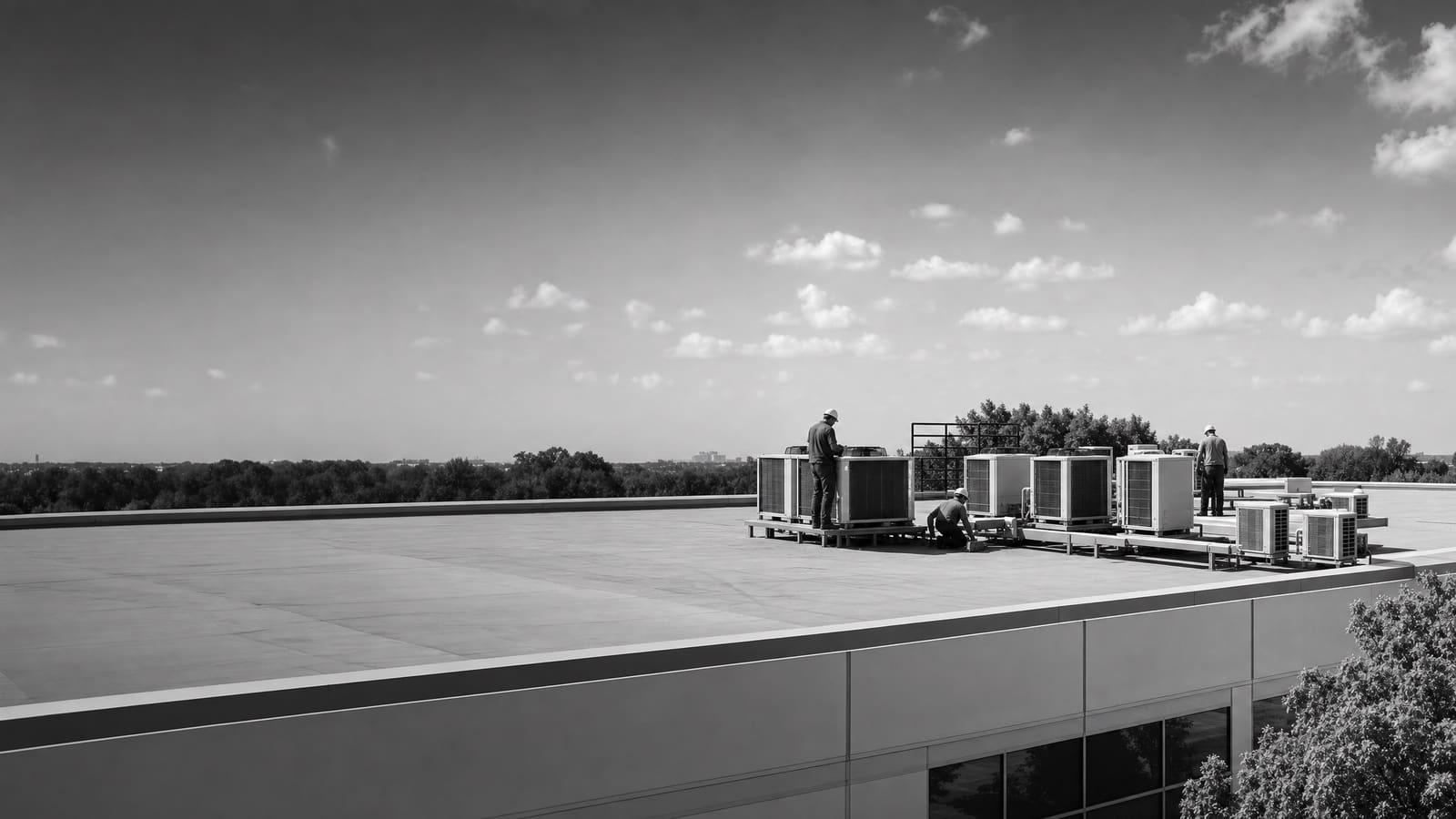
A commercial HVAC replacement is a chain of work, not a swap: confirm the load against how the building is used today, select equipment, recover refrigerant from the old unit, set and connect the new one, then commission it. Replacement beats another repair once a unit is past fifteen years, needs frequent service, or no longer holds the space. DOE estimates an old, inefficient rooftop unit wastes $900 to $3,700 in energy every year on its own.
A site review has to confirm the real load, the curb and roof structure, available electrical capacity, and crane access. Those four items decide whether the quoted number holds.
THREE WAYS TO GO
Three replacement paths, and who each one fits
The right path depends on whether the building changed since the last unit was set. Same occupancy, same layout, same hours, and a like-for-like swap is the cleanest route back to conditioned air. A building that runs hard, or one whose bills have crept up, usually earns the higher-efficiency unit — the federal rooftop specification that pushed this tier of equipment into the market targeted up to 50% less energy than the standard it replaced. And if the old unit burned gas, a heat pump rooftop unit is a real third option rather than a gesture. Whichever path you take, the load calculation comes first: a twenty-year-old nameplate describes a building that no longer exists. Make the call before anyone orders equipment, because reversing it after the curb adapter is fabricated costs weeks.
WHAT MOVES THE NUMBER
Where two quotes stop matching
The unit itself is rarely what separates two numbers. These lines are where quotes diverge, and where a low bid usually turns out to have left something out.
COMPARING BIDS
How to read the quotes you get back
Two quotes for the same roof can differ by a wide margin and both be honest. The difference is almost never the unit. It is what each contractor assumed about the work around it.
Start by checking that both quotes describe the same equipment: tonnage, efficiency tier, and heating type. Then check what each one says about the curb. A new unit rarely matches the old footprint, so somebody is paying for an adapter or for roof repair, and if only one quote names it, that quote is not lower — it is less complete. Do the same for electrical. If the replacement adds tonnage or moves to heat pump heating, the panel has to carry it, and that is expensive to discover after the crane leaves.
Finally, look at what happens after the unit lands. Startup, refrigerant charge, airflow, and control settings verified against the design is the difference between a unit that performs and a unit that merely runs. It is also the line most often trimmed to win a bid. If one proposal is meaningfully cheaper and includes no commissioning, you have found the reason.
SCOPE CHECK
What keeps this simple, and what makes it complicated
Not every replacement carries the same risk. Before you budget, work out which side of this line your building sits on. The gap between the two is mostly access and infrastructure, not the equipment.
LOWER COMPLEXITY
Straight swap conditions
Same tonnage and heating type, an existing curb that takes an adapter, an open lot with clear crane reach, adequate electrical service, and a building that can lose conditioning for one morning.
HIGHER COMPLEXITY
Where the scope grows
Tight or shared parking, a roof set back from the street, added tonnage, a fuel switch that needs panel work, tenant spaces that cannot go warm, or structural review on a heavier unit.
BEFORE THE QUOTE
What a site review has to confirm
A number given over the phone from a nameplate photo is a starting point, not a price. Four things get verified on site before it becomes real.
The first is the load. Sizing from the old nameplate carries forward every mistake the last install made, and buildings change — occupancy, plug loads, lighting, and envelope all shift over twenty years. The second is the roof itself: curb dimensions, structural capacity for the new unit's weight, and whether the deck needs attention while it is open.
The third is infrastructure. Electrical capacity is the one that surprises owners, because the gap does not appear until the new unit's requirements are compared against what the panel can actually deliver. Gas line decisions belong here too if the heating type is changing. The fourth is access: crane reach, the path the truck takes into the lot, how many stalls close, and what hours the building can afford to lose them.
None of this is exotic. It is the difference between a quote that holds and a change order in week three.
The question that separates a quote from a guess
Ask what the contractor verified in person versus what they assumed from the nameplate. If the answer is mostly assumption, expect the number to move once the crane is scheduled and the roof is actually measured.
COLUMBIA CONDITIONS
What a South Carolina climate changes about the heating decision
Columbia sits in the warm end of the country, and that changes one decision in particular: whether the replacement keeps gas heat or moves to a heat pump. Federal guidance is direct about it — for most of the U.S. South, today's heat pump rooftop units are an appropriate solution and are capable of addressing most or all of the winter heating demand. Heat pump heating does get less efficient as outdoor temperatures drop, trending toward parity with electric resistance heat, so the real question is how many hours a year your building spends down there. In a mild-winter market that number is small. It is not zero. Southern climates have taken sharp cold snaps in recent years, which is why dual fuel stays on the table for buildings that cannot afford a cold morning.
Make the heating design explicit
Ask the contractor to state which heating design the quote assumes — all-electric heat pump, dual fuel, or gas — and what covers the coldest morning of the year. That one answer changes the equipment, the electrical work, and the operating cost.
OWNERSHIP AND OPERATIONS
Two conditions that change the math
The equipment decision does not sit by itself. Two conditions around it usually decide how much you should spend and when.
The first is who holds the building and for how long. An owner planning to keep the property another decade is buying operating cost, and the efficiency premium is easy to justify. A landlord facing a lease turn, or a tenant with a few years left on a term, is buying reliability and a clean handoff instead. Both are legitimate positions. They point at different equipment.
The second is whether this is one unit or the first of several. Rooftop units cool close to half the commercial floor area in the country, and buildings rarely have just one. If three units went in the same year, they will fail in the same window, and the choice you make now sets the pattern for the rest.
HOLD PERIOD
How long you own the outcome
Efficiency premiums pay back monthly. If the building sells or the lease turns in two years, that payback lands on someone else's ledger, and reliability matters more than the efficiency tier.
FLEET AGE
One unit, or the first of several
Units installed together age together. Replacing them one at a time on failure costs more over a decade than a planned sequence, and gives you no leverage on scheduling or pricing.
PLANNING AHEAD
Replace on a plan, not on a failure
Most facilities wait. The unit gets replaced when it stops holding the space, needs constant service, or dies outright, usually during the hottest week of the year. Federal guidance is blunt about the cost of that habit: replacing an aging, underperforming unit proactively is often the smarter business move than replacement on failure, and often better than a like-for-like swap at the end of service life.
The reason is that failure removes your options. In an emergency you take what is available, at whatever price, in whatever efficiency tier a distributor happens to have. On a plan, you compare equipment, schedule the crane for a morning the building can spare, and let the work happen without overtime.
For buildings with more than one unit, the same logic scales. A national upgrade program built on this idea has seen more than 200 organizations replace or retrofit over 43,000 rooftop units, cutting a combined $37 million a year from their energy bills. No single upgrade was dramatic. Doing them on a schedule, instead of one funeral at a time, is what produced the number.
Set a replacement order by age and condition, budget one or two a year, and stop letting failures choose for you.
THE QUOTE CHECKLIST
Five things a comparable quote has to show
If two proposals do not show these five items in the same terms, you are not comparing them — you are guessing. Ask for the missing ones in writing before you sign anything.
01
The equipment, in full
Manufacturer, model, tonnage, efficiency tier, heating type, and refrigerant. Enough detail that two quotes can be laid side by side.
02
Availability next to the price
When the unit can actually ship. A lower price on equipment that arrives six weeks later is a different offer, not a better one.
03
Curb, structure, and roof work
The adapter, any structural review the new unit triggers, and who repairs the roof around the new footprint.
04
Rigging, permits, and inspections
Crane, lot closure plan, permit applications, and inspection coordination, priced into the installed number rather than billed later.
05
Commissioning and documentation
Verified charge, airflow, and control settings, with a startup report that keeps the manufacturer's warranty intact.
Get a defensible number
Price the equipment and the building together.
Send the address, operating target, and target opening date. Flux will identify what must be verified before the project can be priced.
Get a free estimateQuestions
Straight answers.
When does replacement beat one more repair?
Once a unit is past fifteen years and needs frequent service, repair money stops buying reliability. DOE estimates an old, inefficient rooftop unit wastes $900 to $3,700 a year in energy alone, before you count the service calls or the hours the space is uncomfortable.
Should a Columbia building switch to a heat pump rooftop unit?
Often yes. Federal guidance says heat pump rooftop units suit most of the U.S. South and can address most or all of the winter heating demand. Confirm the electrical capacity first, and decide how the coldest mornings get covered before ordering.
Does the old unit's refrigerant matter?
At removal, yes. EPA regulations under the Clean Air Act govern how refrigerant is handled and recycled when equipment comes out of service, so recovery and disposal belongs on the quote as a priced line rather than something left to the crew on the day.
Should the new unit be the same size as the old one?
Only if the building has not changed. Sizing from the old nameplate carries forward whatever the last installer got wrong. A load calculation against today's occupancy, equipment, and operating hours is the cheapest step in the whole project.
How much of the parking lot does the crane need?
Enough for reach and a safe swing path, which depends on where the unit sits relative to the lot. The plan should name the stalls and the hours in advance, so tenants hear about it before they find cones in front of the door.
Sources used for this guide
- [1]betterbuildingssolutioncenter.energy.gov — DOE Advanced Rooftop Unit Replacement Guidance
- [2]betterbuildingssolutioncenter.energy.gov — DOE Commercial Heat Pump Rooftop Unit Replacement Guidance
- [3]betterbuildingssolutioncenter.energy.gov — DOE High-Efficiency Commercial Rooftop Unit Toolkit
- [4]energy.gov — DOE Efficient Commercial Rooftop Air Conditioner Program
- [5]epa.gov — EPA Stationary HVAC Refrigerant Management
- [6]columbiact.gov — Online Permitting | Columbia, CT