THE SHORT ANSWER
What a commercial HVAC replacement actually covers
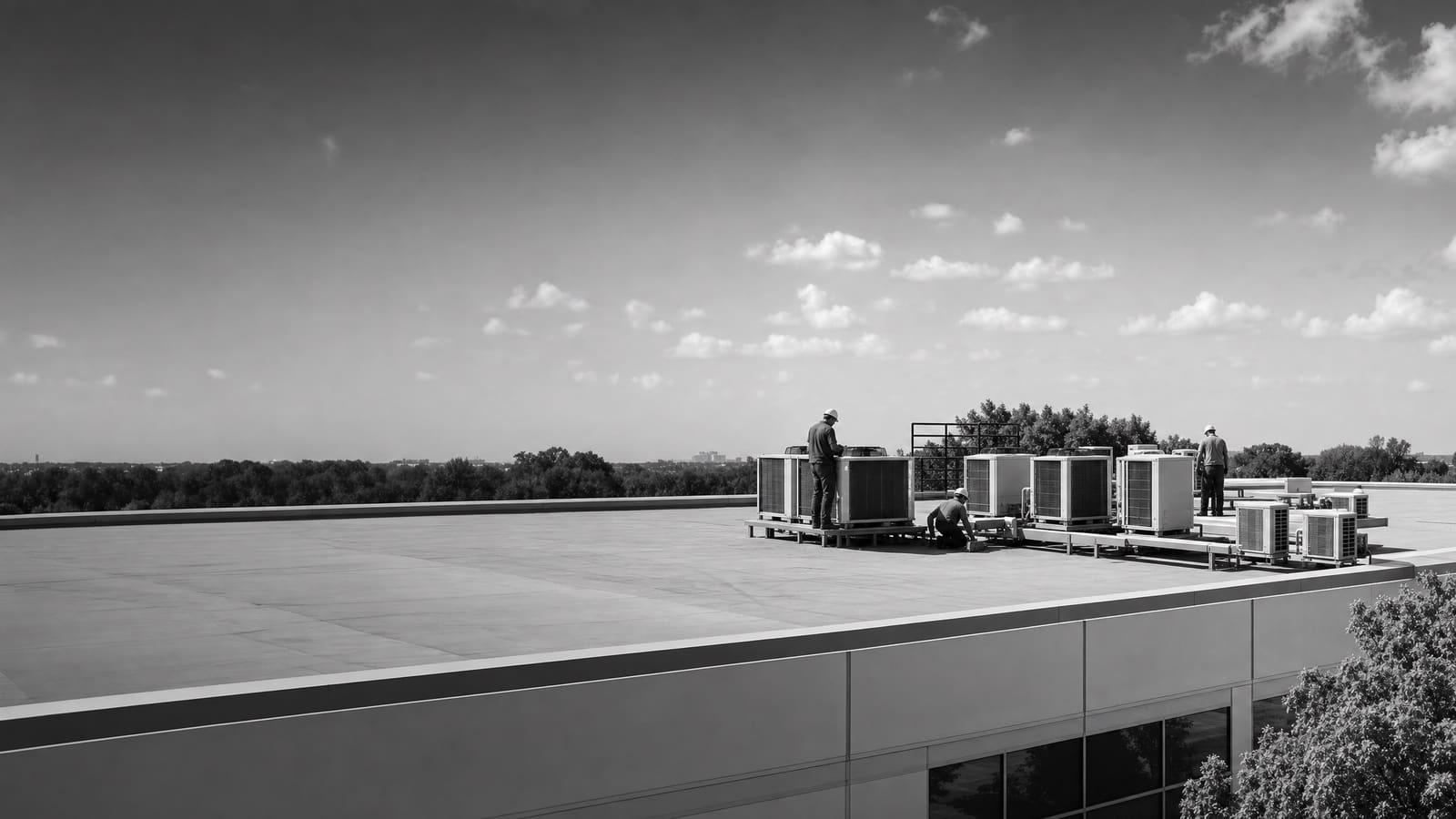
A commercial HVAC replacement covers the load calculation, the equipment, the curb and connection work, the rigging and set, the permit and inspection, and commissioning before handoff. Replacement beats another repair once a unit is past roughly fifteen years and repairs are stacking up, because an aging rooftop unit wastes energy every year it stays in service. The Department of Energy puts that waste at $900 to $3,700 per unit annually.
A site review has to confirm the actual load, the curb and roof structure, available electrical capacity, and crane access before any of that turns into a real installed price.
THREE PATHS
Replace on failure, replace on plan, or upgrade controls
Most buyers land in one of three places. The first is running the unit until it quits. That works until it doesn't, and the cost arrives as an emergency in the worst week of the year, with whatever equipment happens to be available.
The second is planning the replacement while the unit still runs. DOE is direct about this: rooftop units past fifteen years waste substantial energy, and proactively replacing an underperforming unit usually beats both replacement-on-failure and a like-for-like swap at end of life. Planning also means you choose the efficiency tier instead of accepting whatever is on the truck.
The third is leaving the box alone and upgrading its controls. DOE's rooftop guidance treats replacement and advanced controls as two valid paths, with the right one being whichever makes better financial sense for that specific unit. A cabinet with a sound compressor can be worth controlling. A unit with a failing compressor is not.
WHAT MOVES THE NUMBER
The lines that separate two quotes on the same roof
No two roofs price the same, so read a quote as a set of lines rather than one number. These are the lines that move most, roughly in order of how much they can surprise you.
BUYING THE RIGHT UNIT
Three decisions that matter more than brand
The first decision is not brand. It is whether you are buying the same machine again or a different one. A like-for-like swap is the fastest path back to conditioned air, and when a space is used the way it was when the old unit went in, it is often the right call. It also carries forward every sizing mistake the original design made.
Efficiency tier is the second decision, and it deserves more thought than most buyers give it. DOE's high-performance rooftop specification challenged manufacturers to cut unit energy use by up to half against the standard of the day, and manufacturers answered with more than twenty models that exceed it. That gap is not marketing. It shows up on every bill for as long as the unit sits on your roof.
The third decision is fuel. If the old unit heated with gas, a heat pump rooftop unit is a genuine option now, and DOE treats the choice as a checklist rather than a preference: climate, utility rates, electrical capacity, physical constraints, existing gas lines, equipment availability, and installer experience. Any one of those can rule it out. All of them pointing the same direction is what makes the switch safe.
SIDE BY SIDE
Why identical tonnage can price very differently
Two projects with the same tonnage can be a week apart on schedule and far apart on price. The difference is usually access and infrastructure, not the equipment itself.
STRAIGHTFORWARD
Same footprint, same fuel
The new unit lands on an adapter curb, reuses the existing gas and electric, and the lot gives the crane a clean pick. Scope is tight, review is routine, and the visible disruption is one morning of coned-off stalls.
MORE INVOLVED
New load, new infrastructure
Tonnage changes, the roof structure needs review, electrical capacity has to grow, or the only workable crane position closes a drive aisle. Each of those adds engineering, review time, and coordination that a same-for-same swap never touches.
SCOPING IT PROPERLY
What a real site review checks before quoting
A quote written from a nameplate photo is a guess with a number on it. The site review is where it becomes a price, and it should cover more ground than most buyers expect.
Start with the load. Twenty years of tenant changes, added equipment, and new lighting rarely leave a space with the load it had when the original unit was specified. The nameplate tells you what someone sized in a different decade. A load calculation tells you what the building needs now, and that is the difference between fixing a comfort complaint and inheriting it for another equipment lifetime.
Then the physical constraints. DOE's rooftop guidance names these directly: electrical capacity, physical space, and existing gas lines decide what can go up there before anyone talks about brands. Add the roof itself — curb dimensions, deck condition, and whether the structure carries a heavier unit — plus the crane path, the pick radius, and which stalls close for the morning.
Finally, how the building runs. Occupancy hours, tenant tolerance for noise, and whether there is any outage window at all shape the schedule as much as the equipment does. A contractor asking these questions before quoting is not stalling. They are removing the change orders you would otherwise pay for later.
The one thing to insist on
Ask for the load calculation the equipment was selected from. If the answer is the old unit's nameplate, you are buying a twenty-year-old sizing decision a second time.
COLUMBIA CONTEXT
What mid-Missouri winters change about the fuel decision
Columbia's winters are the deciding factor the moment anyone offers you an all-electric rooftop unit. DOE's guidance on heat pump rooftop units is blunt about the physics: as outdoor temperature drops, heat pump heating efficiency falls and trends toward parity with electric resistance heat. That is why DOE points to mild-to-moderate winter climates as the best fit for standard heat pump rooftop units, and why a Columbia building generally belongs in the dual-fuel or cold-climate column rather than the standard all-electric one.
That does not close the door on electrifying heat here. It changes which product you should be comparing, and it moves two questions to the front of the conversation: how much electrical capacity the building actually has, and whether the existing gas service stays in place as backup heat.
Check the panel before you check the price
All-electric and cold-climate units lean on electric resistance heat at the bottom of the temperature range. Confirm available panel capacity and service size early, because an upgrade discovered after the order is placed resets the whole schedule.
OWNERSHIP AND OPERATIONS
Two questions that shape the project as much as the equipment
Two things decide what a good outcome looks like here, and neither one is on a spec sheet: who owns the asset once it is installed, and whether this unit is alone on the roof.
A landlord amortizing equipment across two lease cycles weighs efficiency differently than a tenant with three years left on a term. And an owner with several units overhead is making a fleet decision whether they intend to or not, because the first replacement quietly sets the standard the rest get measured against.
OWNERSHIP
Lease term versus equipment life
When the lease is shorter than the unit's service life, settle who pays and who benefits before the order goes in. That conversation is far cheaper before the crane is booked than after the invoice lands.
FLEET
One roof, several units
Mixed ages mean mixed refrigerants, mixed parts, and mixed service plans. DOE frames rooftop replacement as a portfolio decision, and sequencing the worst performers first beats replacing whichever unit fails next.
PHASING AND LIFETIME COST
Sequence the work instead of reacting to it
If more than one unit is near end of life, resist replacing them one emergency at a time. Rank them by age, repair history, and the load each one carries, then replace the worst first and put the rest on a schedule you control. DOE's rooftop campaign was built on exactly that idea, and participating organizations upgraded more than forty-three thousand units and cut a combined thirty-seven million dollars a year from their energy bills.
Procurement follows the same logic. Equipment availability is a real constraint, and DOE lists it alongside climate and infrastructure as a factor that decides whether a given unit is even an option for your building. Ask for availability next to price on every option quoted, because a unit you can get in three weeks and a unit you can get in three months are not the same decision, no matter how close the prices look.
Then look past the invoice. The old unit is already costing you money every month it runs, somewhere between $900 and $3,700 a year by DOE's accounting. Set that against the installed price difference between a baseline unit and a better one, and the higher tier often stops looking like an upgrade and starts looking like the cheaper path.
COMPARING QUOTES
Five things a comparable quote shows
A quote you can fairly compare against another quote shows its work. If any of these five are missing, ask before you sign. Every one of them is a place where a low number hides a change order.
01
Model, tonnage, and efficiency tier
The specific unit quoted, plus the load calculation it was selected from.
02
Equipment availability
A lead time printed next to the price, not a promise to check later.
03
Curb, structural, and roof scope
Adapter curb, any framing work, and who patches the roof when the unit is set.
04
Rigging and site plan
Crane position, lot closure hours, and who coordinates with tenants.
05
Permits, inspection, and commissioning
Who pulls permits, who meets the inspector, and what startup documentation you receive.
Get a defensible number
Price the equipment and the building together.
Send the address, operating target, and target opening date. Flux will identify what must be verified before the project can be priced.
Get a free estimateQuestions
Straight answers.
When does replacement beat another repair?
Once a unit is past about fifteen years and repairs are repeating, the math usually favors replacement. DOE puts the annual energy waste of an old, inefficient rooftop unit at $900 to $3,700 per unit, which is money you spend whether or not the unit is currently broken.
How much does commercial HVAC installation cost in Columbia?
There is no honest universal number, because tonnage, curb and structural work, electrical or gas changes, and crane access all move it. Ask for the price broken into those lines. Two quotes that differ by thousands usually differ on scope, not on margin.
Should a Columbia building switch to an all-electric rooftop unit?
Usually the better comparison here is a dual-fuel or cold-climate heat pump unit. DOE notes that heat pump heating efficiency falls as outdoor temperatures drop, trending toward parity with electric resistance heat, so winter performance and electrical capacity both need checking first.
What happens to the refrigerant in the old unit?
It does not leave with the scrap metal. EPA's Section 608 rules govern how refrigerant is handled and recovered from stationary air-conditioning equipment, so recovery is a documented step in the removal and a real line in the quote.
Can better controls replace a full replacement?
Sometimes. DOE treats replacing a unit and retrofitting it with advanced controls as two legitimate paths, chosen by whichever makes better financial sense. Controls can extend a mechanically sound cabinet. They cannot rescue a failing compressor or a cracked heat exchanger.
Sources used for this guide
- [1]betterbuildingssolutioncenter.energy.gov — DOE Advanced Rooftop Unit Replacement Guidance
- [2]betterbuildingssolutioncenter.energy.gov — DOE Commercial Heat Pump Rooftop Unit Replacement Guidance
- [3]betterbuildingssolutioncenter.energy.gov — DOE High-Efficiency Commercial Rooftop Unit Toolkit
- [4]energy.gov — DOE Efficient Commercial Rooftop Air Conditioner Program
- [5]epa.gov — EPA Stationary HVAC Refrigerant Management
- [6]columbiact.gov — Online Permitting | Columbia, CT