THE SHORT ANSWER
What a commercial HVAC replacement actually includes
A commercial replacement covers load confirmation, equipment selection against real lead times, curb and rigging work, utility and control connections, and commissioning that proves the unit performs. Replacement usually beats another repair once a unit is past fifteen years. DOE research puts the annual energy waste of an old, inefficient rooftop unit at $900 to $3,700 per unit, and two more service calls rarely close that gap.
An installed price only becomes real after a site review confirms tonnage against current use, curb and roof condition, crane access, and the electrical and gas capacity already at the unit.
THE DECISION
Three ways to handle a unit near end of life
Most buildings face the same three-way choice, and the right answer depends on how much runway the unit has left and how much the space has changed since it was installed.
DOE is blunt about the most common pattern: facility managers often delay buying until the current unit no longer conditions the space, needs constant maintenance, or fails outright. That is the most expensive version of this decision. Waiting removes the ability to compare equipment, negotiate a ship date, or schedule the crane around your operating hours.
The Advanced RTU Campaign framed the same choice as replace or retrofit. Owners can commit to replacing old units with more efficient equipment, or add advanced controls to what they already have, depending on which makes better financial sense. Both are legitimate paths. What is not legitimate is skipping the comparison entirely and letting a failure in August pick the equipment for you.
WHAT MOVES THE NUMBER
The lines that decide your installed price
No two roofs price the same. These are the items that separate a clean same-curb swap from a project with engineering in it, roughly in the order they appear on a quote.
IN PRACTICE
How to compare equipment without guessing
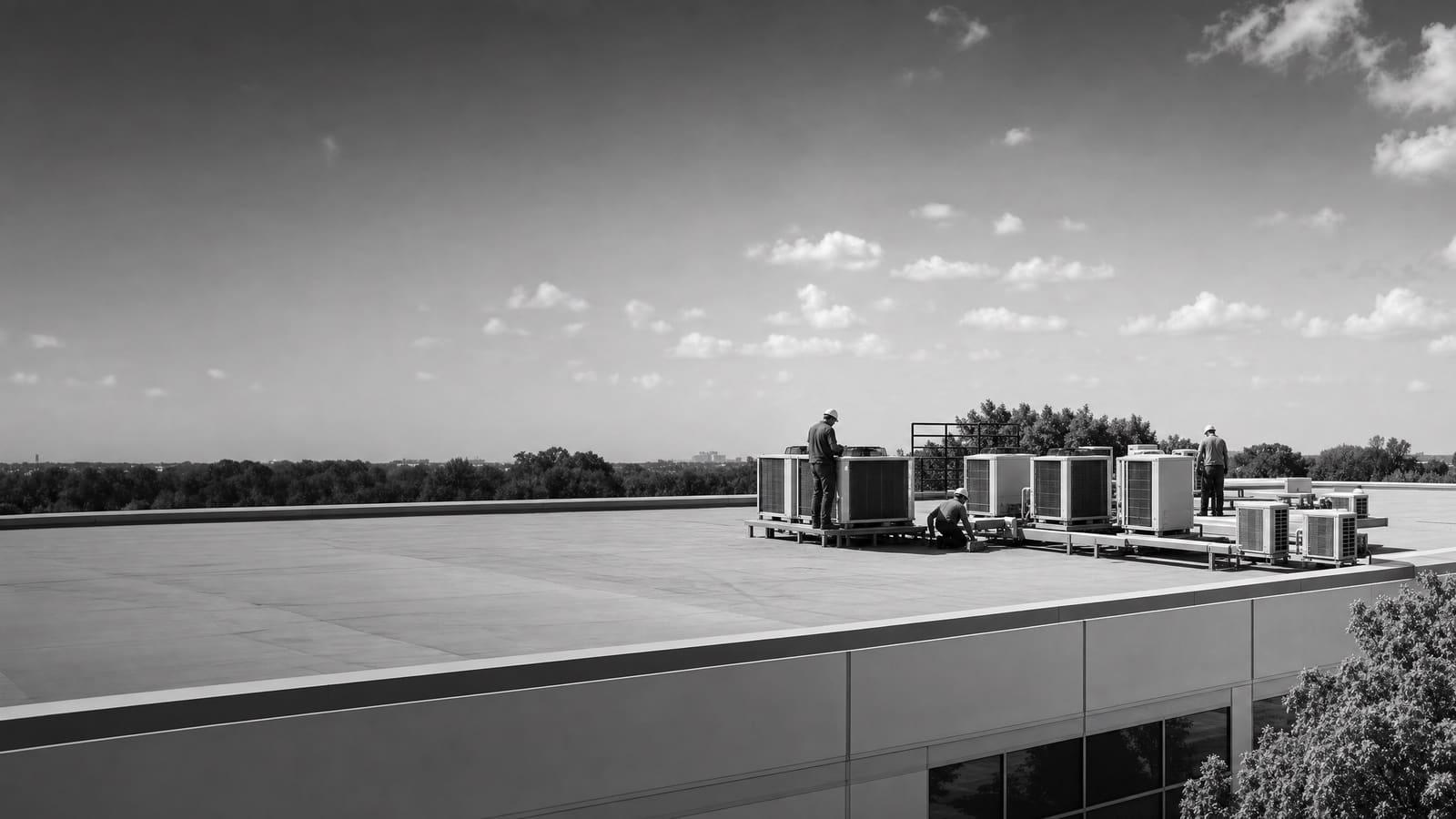
The visible part of a replacement is one morning. The crane arrives, stalls get coned, the old unit comes off, and the new one lands on a curb adapter measured weeks earlier. Everything that makes that morning boring happened well before it.
Efficiency tier is where most owners either save or lose real money, and the spread is wider than a spec sheet suggests. DOE's High-Performance Rooftop Unit Challenge asked manufacturers to cut unit energy use by up to 50% against the standard of the day, and more than twenty models now exceed that specification. Rooftop equipment conditions close to half of all commercial floor area in the country, so this is not a niche line item. For most buildings it is the single largest energy decision the owner actually controls.
Availability belongs right next to price. DOE lists equipment availability as a core decision factor alongside cost, infrastructure, and contractor knowledge, and the reason is practical: a unit you cannot get for ten weeks is not a cheaper unit. Ask each option to carry three numbers — installed price, rated efficiency, and a real ship date — and the comparison stops being a judgment call.
COMPLEXITY
What makes a swap simple, and what makes it a project
The same tonnage can be a one-morning job or a six-week project. The difference is almost never the unit itself. It is the curb, the power, and what the roof is willing to carry.
LOWER COMPLEXITY
Same curb, same fuel
A like-for-like swap on an unchanged footprint reuses the existing curb, gas line, and electrical feed. Engineering is minimal, the rigging plan is short, and the building is back to normal within a day or two.
HIGHER COMPLEXITY
New footprint or new fuel
Changing tonnage, converting to all-electric, or landing a larger box pulls structural review, panel and feeder work, and gas line changes into scope. DOE names those same three — electrical capacity, physical constraints, gas lines — as the make-or-break infrastructure checks.
BEFORE YOU BUY
What the site review has to settle
Sizing should come from how the space is used now, not from the old nameplate. Twenty years changes occupancy, plug load, lighting heat, and sometimes the envelope itself. A unit sized for a floor full of desktop towers is often oversized for the same floor today, and an oversized unit short-cycles, dehumidifies poorly, and wears itself out early.
The second thing a review settles is infrastructure. DOE's rooftop replacement checklist puts three items under that heading: electrical capacity, physical constraints, and gas lines. Electrical capacity decides whether an electric or dual-fuel option is even on the table without a service upgrade. Physical constraints decide whether the box you want can be reached, landed, and later serviced. Gas lines decide what gets capped, moved, or left alone.
The third is the roof itself. Curb dimensions, deck condition, and where the new unit's weight lands are structural questions. They are far cheaper to answer with a tape measure than with a crane already parked in the lot and a rental clock running.
Ask for this in writing
A scope that names tonnage, efficiency tier, curb adapter, electrical and gas work, crane and lot plan, and who pulls the permits. If any of those is missing, the number on the page is an estimate, not a price.
OWNERSHIP
Two things to decide before the order goes in
Two questions outlive the install, and both are much easier to answer before the purchase order than after.
The first is fuel. Heat pump rooftop units are technically similar to standard air-conditioning units, with reverse-cycle heating added. DOE places most of the U.S. South and West in the range where they can handle most or all of the winter heating demand, while noting that southern climates still see sharp cold snaps — the February 2021 Texas freeze is the example it cites. That tension is exactly why dual-fuel configurations exist.
The second is refrigerant. EPA Section 608 governs how refrigerant is handled and recycled when the old unit comes down, and a roof running more than one refrigerant is harder to stock parts for and slower to service.
FUEL
Electric, dual-fuel, or gas
DOE describes three heat pump rooftop types: dual fuel, all-electric, and cold climate. Heating efficiency drops as it gets colder, so the choice turns on how much winter heating the building truly needs and what electrical capacity is already there.
FLEET
One unit or the whole roof
If three units are within a few years of each other, replacing on failure means three separate crane days, three permit cycles, and a mixed fleet to stock parts for. Phasing them deliberately is usually cheaper and always quieter.
THE LONGER VIEW
Phasing, procurement, and what the unit costs after year one
The purchase price is the smaller half of the decision. DOE's Advanced RTU Campaign is the clearest evidence for that: more than 200 organizations upgraded over 43,000 rooftop units and now save a combined $37 million a year on energy bills. That is the shape of the tradeoff — capital once, savings every year the unit runs.
The same math argues hard against replacement-on-failure. A unit replaced in an emergency gets whatever efficiency tier is on the truck that week, and that tier is locked in for the entire service life of the equipment. A unit replaced on a plan gets compared, bid, and scheduled around your operating hours.
If you own several units of similar age, phase them. Group the roof by remaining life, replace the worst performer first, and use what that job teaches you — curb fit, crane access, control integration, actual lead time — to price the rest with confidence. The second replacement on a roof is almost always smoother than the first, because the unknowns are already answered.
Procurement follows the same logic. Order early enough that the ship date is your choice, and keep the lead time written on the quote so a slip becomes a conversation instead of a scramble.
THE QUOTE
Five things a comparable quote must show
Two quotes are only comparable when they price the same scope. Ask every bidder to put these five in writing before you compare bottom lines.
01
Unit, tonnage, and efficiency rating
Model number and rated efficiency, not a line that reads only 'high-efficiency rooftop unit.'
02
A real ship date
Written lead time for that specific model, and what happens to your schedule if it slips.
03
Curb, structural, and roof scope
Adapter, framing, and any deck work priced in, rather than noted as by others.
04
Electrical and gas scope
Feeder, panel, disconnect, and any gas capping or re-routing inside the installed number.
05
Rigging, permits, and commissioning
Crane day, lot closure, permit fees, startup, and documented verification of charge, airflow, and controls.
Get a defensible number
Price the equipment and the building together.
Send the address, operating target, and target opening date. Flux will identify what must be verified before the project can be priced.
Get a free estimateQuestions
Straight answers.
How fast can a dead rooftop unit be replaced?
The set itself is usually a one- to two-day event once the equipment is on site. The honest variable is lead time on the unit. That is why availability belongs on the quote next to the price — a cheaper unit that is ten weeks out is not actually cheaper.
Is it worth replacing a unit that still runs?
Often, yes. DOE puts the annual energy waste of an old, inefficient rooftop unit at $900 to $3,700 per unit and flags units over fifteen years old as the ones worth reviewing. Replacing proactively also lets you pick the equipment instead of taking whatever ships fastest.
Should we replace like-for-like or resize?
Confirm the load either way. If the space and its use have not changed, like-for-like is often right and always simpler. If occupancy, layout, or internal equipment changed, a right-sized unit fixes comfort complaints that the old nameplate would otherwise carry forward for another twenty years.
Does a heat pump rooftop unit make sense for our building?
DOE considers heat pump rooftop units appropriate across most of the U.S. South and West, capable of handling most or all winter heating demand. The two checks are electrical capacity at the unit and how the building would ride out a hard cold snap, which is what dual-fuel configurations are for.
Who handles the crane, permits, and old refrigerant?
The installing contractor should own the rigging plan, lot coordination, permits, inspections, and recovery of the old refrigerant charge under EPA rules, all as part of the installed price. Confirm that language appears in the quote before you sign anything.
Sources used for this guide
- [1]betterbuildingssolutioncenter.energy.gov — DOE Advanced Rooftop Unit Replacement Guidance
- [2]betterbuildingssolutioncenter.energy.gov — DOE Commercial Heat Pump Rooftop Unit Replacement Guidance
- [3]betterbuildingssolutioncenter.energy.gov — DOE High-Efficiency Commercial Rooftop Unit Toolkit
- [4]energy.gov — DOE Efficient Commercial Rooftop Air Conditioner Program
- [5]epa.gov — EPA Stationary HVAC Refrigerant Management