Direct answer
What a commercial HVAC replacement actually includes
A commercial HVAC replacement covers load verification, equipment selection, the crane set, gas, electric, and control connections, permits, and commissioning. Replacement earns a serious look once a rooftop unit passes fifteen years, because federal research finds units that old waste substantial energy against current models — roughly $900 to $3,700 per unit each year on an old, inefficient rooftop system. That is money another repair never gives back.
A site review still has to confirm the current load, the roof curb and the framing under it, available electrical capacity, gas service, and crane access before any of that becomes a real price.
Choose the system, not the box
Three ways to replace a gas rooftop unit
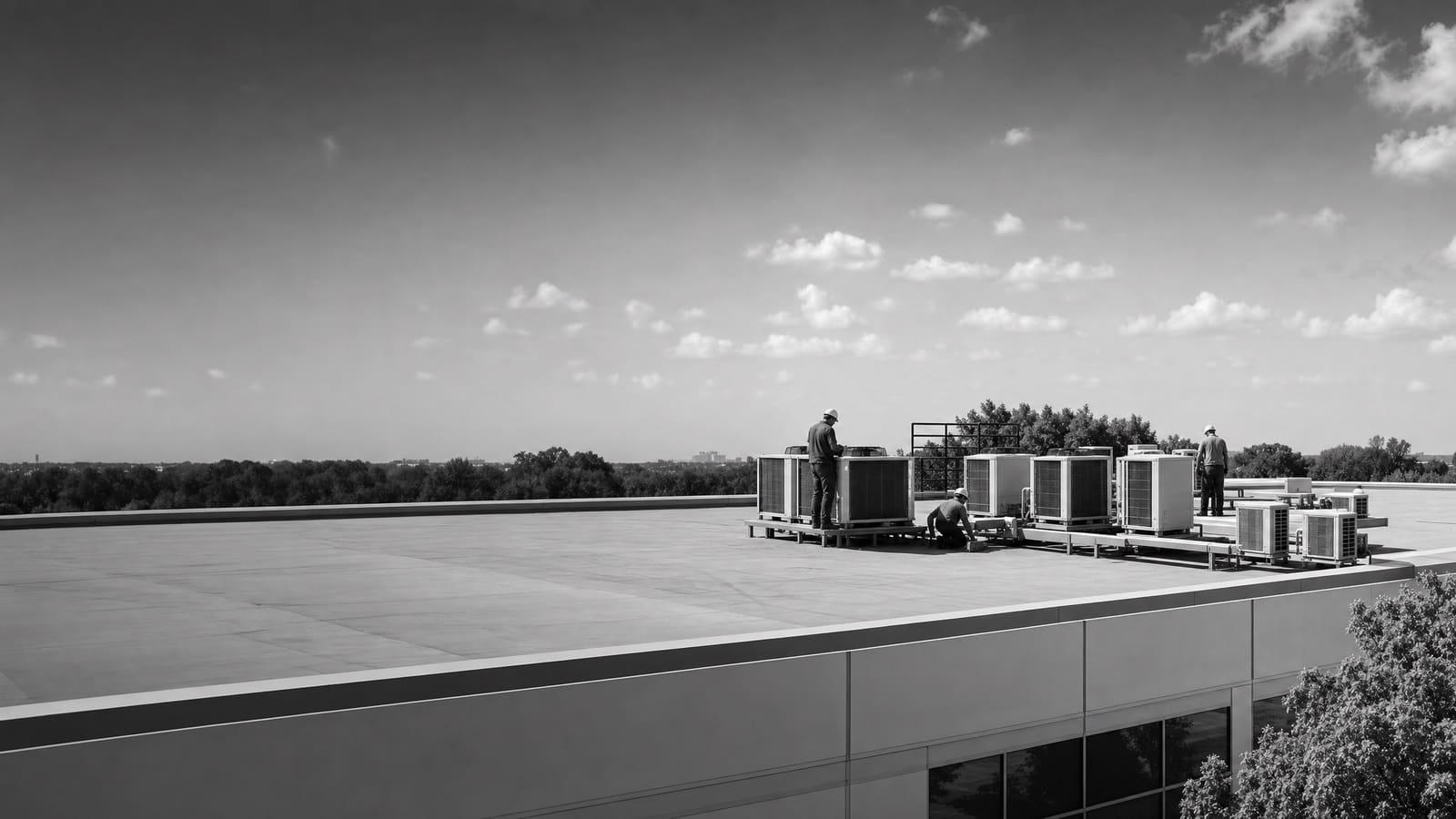
Rooftop units condition close to half of all commercial floor area in the country, so most replacement decisions start on a roof that already has a packaged unit on it. The first choice is like-for-like: a new air-conditioning unit with gas heat, on the same curb, with the same services. It is the fastest path and the least engineering, and it carries forward whatever the old unit got wrong.
The second choice is a dual-fuel heat pump unit. It heats with the compressor when that is efficient and falls back to gas when it is not. The third is all-electric. The Department of Energy says heat pump rooftop units are best suited to mild-to-moderate winter heating, and that across most of the West they can carry most or all of the winter heating demand. That makes all-electric a real option here rather than a stretch. What decides it is electrical capacity at the building, the gas line you already have, and what your utility rates do to the operating number.
Build the whole number
What belongs in a replacement budget
A rooftop price and a project price are different numbers. Separate the equipment from the work required to land it, power it, and prove it runs. Otherwise a cheap unit hides an expensive roof.
Do not order the unit first
Confirm the load before anyone picks a model
The nameplate on a twenty-year-old rooftop unit tells you what the building needed twenty years ago. Occupancy changed. Lighting changed. Plug loads changed. Sometimes the envelope changed. Replacing to the old tonnage is a guess dressed up as a spec, and it is how a building ends up with a brand-new unit that short-cycles all summer and still cannot hold a back office.
Confirm the load against how the space is used now. That calculation is also what makes the equipment conversation honest, because it fixes the tonnage before anyone shows you a brochure. The Department of Energy's high-performance rooftop specification was written to cut unit energy use by as much as half against the older standard, and more than twenty models now exceed it. That efficiency is only real if the unit is sized for the load it will actually see.
Then check availability early. Equipment availability and contractor familiarity sit on the Department of Energy's own list of factors that decide whether a heat pump rooftop replacement is workable at a given site. A unit that is right on paper and unavailable for months is not the right unit for a building currently running on a failing one.
Why two roofs price apart
What makes one Clovis replacement simple and the next one not
Two buildings can run identical units and get very different numbers. One sits on the same curb with the same services and an open lot for the crane. The other needs a curb adapter, a panel upgrade, a structural look, and a lift staged around traffic that never stops.
Lower-complexity replacement
Same footprint, same services
• Existing curb accepts the new unit
• Electrical and gas service already sized
• Open lot with clear crane reach
• Controls and efficiency tier carry over
Higher-complexity replacement
The building has to change too
• Curb adapter plus structural review
• Panel or service upgrade for electric heating
• Gas line abandoned or resized
• Tight access, a night lift, or a staged roof plan
Replace guesses with roof facts
What a site review has to settle before design starts
The first visit is not a look at the unit. It is a look at everything the unit depends on. The reviewer should measure the curb, check the framing under it, trace the electrical feed back to the panel and confirm how much spare capacity is actually there, locate the gas line, find the condensate path, and identify the controls the new unit has to talk to. The Department of Energy groups these under infrastructure for a reason: electrical capacity, physical constraints, and gas lines are the three that most often turn a straightforward replacement into a larger project.
Outside, walk the lift. Where does the crane set up, what does it have to reach over, which stalls close, and for how long. Roof access, screen walls, parapets, adjacent equipment, and overhead lines all decide whether the set takes a morning or a weekend.
Then interview the operation. When is the building occupied, what can be down and for how long, which spaces cannot lose conditioning, and who signs off on a night or weekend lift. Those answers change the schedule, and the schedule changes the price.
A nameplate photo is a starting point, not a scope.
A remote estimate can name likely equipment and likely problems. A firm number needs the measured curb, verified electrical capacity, a confirmed crane path, and a permit answer. Every assumption still open should be written on the quote.
Clovis planning
Settle the permit path before the unit ships
California building departments treat HVAC work as permit work, and the scope is broader than most owners expect. Published municipal permit guidance in California lists any electrical, plumbing, or mechanical upgrade or repair as permit-required, alongside items like re-roofing. That matters on a rooftop replacement, because one project usually touches all three at once: the mechanical set, the electrical feed, and often condensate or gas.
Confirm the Clovis requirements with the local building department before equipment is ordered, not after it lands. Ask which permits apply, whether plan review is needed, what the inspection sequence looks like, and how a re-roof in the same season should be coordinated with the unit set.
The Clovis takeaway
Get the permit list and inspection sequence in writing while the equipment order is still open. A lead time you can plan around is manageable. A crane day that cannot be inspected is not.
After the crane leaves
Two things that outlive the installation
Refrigerant is the first. EPA rules under Section 608 of the Clean Air Act govern how refrigerant is handled and recycled in stationary air conditioning and heat pump equipment, and those rules follow the unit for its whole life, not just installation day. New equipment ships on newer refrigerants, so a building replacing units one at a time will run a mixed fleet for years. Plan the service contract and the spare-parts strategy around that.
Incentives are the second. The Department of Energy publishes guidance on rooftop replacement incentives, and utility programs are one of the factors it names for heat pump rooftop adoption. Programs change and expire. Confirm what is actually open before you commit to an efficiency tier — an incentive that existed two years ago is not a line item until someone verifies it is still funded today.
Year one
Commissioning and documentation
Startup readings, refrigerant charge, airflow, economizer settings, control integration, and a documented handoff that keeps the warranty enforceable.
Later years
Mixed-fleet service reality
Refrigerant handling rules, parts across two refrigerant generations, technician familiarity with heat pump units, and a maintenance plan that keeps efficiency from drifting.
Plan the fleet, not the failure
Replacing on your schedule beats replacing on the unit's
Most rooftop units get replaced the day they die. The Department of Energy is direct about the cost of that habit: facility managers often delay until the unit no longer conditions the space, needs constant service, or fails outright, and replacing inefficient units proactively is frequently the better business move than replacement-on-failure — or even than a like-for-like swap at the end of service life. A failure in August removes every option except whatever is on a truck.
If your roof carries more than one unit, treat them as a fleet. Rank them by age, run hours, service history, and how much of the building each one serves. Replace in that order, in the shoulder seasons, with load calculations and permits done in advance. The Advanced Rooftop Unit Campaign brought together more than two hundred organizations that upgraded over forty-three thousand units and cut a combined thirty-seven million dollars a year in energy cost. That came from planned programs, not emergencies.
Phasing also lets you buy once for the building. If a panel upgrade or a control platform will serve several future units, doing it during the first replacement usually costs less than mobilizing for it three separate times.
Before you compare bids
Five things a comparable quote has to show
Ask every bidder to price the same tonnage, the same efficiency tier, the same curb work, and the same permit and commissioning scope. If one quote excludes rigging or structural work and another includes it, the totals are not comparable.
01
The load calculation behind the tonnage, not just the old nameplate
02
Equipment model, efficiency tier, heating type, and current lead time
03
Curb adapter, structural review, and any roof work included
04
Rigging plan, lot closure hours, permits, and inspections in the price
05
Commissioning scope with documented charge, airflow, and control settings
Get a defensible number
Price the equipment and the building together.
Send the address, operating target, and target opening date. Flux will identify what must be verified before the project can be priced.
Get a free estimateQuestions
Straight answers.
When is replacing a rooftop unit better than repairing it again?
Age and repair history decide it. Federal guidance notes that units over fifteen years old can waste substantial energy and money against newer models, and old, inefficient rooftop units run roughly $900 to $3,700 per unit each year in wasted energy. Weigh that against the next repair bill and how often you have written one.
Does a heat pump rooftop unit make sense in Clovis?
It is a real option here. Federal guidance says heat pump rooftop units are best suited to mild-to-moderate winter heating and can address most or all of the winter heating demand across most of the West. The deciding factors are electrical capacity at the building, your existing gas service, and what utility rates do to the operating number.
What does a commercial HVAC replacement cost?
There is no honest per-unit price without a roof review. Tonnage, curb work, electrical capacity, crane access, and permits move the number more than the equipment does. What can be estimated early is the waste side: an old, inefficient rooftop unit can burn $900 to $3,700 a year in energy it does not need to use.
Do we need a permit to replace a rooftop unit?
Assume yes and confirm with the Clovis building department. California permit guidance treats any mechanical, electrical, or plumbing upgrade or repair as permit work, and a rooftop replacement usually touches all three. Get the permit list and inspection sequence before equipment ships, not after.
Will a new unit use a different refrigerant?
New equipment ships on newer refrigerants. It changes nothing about day-one operation, but replacing units one at a time leaves you with a mixed fleet for years. EPA Section 608 rules govern how refrigerant is handled and recycled for the life of the equipment, so build that into the service contract and spare-parts plan.
Sources used for this guide
- [1]betterbuildingssolutioncenter.energy.gov — DOE Advanced Rooftop Unit Replacement Guidance
- [2]betterbuildingssolutioncenter.energy.gov — DOE Commercial Heat Pump Rooftop Unit Replacement Guidance
- [3]betterbuildingssolutioncenter.energy.gov — DOE High-Efficiency Commercial Rooftop Unit Toolkit
- [4]energy.gov — DOE Efficient Commercial Rooftop Air Conditioner Program
- [5]epa.gov — EPA Stationary HVAC Refrigerant Management
- [6]californiacity-ca.gov — HVAC Permits