THE SHORT VERSION
What a commercial HVAC replacement actually includes
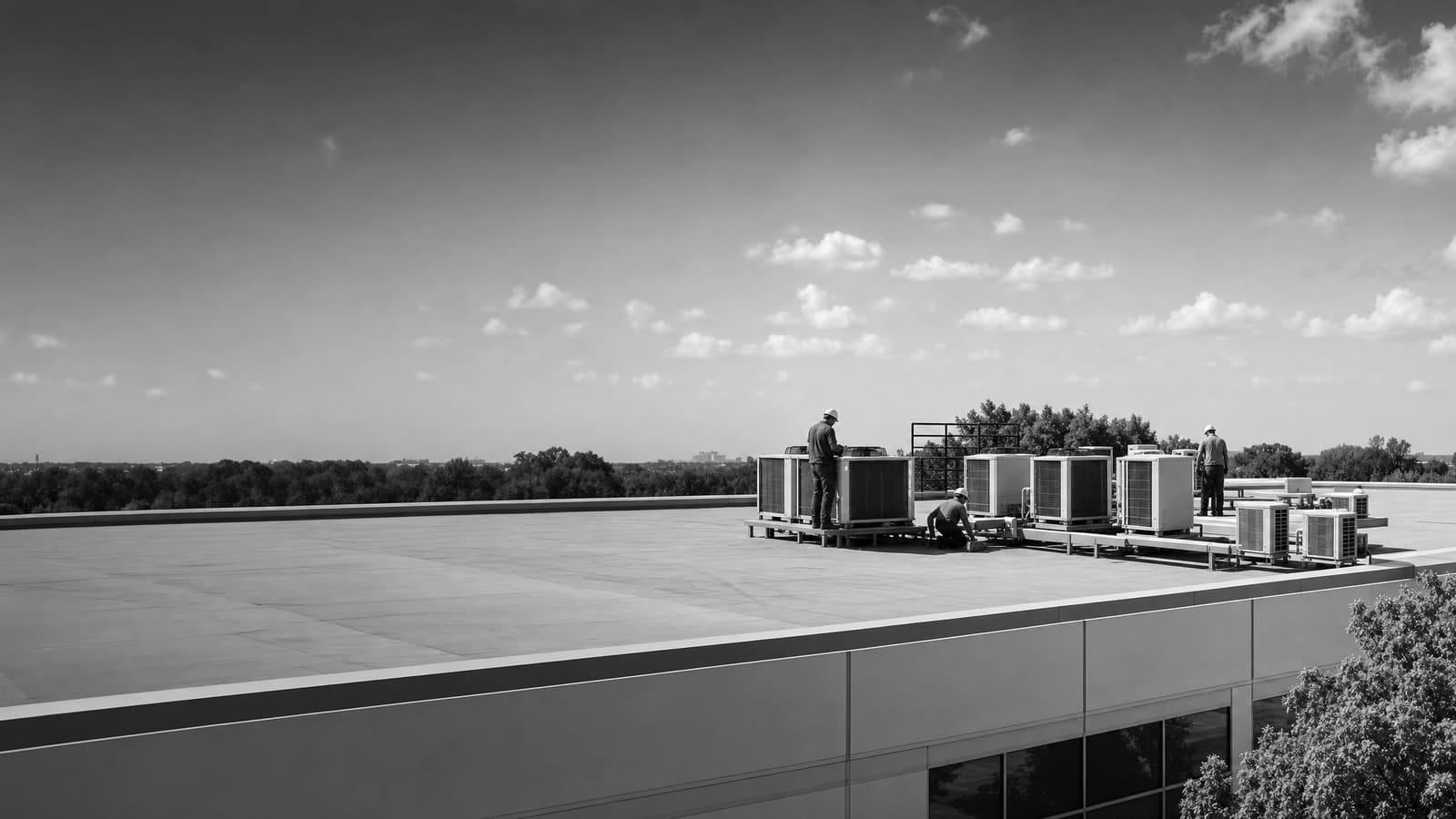
A commercial HVAC replacement covers load confirmation, equipment selection against real availability, rigging and set, connection to gas, power and controls, permits, and commissioning. Replacement beats another repair once a unit is aging and the failures stack up. DOE puts rooftop units over 15 years old in the wasteful category, and estimates old, inefficient units burn $900 to $3,700 per unit each year in avoidable energy. That annual bleed, not the breakdown itself, is usually what makes the swap pencil.
A site review has to verify tonnage against how the space is used now, curb and structural condition, available electrical capacity, gas line status, and crane reach across your lot.
THREE WAYS TO GO
Replace, retrofit, or convert
Most buildings face the same three-way choice, and the right answer is financial before it is technical. DOE's Advanced RTU Campaign frames it plainly: owners either replace an old unit with a more efficient one or retrofit it with advanced controls, depending on which option makes better financial sense.
The third path is a fuel change. Heat pump rooftop units are technologically similar to air-conditioning rooftop units but add reverse-cycle heating, and they come in dual fuel, all-electric, and cold climate versions. That choice depends on your heating hours, your electrical capacity, and the gas service you already have.
Timing matters as much as the option. DOE notes that facility managers often delay until the unit fails, and that replacing an underperforming unit proactively can be the smarter move compared with replacement-on-failure or even a like-for-like swap at the end of service life.
WHAT MOVES THE NUMBER
The lines that decide your installed price
No honest universal price exists for a commercial rooftop replacement, because the same tonnage lands very differently on two roofs. These are the lines that separate a low bid from a real one. Ask every bidder to show them separately.
IN PRACTICE
Buying the right unit, not just a new one
The most common mistake is buying the nameplate again. A unit installed two decades ago was sized for a building that no longer exists in practice: different occupancy, different plug load, different envelope, sometimes a different tenant entirely. Confirming the load first is cheap, and it is the only way to know whether you are solving the comfort complaints or reinstalling them.
The efficiency tier deserves the same scrutiny. Rooftop units condition close to half of all commercial floor area in the country, which is why DOE pushed manufacturers hard on this equipment. The High-Performance Rooftop Unit Challenge asked for units that cut energy use by up to 50% against the standard of the day, and more than twenty models now exceed that specification. These are ordinary catalog items, not exotic orders.
Availability is the third input, and the one most quotes hide. DOE lists equipment availability and contractor familiarity among its core considerations for a reason. A better unit you cannot get for months is not better if the building is limping along on portable cooling. Ask for the option you want and the option that ships, priced side by side, then make the trade knowingly.
SCOPE CHECK
What makes this simple, and what makes it hard
Two replacements with identical tonnage can differ by weeks and by a large share of the budget. The difference is almost always infrastructure and access, not the box itself.
LOWER COMPLEXITY
Like-for-like on a sound curb
Same footprint, same connections, same fuel. The existing curb carries the load, gas and power stay as they are, and the crane has clear reach. Engineering is minimal, the permit path is short, and the on-site work is measured in days.
HIGHER COMPLEXITY
Fuel change, resize, or tight access
A larger or heavier unit brings structural review. A heat pump conversion brings electrical capacity into play, and DOE also flags physical constraints and existing gas lines. Restricted lot access can push the lift to a weekend and add closure cost.
BEFORE YOU BID IT
What a real site review settles
A site review is not a formality, and skipping it is how a quote turns into a change order. The person walking your roof should be answering questions, not measuring for a catalog.
Start with the load. Sizing pulled from the old nameplate carries forward every mistake the old unit had, including the ones your tenants have been complaining about for years. Then the physical picture: curb dimensions and condition, roof structure under the unit, and whether the new footprint sits where the old one did.
Infrastructure comes next. DOE groups electrical capacity, physical constraints, and gas lines together as the infrastructure check for anyone weighing heat pump equipment, and the same three questions matter on a straight replacement. You simply find out sooner whether the answer changes the price. Then access: crane reach, staging space, which stalls close, and for how long.
One item gets skipped more than any other. Refrigerant on the outgoing unit is regulated. EPA rules under Section 608 of the Clean Air Act govern the handling and recycling of refrigerants in stationary air-conditioning and heat pump equipment, and recovery belongs to the installing contractor.
The five things to settle on site
Confirmed load for the space as it is used today, curb and structural condition, available electrical capacity, gas line status, and a crane plan with named closure hours. If a bid arrives without these settled, it is a placeholder, not a price.
OWNERSHIP MATH
Two things that outlast the install
The install is a week of your attention. The consequences run for as long as that unit stays on the roof, and two of them are worth deciding on purpose rather than by default.
The first is when you buy. DOE is direct about this: facility managers often wait until a unit no longer conditions the space, needs constant attention, or fails outright, and proactive replacement of an underperforming unit can beat both replacement-on-failure and a like-for-like swap at end of life. An emergency removes your leverage on price, equipment choice, and schedule all at once.
The second is what the fleet looks like afterward. If you run several units, replacing them one crisis at a time leaves a roof full of mismatched ages, efficiencies, and refrigerants, plus a service contract that has to cover all of it.
TIMING
Planned beats emergency
A planned replacement lets you compare equipment, use normal lead times, and pick the lift date. A failure in season narrows you to whatever ships this week, at whatever it costs, with portable cooling running while you wait.
FLEET
Standardize while you can
Replacing in planned groups keeps refrigerants, controls, and parts consistent across the roof. That savings shows up in service response and spares, not on the installation invoice.
THE LONGER VIEW
Phasing, procurement, and what the unit costs after year one
If you own more than one unit, treat the roof as a program instead of a series of emergencies. The math is straightforward. An old, inefficient rooftop unit wastes somewhere between $900 and $3,700 a year by DOE's estimate. Multiply that across the aging units on your roof and you have both a budget case and a priority order: worst performer first, rather than whichever one fails first.
The approach scales. Through DOE's Advanced RTU Campaign, more than 200 organizations upgraded over 43,000 rooftop units and cut a combined $37 million a year from their energy bills. Those are portfolios, but the logic holds on a roof with four units. Stage the replacements across two or three budget cycles and let the savings from the first help fund the next.
Procurement should follow the same discipline. Get the efficiency tier, the availability date, and the installed price on one page for each option you are weighing, and ask what the unit is expected to cost to run, not only to buy. Incentives sit on DOE's own list of decision factors, so confirm what your utility currently offers before you sign. Programs change, and a rebate you assumed exists may no longer be open.
APPLES TO APPLES
Five things every quote should show
Three bids on the same roof are only comparable if they price the same scope. Ask for these five items broken out, and the cheap bid usually explains itself.
01
Tonnage, model, and efficiency tier
The specific unit, not a class. Efficiency rating stated, not implied.
02
Confirmed availability date
Lead time for that exact model, in writing, sitting next to the price.
03
Curb, structural, and roof work
Adapter, any framing, and patching, priced rather than noted as by others.
04
Rigging, closures, and permits
Crane, staging, lot hours, and who pulls the mechanical and electrical permits.
05
Commissioning and refrigerant recovery
Startup, airflow, and charge verified against spec, plus Section 608 recovery on the outgoing unit.
Get a defensible number
Price the equipment and the building together.
Send the address, operating target, and target opening date. Flux will identify what must be verified before the project can be priced.
Get a free estimateQuestions
Straight answers.
When is replacement better than another repair?
When repairs stop being isolated events. DOE puts rooftop units past 15 years in the wasteful category and estimates old, inefficient units burn $900 to $3,700 a year in avoidable energy. Once repair frequency climbs on a unit that age, the annual waste usually outweighs the fix.
How much does commercial HVAC installation cost in Clifton?
There is no honest single number, and a contractor quoting one before seeing the roof is guessing. Price is driven by tonnage and efficiency tier, curb and structural work, crane access, electrical or gas changes, and controls integration. Ask for those lines separately so bids are actually comparable.
Should we switch to a heat pump rooftop unit?
It depends on your heating hours and your infrastructure. Heat pump units add reverse-cycle heating and come in dual fuel, all-electric, and cold climate versions. DOE notes efficiency falls as outdoor temperature drops, trending toward electric resistance, so they suit mild-to-moderate winter heating best. Electrical capacity is the other gate.
Should we replace like-for-like or resize?
Confirm the load either way. If occupancy, plug load, and use have not changed, like-for-like is often right and it is the fastest path back to conditioned space. If the space changed or the comfort complaints never resolved, resizing fixes what the old unit could not.
Who handles refrigerant on the old unit?
The installing contractor. EPA regulations under Section 608 of the Clean Air Act cover the handling and recycling of refrigerant in stationary refrigeration, air-conditioning, and heat pump equipment. Recovery from the unit coming down should appear in the written scope, not be left as an assumption.
Sources used for this guide
- [1]betterbuildingssolutioncenter.energy.gov — DOE Advanced Rooftop Unit Replacement Guidance
- [2]betterbuildingssolutioncenter.energy.gov — DOE Commercial Heat Pump Rooftop Unit Replacement Guidance
- [3]betterbuildingssolutioncenter.energy.gov — DOE High-Efficiency Commercial Rooftop Unit Toolkit
- [4]energy.gov — DOE Efficient Commercial Rooftop Air Conditioner Program
- [5]epa.gov — EPA Stationary HVAC Refrigerant Management