THE DIRECT ANSWER
What a commercial HVAC replacement actually includes
A commercial HVAC replacement means confirming the load your building runs today, selecting equipment against real availability, setting the unit, connecting power, gas, and controls, then commissioning it against spec. Replacement beats another repair once the unit is past fifteen years and failures start stacking up. DOE puts the waste from an old, inefficient rooftop unit at $900 to $3,700 a year — money the repair invoice never shows you.
A site review still has to confirm curb fit, roof structure, electrical capacity at the panel, and crane access before any of that price becomes real.
THREE WAYS TO GO
Three operating choices for the replacement
Most commercial replacements come down to three paths, and the right one depends on what changed in the building since the old unit went in. If the space is used the way it always has been, matching the old configuration is fast and cheap to engineer. If occupancy, layout, or plug load changed, carrying forward the old nameplate carries forward the old comfort complaints. And if the unit burns gas, this is the moment to price the electric option, because the ductwork, the curb, and the crane day are already being paid for. DOE's rooftop guidance treats climate, electrical capacity, gas service, and installer availability as the deciding inputs rather than brand preference. Chico sits in the western band where DOE considers today's heat pump rooftop units capable of carrying most or all of the winter heating demand.
WHAT MOVES THE NUMBER
Budget lines that decide the quote
No two roofs price the same. These are the lines that separate a clean changeout from an expensive one, and every one of them is visible from the roof before anybody writes a number down.
IN PRACTICE
Buy the equipment, not just the install
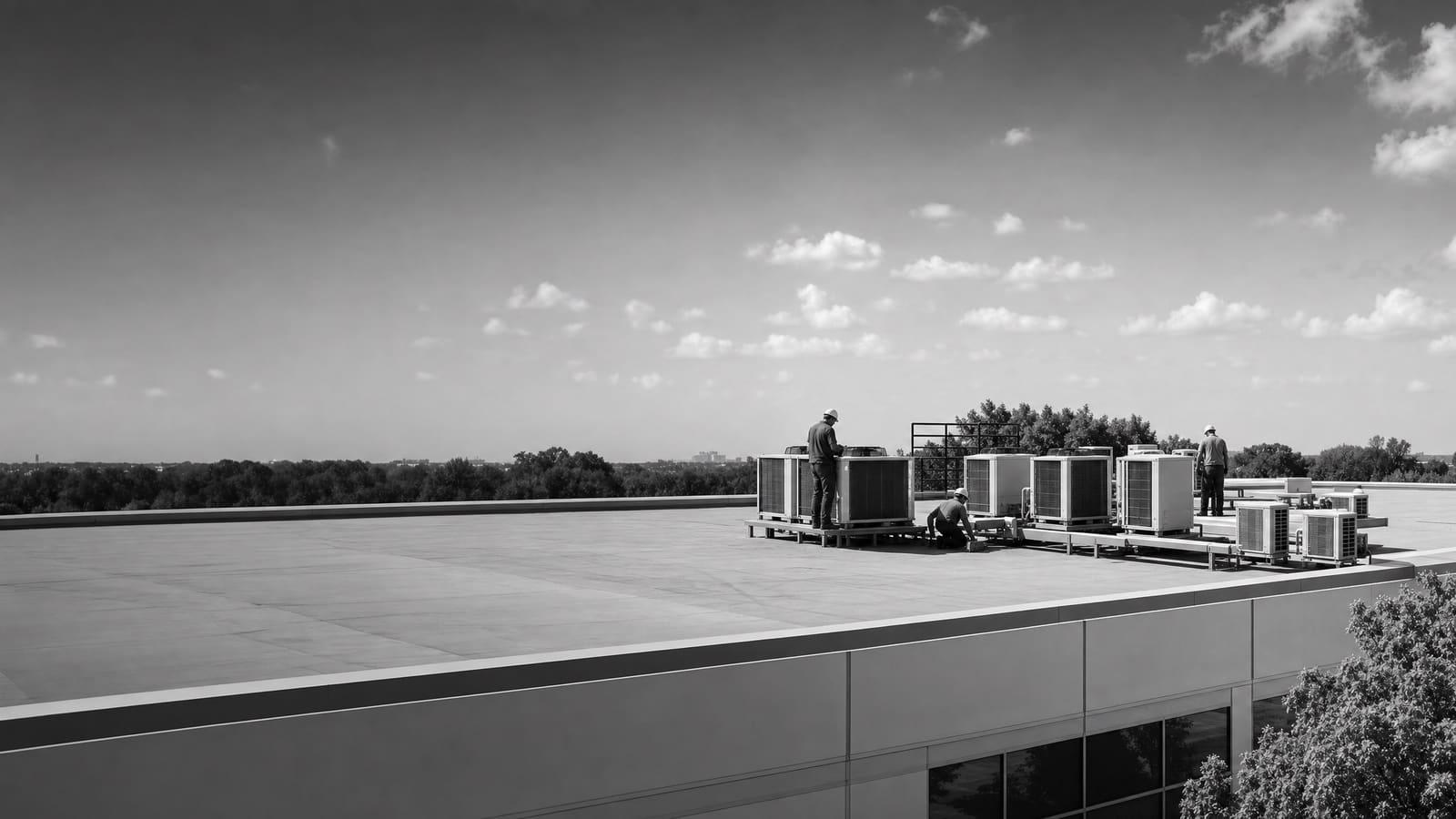
Rooftop units condition close to half of all commercial floor area in the country, which is why most commercial HVAC work in Chico is a rooftop changeout rather than a custom plant. That is good news for a buyer. The category is standardized enough that you can compare real options instead of taking one contractor's word for it.
The buying decision should start with age and behavior, not failure. DOE is blunt about the pattern: owners wait until the unit stops holding the space, needs constant attention, or dies outright, and by then the choice gets made under pressure with whatever is in stock. A unit past fifteen years that is burning $900 to $3,700 a year in wasted energy is already funding part of its own replacement.
The second decision is efficiency tier. DOE's high-performance rooftop specification pushed manufacturers to build units that use up to half the energy of the standard baseline, and more than twenty models have been offered that exceed that spec. Ask for two prices on the same tonnage — baseline and high-efficiency — with the annual energy difference written down. That single extra page is where the real money on this project lives.
SIMPLE VS COMPLICATED
What makes a changeout easy or hard
Two buildings on the same street can quote very differently, and the difference is almost never the equipment. It is what the roof, the panel, and the parking lot allow on the day of the set.
LOWER COMPLEXITY
Same footprint, same fuel
The new unit lands on the existing curb with a standard adapter, the electrical service already carries the load, and the crane has clear reach from your own lot. Permitting is routine and the building keeps running around it.
HIGHER COMPLEXITY
New footprint or new fuel
Larger tonnage, a heavier unit, or a move to all-electric heating. Now you are checking roof structure, panel capacity, and feeder runs — and DOE flags every one of those as a project-stopper when it gets found late.
BEFORE YOU QUOTE
What the site review has to confirm
A quote written from a nameplate photo is a starting number, not a price. It is genuinely useful for triage when a unit dies in season and you need the order of magnitude today. It is not what you sign.
The site review exists to close the gaps that turn a fixed price into a change order. DOE's rooftop guidance groups them into infrastructure and access: electrical capacity at the panel and the feeder, physical constraints like curb size and roof structure, and gas service if the unit is staying on gas or coming off it. Add crane reach and staging, because a set that needs a bigger crane or a street closure is a different job than one that works from your own parking lot.
Contractor availability belongs on that list too. DOE names it directly as a factor in whether a heat pump rooftop unit is a realistic choice for a given site, because the equipment only performs if whoever sets it knows how to commission and service it. Ask who is starting the unit up, and who is on the service contract afterward, before the equipment gets ordered.
Four things to verify on the roof
Curb dimensions and roof structure, electrical capacity at the panel, gas service status, and crane reach from your own lot. Anything left unverified here tends to reappear later as a change order.
IN CHICO
Permits, roof work, and sequencing
In California, a rooftop changeout is permitted work. Building departments require permits for mechanical and electrical upgrades and repairs — including work that looks like straight maintenance — and re-roofing is its own permitted item, whether it is an overlay or a tear-off. That last detail decides sequencing more often than owners expect.
If your roof is near the end of its life, set the roofing schedule before the crane schedule. Replacing the membrane after a new unit lands means flashing around a curb you just paid to install, and it means a second round of permits and inspections on the same section of roof. Doing both inside one window costs less and disrupts the building once instead of twice.
Confirm the exact submittal set, fees, and review time with the City of Chico building division before you book the crane, since those are set locally.
Sequence the roof before the crane
If the membrane is near end of life, re-roof first or do both in one window. A new curb set on an old roof means redoing flashing and a second permit round on the same section.
OWNERSHIP MATH
Two things that outlive the install
The install takes a week of your attention. The unit sits on your roof for the next couple of decades, and two decisions made during the quote determine what those years cost: what the equipment does to your utility bill every month, and what happens when it needs service. DOE's Advanced RTU Campaign is a useful reference point. More than two hundred organizations upgraded over forty-three thousand rooftop units and have saved a combined $37 million a year on energy. That is the compounding side of this decision, and none of it shows up on the installed price.
OPERATING COST
The bill after the install
An old unit can waste $900 to $3,700 a year by itself. Ask for the annual energy difference between the baseline and the high-efficiency option in writing, so the payback is a number you can check rather than a pitch.
SERVICE PLANNING
Refrigerant and mixed fleets
EPA Section 608 governs how refrigerant is handled and recycled in commercial equipment. If your roof will carry old and new units side by side, plan certified service coverage and parts for both, not just the new one.
PHASING AND PROCUREMENT
If you have more than one unit
Buildings rarely have one rooftop unit, and they rarely have one that fails on a convenient schedule. If you own several, stop treating each failure as its own emergency and build a replacement order instead. Rank the units by age, service history, and the load each one carries, then replace from the top of that list on your calendar rather than on the equipment's.
Phasing buys three things. You order equipment ahead of the season instead of taking whatever is available. You reuse the same crane mobilization and the same permit process across more than one unit when they share a roof. And you end up with a consistent controls platform across the building instead of four generations of equipment that will not talk to each other.
DOE frames proactive replacement as the better business move compared with replacement-on-failure, and even compared with a like-for-like swap at the end of a unit's service life. That is not a comfort argument. A unit that dies in August gets replaced at emergency pricing, with whatever tonnage is on a truck, by whoever can get a crane that week. Planning removes all three of those penalties.
COMPARE THE QUOTES
Five things a comparable quote shows
Bids that look far apart usually differ in scope, not in price. Make every proposal show the same five items and the comparison gets simple — you will see immediately which one left something out.
01
Equipment make, model, capacity, and efficiency tier
Named on the page, with the baseline alternate priced right next to it.
02
Lead time and equipment availability
A real ship window, not "ordered upon approval."
03
Curb, structural, and roof scope
Adapter, any framing, and who owns the flashing back to the roofer.
04
Crane day plan
Rigging, staging, stall closures, and the weather-delay policy.
05
Commissioning and closeout
Charge, airflow, and controls verified against spec, permits closed, documents handed over.
Get a defensible number
Price the equipment and the building together.
Send the address, operating target, and target opening date. Flux will identify what must be verified before the project can be priced.
Get a free estimateQuestions
Straight answers.
When does replacement beat one more repair?
Once the unit is past fifteen years and repairs start repeating, replacement usually wins. DOE puts the annual energy waste from an old, inefficient rooftop unit at $900 to $3,700, which is money the repair invoice never shows. Add the downtime from the next failure and the math is rarely close.
Should you replace like-for-like or resize?
Confirm the load either way. If the space is used the same way it was when the old unit went in, matching it is fast and cheap to engineer. If occupancy, layout, or equipment load changed, matching the old nameplate moves the old comfort complaints onto a brand new unit.
Does a heat pump rooftop unit make sense in Chico?
It can. DOE considers today's heat pump rooftop units capable of covering most or all of the winter heating demand across most of the West, where winters run mild to moderate. The deciding factor is usually electrical capacity at your panel rather than the weather, so that gets verified before the option is priced.
Who handles the crane, permits, and inspections?
The installing contractor should own the rigging plan, lot coordination, permit applications, and inspections inside the installed price. In California, mechanical and electrical work each pull permits, so make sure the proposal names which ones are included and who schedules the inspector.
What happens to the refrigerant in the old unit?
It gets recovered, not vented. EPA Section 608 rules govern how refrigerant is handled and recycled in commercial air conditioning and heat pump equipment, and recovery is part of the removal scope. Ask for it to appear on the quote so there is no question who is responsible for it.
Sources used for this guide
- [1]betterbuildingssolutioncenter.energy.gov — DOE Advanced Rooftop Unit Replacement Guidance
- [2]betterbuildingssolutioncenter.energy.gov — DOE Commercial Heat Pump Rooftop Unit Replacement Guidance
- [3]betterbuildingssolutioncenter.energy.gov — DOE High-Efficiency Commercial Rooftop Unit Toolkit
- [4]energy.gov — DOE Efficient Commercial Rooftop Air Conditioner Program
- [5]epa.gov — EPA Stationary HVAC Refrigerant Management
- [6]californiacity-ca.gov — HVAC Permits